by Sarah Whitfield
Approximately 14 million windshields are replaced in the United States every year, and the overwhelming majority of those replacements trace back to a single chip that a driver chose to ignore. Windshield cracking causes are more varied than most vehicle owners realize, ranging from gravel impact at highway speed to the thermal shock of a cold-weather defroster blasted at full heat without any gradual warm-up period. Understanding what drives crack formation — and what accelerates it — is essential for anyone who wants to extend the life of their windshield, protect vehicle occupants, and avoid a repair bill that can exceed $1,000 for vehicles equipped with advanced driver assistance systems.
A cracked windshield is not merely a cosmetic nuisance. Laminated safety glass contributes directly to the structural rigidity of the vehicle cabin, supports the deployment geometry of the front passenger airbag, and provides an unobstructed visual field for the driver. Addressing windshield damage promptly — before a chip becomes a crack and a crack becomes a web — remains one of the most cost-effective forms of automotive maintenance available to any vehicle owner.
Contents
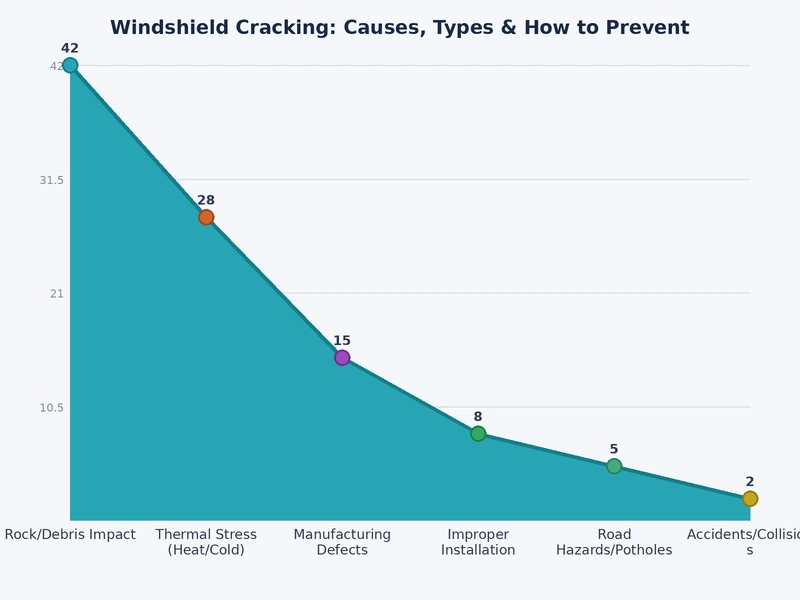
Before addressing specific windshield cracking causes, a grounding in the material science of automotive glass clarifies why certain conditions produce damage while others do not, and why early intervention consistently outperforms delayed action.
Modern automotive windshields consist of three bonded layers, each serving a distinct structural purpose:
The glass layers themselves are annealed (slowly cooled during manufacturing to relieve internal stress), which gives them predictable fracture behavior — but also means that any external stress concentration point is capable of initiating and propagating a crack through the full glass structure.
A chip in the windshield creates what engineers call a stress concentration point — a microscopic geometric irregularity where mechanical and thermal forces are amplified relative to the surrounding intact glass. Even a chip the size of a pencil eraser multiplies local stress by a factor of two to four, meaning that everyday vibration, temperature cycling, and road flex steadily push the crack forward along the path of least resistance through the glass matrix.
This progression explains why a chip that looks completely stable during mild autumn weather can become a full-width crack after the first cold snap of winter, when overnight contraction pulls the glass simultaneously in multiple directions and the stress concentration point finally exceeds the material's tensile (pulling) strength.
Experienced glass technicians consistently report that windshield cracking causes fall into two broad categories: high-visibility impact events that drivers notice immediately, and slow-developing structural or thermal stresses that drivers tend to dismiss until the damage has become irreversible and repair is no longer an option.
Road debris remains the leading reported cause of windshield damage across North America. The following sources account for the majority of chips and initial cracks:
Thermal stress — the internal tension created when different parts of the glass expand or contract at different rates — is responsible for a substantial share of windshield cracks, and it is the cause most frequently underestimated by vehicle owners who focus exclusively on impact events.
The most damaging thermal scenarios include:
Structural causes are less frequently discussed but equally important as windshield cracking causes. A vehicle that has sustained a prior collision — even one that appeared minor — may have a subtly misaligned body frame that places continuous mechanical tension on the windshield perimeter. Degraded rubber molding (the seal strip surrounding the windshield edge) amplifies this problem by allowing micro-movement of the glass during driving vibration, which initiates and extends edge cracks. Drivers who notice increasing wind noise at highway speed should inspect the windshield seal promptly, as seal failure and cracking frequently share a common root cause — a relationship also explored in the guide on how to reduce wind noise in a car.
Accurate damage assessment determines whether professional repair is possible or whether immediate replacement is the only responsible course of action. Drivers should develop the habit of inspecting windshield damage systematically rather than making the repair-or-replace decision based on visual impression alone.
A basic windshield inspection kit requires no specialized automotive training and costs very little to assemble:
Windshield cracks fall into distinct categories, each with different repairability profiles. The table below summarizes the most common crack types, their defining characteristics, and the standard professional guidance on repair versus replacement eligibility:
| Crack Type | Description | Typical Size | Generally Repairable? |
|---|---|---|---|
| Bull's-Eye Chip | Circular impact point with a clean cone-shaped void in the outer layer; no radiating arms | Up to 1 inch diameter | Yes — high success rate with resin injection |
| Star Break | Central impact point with multiple radiating cracks extending outward, resembling a starburst pattern | Up to 3 inches diameter | Yes, if arms are short and not at the glass edge |
| Combination Break | Bull's-eye with additional radiating cracks; more complex damage pattern at the impact center | Up to 2 inches diameter | Sometimes — depends on arm length and location on glass |
| Half-Moon | Semicircular chip where impact struck at an oblique angle rather than straight on the surface | Up to 1 inch | Yes — similar repairability profile to standard bull's-eye |
| Linear Crack | A single straight or gently curved line running across the glass, often originating from an edge | Any length | No — replacement required if longer than 6 inches or at edge |
| Edge Crack | A crack that originates at or within 2 inches of the windshield's outer perimeter edge | Any length | No — replacement always required regardless of length |
| Floater Crack | A crack that begins in the center of the glass rather than at an edge or clear impact point | Variable | Sometimes — depends on total length and proximity to driver sightline |
Location matters as much as crack type. Damage within the driver's primary sightline — a roughly 12-inch horizontal band centered at steering column eye level — requires professional evaluation even when the damage would otherwise qualify for resin repair, as optical distortion in this zone impairs depth perception and reaction time in ways that may not be consciously noticeable until a critical moment arrives. Moisture-related glass problems follow a similar principle of early intervention yielding better outcomes, a pattern also visible with headlight condensation inside the housing, where waiting converts a straightforward fix into a full unit replacement at significantly higher cost.
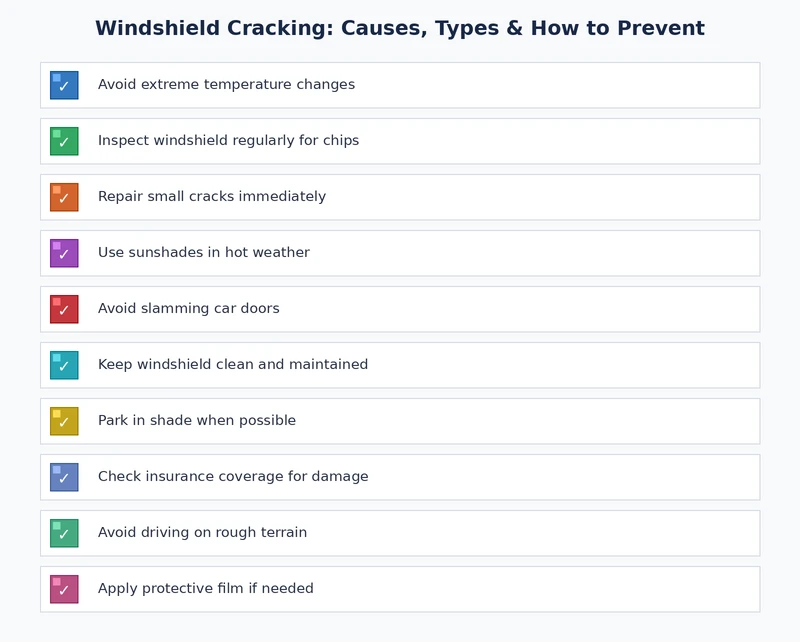
Prevention addresses windshield cracking causes before damage occurs and is substantially less expensive than any repair or replacement option. The following practices target the highest-frequency causes identified by professional glass technicians across North America.
Pro Warning: Never pour hot or boiling water on a frost-covered windshield — the instantaneous thermal shock can fracture an otherwise intact windshield in seconds, producing damage that is both irreversible and uncoverable under standard insurance repair provisions.
Daily and weekly habits that most drivers overlook have a compounding protective effect on windshield longevity when maintained consistently across the vehicle's service life.
The windshield cleaning routine also serves as the primary early-warning inspection system for new damage, and the two tasks should always be performed together:
The rubber molding and urethane bonding bead that secure the windshield to the vehicle frame are directly linked to windshield longevity and should receive the same maintenance attention as any other weatherproofing system on the vehicle. Degraded seals permit micro-movement of the glass during driving vibration, which accelerates existing cracks and initiates new edge cracks along the entire perimeter. Cold-climate drivers face additional seal stress from freeze-thaw cycling, and understanding how cold weather affects multiple vehicle systems can help prioritize maintenance intervals appropriately — as explored in the resource on car stalls in cold weather and related low-temperature mechanical failures.
Recommended seal maintenance steps:
Cost awareness allows drivers to make the repair-or-wait decision intelligently, rather than deferring action simply because both options seem expensive in the abstract without specific figures for comparison.
Professional chip and small-crack repair uses a resin injection process — a low-viscosity polymer resin is injected into the damage void under vacuum pressure and then cured with ultraviolet light to achieve both optical clarity and structural bonding. The procedure typically takes 30 to 45 minutes and restores approximately 85 to 95 percent of the original glass strength at the repair site, which is sufficient for the vast majority of real-world driving conditions.
| Service Type | Typical Cost Range | Time Required | Key Notes |
|---|---|---|---|
| Single chip repair (bull's-eye or star break) | $50–$100 | 30–45 minutes | Often covered at zero cost under comprehensive insurance policies |
| Multiple chip repair (same session) | $75–$150 | 45–75 minutes | Most shops offer reduced per-chip rates for additional damage repaired at the same appointment |
| Short crack repair (under 6 inches) | $60–$125 | 30–60 minutes | Only viable before dirt or moisture contamination compromises the void |
| Full replacement (non-ADAS vehicle) | $250–$500 | 60–90 minutes + cure time | OEM glass costs more than aftermarket; both are acceptable in most non-sensor applications |
| Full replacement (ADAS-equipped vehicle) | $600–$1,400+ | 2–4 hours total | Camera and sensor recalibration adds $150–$400 to the base replacement cost |
Several variables determine where a specific replacement falls within the cost ranges shown above:
The repair-versus-replace decision must be made on objective criteria, not cost preference or optimism about damage stability. Windshield cracks do not remain stable indefinitely — they grow under normal driving conditions, and that growth is irreversible once it begins.
A windshield crack or chip is a viable candidate for resin repair when ALL of the following conditions are met simultaneously:
Replacement is the only correct response — not a repair attempt — under any of the following conditions:
According to the National Highway Traffic Safety Administration, the windshield contributes up to 45 percent of the structural integrity of the vehicle cabin during a frontal collision and up to 60 percent during a rollover — figures that underscore why operating a vehicle with a compromised windshield represents a genuine physical safety risk rather than a manageable cosmetic inconvenience that can be deferred indefinitely.
Modern laminated safety glass is engineered so that the PVB interlayer holds both glass layers together even under severe impact, preventing the glass from dispersing into sharp fragments across the cabin. However, a heavily cracked windshield can collapse inward during a collision if the structural integrity of the outer layer is sufficiently compromised — which is precisely why operating a vehicle with significant windshield cracking is classified as a safety violation in most jurisdictions and invalidates liability coverage in some insurance policies.
Most comprehensive auto insurance policies include windshield repair or replacement coverage, and many insurers waive the deductible entirely for chip or short-crack repairs as a cost-saving measure — a repaired chip costs the insurer far less than a future full replacement. Several U.S. states mandate zero-deductible windshield replacement coverage under all comprehensive policies. Drivers should contact their insurer directly before scheduling any glass service to confirm current coverage terms.
Crack growth rate varies with temperature cycling, driving vibration, and moisture exposure, but damage that appears stable in mild conditions can extend by several inches overnight during a cold snap or after a significant temperature swing. Any chip larger than a quarter or any crack longer than one inch should be professionally evaluated within 48 to 72 hours of discovery — waiting beyond that window frequently converts a $75 repair into a $500 replacement, and no intermediate outcome is recoverable once the crack reaches the glass edge.
Legality depends on the jurisdiction and the specific location of the damage on the glass. In most U.S. states and Canadian provinces, any crack or chip that falls within the driver's primary line of sight is explicitly prohibited, and traffic officers may issue a fix-it citation requiring documented professional repair or replacement within a specified number of days. Damage located outside the driver's sightline may be tolerated in some jurisdictions but remains a liability exposure in the event of any collision.
Windshield cracking causes are varied, but the response strategy is straightforward: inspect the glass at every cleaning, apply painter's tape over any new chip within hours of discovery, maintain the seal and molding as diligently as any other vehicle system, and apply the objective repair-or-replace criteria from this guide rather than making the decision based on cost avoidance alone. Drivers who want to take the next concrete step should schedule a professional windshield inspection with a certified auto glass technician this week, verify comprehensive insurance coverage before any service appointment to avoid unnecessary out-of-pocket expense, and apply a hydrophobic glass coating as an immediate low-cost protective measure — three actions that cost very little but deliver significant long-term protection for one of the most structurally critical safety components on any vehicle.
 |
 |
 |
 |

About Sarah Whitfield
Sarah Whitfield is a diagnostics and troubleshooting specialist who spent ten years as an ASE-certified technician before joining the editorial team. She specializes in OBD-II analysis, electrical gremlins, and the kind of intermittent problems that make most owners give up.
Get some FREE car parts & gear.. Or check out the latest free automotive manuals and build guides here.
Disable your ad blocker to unlock all the hidden deals. Hit the button below 🚗
| | | |
