by Sarah Whitfield
Windshield wipers not working trace back to one of seven specific failures — and you can identify the culprit in under twenty minutes with a multimeter and a methodical inspection of the fuse box, motor, and linkage. Whether your wipers have stopped completely, run on only one speed, or push water across the glass without actually clearing it, every symptom maps to a defined component in that short electrical-mechanical loop.
Your wiper system is simpler than most drivers assume, and diagnosing it follows a strict sequence from cheapest to most expensive — you almost never need to go past the third step. Before chasing motor or linkage failures, confirm your electrical foundation is sound, because a car battery that keeps dying can deprive the wiper circuit of sufficient voltage to run at normal torque, producing symptoms that mimic motor failure. If you're also seeing other dashboard warning lights active alongside your wiper failure, cross-reference any stored fault codes through the check engine light diagnostic process before purchasing parts — wiper circuit faults occasionally set generic DTCs on late-model platforms.
Contents
The fuse is your first stop, because it costs under $5 and takes less than two minutes to inspect. A blown wiper fuse cuts power to the entire circuit and produces completely dead wipers on every speed setting — the fix requires nothing more than matching the original amperage rating exactly and seating the replacement fuse firmly in its holder. The wiper relay, typically located in the under-hood fuse box alongside the fuse, controls high-current switching to the motor, and a failed relay produces a different symptom pattern: wipers that function on intermittent or low speed while failing completely on high, or one direction of sweep that completes while the return stroke stalls.
A dead wiper motor is the second most common cause of windshield wipers not working, and the presentation is straightforward — pivot arms stay stationary despite a confirmed good fuse and relay, and you may hear a faint hum from the motor attempting to turn before its internal thermal breaker trips. Motors fail from age, corrosion at the brush contact surfaces, and repeated stall-load events. Every time wipers run against frozen glass or fight through heavy slush, the stall current runs 8–10× the normal operating draw, which accelerates brush wear and degrades permanent magnet field strength over successive events.
The wiper transmission — the crank-arm assembly converting rotary motor output into the sweeping arc the blades follow — is the most mechanically fragile assembly in the system. A stripped gear inside the gearbox, a bent connecting rod, or a sheared crank pin lets the motor spin freely while the arms remain motionless, and this failure typically announces itself with grinding or clicking sounds from behind the cowl panel before the system stops completely. If you hear that rhythm building over several weeks, the linkage is telling you it's about to fail completely.
Each wiper arm mounts to the body via a splined pivot post, and those splines are a consistent wear point on high-mileage vehicles. When the splines strip — from ice loading, corrosion, or chronically over-tightened arm retention nuts — the pivot shaft rotates without driving the arm, and the failure looks exactly like a dead motor from the driver's perspective. The diagnostic distinction is clean: disconnect the motor crank arm from the linkage, apply direct 12V to the motor, and observe whether the linkage moves freely while the wiper arm stays locked on its stripped post.
Running wipers against a frozen windshield is the single most preventable cause of premature motor and linkage failure in cold-climate vehicles. NHTSA vehicle safety guidelines are explicit about clearing all snow and ice from the windshield before activating wipers, and the engineering reason is significant: stall current during an ice-load event can permanently burn motor windings before the protective fuse reacts, because fuses are sized to protect against short circuits, not prolonged mechanical overloads. Always lift wiper arms off the glass before a forecast freeze, and run the front defroster for five minutes before activating wipers after an overnight frost.
Never activate your wipers against a snow-covered windshield — a single ice-load stall event can permanently burn motor windings before the fuse has time to respond.
A blade that has separated from its carrier or one where the rubber compound has hardened and cracked still sweeps an arc across the glass without clearing water — from the driver's seat, this looks like a wiper system failure, but the mechanism is intact and the problem is purely the blade itself. Inspect the rubber element by gripping it along its length and checking for tears, folds, stiffness, and end-cap retention; the refill should sit firmly in the carrier without lateral play. Replace the entire blade assembly rather than just the rubber insert when you find degradation — the carrier spring tension diminishes over time and contributes to poor glass contact independent of the rubber condition.
Corroded ground straps and chafed wiring in the wiper harness produce voltage-drop failures that follow predictable patterns even if they're harder to localize than a blown fuse. Wipers that run normally when cold but slow or stop progressively after the system warms up point directly to a marginal connection whose resistance increases with thermal expansion — a defining symptom of corroded terminal contacts. If your headlights are flickering alongside your wiper problems, suspect a shared ground point or deteriorating main body harness connector rather than two independent failures occurring simultaneously, because coincident electrical symptoms almost always share a common root.
Pull the wiper fuse using the puller stored in your fuse box cover — or needle-nose pliers if you're working without tools — and hold it against a light source to inspect the internal element. A broken filament is always visible and unambiguous. Replace with an identical amperage fuse; a higher-amp substitute bypasses circuit protection and risks harness damage if a downstream short exists. If the replacement fuse blows within seconds of activation, you have a direct short somewhere between the fuse box and the motor, which requires systematic continuity testing with a multimeter before any further part replacement — buying a new motor into an unresolved short destroys it immediately.
With the fuse confirmed good, probe the motor connector with a multimeter set to DC volts while an assistant activates the wiper switch — you need to see battery voltage on the supply terminal and solid continuity to the chassis ground on the return. Voltage present at the connector with no motor movement confirms a dead motor. Bench-test the removed motor by connecting it directly to a 12V source via jumper wires and observing whether the output shaft rotates cleanly — this confirmation prevents ordering a replacement only to discover the real fault is upstream. Motor installation is three mounting bolts, one electrical connector, and a cotter pin securing the crank arm to the linkage rod on most platforms.
With the wipers stopped mid-stroke, grip each arm at the base and apply lateral pressure while watching the pivot post — more than two millimeters of side-play indicates stripped splines requiring pivot assembly replacement rather than motor work. Pop the cowl panel to visually trace each linkage rod for bends, detached ball-socket clips, and sheared pins; this takes five minutes and eliminates most linkage failures by sight alone. The same diagnostic discipline that serves you well when chasing power steering that isn't working applies here — rule out battery and charging system deficiencies before attributing the problem to a specific actuator, because low system voltage masks as mechanical failure across multiple circuits simultaneously.
Replace wiper blades on a 12-month cycle regardless of visible condition, because UV exposure degrades the rubber compound well before physical wear becomes apparent to a visual check. Beam-style blades outperform traditional bracket frames in winter conditions, because there's no exposed metal framework to ice up and create uneven downforce distribution across the blade length — that uneven pressure is what causes the chatter and skip that eventually leads to arms over-sweeping and stalling against the A-pillar seal. The single most effective wiper preservation habit costs nothing: lift the arms off the glass whenever you park in forecast freezing conditions, eliminating the ice-stall events that destroy motors.
The wiper linkage pivot points and ball-socket connectors operate dry from the factory and respond well to annual lubrication with white lithium grease. Dry pivots bind under load, and that binding imposes elevated current draw on the motor even without a full ice-stall event — sustained elevated current degrades motor windings as surely as acute overloads, just more slowly. Check the motor mounting bolt torque each time you service the linkage, since road vibration works bolts loose over multiple seasons and motor misalignment accelerates brush wear from within. Fold this inspection into your broader under-hood maintenance schedule — if you're already verifying serpentine belt condition and coolant hose integrity, the cowl area adds under five minutes to the session.
Annual lubrication of the wiper linkage pivots is a five-minute task that eliminates most premature motor failures caused by chronic elevated current draw from binding joints.
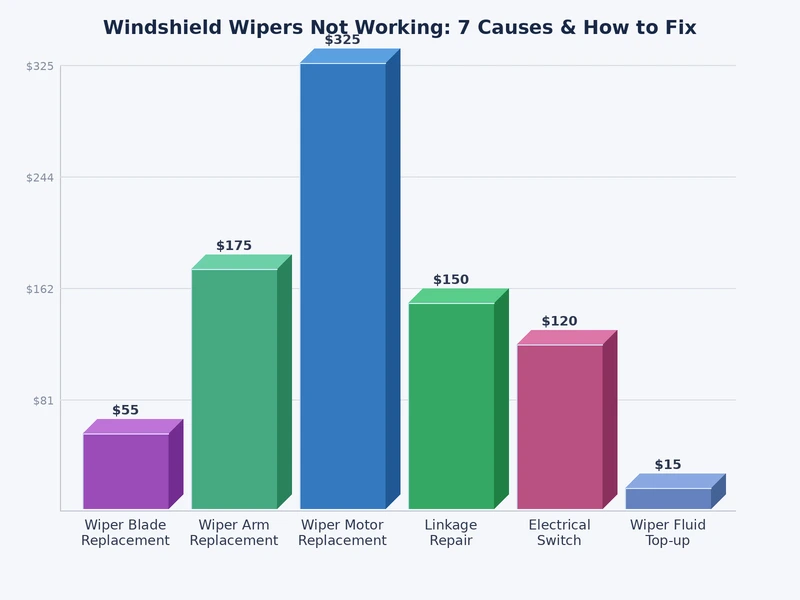
Wiper system repairs span a wide cost range depending on which component failed and whether you're paying shop labor rates. The fuse end of the spectrum is trivially cheap; wiring harness diagnosis at the professional end is where costs climb, driven primarily by diagnostic time rather than parts cost.
| Component | DIY Parts Cost | Shop Labor | Total Estimate |
|---|---|---|---|
| Wiper fuse | $2–$5 | — | $2–$5 |
| Wiper relay | $10–$25 | $15–$30 | $10–$55 |
| Wiper blades (pair) | $20–$45 | $15–$30 | $35–$75 |
| Wiper pivot assembly | $25–$60 | $60–$120 | $85–$180 |
| Wiper linkage assembly | $40–$90 | $80–$150 | $120–$240 |
| Wiper motor (aftermarket) | $60–$120 | $100–$200 | $160–$320 |
| Wiper motor (OEM) | $110–$250 | $100–$200 | $210–$450 |
| Wiring harness repair | $30–$80 | $150–$300 | $180–$380 |
If your wiper failure arrived alongside other simultaneous electrical symptoms — a brake warning light, erratic gauge behavior, or an oil pressure warning — address the charging system before authorizing wiper-specific repairs, because multiple electrical failures occurring at the same time almost never reflect three independent components failing together; they reflect a single compromised power or ground path expressing itself across several circuits at once.
Fuse replacement, relay swapping, blade replacement, and linkage lubrication are unambiguous DIY repairs requiring no special tools and no post-repair calibration — these cover the majority of wiper failures you'll encounter across a vehicle's lifetime. Wiper motor replacement is intermediate-level work: the mechanical procedure is genuinely straightforward on most platforms, but some vehicles require removing the wiper arms, the cowl panel, and the washer reservoir bottle to access the motor mount, which adds an hour to the job. The wiper arm puller is the only specialty tool required and is available as a free loaner at most auto parts stores.
Wiring harness diagnosis — intermittent failures, voltage-drop testing across connector pins, and short-to-ground tracing — demands a lab scope and a factory wiring diagram, and the diagnostic time alone justifies professional shop rates on complex intermittent problems. Rain-sensing wiper systems and any vehicle with an integrated camera module in the cowl require scan-tool recalibration after motor replacement; attempting this without the correct OEM calibration procedure produces worse behavior than the original failure, including false rain-sensor triggers and unexpected wiper activation at highway speed. Long-term, OEM or OEM-equivalent motors consistently outperform budget aftermarket units — shop experience confirms that bargain aftermarket wiper motors typically fail within 18 months of installation, while OEM units routinely outlast the vehicle. If you detect smoke coming from under the hood after a motor swap, stop immediately — an incorrectly wired motor connector draws continuous stall current and can ignite harness insulation within minutes.
Speed-selective failure points directly at the wiper relay or the park and low-speed brush circuit inside the motor itself. High and low speed circuits in a wiper motor use different internal brush positions and separate relay contacts, so a relay with one failed contact — or a motor with a worn low-speed brush track — produces exactly this symptom. Swap the relay first, because it's a $15 fix; if the problem persists, the motor needs replacement and the relay was not the root cause.
Driving with non-functional wipers in rain or snow is illegal in every U.S. state and in most jurisdictions globally, and officers routinely issue equipment violation citations during wet-condition traffic stops. Beyond the legal exposure, operating a vehicle with compromised forward visibility in active precipitation creates a direct hazard to other drivers regardless of how short the intended trip is. Treat inoperative wipers as a same-day repair priority, not a deferred maintenance item.
A factory wiper motor on a well-maintained vehicle lasts 150,000–200,000 miles or more under normal operating conditions. The two most reliable predictors of early failure are ice-stall events from running wipers against a frozen windshield, and neglected linkage lubrication that forces the motor to overcome dry-pivot binding on every single sweep cycle. Vehicles in heavy-precipitation climates with owners who skip the pre-freeze arm-lifting habit consistently see motor failures at 80,000–100,000 miles instead of the full service life the motor was designed to deliver.
Windshield wipers not working is always a diagnosable, fixable problem — work the sequence from fuse to relay to motor to linkage, and you will find the cause before you ever need to guess.
 |
 |
 |
 |

About Sarah Whitfield
Sarah Whitfield is a diagnostics and troubleshooting specialist who spent ten years as an ASE-certified technician before joining the editorial team. She specializes in OBD-II analysis, electrical gremlins, and the kind of intermittent problems that make most owners give up.
Get some FREE car parts & gear.. Or check out the latest free automotive manuals and build guides here.
Disable your ad blocker to unlock all the hidden deals. Hit the button below 🚗
| | | |
