by Sarah Whitfield
Has anyone ever had their windshield wipers running nonstop on a perfectly dry day, with no obvious way to stop them? That's the exact problem we're unpacking here — and when windshield wipers won't turn off, the cause usually traces back to one of a handful of well-understood components in the wiper control circuit. Our team has worked through this diagnosis on everything from older trucks to late-model sedans, and the pattern stays consistent across makes and models. The good news is that most fixes start with a cheap relay swap and a little patience. For anyone also dealing with wiper streaking or chattering alongside this issue, our guide on windshield wiper chattering covers related blade and linkage faults in detail. The windshield wipers category page also has a full library of wiper system resources worth bookmarking.
Contents
Before assuming the wiper system has failed, it helps to know how these systems are designed to behave from the factory. Several behaviors that look like malfunctions are actually built-in features.
These are the symptoms our team treats as real problems that need diagnosis, rather than normal quirks in the wiper programming.
If wipers keep running after the ignition is fully off and the key is removed, our team recommends checking the wiper relay first — it's a $10–$15 part, and a stuck relay is the most common cause of exactly that symptom.
When windshield wipers won't turn off, the fault almost always lives in one of four places: the relay, the switch, the body control module, or the wiring between those components. Here's a quick reference showing how each failure behaves.
| Component | What It Does | Failure Symptom | DIY Friendly? | Typical Repair Cost |
|---|---|---|---|---|
| Wiper Relay | Controls power to the wiper motor | Wipers run non-stop, can't be turned off | Yes — simple swap | $10–$20 |
| Wiper Switch / Stalk | Sends on/off and speed signals | Wipers unresponsive to stalk input | Moderate — stalk replacement | $40–$150 |
| Body Control Module (BCM) | Interprets signals and controls timing | Erratic behavior, ignores all commands | No — requires programming | $300–$700 |
| Wiring / Connector Fault | Carries signals between components | Intermittent, often weather-related | Sometimes — visual inspection first | $50–$300 |
| Rain Sensor | Triggers wipers when moisture detected | Wipers activate without any rain present | Sometimes — clean or recalibrate first | $20–$200 |
The wiper relay is a small electromechanical switch, usually housed in the underhood fuse box or the cabin fuse panel, that controls electrical power to the wiper motor. When the relay's internal contacts weld together in the closed position — a common failure mode in relays — the motor receives constant power regardless of switch commands. Our team considers this the first thing to check on any vehicle where wipers won't stop, because the part costs under $15, fits in a shirt pocket, and swaps out in about ten minutes without any special tools.
The wiper switch — usually part of the combination stalk on the steering column — contains internal contacts that wear down with repeated use over many years. When those contacts develop an internal short, they can hold the wiper circuit in the "on" state even with the stalk physically moved to "off." This fault often appears alongside erratic speed behavior: wipers that jump between intervals unpredictably, or that don't respond when the intermittent delay is adjusted. A worn switch typically needs full stalk replacement, since the internal contacts aren't serviceable on most modern designs.
On modern vehicles, the BCM (a small onboard computer module that manages body electronics including wipers, locks, and lighting circuits) sits between the wiper switch and the relay. When the BCM experiences a software glitch, receives corrupted input from a rain sensor, or suffers water damage, it can send a continuous "run" command to the relay regardless of switch position. Our team has seen this fault appear alongside broader electrical problems — when symptoms like all dashboard gauges not working show up at the same time as stuck wipers, the BCM is worth investigating as a shared root cause.
The wiring harness that runs through the cowl area (the plastic panel at the base of the windshield) is exposed to water, temperature swings, and constant vibration over years of service. A spot where insulation has worn through and the wire contacts a power source can mimic a permanent "wiper on" signal throughout the circuit. Connector pins at the wiper motor or inside the fuse box can also corrode, creating unintended electrical paths that are difficult to trace by sight alone. When a car fuse keeps blowing in the wiper circuit alongside non-stop wiper operation, a wiring short is almost certainly the root cause of both symptoms at once.
One of the most repeatable cases in our experience involves a late-model pickup or SUV where the wipers suddenly start running on high speed and won't respond to the stalk at all. The fastest diagnostic step in those situations is pulling the wiper relay directly from the fuse box while the engine runs. In the vast majority of these cases, removing the relay stops the wipers instantly — which confirms the relay was the problem, not the switch or BCM. A matching replacement relay from any auto parts store resolves the fault completely, and the whole job wraps up in about fifteen minutes from opening the hood to confirming the fix.
Vehicles with automatic rain-sensing wipers use a small optical sensor bonded to the inside of the windshield near the rearview mirror to detect moisture on the glass. When that sensor malfunctions — which often happens after a windshield replacement where the sensor isn't properly recalibrated — it can send a constant "wet glass" signal that keeps wipers cycling. Our team has also seen direct sunlight at low angles, reflections from wet pavement, and certain window tint films trigger false activations, leading most drivers to assume the wiper control circuit has failed when the actual solution is simply cleaning the sensor lens or recalibrating it through the vehicle's settings menu.
The cowl drainage system is designed to direct water away from the firewall and wiring harness, but blocked drain holes and deteriorated seals allow water to pool directly over that harness on older vehicles. Our team has traced persistent wiper faults to corroded connector pins in that area multiple times, typically on vehicles that also had a musty cabin smell — a telltale sign of cowl water intrusion that our guide on car smells like mildew covers in depth. Cleaning the affected connectors with electrical contact cleaner and clearing the cowl drain holes resolved the wiper fault in each of those cases without replacing any components.
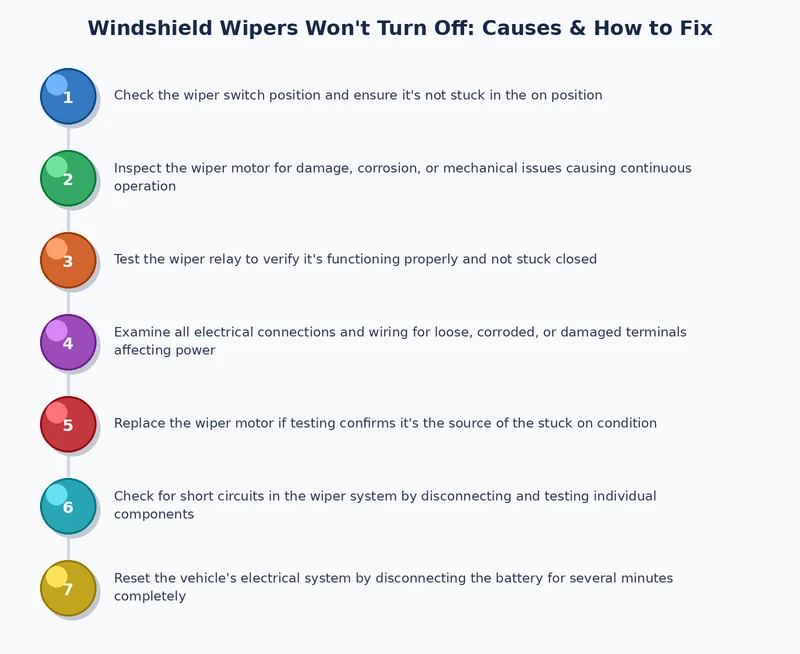
Diagnosing most wiper-won't-turn-off faults doesn't require expensive equipment. According to Wikipedia's overview of automotive relays, these components are intentionally designed for field replacement — and that accessibility extends to the diagnosis process as well.
| Repair Task | Skill Level | Key Tools | Time Estimate |
|---|---|---|---|
| Swap the wiper relay | Beginner | Relay puller, replacement relay | 10–15 minutes |
| Clean corroded connectors | Beginner | Contact cleaner, trim tools, flashlight | 30–60 minutes |
| Replace the wiper switch stalk | Intermediate | Trim tools, multimeter, screwdrivers | 60–90 minutes |
| Trace a wiring short | Intermediate–Advanced | Multimeter, wiring diagram, test light | 1–3 hours |
| BCM replacement and programming | Professional | Dealer-level scan tool, programming interface | 1–4 hours at a shop |
BCM replacement is the clearest case where professional tools become necessary, because most BCMs need to be flashed with vehicle-specific software using a dealer-level interface before the wiper system recognizes the new module. Wiring shorts that aren't visible during a physical inspection may also require an oscilloscope or a dedicated automotive wiring tracer to pinpoint — equipment that most home garages don't stock. Our team's general guidance is to work up the repair ladder: start with the relay, move to the connectors and switch, and bring in a professional specifically for BCM faults or shorts that don't surface during hands-on visual inspection.
This is always the first step when windshield wipers won't turn off — and it doubles as a quick diagnostic that can immediately confirm or rule out the relay as the cause.
If swapping the relay doesn't resolve the fault, the switch stalk becomes the next logical suspect — particularly on high-mileage vehicles with a history of erratic wiper response.
When both the relay and switch test clean but wipers still won't respond to the off command, the diagnosis shifts to either a wiring fault or a BCM issue. Here's how our team approaches that next step.
A blown wiper fuse typically causes wipers to stop working entirely rather than run continuously, since a blown fuse breaks the circuit instead of holding it closed. However, a short circuit that causes a fuse to blow repeatedly — a situation our guide on car fuses that keep blowing covers in detail — can produce erratic wiper behavior in the moments just before the fuse finally opens the circuit and shuts everything down.
Running wipers on a dry windshield causes accelerated blade wear and can eventually scratch the glass if the rubber edge tears away from the blade frame, but it isn't immediately dangerous from a safety standpoint. The more pressing concern is that the underlying fault — a stuck relay or active wiring short — draws excess current continuously and can damage the wiper motor or surrounding fuse box components if left unaddressed for an extended period.
The cost depends entirely on the root cause. A wiper relay swap runs $10–$20 in parts and takes about fifteen minutes at home, while a wiper switch stalk replacement costs $40–$150 depending on the vehicle make and model. A BCM replacement with reprogramming is the most expensive path, typically ranging from $300–$700 at a shop, which is why our team always recommends starting at the relay and working systematically up the diagnostic ladder before assuming the worst.
When windshield wipers won't turn off, the fix is almost always simpler than the problem feels — start with the relay, work up the ladder systematically, and save the expensive diagnosis for last.
 |
 |
 |
 |

About Sarah Whitfield
Sarah Whitfield spent ten years as an ASE-certified automotive technician before transitioning to full-time automotive writing, giving her a diagnostic skillset that goes well beyond what most reviewers bring to the subject. She specializes in OBD-II code analysis, electrical system troubleshooting, and the intermittent failure modes that frustrate owners and confound general mechanics. At CarCareTotal, she covers car troubleshooting guides, diagnostic tools, and repair resources for drivers dealing with warning lights, strange symptoms, and hard-to-diagnose problems.
Get some FREE car parts & gear.. Or check out the latest free automotive manuals and build guides here.
Disable your ad blocker to unlock all the hidden deals. Hit the button below 🚗
| | | |
