by Sarah Whitfield
During a routine pre-trip vehicle inspection, our team encountered a sedan that had been misdiagnosed three separate times across different repair shops — each visit attributed the sluggish acceleration and sulfur odor to a faulty fuel injector. The real culprit was a severely clogged catalytic converter. Understanding bad catalytic converter symptoms early can mean the difference between a manageable repair and a cascading failure that spreads damage throughout the exhaust and engine systems.
The catalytic converter sits between the engine and the muffler, converting toxic combustion byproducts — carbon monoxide, unburned hydrocarbons, and nitrogen oxides — into carbon dioxide, nitrogen, and water vapor. According to the U.S. Environmental Protection Agency, catalytic converters are federally mandated on all gasoline-powered vehicles sold in the United States, making them both a legal requirement and a functional necessity. When this component begins to fail, the effects ripple through engine performance, fuel economy, and emissions compliance simultaneously. This guide covers every sign of converter failure, how to confirm the diagnosis accurately, and what replacement realistically costs across a range of vehicle types.
Contents
Even though the catalytic converter serves the same fundamental purpose in every gasoline-powered vehicle, the specific bad catalytic converter symptoms it produces vary depending on engine configuration, vehicle age, and driving patterns. Identifying which category a vehicle falls into helps narrow the diagnosis considerably.
In vehicles with over 100,000 miles, converter degradation is often gradual. Most owners notice declining fuel economy long before a check engine light appears. The internal ceramic honeycomb substrate wears down incrementally, reducing catalytic efficiency without triggering an immediate fault code. By the time a code appears, significant efficiency has already been lost.
Newer vehicles equipped with OBD-II systems will typically store a P0420 or P0430 code — indicating catalyst system efficiency below threshold for banks 1 and 2, respectively. This code is one of the clearest digital indicators of converter failure and warrants immediate diagnostic follow-up. It is also one of the most commonly misdiagnosed codes, frequently confused with oxygen sensor faults.
In sport or turbocharged applications, a failing converter often manifests first as a noticeable loss in top-end power. The back-pressure created by a clogged or collapsing substrate restricts exhaust flow, effectively choking the engine at higher RPMs. Affected vehicles may feel adequate around town but noticeably flat during highway acceleration or full-throttle application.
Understanding the internal mechanics of a catalytic converter clarifies why failure produces such varied and sometimes misleading symptoms.
Most modern converters use a three-way catalyst — a combination of platinum, palladium, and rhodium — embedded within a honeycomb ceramic or metallic substrate. These precious metals catalyze both oxidation and reduction reactions simultaneously, converting carbon monoxide and hydrocarbons through oxidation while reducing nitrogen oxides through reduction. The operating temperature window is narrow: below 400°F, the catalyst is essentially inactive (known as the cold-start phase); above 1,800°F, the substrate begins to sustain permanent thermal damage.
The catalytic converter does not operate in isolation. It depends on both upstream (pre-cat) and downstream (post-cat) oxygen sensors to provide feedback for the engine's fuel control loop. A failing upstream O2 sensor disrupts the air-fuel ratio, causing conditions that overload the converter. A failing downstream sensor can generate false catalyst efficiency codes that mimic converter failure. Our team strongly recommends reviewing bad O2 sensor symptoms and replacement cost as part of any converter diagnosis, because sensor misdiagnosis accounts for a significant share of unnecessary converter replacements.
Several symptoms signal that a converter has progressed beyond marginal inefficiency into active failure. Each sign carries different implications for urgency and repair strategy.
A strong sulfur smell from the exhaust — commonly described as rotten eggs — indicates that hydrogen sulfide is passing through the converter unconverted. This occurs when the converter's reduction catalyst can no longer process sulfur compounds at the required rate. The smell is most noticeable during deceleration or when the vehicle is idling in an enclosed space. Persistent sulfur odor after a cold start that does not dissipate within two minutes of driving is a reliable indicator of significant catalyst degradation.
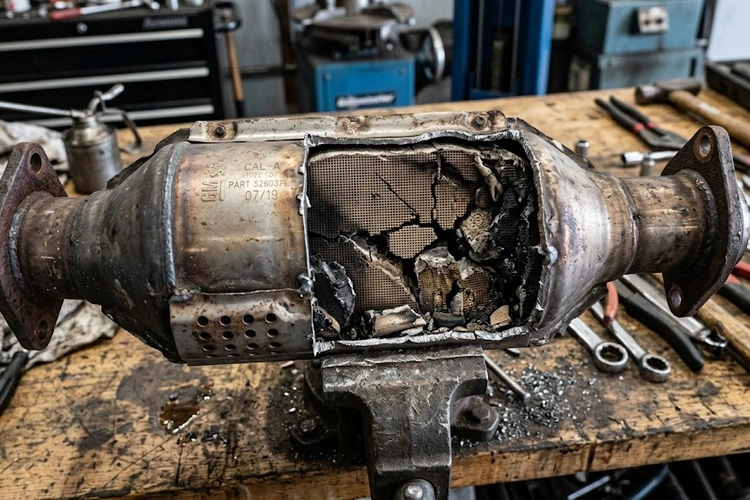
A metallic rattling noise, particularly noticeable during cold starts or hard acceleration, indicates that the internal ceramic substrate has fractured. Broken ceramic pieces shift freely within the converter housing, creating a distinctive sound that intensifies as fragmentation progresses. Once rattling begins, the converter is beyond cleaning or repair — replacement is the only viable solution, and delay risks substrate fragments migrating further into the exhaust system or being ingested back toward the engine.
A vehicle that fails a state emissions inspection has almost certainly exceeded legal thresholds for hydrocarbons or carbon monoxide output. A converter operating below approximately 90% catalyst efficiency will typically fail modern smog checks. Our team has documented multiple cases where vehicle owners attempted to pass emissions without addressing the underlying converter failure — using fuel additives or temporary sensor resets — an approach that produces only short-term results while allowing the root problem to worsen.
Unusual exhaust smoke warrants careful interpretation alongside converter diagnosis. Black smoke indicates a persistently rich-running engine overloading the converter with unburned fuel. White smoke may indicate coolant entering the combustion chamber. Bluish or gray smoke suggests oil burning, which deposits ash on the catalyst surface over time. For a complete breakdown of what each color means, our team's guide on exhaust smoke colors covers each scenario in clinical detail and helps distinguish converter issues from combustion problems.
The decision between replacement and repair is not always clear-cut. Vehicle age, converter condition, mileage, and the presence of upstream problems all factor into the correct recommendation.
Full replacement is warranted when the substrate is physically fragmented, when the converter produces a rattle under any condition, when visible heat damage is present (evidenced by blue or purple discoloration on the outer housing), or when the P0420 or P0430 code persists after confirmed repair of all upstream causes. Attempting to clean or rehabilitate a rattling converter wastes both time and money — the substrate damage is structural and irreversible.
In early-stage inefficiency — where a catalyst code has just appeared for the first time, performance loss is minimal, and no rattling is present — a professional cleaning can sometimes restore adequate function. Our team's detailed walkthrough on how to clean a catalytic converter explains both the on-vehicle and off-vehicle methods, along with an honest assessment of when cleaning is realistic and when it is merely postponing an inevitable replacement.
Pro Insight: Cleaning a catalytic converter delivers meaningful results only when the substrate remains structurally intact and uncontaminated by engine oil or coolant. A converter that has been oil-fouled over thousands of miles rarely recovers through cleaning alone — the phosphorus and calcium deposits from combusted oil permanently deactivate the catalyst surface.
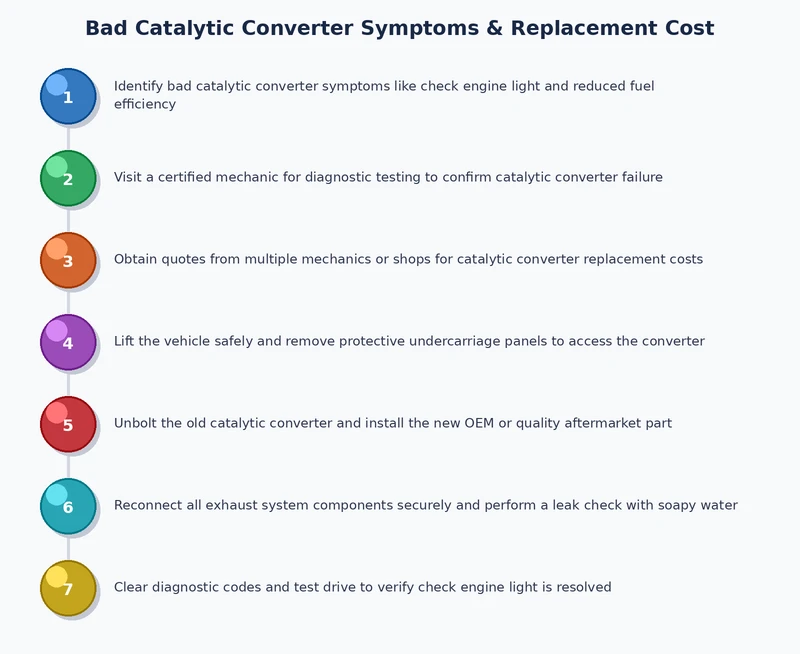
Accurate diagnosis is essential before committing to a replacement that can cost several hundred dollars or more. Our team follows a structured five-step process to confirm converter failure with confidence.
Connect a quality OBD-II scanner and record all stored, pending, and permanent codes. P0420, P0430, P0421, and P0431 are the primary converter efficiency codes. Also note any oxygen sensor codes (P0136, P0137, P0141, P0161, etc.), fuel trim codes (P0171, P0172), or misfire codes (P0300–P0308). These ancillary codes reveal upstream conditions that may be causing or mimicking converter failure.
Perform a thorough visual and tactile inspection of the converter housing. Look for cracks, holes, or significant heat discoloration. Using a rubber mallet, tap firmly along the housing — any rattling from inside confirms substrate fragmentation. Also inspect the oxygen sensor bungs for evidence of exhaust leaks, which can introduce false air readings and trigger efficiency codes.
Using a quality infrared thermometer, measure temperatures at the converter inlet and outlet after at least ten minutes of driving at operating temperature. A functioning converter should produce a meaningfully higher outlet temperature than inlet temperature — typically 50 to 200°F higher — indicating that exothermic oxidation reactions are occurring within the substrate. Equal or lower outlet temperatures confirm a dead or severely degraded catalyst.
Remove the upstream oxygen sensor and connect a pressure gauge to the sensor port. Measure exhaust back-pressure at idle and at 2,500 RPM. Acceptable values are generally below 1.5 PSI at idle and below 3 PSI at steady 2,500 RPM. Elevated readings confirm internal restriction from a clogged or collapsed substrate. This test is particularly valuable on vehicles where temperature testing is inconclusive.
Before purchasing any replacement part, confirm there are no active misfires, persistent rich fuel conditions, oil consumption issues, or coolant leaks introducing contaminants into the exhaust stream. Replacing a converter without correcting the upstream cause typically results in failure of the new unit within 10,000 to 20,000 miles — a costly lesson our team has seen repeated across dozens of vehicles.
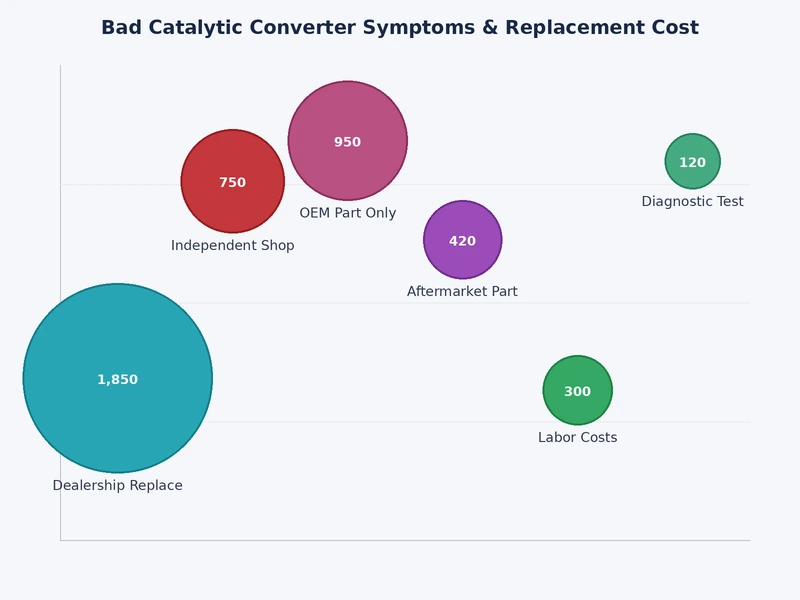
Replacement costs vary substantially based on vehicle type, converter design, emissions certification requirements, and regional labor rates. The table below summarizes typical ranges observed across common vehicle categories.
| Vehicle Category | OEM Part Cost | Aftermarket Part Cost | Labor Estimate | Total Range |
|---|---|---|---|---|
| Compact / Sedan | $200–$400 | $80–$250 | $140–$300 | $220–$700 |
| Midsize Sedan / Crossover | $350–$600 | $150–$350 | $140–$300 | $290–$950 |
| Full-Size Truck / SUV | $400–$800 | $200–$450 | $140–$450 | $340–$1,250 |
| Luxury / European Import | $800–$1,500+ | $300–$600 | $200–$600 | $500–$2,100+ |
| Hybrid Vehicle | $1,000–$3,000 | N/A (OEM required) | $200–$400 | $1,200–$3,400 |
OEM converters carry a significant price premium over aftermarket alternatives but offer guaranteed fitment, certified emissions performance, and manufacturer warranty coverage. In California and other states that have adopted CARB (California Air Resources Board) emissions standards, only CARB-compliant aftermarket converters are legal for installation — these units cost more than standard aftermarket options but remain substantially less expensive than OEM. Direct-fit aftermarket converters that bolt directly in place minimize labor time; universal-fit units require additional cutting, welding, or fabrication work.
Labor charges in most metropolitan areas range from $80 to $150 per hour. Most converter replacements on modern, accessible vehicles require one to two hours of labor. Older vehicles, or those where the converter is integrated into the exhaust manifold assembly, can require three to four hours. Severely rusted exhaust hardware — a common complication in northern states with heavy road salt use — adds unpredictable time and, in some cases, requires replacing exhaust pipe sections, flex couplings, or manifold studs.
Many converter failures are preventable. Several avoidable errors account for the majority of premature replacements our team observes in practice.
Engine misfires push raw, unburned fuel directly into the exhaust stream. The catalytic converter attempts to combust this excess fuel, generating extreme internal temperatures that can exceed the substrate's thermal threshold within minutes. A single severe misfire event — caused by a failed ignition coil, fouled spark plug, or damaged fuel injector — can destroy a converter that was otherwise in good condition. Our team identifies ignored misfire codes as the leading cause of premature converter failure in vehicles under 80,000 miles.
High-phosphorus engine oils — particularly older API SH and SJ-rated formulations — deposit phosphorus and zinc compounds (from ZDDP additive packages) onto the catalyst surface over time, permanently deactivating the precious metal coating. Modern vehicles require API SN or SP rated oil with controlled phosphorus content. Using outdated oil specifications is a slow but predictable path to catalyst poisoning, and the damage accumulates invisibly until efficiency has dropped well below acceptable thresholds.
A degraded oxygen sensor disrupts the engine's closed-loop fuel management, causing persistent rich or lean fuel conditions that stress the converter continuously. Most upstream O2 sensors degrade gradually after 80,000 to 100,000 miles. Proactive replacement at the manufacturer's recommended interval — rather than waiting for a fault code — is one of the most effective and least expensive ways to protect a functioning converter from premature failure.
Across our team's diagnostic experience, converter failures fall into recognizable patterns. Three representative cases illustrate how the failure modes described above play out in real vehicles.
On a 2008 Honda Accord with 175,000 miles, the owner reported gradual power loss over approximately six months, most noticeable during highway on-ramp merging. A full OBD-II scan revealed a stored P0420 code with no associated oxygen sensor faults and no misfire history. Temperature testing confirmed a dead catalyst — inlet and outlet temperatures were within 15°F of each other after a 15-minute drive. A direct-fit aftermarket converter rated for federal emissions standards resolved the issue entirely at a total cost of approximately $420, including labor.
A 2017 Ford F-150 with only 42,000 miles presented with a P0420 code and a pronounced sulfur odor. Initial inspection suggested a straightforward converter replacement. Deeper investigation revealed a leaking valve cover gasket allowing engine oil to enter the intake manifold and ultimately the combustion chamber. The converter substrate was fully oil-fouled with ash deposits. Replacing the converter without first addressing the gasket leak would have destroyed the new unit within weeks. The correct repair sequence — gasket replacement first, followed by converter replacement — resolved both the code and the odor permanently.
Our team assisted in diagnosing a 2011 Toyota Camry that had failed state emissions testing twice in 12 months. Between failures, the owner had used a commercially marketed fuel additive claiming to restore catalyst function and clear P0420 codes. Neither attempt produced lasting results. A CARB-compliant aftermarket direct-fit converter combined with a new upstream oxygen sensor restored full emissions compliance on the first retest. The total repair cost was $610 — less than the combined cost of the two failed emissions retests, missed registration renewal fees, and ineffective additive purchases.
Proactive maintenance and attentive vehicle ownership extend converter service life well beyond the standard 80,000- to 100,000-mile range that many drivers accept as inevitable.
Any fault code related to fuel trim, misfires, oxygen sensors, or mass airflow should be diagnosed and repaired without delay. Deferred maintenance on these systems is the single most reliable predictor of premature converter failure. The cost of ignoring a P0301 misfire code for three months routinely exceeds the cost of a complete tune-up by a factor of five or more when converter replacement is factored in.
Top-tier gasoline — meeting the Top Tier Detergent Gasoline standard established by a consortium of major automakers — contains additive packages that keep injectors and combustion chambers cleaner, reducing unburned hydrocarbon load on the converter. Combined with API-correct engine oil at the manufacturer's specified viscosity and change interval, these two choices represent the highest-value preventive maintenance investment available to most vehicle owners.
Worn spark plugs cause incomplete combustion. Replacing plugs at the manufacturer's recommended interval — typically every 30,000 miles for standard copper plugs and every 60,000 to 100,000 miles for iridium or platinum plugs — ensures complete combustion and minimizes the exhaust hydrocarbon load reaching the converter. A complete tune-up also provides an opportunity to inspect ignition coils, fuel injectors, and vacuum lines — components whose failure modes all have documented pathways to converter damage.
Most catalytic converters are designed to last the lifetime of the vehicle — often 100,000 miles or more — when upstream engine systems are maintained properly. Premature failure before 80,000 miles almost always traces back to an identifiable upstream cause such as misfires, oil consumption, or oxygen sensor neglect rather than a defect in the converter itself.
A severely clogged converter creates excessive back-pressure that can cause overheating, valve damage, and, in extreme cases, complete engine failure due to inability to expel exhaust gases. In addition, a clogged converter that forces exhaust gases backward can damage piston rings and cylinder walls over time. Early intervention prevents these downstream consequences.
Driving with a mildly inefficient converter is generally safe for a short period, but driving with a severely clogged or rattling converter poses real risks — including overheating, loss of power at highway speeds, and the possibility of the vehicle stalling under load. A converter producing rattling sounds should be addressed immediately, as fragmented substrate can migrate through the exhaust system.
Engine misfires that push unburned fuel into the exhaust stream are the leading cause of converter failure in vehicles under 80,000 miles. In high-mileage vehicles, gradual thermal degradation of the substrate combined with accumulated catalyst poisoning from engine oil combustion is the most common failure mechanism. Both causes are largely preventable with consistent maintenance.
Cleaning can restore adequate efficiency in early-stage catalyst degradation where the substrate remains structurally intact and contamination is limited to carbon deposits or light fuel residue. It will not fix a converter with a fractured substrate, oil-fouled catalyst surface, or substrate that has been thermally damaged. When cleaning fails to clear the P0420 code after two drive cycles, replacement is the appropriate next step.
Both codes indicate catalyst system efficiency below the acceptable threshold. P0420 refers to Bank 1 — the side of the engine containing cylinder 1 — while P0430 refers to Bank 2 on V6 and V8 engines. On inline four-cylinder engines, only Bank 1 exists, so only P0420 is possible. On V-configuration engines, both codes appearing simultaneously typically indicates complete converter failure rather than a sensor issue.
A severely clogged converter can create enough back-pressure to prevent the engine from starting, though this is an extreme scenario that typically develops only after prolonged operation with significant restriction. More commonly, a heavily clogged converter causes the engine to start, then immediately stall, or to run only at low idle with no ability to rev. Any no-start condition with known converter issues warrants immediate professional inspection.
Most converter replacements fall in the $300 to $900 range for domestic and Asian-market vehicles using quality aftermarket parts and standard labor rates. Luxury European vehicles and hybrids can exceed $1,500 to $3,000 when OEM parts are required. Labor alone typically runs $140 to $300 for straightforward applications, with additional costs when rusted exhaust hardware or integrated manifold designs complicate access.
The most consequential error our team observes is treating converter failure as an isolated event rather than as a symptom of upstream neglect — replacing the converter without correcting the misfires, oil consumption, or sensor failures that caused it in the first place. Anyone facing a P0420 code or any of the bad catalytic converter symptoms described in this guide should begin with a complete upstream diagnosis before purchasing any parts. Our team recommends starting with a professional OBD-II scan, performing the back-pressure and temperature tests outlined above, and consulting our guide on how to clean a catalytic converter to determine whether cleaning is a realistic first step — or whether direct replacement is the more efficient path forward.
 |
 |
 |
 |

About Sarah Whitfield
Sarah Whitfield is a diagnostics and troubleshooting specialist who spent ten years as an ASE-certified technician before joining the editorial team. She specializes in OBD-II analysis, electrical gremlins, and the kind of intermittent problems that make most owners give up.
Get some FREE car parts & gear.. Or check out the latest free automotive manuals and build guides here.
Disable your ad blocker to unlock all the hidden deals. Hit the button below 🚗
| | | |
