by Sarah Whitfield
A driver navigating a rough stretch of highway notices the vehicle bouncing persistently after each pothole, the chassis refusing to settle between impacts. That characteristic wallowing motion, easy to dismiss as a road quality issue, stands among the clearest bad shock absorber symptoms a vehicle produces throughout its service life. Recognizing these signs early, and understanding realistic replacement costs, allows vehicle owners to act before minor damper wear escalates into compounding structural damage across the entire suspension assembly.
This guide examines the full spectrum of bad shock absorber symptoms, quantifies replacement costs across vehicle categories, and provides the diagnostic framework needed to make well-informed repair decisions before the situation becomes a safety concern.
Contents
The most recognizable bad shock absorber symptoms emerge during routine driving on imperfect surfaces, where the damper's inability to control spring oscillation becomes immediately apparent to any attentive driver. A vehicle with degraded shock absorbers exhibits excessive vertical movement that persists well beyond the initial road impact, a condition technicians commonly describe as "float" or "wallowing." This progressive loss of damping efficiency traces directly to internal seal degradation, fluid bypass around the piston, or advanced piston wear within the shock body. As documented extensively in automotive engineering literature, shock absorbers function as velocity-sensitive hydraulic devices that convert kinetic energy into heat, and their failure follows a predictable path from reduced efficiency toward complete mechanical collapse.
Cornering behavior deteriorates measurably as shock absorbers wear, with lateral body roll increasing beyond manufacturer tolerance and the vehicle leaning excessively through curves. At highway speeds, lane changes feel vague and unsettled, and pronounced nose-dive under moderate braking reduces tire contact consistency while extending stopping distances. These handling deficiencies commonly appear alongside the conditions documented in the analysis of car vibration at highway speeds, since degraded dampers and unbalanced rotating components often produce overlapping symptom profiles that complicate initial diagnosis efforts significantly.
Metallic clunking and knocking during suspension travel signal degradation extending well beyond simple fluid loss within the damper body itself. When the piston assembly wears excessively, metal-on-metal contact produces sounds that vehicle owners routinely misattribute to wheel bearings or worn control arm bushings rather than the shock absorber. These acoustic symptoms align directly with the failure modes catalogued in the systematic guide to clunking noise over bumps, where methodical suspension diagnosis isolates the precise source before unnecessary and costly part replacement occurs.
A shock absorber is a standalone damping unit that operates alongside a separate coil spring, while a strut assembly integrates the damper, spring perch, and steering knuckle attachment into a single load-bearing structural component. This distinction carries significant diagnostic implications when interpreting bad shock absorber symptoms, because strut failure introduces steering geometry deviation — camber change and toe shift — in addition to the ride quality degradation common to both component types. A vehicle with a failed front strut typically pulls toward the affected side and displays measurable tire wear asymmetry, symptoms that are absent from rear standalone shock absorber failure.
Rear shock absorber replacement on vehicles using a coil spring and shock configuration is generally straightforward, requiring basic hand tools, a floor jack, and under two hours of shop labor in most cases. Front strut replacement involves compressing the coil spring under load, repositioning the steering knuckle, and performing a wheel alignment to restore correct geometry. This labor time differential — often double for a front strut versus a rear standalone shock — explains the substantial cost range observed across vehicle classes in real-world replacement estimates.
Degraded damping allows tires to bounce and skip across the road surface rather than maintaining consistent contact pressure, producing the distinctive cupped or scalloped wear pattern characterized by alternating high and low spots around the tread circumference. Left unaddressed, this irregular wear accelerates dramatically and destroys a quality tire set well before its rated service mileage. Drivers experiencing cupped tires should verify tire pressure sensor accuracy simultaneously, since chronically underinflated tires compound the uneven contact loading that worn shock absorbers impose continuously during operation.
The suspension system functions as an integrated mechanical network, and when shock absorbers no longer control spring oscillation properly, neighboring components absorb kinetic energy they were never engineered to manage. Ball joints, tie rod ends, and control arm bushings experience dramatically accelerated degradation under these conditions, eventually manifesting as the bad wheel alignment symptoms that appear progressively across vehicles with neglected dampers accumulating service mileage. The resulting repair bill encompasses not just the shock absorbers but the entire array of components damaged by sustained exposure to uncontrolled suspension impact forces.
The standard bounce test delivers reliable field assessment for severely worn shock absorbers without requiring any specialized equipment beyond the technician's own body weight. The procedure involves pushing firmly on each vehicle corner and releasing; a functional damper allows the body to rise once and settle immediately, while a failed unit permits two or more complete oscillations before the motion dissipates. Visual inspection of the shock body should identify oil weeping around the seal, confirming internal fluid loss, while mounting hardware should be examined for corrosion, cracking, and bushing deterioration. Technicians with access to a quality lift — whether a professional shop unit or the home garage options compared in the 2-post vs. 4-post lift guide — perform far more thorough undercarriage assessments than ground-level inspection allows.
When inspecting shock absorbers on a lift, always examine the bump stops and jounce buffers at the same time — their deterioration is a low-cost early indicator of total suspension health and often predicts imminent damper failure.
Hydraulic dynamometer testing measures shock absorber force output across the full velocity range, providing quantitative data that neither visual inspection nor the bounce test can deliver with engineering precision. Vehicles equipped with electronic adaptive damping control require dealer-level scan tools to read suspension module fault codes and reliably distinguish mechanical failure from sensor malfunction. A complete diagnosis on these platforms involves both mechanical inspection and software interrogation of the adaptive damping control module, making professional shop involvement essentially mandatory for accurate fault isolation.
At highway speeds, degraded shock absorbers produce pronounced steering instability that experienced drivers describe as the vehicle "hunting" across the lane, requiring constant small corrections to maintain a straight trajectory. The front end becomes hypersensitive to crosswinds, road crown irregularities, and expansion joint impacts, while emergency lane changes become genuinely hazardous due to excessive body motion. This directional instability shares symptom characteristics with the front suspension failures analyzed in the guide to steering wheel noise when turning, where overlapping worn component profiles frequently complicate first-diagnosis attempts and lead to misdirected repair expenditure.
Trucks and SUVs operated under sustained towing loads or in off-road conditions place disproportionate stress on shock absorbers, compressing the typical 50,000-mile service interval to as few as 25,000 miles in demanding duty cycles. The heat generated during repeated high-amplitude suspension cycling degrades damper fluid viscosity and accelerates seal wear, producing gradual performance fade that operators often misattribute to road surface variation rather than component degradation. Upgrading to heavy-duty monotube units provides a measurable cost benefit for these applications, as the extended service life offsets the higher acquisition cost within two replacement cycles.
Immediate replacement is warranted when oil seeping around the shock body seal advances to active drip leakage, when mounting hardware shows fatigue cracking visible to the naked eye, or when braking distances increase measurably during test stops on a consistent surface. A vehicle nose-diving aggressively under moderate braking has already crossed the threshold where damper degradation impairs active safety rather than merely reducing ride comfort. The relationship between shock absorber condition and stopping performance is direct — degraded units reduce tire contact patch consistency at precisely the moment maximum braking grip is required.
Minor seeping around the shock body seal without active drip, slight rebound control reduction detectable only on test equipment, and dampers below 70,000 miles showing no confirmed ride quality complaints may support a structured monitoring approach with reinspection scheduled at 10,000-mile intervals. The critical distinction is whether the observed degradation affects active safety functions — braking response, steering precision, and emergency maneuver stability — or remains confined to marginal comfort reductions on rough surfaces. Noise symptoms occurring in isolation, without corresponding handling degradation, similarly support a diagnostic confirmation step before committing to immediate replacement expenditure.
| Vehicle Type | OEM Part Cost (Each) | Aftermarket Cost (Each) | Labor Per Axle | Total Estimate (Both Axles) |
|---|---|---|---|---|
| Compact Sedan | $45 – $90 | $25 – $60 | $80 – $150 | $300 – $600 |
| Mid-Size Sedan | $60 – $120 | $35 – $80 | $90 – $160 | $350 – $720 |
| SUV / Crossover | $70 – $160 | $45 – $110 | $100 – $180 | $430 – $900 |
| Pickup Truck | $80 – $180 | $50 – $130 | $120 – $200 | $500 – $1,020 |
| Performance / Sport | $150 – $400 | $90 – $250 | $150 – $300 | $780 – $1,900 |
The aftermarket suspension parts market offers meaningful cost savings without quality compromise when reputable brands are selected based on application-specific performance requirements. KYB, Monroe, Bilstein, and Gabriel occupy distinct price and performance tiers — Bilstein monotube units suit performance and towing applications, while Monroe OESpectrum units adequately serve standard passenger car replacement needs. Dealership OEM parts command a premium that rarely translates to extended service life relative to quality aftermarket alternatives on standard vehicle applications, making brand research a straightforward avenue for cost reduction without sacrificing durability.
Labor represents 40 to 60 percent of the total shock absorber replacement invoice, making strategic repair bundling an effective cost management approach when multiple wear items are identified simultaneously. Combining shock absorber replacement with strut mount bearings, bump stops, and a wheel alignment during a single service visit eliminates redundant labor charges that would otherwise accumulate across separate appointments. Vehicles exhibiting rear differential noise symptoms alongside suspension wear benefit particularly from a comprehensive undercarriage inspection that addresses all deteriorating components within a single labor session rather than across sequential visits.
Most shock absorbers deliver a service life of 50,000 to 100,000 miles under normal driving conditions. Vehicles subjected to heavy towing, off-road use, or consistently rough road surfaces often require replacement between 25,000 and 40,000 miles, as demanding duty cycles accelerate internal wear significantly.
Yes — degraded shock absorbers allow tires to bounce and lose consistent road contact, producing a cupped or scalloped wear pattern around the tread circumference. This irregular wear accelerates rapidly once it begins and frequently destroys a tire set well before its rated mileage is reached.
Worn shock absorbers typically produce metallic clunking or knocking sounds as the suspension travels over bumps, particularly at lower speeds on rough surfaces. In advanced failure stages, a rattling or banging noise may be audible even on smooth roads as internal piston components lose mechanical integrity.
Mildly degraded shock absorbers that affect only ride comfort are generally acceptable for short-term operation, but severely worn units that increase braking distances, impair emergency handling, or show active fluid leakage constitute a genuine safety hazard requiring immediate professional attention before continued driving.
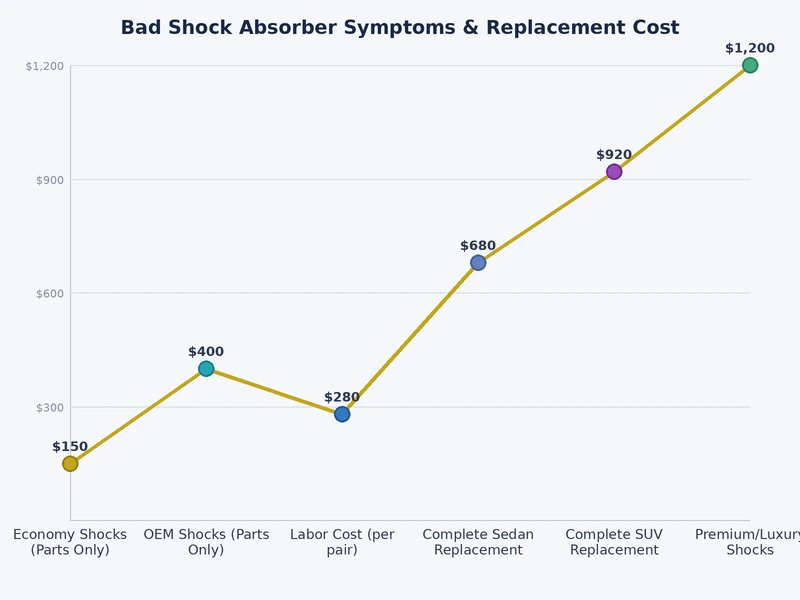
Total replacement cost for both axles ranges from approximately $300 to $600 for compact sedans up to $780 to $1,900 for performance vehicles, depending on whether OEM or quality aftermarket parts are selected and whether a post-replacement wheel alignment is required by the vehicle's suspension configuration.
Replacing shock absorbers in axle pairs — both front units or both rear units simultaneously — is standard practice because matched damping characteristics on each axle preserve balanced vehicle handling. Installing one new unit alongside one worn unit creates asymmetric damping that degrades braking stability and cornering behavior measurably.
A shock absorber is a standalone damping component working alongside a separate spring, while a strut integrates the damper, spring perch, and steering knuckle attachment into a single structural unit. Strut replacement is more labor-intensive, requires a wheel alignment afterward, and typically costs substantially more than a standard shock absorber swap.
The bounce test — pushing down firmly on each vehicle corner and observing the number of oscillations before the body settles — provides a reliable field check for severely worn units. Visual inspection for active fluid leakage around the seal confirms internal failure, while hydraulic dynamometer testing provides definitive quantitative data for borderline cases.
Identifying bad shock absorber symptoms early and understanding the realistic cost structure of professional replacement empowers vehicle owners to address suspension wear before it escalates into a compounding and significantly more expensive repair scenario. Any vehicle displaying persistent bouncing, audible clunking over bumps, cupped tire wear, or increased braking distances deserves prompt undercarriage evaluation by a qualified suspension technician. Schedule a comprehensive suspension inspection at a trusted shop, request assessment of all related wear components simultaneously, and address identified issues in a single service visit to minimize both total cost and vehicle downtime.
 |
 |
 |
 |

About Sarah Whitfield
Sarah Whitfield is a diagnostics and troubleshooting specialist who spent ten years as an ASE-certified technician before joining the editorial team. She specializes in OBD-II analysis, electrical gremlins, and the kind of intermittent problems that make most owners give up.
Get some FREE car parts & gear.. Or check out the latest free automotive manuals and build guides here.
Disable your ad blocker to unlock all the hidden deals. Hit the button below 🚗
| | | |
