by Sarah Whitfield
Why does a perfectly good car start drifting toward the curb the moment the driver lets go of the steering wheel? The answer, more often than not, is misaligned wheels — and the bad wheel alignment symptoms that come with them are rarely as subtle as most drivers hope. This post identifies all seven warning signs, explains the chain of damage they set in motion, and tells drivers exactly when to act and what not to do.
Wheel alignment refers to the adjustment of a vehicle's suspension angles so that all four tires contact the road at the precise angles the manufacturer specified. When those angles shift — even by a single degree — the effects ripple outward: tires wear unevenly, steering feels vague, fuel economy drops, and suspension components wear faster than they should. The good news is that misalignment is diagnosable early and inexpensive to fix. The bad news is that most drivers wait far too long.
Contents
According to Wikipedia's overview of wheel alignment, a correctly aligned vehicle has all four wheels sitting at precise manufacturer-specified angles for camber, caster, and toe. When those angles drift, the following symptoms emerge — usually in order of subtlety, with the easiest to spot appearing first.
The most reported bad wheel alignment symptom is a car that drifts or pulls to one side when the driver releases the steering wheel on a level road. The pull can be barely perceptible or strong enough to require constant correction, depending on how far the alignment has shifted.
Always rule out uneven tire pressure first — a flat or significantly under-inflated tire can mimic a pull. If pressure is correct on all four tires and the car still drifts, alignment is the primary suspect.
Misalignment forces tires to scrub across the road at an unintended angle rather than rolling flat. The result is wear that concentrates on one edge — inside or outside — instead of spreading uniformly across the tread surface.
Uneven wear from misalignment is irreversible once set into the tread. Those tires must be replaced. The alignment must be corrected simultaneously — or the new tires will simply repeat the same pattern.
On a car tracking straight, the steering wheel's center emblem should sit perfectly level. If it's rotated — even a small amount — the toe angle is almost certainly off. This is a clean, easy-to-spot bad wheel alignment symptom that many drivers rationalize as a minor quirk rather than a real problem.
A steering wheel that shakes — particularly at highway speeds — can trace back to several causes. Misalignment is one of them. When misaligned tires are forced to work against each other, the tension travels through the steering column as vibration. Drivers who also experience car vibration at highway speeds should add wheel alignment to the diagnosis list alongside tire balance and worn suspension parts.
Wandering steering — where the car requires constant small corrections to stay in a straight line — is a less-discussed but equally serious bad wheel alignment symptom. It is particularly dangerous at highway speeds, where a momentary distraction causes a sudden lane drift.
Drivers already experiencing car shaking while driving should note that wandering and shaking can share root causes in the front suspension — a full suspension inspection often resolves both at once.
Tires squeal when they scrub the road at an unintended angle. Misaligned tires — especially those with significant toe-in or toe-out — drag laterally as the vehicle moves forward. That sideways friction generates heat and a consistent squealing sound that differs from the squeal of hard braking or aggressive cornering.
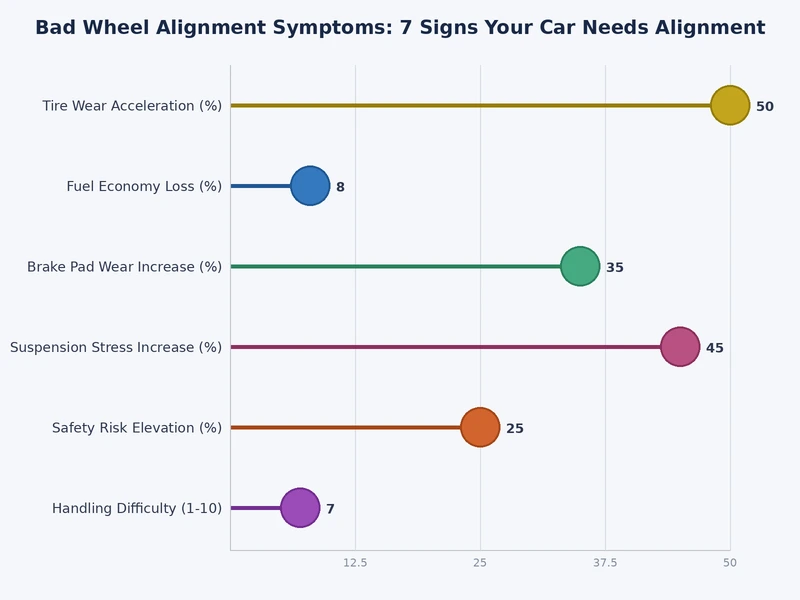
Misaligned tires create rolling resistance — the engine must work harder to push the car forward while tires are fighting to travel at an angle. The result is measurably worse fuel economy. This symptom builds gradually, which is exactly why most drivers miss it until the drop becomes significant.
Misalignment accelerates tire wear at a rate most drivers significantly underestimate. A tire rated for 50,000 miles can reach replacement condition in under 20,000 miles when alignment is substantially off. The math is unforgiving.
Beyond cost, uneven tread wear degrades wet-road grip and cornering stability. Tires with feathered or edge-worn treads perform significantly worse in emergency braking situations than evenly worn tires with the same remaining depth.
Misalignment's damage does not stop at the tires. The abnormal forces it introduces stress ball joints, tie rods, wheel bearings, and control arm bushings — wearing them faster than normal driving would. Drivers who notice a grinding noise when braking alongside alignment symptoms should have both wheel bearings and alignment inspected at the same visit, since misalignment-driven bearing wear is a common combination.
The financial chain reaction is significant. A $100 alignment corrected early replaces what could become a $600–$1,200 repair involving tires, bearings, and tie rods all failing within the same short period.
Alignment does not drift on its own without cause. Something physical shifts it. The most common triggers, in order of frequency:
Road quality matters enormously. Vehicles driven primarily on rough urban roads drift out of alignment two to three times faster than those covering smooth highway miles. High-mileage vehicles on deteriorating infrastructure should be checked more frequently than annual intervals suggest.
No universal mileage interval covers every driving situation, but clear triggers exist. Schedule a check:
The single most expensive alignment mistake is the most common one: waiting. Many drivers notice a slight pull or a mildly crooked steering wheel and file it away as a quirk of the car or the road. Neither explains it. The early bad wheel alignment symptoms described above are the car's direct signal that a correctable problem exists — and that it will worsen with every mile.
A vehicle producing a burning rubber smell during or after extended driving may already have tires scrubbing themselves apart from chronic misalignment. That odor combined with any of the seven symptoms above is a clear signal to stop deferring the appointment.
Replacing worn tires without correcting the alignment that wore them is a direct path to wasting money. New tires mounted on a misaligned vehicle will reproduce the exact same uneven wear pattern as the originals — often within 5,000 miles.
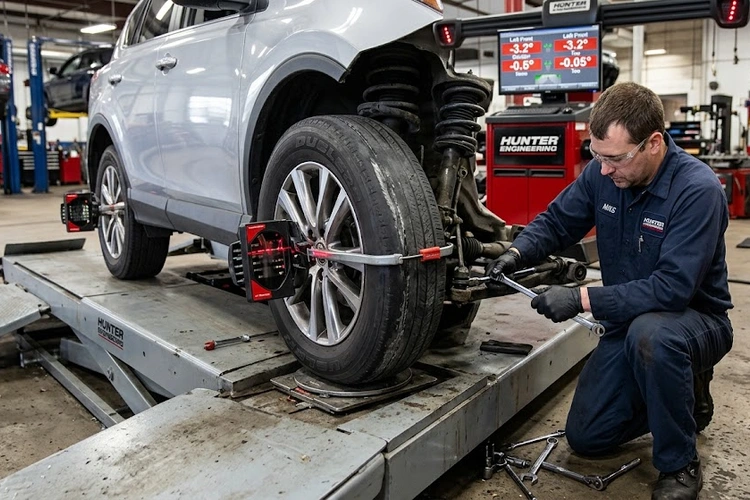
A professional alignment takes 30–60 minutes on a computerized alignment rack. The technician places sensors on all four wheels, measures camber, caster, and toe angles against the manufacturer's specifications, then adjusts them with calibrated tools. Most shops provide a printed before-and-after report showing exactly which angles were corrected and by how much.
Drivers who also see a Service StabiliTrak warning light alongside alignment complaints should inform the technician before the appointment begins. Alignment correction can require steering angle sensor recalibration, which some shops perform as a separate step.
True wheel alignment requires a computerized alignment rack. There is no reliable DIY equivalent for standard passenger vehicles. String-alignment methods and home angle gauges produce rough approximations that cannot match the 0.01-degree precision of professional equipment.
| Approach | Accuracy | Typical Cost | Best Application | Verdict |
|---|---|---|---|---|
| Professional 4-wheel alignment | High (±0.01° precision) | $75–$150 | All passenger vehicles | Recommended |
| Professional 2-wheel (front only) | Medium | $50–$100 | Vehicles with non-adjustable rear suspension | Acceptable where rear is fixed |
| DIY string method | Low | Near $0 | Track/race rough toe reference only | Not appropriate for street use |
| Toe plates / angle gauges | Very low | $30–$80 | Enthusiast reference only | Unreliable for daily drivers |
The professional alignment is the only option worth taking seriously for any vehicle driven daily on public roads. A single alignment service typically saves far more in tire costs over the next 30,000 miles than the service itself costs.
Alignment does not have to degrade quickly. Deliberate driving choices extend the interval between services significantly, reduce tire wear, and lower the cumulative cost of ownership over a vehicle's life.
Drivers noticing their vehicle shaking at a stop should not automatically assume an alignment problem. A car that shakes when idle is typically dealing with an engine or drivetrain issue rather than a suspension geometry problem. These are separate diagnoses that call for separate inspections.
Alignment holds longest when paired with a consistent maintenance routine. The following schedule applies to most passenger vehicles under normal use conditions.
Pairing alignment inspections with scheduled tire rotations keeps the routine simple and avoids missed service intervals. Most shops offer both services together at a reduced bundled rate. Consistent proactive maintenance is the most reliable protection against the expensive chain reaction that untreated bad wheel alignment symptoms set in motion.
A car that pulls, squeals, or wanders is asking for an alignment — ignore it long enough, and it starts asking for tires, tie rods, and wheel bearings instead.
 |
 |
 |
 |

About Sarah Whitfield
Sarah Whitfield is a diagnostics and troubleshooting specialist who spent ten years as an ASE-certified technician before joining the editorial team. She specializes in OBD-II analysis, electrical gremlins, and the kind of intermittent problems that make most owners give up.
Get some FREE car parts & gear.. Or check out the latest free automotive manuals and build guides here.
Disable your ad blocker to unlock all the hidden deals. Hit the button below 🚗
| | | |
