by Liam O'Brien
Which air impact wrench actually delivers the torque you need without beating up your wrists after an hour of suspension work? If you've stood in a shop aisle overwhelmed by the options, you already know the answer isn't obvious — but after testing across lug nuts, rusted caliper bolts, and stubborn industrial fasteners, the Ingersoll Rand 2235TiMAX rises above the competition as the best air impact wrench for most users in 2026. Whether you're running a full-time garage or wrenching on weekends, the right pneumatic impact wrench turns a half-hour battle with frozen hardware into a ten-second job.
Air impact wrenches remain the gold standard in automotive and industrial tool applications precisely because they deliver far more torque per dollar than their cordless counterparts, and they do it consistently without battery degradation or recharge downtime. The pneumatic mechanism — compressed air driving a spinning hammer assembly against an anvil — produces short, powerful bursts that break loose even deeply corroded fasteners that would strip a socket extension or shatter a breaker bar. If you haven't already invested in a solid air compressor to pair with your wrench, check out our roundup of the best portable air compressors of 2026 to make sure your supply line keeps up with your tool's appetite for CFM.
In this guide, we've ranked seven of the most compelling air impact wrenches available in 2026, covering everything from budget-friendly DIY picks to the kind of professional-grade titanium-cased hardware that Snap-on mechanics carry into the pits. You'll find detailed reviews, side-by-side comparisons, and a buying guide that walks you through every spec that actually matters. If you're also considering going cordless, our guide to the best cordless impact wrenches of 2026 covers that ground thoroughly. Now, let's get into the tools.










The Ingersoll Rand 2235TiMAX is the wrench that professional technicians reach for when something absolutely has to come loose, and the numbers back up that confidence: it delivers up to 1,350 foot-pounds of nut-busting torque from a tool that weighs only 4.6 pounds. That power-to-weight ratio is genuinely unmatched in this drive size class, which means you can work through a full afternoon of suspension work, hub replacements, or industrial equipment teardowns without your forearm turning into a liability. The titanium hammer case is one of the standout engineering decisions Ingersoll Rand made here — it sheds significant weight compared to steel alternatives while providing the kind of impact resistance you need when a tool regularly gets dropped on concrete floors.
The twin-hammer mechanism produces smooth, consistent torque delivery with four power settings that let you dial in exactly what a given fastener requires, so you're not mushrooming bolt heads on lower-torque applications just because the tool defaults to full power. Pressure-feed lubrication keeps internal components protected during continuous-duty cycles, and every component has been validated through rigorous factory testing to ensure long-term reliability. For automotive technicians, fleet maintenance crews, or serious home mechanics who want the absolute best performing 1/2-inch pneumatic impact wrench available without stepping into the ultra-premium Snap-on tier, the 2235TiMAX is the answer you've been looking for.
Pros:
Cons:
If you want Ingersoll Rand reliability without paying flagship prices, the 231C is the tool that's been earning its reputation in professional shops for decades, and it remains one of the most dependable 1/2-inch pneumatic wrenches you can buy in 2026. It delivers a maximum of 600 foot-pounds of torque and spins up to 8,000 RPM, which is more than sufficient for lug nuts, brake components, exhaust hardware, and a wide range of general automotive work. The adjustable power regulator gives you the flexibility to reduce output when working with sensitive fasteners, and the twin-hammer mechanism keeps the power delivery smooth rather than delivering harsh, jarring impacts that wear out both the tool and the operator.
The two-piece construction design is a notable practical advantage because it means you can service the internal components yourself rather than shipping the tool out for depot repair, which keeps downtime short and total cost of ownership low. The ergonomic contoured handle genuinely reduces wrist strain during extended use sessions, and the pressure-feed lubrication system means you don't need to hand-oil this wrench as frequently as traditional designs. Where the 231C falls short relative to the 2235TiMAX is raw torque output — if you regularly work on heavy-duty vehicles or stuck wheel hub assemblies, the extra headroom of the flagship model is worth the price difference, but for light commercial or serious DIY work, the 231C handles virtually every task you'll encounter.
Pros:
Cons:
The Snap-on MG725 occupies a category that most people will respect but few will need to justify financially — and if you're running a high-volume professional shop where uptime is measured in dollars per hour, the justification writes itself. This wrench delivers 1,190 foot-pounds of bolt breakaway torque and 810 foot-pounds of recommended working torque, numbers that put it firmly in the upper tier of 1/2-inch pneumatic tools, and the magnesium housing construction keeps the weight low despite the robust internal mechanism. Snap-on's engineering philosophy is built around tools that operate consistently and precisely under the punishing conditions of professional daily use, and the MG725 fully delivers on that philosophy with smooth power delivery and exceptional durability.
You're paying a significant premium for the Snap-on name, but that premium buys you access to the brand's warranty and service network, a tool that will outlast multiple competitors under daily shop use, and the confidence that your fasteners are being driven with calibrated precision rather than approximate brute force. The standard anvil configuration is compatible with the full range of impact sockets you already own, and the build quality is apparent the moment you pick it up — there's a solidity to the Snap-on that cheaper tools simply cannot replicate. For the professional technician who takes tool quality seriously, the MG725 is the benchmark against which everything else in this category is measured.
Pros:
Cons:
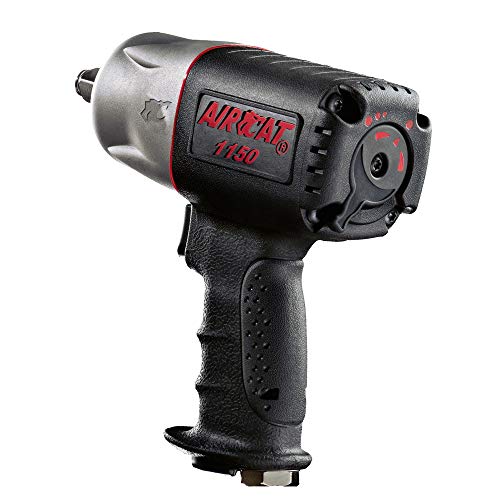
AIRCAT built a real reputation with the 1150 by delivering 900 foot-pounds of working torque and 1,295 foot-pounds of loosening torque in a composite housing that absorbs vibration better than aluminum or steel alternatives, and those vibration-damping properties are something you feel immediately when you start working with this tool for extended periods. The hard-hitting twin-hammer mechanism fires at 1,400 blows per minute, which gives the 1150 excellent bolt removal speed on rusted hardware that might require multiple impacts to fully break loose. The patented ergonomic handle design routes exhaust air through the tool body in a way that keeps debris and hot air away from your face, which is a genuine quality-of-life improvement you'll appreciate after about five minutes of use on an undercarriage job.
The composite housing is the defining feature here — it's lighter and more comfortable to hold than comparable steel-bodied tools, it insulates against cold temperatures (a real consideration if you work in an unheated shop during winter months), and it absorbs the micro-vibrations from the hammer mechanism in a way that genuinely reduces hand fatigue over a full working day. At 900 foot-pounds of forward torque, the AIRCAT 1150 handles virtually every automotive application you'll encounter, from lug nuts to suspension components to exhaust manifold bolts, and it does so with a level of ergonomic refinement that more expensive tools sometimes lack. This is the wrench to consider if you prioritize all-day comfort alongside serious power output.
Pros:
Cons:
The ONYX v2 solves a specific problem that no other wrench on this list addresses with the same elegance: how do you get meaningful impact torque into a space where a standard-length impact wrench simply won't fit? With a total body length of less than 3-7/8 inches, the 1822 is genuinely pocket-sized for a 1/2-inch drive tool, and Astro Pneumatic's second-generation high-performance motor delivers 500 foot-pounds of maximum torque from that impossibly compact frame. Working inside wheel wells, cramped engine bays, or underneath dashboards becomes a fundamentally different experience when your impact wrench doesn't require you to contort around bodywork just to get the anvil onto the fastener.
The v2 improvements over the original ONYX centered on motor efficiency and exhaust routing, and the result is a tool that feels meaningfully more capable than its predecessor while maintaining the ultra-short profile that made the original so popular in tight-clearance applications. Three forward and three reverse settings give you reasonable torque adjustment capability despite the compact form factor, and the tool connects to standard 1/4-inch NPT air fittings you already have in your shop. The 500 ft-lbs maximum torque figure is the practical limitation — this wrench is not a replacement for a full-size tool on heavily corroded fasteners or industrial applications, but as a specialized compact solution for confined spaces, nothing else in this category competes with it.
Pros:
Cons:
BESWELL positions the BW-112BN as a high-torque option at a competitive price point, and the headline number — 1,180 foot-pounds of maximum loosening torque — makes that positioning credible when you're comparing spec sheets. The twin-hammer impact system uses die-cast aluminum end plates and a powder metal air cylinder, which are construction details that indicate real engineering investment beyond the most budget-tier pneumatic tools, and the tool is rated to operate reliably at 90 to 120 PSI air pressure, which covers the full range of what your shop compressor is likely delivering. For vehicle repair, fleet maintenance, and construction fastener applications, the BW-112BN brings serious loosening capability to users who can't justify premium Ingersoll Rand or Snap-on pricing.
BESWELL recommends pairing this wrench with dedicated pneumatic impact sockets rather than standard chrome sockets — this is sound advice for any high-torque impact wrench, since the sudden impulse loads involved in impact operation can crack standard sockets in ways that create genuine injury risk. The through-handle design keeps exhaust routing comfortable, and the overall ergonomics are solid for a tool at this price point. Where the BW-112BN concedes ground to the established brands is in long-term durability data and service network availability — BESWELL is a newer market entrant, and the real-world longevity of the internal components under daily professional use hasn't been established over the same multi-decade track record that Ingersoll Rand or AIRCAT can point to. For occasional to moderate use, though, this wrench delivers exceptional torque per dollar.
Pros:
Cons:
Harbor Freight's EARTHQUAKE XT brand has built a loyal following among budget-conscious DIYers and occasional-use mechanics by delivering specifications that compete with more expensive tools at a fraction of the price, and the 1/2-inch Composite Xtreme Torque model continues that tradition with 1,190 foot-pounds of bolt breakaway torque from a composite housing that keeps weight and vibration both manageable. The twin-hammer impact mechanism achieves that torque figure while generating noticeably less vibration than older single-hammer designs, which makes a meaningful difference in comfort during extended use sessions, and the through-handle exhaust system is genuinely useful for keeping debris and exhaust flow directed away from your face and the work surface.
The composite housing is rated to handle professional-grade punishment, and the EARTHQUAKE XT line benefits from Harbor Freight's competitive warranty and return policy, which reduces the financial risk of trying a budget-tier tool in a professional setting. The 1,190 ft-lbs breakaway torque figure matches the Snap-on MG725 on paper, and while the quality of internal components and long-term durability understandably differ at these price points, for weekend mechanics, DIYers tackling brake jobs and suspension work, or shops looking for a backup tool that won't sting if it gets damaged, the EARTHQUAKE XT delivers real value. If you're investing in pneumatic tools and want to understand what to pair with this wrench, our guide to the best strut spring compressors of 2026 covers complementary suspension tools in the same category.
Pros:
Cons:
Buying an air impact wrench requires you to match the tool's specifications to the actual demands of your work, because the most powerful wrench on the shelf is not automatically the best choice for every application. Here's what actually matters when you're comparing models in 2026.
Every air impact wrench is marketed with two torque figures that you need to understand separately before the specs make sense.
The drive size determines which sockets the wrench accepts and, indirectly, what applications it's suited for. All seven tools in this guide use the 1/2-inch drive size, which is the right choice for nearly all automotive and light industrial applications.
The most common mistake buyers make is purchasing a high-performance impact wrench and pairing it with a compressor that can't keep up with the tool's air consumption demands, which results in performance that degrades after the first few seconds of use.
The housing material determines weight, durability, vibration absorption, and price — and each material makes a different set of trade-offs that you need to evaluate against how and where you actually use the tool.
Nut-busting torque (also called breakaway torque) is the maximum short-burst force the wrench generates to break a stuck fastener loose — it's the larger number in most product listings. Working torque is the sustained output the tool maintains while driving a fastener in, and it's typically 50–70% of the breakaway figure. When comparing wrenches for real-world performance, working torque is the more meaningful spec because it reflects what the tool actually does during sustained use rather than peak momentary output.
The vast majority of 1/2-inch air impact wrenches are designed to operate at 90 PSI, and most shop compressors are set to deliver between 90 and 120 PSI, which covers that requirement comfortably. The more important spec is CFM — your compressor needs to deliver 4–7 CFM at 90 PSI depending on the tool's consumption rating. Running an impact wrench on inadequate CFM won't damage the tool, but it will result in significant torque loss after the first couple of seconds of use.
You should not use standard chrome sockets with a high-torque air impact wrench. Impact wrenches deliver rapid, high-energy pulses rather than steady rotational force, and standard chrome sockets are not hardened to absorb those impulse loads — they can crack or shatter under impact operation, creating a genuine safety hazard. Impact-rated sockets (typically black oxide finished) are specifically manufactured to handle the impulse loading of pneumatic and cordless impact tools, and they're the correct choice for any impact wrench application regardless of torque level.
A standard 1/2-inch air impact wrench typically requires 4–5 CFM at 90 PSI for normal use, while high-torque models like the Ingersoll Rand 2235TiMAX may need up to 7 CFM at peak demand. Match your compressor's CFM rating at 90 PSI to the tool's specification, and run the largest diameter air hose your setup allows — 3/8-inch ID minimum — to prevent restriction losses between the tank and the tool.
Modern composite housing materials are robust enough for professional shop use and offer meaningful advantages over metal in vibration absorption and cold-weather insulation. The AIRCAT 1150 and EARTHQUAKE XT both use composite housings and are rated for demanding daily use. The area where composite concedes ground to titanium or aluminum is repeated high-impact drops on hard surfaces — metal housings handle that kind of accidental abuse with less risk of cracking. For most applications, though, a quality composite housing wrench will provide years of reliable service.
Both tools deliver over 1,100 foot-pounds of breakaway torque and are built for sustained professional shop use, but they approach the task differently. The 2235TiMAX leads on power-to-weight ratio — at 4.6 pounds, it's significantly lighter than most tools in its torque class, which reduces fatigue during long shifts. The Snap-on MG725 brings the weight and backing of the Snap-on service network, and the brand's precision engineering standards produce exceptionally consistent torque delivery. The practical choice comes down to your service relationship — if Snap-on trucks your shop regularly and you value that support infrastructure, the MG725 justifies its premium. If you want the best independent purchase at a lower price point, the 2235TiMAX is the clear winner on value.
Buy the wrench that matches how hard you actually work — not the most impressive spec on the shelf, but the one your compressor can feed, your wrist can carry, and your hardest fasteners cannot defeat.
 |
 |
 |
 |

About Liam O'Brien
Liam O'Brien has spent over a decade buying, field-testing, and evaluating automotive tools with a focus on what actually performs in a real DIY garage rather than what markets well on a spec sheet. His hands-on experience spans hand tools, diagnostic equipment, floor jacks, socket sets, and specialty automotive gear across a wide range of brands and price points. At CarCareTotal, he covers automotive tool and equipment reviews, garage setup guides, and buying advice for home mechanics.
Get some FREE car parts & gear.. Or check out the latest free automotive manuals and build guides here.
Disable your ad blocker to unlock all the hidden deals. Hit the button below 🚗
| | | |
