by Marcus Chen
The OTC Clamshell Strut Spring Compressor (6494) earns the top spot in 2026 for one reason: it fully encases the spring, eliminating the single greatest hazard in suspension work — a coil under pressure slipping free. Strut spring replacement ranks among the most mechanically dangerous jobs a home mechanic or shop technician can attempt without the right equipment. Compressed coil springs store enormous energy, and an improperly secured spring can release with enough force to cause serious injury or destroy surrounding components.
Choosing the right strut spring compressor is not about picking the cheapest tool that fits in a drawer. It is about matching the design, material quality, and compression range to your specific vehicle and workflow. Whether you are servicing a single car in your home garage or running a high-volume shop, the market in 2026 offers purpose-built solutions ranging from budget-friendly fork-style sets to professional clamshell rigs. If your suspension work extends to performance upgrades — lowering springs, coilovers, or track-day setups — the precision and safety margin of a quality compressor become even more critical. This guide covers seven of the best available right now, with full breakdowns, a practical buying guide, and answers to the questions mechanics ask most.
Before you lift the vehicle, it is worth pairing a quality compressor with a reliable low-profile floor jack — getting the car safely off the ground and properly supported is step one of any strut job. Once you understand the options below, you will know exactly which tool belongs in your kit for 2026 and beyond.

Contents





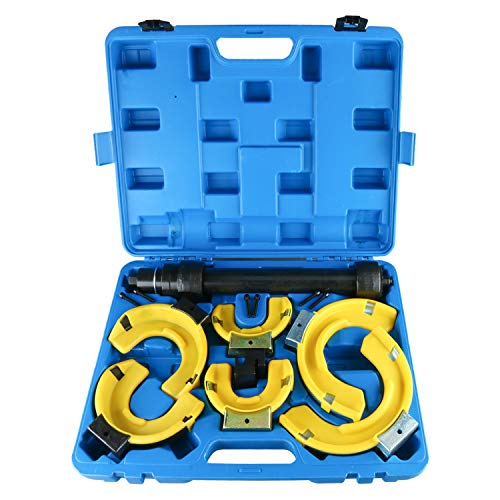



The OTC 6494 has been the benchmark for strut spring compressors for years, and in 2026 it remains the safest design available to home mechanics and professionals alike. The clamshell configuration — two opposing jaws that fully enclose the spring — is fundamentally different from fork-style tools. Instead of relying on small contact points at opposite ends of a coil, the clamshell distributes compression force around the entire circumference. This design all but eliminates the risk of a spring slipping off the tool mid-compression, which is the most dangerous failure mode in this category of work.
OTC manufactures this compressor in the United States, and the build quality reflects it. The steel construction is heavy but reassuringly solid, and the jaws open wide enough to accommodate a broad range of spring diameters and heights. For technicians working in a professional environment or DIYers who work on their vehicles regularly, this is not a tool you buy twice. The investment in the clamshell design pays dividends every time you compress a spring and the spring stays exactly where it belongs throughout the entire procedure. It is the tool recommended by ASE-certified technicians precisely because the design does not compromise on containment.
One trade-off is size and price. The OTC 6494 is heavier and costs more than fork-style alternatives. It also requires more clearance around the strut assembly, which can be a constraint on vehicles with tight engine bays. For occasional use or tight budgets, other options on this list are workable. But if you are doing strut work with any regularity, the clamshell is the right tool for the job.
Pros:
Cons:
The Powerbuilt 648628 answers a practical question many mechanics face: what do you need beyond just the compressor itself? This kit delivers a complete solution in a single storage case, including all the hardware required to compress, remove, and reinstall both straight and curved springs made of wire up to 3/4-inch diameter. That wire diameter spec matters — not every compressor on this list explicitly handles larger-gauge springs, and the Powerbuilt addresses that gap directly. The kit format also means you are not hunting for compatible components before you start the job.
Chrome Vanadium Steel construction is the standard for quality hand tools, and Powerbuilt uses it throughout this kit. The arms are precision-built to meet or exceed ANSI standards, which gives you a specific quality benchmark rather than a vague claim. Chrome Vanadium delivers the combination of hardness and toughness needed to withstand the extreme forces generated during spring compression without bending or fracturing. The included storage case keeps all components organized and protected between uses — a small detail that matters when you are looking for a specific piece mid-job.
The Powerbuilt kit is designed for most automotive coil spring suspensions, which covers the overwhelming majority of passenger cars and light trucks you are likely to work on. It is a solid mid-range choice that bridges the gap between entry-level tools and professional-grade equipment. For a home mechanic who services their own vehicles and occasionally helps friends or family, this kit provides the right combination of completeness and quality without requiring a professional-grade budget.
Pros:
Cons:
Orion Motor Tech built the 2pc MacPherson set around a single competitive advantage: a 10.5-inch working range that exceeds most comparable fork-style tools. That extra range directly translates to vehicle compatibility. Taller springs found on trucks, SUVs, and some European sedans often fall outside the usable range of cheaper compressors, forcing you to either stop work or improvise — neither of which is acceptable when a compressed spring is involved. Orion eliminates that constraint with Acme-threaded rods that deliver firm, reliable compression across the full 10.5 inches.
The built-in detent pins are a feature that separates this set from basic alternatives. Once the spring is loaded into the tool, the pins lock it in place and prevent it from shifting during compression. This is not a cosmetic feature — it addresses the real-world scenario where a spring rotates or walks during the compression cycle. The 1/2-inch square drive and 13/16-inch hex compatibility means you can use this with your existing ratchet, breaker bar, or impact wrench. If you already have quality air ratchets in your toolkit, the Orion set integrates seamlessly with them for faster and easier operation.
The set works on most small and medium-sized cars with MacPherson strut suspension, which according to Wikipedia is the most widely used front suspension design in the world — so the compatibility claim is not a stretch. Two compressors are included, which is the correct way to do the job: one on each side of the spring for balanced, controlled compression. At its price point, this Orion set delivers a level of engineering that should be standard and often is not.
Pros:
Cons:
OEMTOOLS designed the 27036 with durability as the primary specification. The forged hooks and hardened center screw are not marketing language — forging produces a denser, stronger grain structure in the steel compared to cast or machined alternatives, and it directly affects how the tool performs under the sustained stress of spring compression. With a 10.75-inch total length and a 9.75-inch maximum safe opening, this set handles the majority of MacPherson strut applications you will encounter on modern passenger vehicles in 2026. It arrives with a carrying case, which is a practical touch for a tool that sees periodic rather than daily use.
The broad spring contact design addresses the fundamental limitation of narrow-hook fork-style compressors. More contact area means the compressive force is distributed over a larger portion of the spring coil, reducing the likelihood of the hook digging in, slipping, or creating a stress concentration point on the spring itself. The built-in detent pins add a secondary safety measure by locking the spring position during compression. These features work together to make the 27036 one of the more mechanically sound fork-style options on the market.
OEMTOOLS positions this product as a long-lasting investment, and the forged construction backs up that claim. Unlike imported tools made from lower-grade steel, the 27036 is built to survive repeated use without the hooks bending or the center screw thread stripping under load. For a home mechanic who services multiple vehicles or works on the same car every year or two, this set's durability justifies the slightly higher price compared to bargain alternatives.
Pros:
Cons:
The 8MILELAKE kit takes a different approach to the compatibility problem by providing three sets of interchangeable jaws: 65–125mm, 88–160mm, and 126–212mm. That three-tier jaw system means a single kit handles spring diameters from compact economy cars all the way up to larger trucks and SUVs without requiring a separate tool for each application. The interchangeable design is particularly valuable if you work on a variety of vehicles, or if your household includes both compact and full-size vehicles that need periodic strut service.
The kit includes one compression rod, one adjustment hook, and six fixing screws in addition to the three jaw pairs. The tool is designed for MacPherson-style coil springs, both front and rear, and operates in one direction — clockwise rotation. This is consistent with how most strut spring compressors function and should not present any learning curve for someone with prior suspension experience. The multi-function claim is backed by the jaw range rather than marketing complexity: the same rod handles all three jaw sets, keeping the kit compact and the learning curve flat.
One specific note from the product documentation: this tool works on shocks that compress in the clockwise direction. Verify your application before purchasing. For the wide range of vehicles where this applies, the 8MILELAKE kit represents an exceptionally cost-effective way to gain genuine multi-vehicle capability without buying multiple single-use tools or committing to a professional-grade clamshell compressor.
Pros:
Cons:
The Branick 7600 occupies a different tier than every other tool on this list. This is professional-grade floor-mounted strut spring compression equipment, the kind you find in independent shops and dealerships that service dozens of strut assemblies per week. The heavy-duty Acme thread design delivers consistent, controllable compression force without adapters — the "no adapters required" specification means you load the strut and compress it, full stop. For a shop environment where time is money and workflow interruptions are unacceptable, that simplicity is worth the price premium.
Branick builds this compressor with versatile mounting options, which means it can be configured for the available floor space and workflow pattern of the shop it lands in. The Acme thread standard — a trapezoidal thread profile used specifically for power transmission applications — is the correct engineering choice for a tool that needs to transfer large forces reliably under repeated cycling. This is not a weekend warrior tool. It is capital equipment, and it performs like capital equipment. Shops that process enough strut work to justify the investment will see it pay back in speed, safety, and reduced technician fatigue compared to manual fork-style tools.
If you run a shop, manage a fleet, or work in a setting where you use a professional car lift daily and do volume suspension work, the Branick 7600 deserves a serious look. For the individual home mechanic doing one or two strut jobs per year, the investment does not pencil out and the tools above will serve you well. But for the professional context it was designed for, the Branick 7600 is the right tool.
Pros:
Cons:
The DASBET 2-piece set lands at the value end of this list without compromising the safety features that matter most. Heat-treated forcing hooks and hardened center screws address the two failure points most likely to cause problems in budget spring compressors: hook bending under load and center screw thread stripping. DASBET specifies that both components are heat-treated rather than simply cold-formed, which produces a meaningfully harder and more durable part for the price. The 10.5-inch adjustable range matches what the Orion and OEMTOOLS sets offer at similar price points.
The built-in stop pin is not a luxury feature at any price — it is a safety requirement. The DASBET set includes it, which is not true of every budget compressor on the market. The stop pin locks the coil spring in position once it is loaded, preventing the kind of spring rotation or walking that can cause the hooks to disengage mid-compression. The heavy-duty threaded rod provides the mechanical advantage needed for large spring contact and smooth, consistent compression. The tool works with a 3/4-inch or 19mm socket and ratchet, which every mechanic already owns.
DASBET notes that the compressor can be used with manual or electric tools to compress the spring on or off the vehicle. That flexibility is useful when you are working in a space-constrained garage and cannot always position a vehicle optimally. For someone doing their first strut job or looking for a second set to have on hand, the DASBET set delivers the core safety features at a price that removes cost as a barrier to doing the job with proper equipment.
Pros:
Cons:


The most consequential decision you make when buying a strut spring compressor is the design type. Two fundamentally different designs dominate the market, and they are not interchangeable in terms of safety margin.
A clamshell compressor, like the OTC 6494, fully encases the spring between two opposing jaw halves. The spring cannot escape the tool during compression because the tool physically surrounds it. This design is the professional standard for a reason: it eliminates the most dangerous failure mode — sudden spring release. The trade-off is bulk, cost, and the need for clearance around the strut assembly.
Fork-style compressors use two hooked arms that attach to individual coils at opposite ends of the spring. They are lighter, cheaper, more compact, and more than adequate for the vast majority of home garage applications when used correctly. The key phrase is "used correctly" — hooks must be fully seated on the spring coil, both sides must be compressed evenly, and the spring must be monitored throughout the process. Built-in detent pins (present on the Orion, OEMTOOLS, and DASBET sets) significantly reduce the slip risk and should be considered a minimum requirement for any fork-style compressor you buy in 2026.
Compression range is the specification that determines whether a given tool will actually work on your vehicle. Most MacPherson strut compressors are rated by maximum safe opening — the widest distance the hooks can be set from each other. A range of 9.75 to 10.5 inches covers most passenger cars and light trucks. Larger vehicles, including full-size trucks, body-on-frame SUVs, and some European luxury cars with taller spring stacks, may require more range.
Check your vehicle's service manual or a trusted source for the compressed and uncompressed spring height before buying. If your spring height at full extension exceeds the tool's maximum safe opening, you need a tool with more range or a different design. The 8MILELAKE's interchangeable jaw system offers the broadest diameter coverage on this list (65–212mm), which is particularly relevant for shops or mechanics serving multiple vehicle types. For a single-vehicle application, verifying the spring diameter and height against the tool specs takes five minutes and prevents a wasted purchase.
Steel quality is the hidden variable in strut spring compressor pricing. A coil spring under full compression generates hundreds of pounds of stored energy. The hooks, threaded rod, and connecting hardware are the only things standing between a controlled compression and an uncontrolled spring release. Forged steel, Chrome Vanadium alloy, and heat-treated components represent the construction standards worth paying for. Cold-formed or cast hooks from unspecified steel are not.
Look for specific material callouts — "Chrome Vanadium Steel," "forged hooks," "heat-treated center screw" — rather than generic claims about being "heavy duty." When a manufacturer specifies ANSI compliance, that is a third-party quality benchmark, not just a marketing claim. Tools meeting ANSI standards have been tested against defined performance requirements. The Powerbuilt 648628 calls this out explicitly; other manufacturers on this list (OEMTOOLS, DASBET) specify their construction methods precisely enough to evaluate the claim. The same attention to material quality applies when choosing complementary tools — quality oil filter wrenches and suspension tools built from proper alloys simply outlast their cheaper counterparts under repeated use.
Where you use the tool and how often shapes the right purchasing decision as much as the technical specifications. A home mechanic doing two or three strut jobs per year across one or two vehicles has completely different requirements than a shop technician who compresses springs daily across dozens of different vehicles.
For home use, a quality fork-style set from Orion, OEMTOOLS, or Powerbuilt with a storage case provides everything you need at a price that makes sense. For mixed home and professional use, the OTC clamshell's safety margin and American build quality justify the premium. For a professional shop doing volume work, the Branick 7600 is the correct tool regardless of price — the efficiency and safety gains over manual fork-style tools recoup the investment quickly in a professional context. Match the tool to the actual use case, not the aspirational one.
A strut spring compressor is a specialized tool used to safely compress and hold a coil spring while you disassemble, service, or replace a vehicle's strut assembly. Coil springs store significant mechanical energy when compressed — a strut spring compressor controls that energy during removal and reinstallation. Without the proper tool, attempting to compress or decompress a strut spring by other means is extremely dangerous and is responsible for serious injuries in both home garages and professional shops.
Yes, MacPherson strut spring compressors are designed for home use when used correctly. Fork-style compressors with built-in detent pins — like those from Orion Motor Tech, OEMTOOLS, and DASBET — provide a safe, controlled compression method for DIY mechanics. The critical safety rules are: always use two compressors evenly positioned on opposite sides of the spring, never compress a spring with only one tool, and wear safety glasses throughout the process. The clamshell design (OTC 6494) provides the highest safety margin for home mechanics who want to minimize risk.
A clamshell compressor fully encloses the spring between two opposing jaw halves, making it physically impossible for the spring to escape the tool during compression. A fork-style compressor uses two hooked arms that attach to individual spring coils from the outside. Clamshell designs are safer because they prevent spring release; fork-style designs are more compact, lighter, and less expensive. Fork-style tools with detent pins and broad hook contact are safe and widely used by both professionals and home mechanics when the hooks are properly seated and both sides are compressed evenly.
MacPherson strut spring compressors are designed for vehicles with MacPherson strut front suspension, which is the most common design on passenger cars and crossovers. They are not the correct tool for multi-link rear suspension, torsion bar suspensions, or coil-over setups without strut tubes. Check your vehicle's service documentation to confirm the suspension type and the spring's compressed and uncompressed height before selecting a compressor. The 8MILELAKE kit's three jaw sets cover spring diameters from 65mm to 212mm, providing the broadest compatibility of the tools reviewed here.
Common indicators of worn or damaged strut springs include: a noticeable drop in vehicle ride height (one corner sitting lower than the others), clunking or rattling sounds from the suspension over bumps, visible cracks or rust pitting on the spring coils, and a harsh or bouncy ride quality that has changed from the vehicle's normal behavior. A broken coil spring is a visible fracture in the spring wire — this requires immediate replacement as a broken spring can damage surrounding components and affects vehicle handling and safety. During any strut service, inspect both the spring and the strut cartridge for wear before reassembly.
Mechanical aptitude and familiarity with basic automotive tools are more important than formal professional training. If you can safely use a floor jack and jack stands, follow a service manual procedure, and work methodically without rushing, you can perform a strut spring replacement with the right compressor. The job requires attention to safety at every step — particularly during spring compression and decompression — and should never be rushed. Watching the manufacturer's instructional video for your specific compressor before beginning is strongly recommended. If you are not comfortable with the process after reviewing the procedure, professional installation is the right call.
Buy the safest tool you can afford — a compressed spring doesn't give you a second chance.
 |
 |
 |
 |

About Marcus Chen
Marcus Chen has over twelve years of hands-on experience modifying cars across a range of platforms — from commuter builds to track-focused setups — with deep expertise in suspension tuning, wheel and tire fitment, and performance upgrades that improve driving dynamics without sacrificing day-to-day reliability. He has worked with both bolt-on and engineered modifications and brings a methodical, results-focused approach to evaluating performance parts. At CarCareTotal, he covers performance upgrades, suspension and handling, and wheel, tire, and drivetrain modifications.
Get some FREE car parts & gear.. Or check out the latest free automotive manuals and build guides here.
Disable your ad blocker to unlock all the hidden deals. Hit the button below 🚗
| | | |
