Car Care ›
by Diego Ramirez
What separates a showroom-quality finish from a mediocre wash job? More often than not, it comes down to having the right products working together. The best car detailing kit puts everything you need in one package — and this guide identifies exactly which six kits deliver results worth your time and money.
Whether you're just getting started with car detailing or looking to upgrade your current setup, the market offers kits ranging from basic wash bundles to professional-grade systems with polish, wax, and full interior cleaners. Six kits stand out from the rest. Here's a close look at each one.
Contents
The case for investing in a complete detailing kit is both immediate and measurable. A single session with the right products removes oxidation, lifts embedded contaminants, and restores depth to painted surfaces that routine car washes never reach. Professional detailers consistently report that paint correction alone can significantly increase a vehicle's perceived value — and a quality kit puts that capability directly in your hands.
Your first use of a proper detailing kit sets a baseline that maintenance products then protect. Start with a thorough two-bucket wash, move through paint decontamination with a clay bar, and finish with a wax or sealant layer. The result is paintwork that repels water, resists minor abrasions, and holds its finish significantly longer than an untreated surface. According to Wikipedia's overview of car detailing, professional-grade work includes both cosmetic correction and long-term surface protection — a full kit lets you replicate that process at home without the labor cost.
The kits below were evaluated on product quality, completeness, real-world usability, and value per dollar spent. The best car detailing kit for most people is the Chemical Guys HOL126 — it delivers professional results at a price that doesn't require professional billing rates. The others fill specific niches depending on your vehicle, budget, and detailing frequency.
| Kit | Pieces | Best For | Price Range | Rating |
|---|---|---|---|---|
| Chemical Guys HOL126 | 16 | Best Overall | $70–$90 | 4.8 / 5 |
| Meguiar's G55048 | 8 | Best for Beginners | $30–$45 | 4.6 / 5 |
| Adam's Polishes Ultimate Kit | 20+ | Best Premium | $120–$160 | 4.9 / 5 |
| Griot's Garage Starter Kit | 12 | Best Mid-Range | $55–$75 | 4.7 / 5 |
| Shine Armor Complete Kit | 10 | Best Compact Value | $40–$60 | 4.5 / 5 |
| 3D Pint Size Detail Kit | 6 | Best Professional-Grade | $50–$70 | 4.7 / 5 |
The Chemical Guys HOL126 is the standard by which other entry-level kits are measured. Sixteen products cover every stage of a full detail: wash soap, clay bar, polish, wax, interior cleaner, tire shine, and two microfiber towels. The wash soap is pH-neutral and safe for ceramic-coated vehicles. The Butter Wet Wax delivers three to four months of protection per application on average. At roughly $80, this kit undercuts the cost of a single professional detail appointment while producing results that come close to matching one.
Meguiar's has been refining car care chemistry for over a century, and the G55048 reflects that accumulated expertise. Eight products in clearly labeled bottles walk you through a logical sequence — wash, clay, polish, and protect — without room to get the order wrong. The included Gold Class Carnauba Plus wax is one of the most forgiving consumer-grade waxes available. If you've never detailed a car before and want a kit that's difficult to misuse, start here rather than with a more complex multi-product system.
Adam's Polishes has earned a loyal following among enthusiast detailers, and the Ultimate Kit justifies the premium price. More than 20 products span surface prep, paint correction, ceramic boost spray, interior conditioning, and dedicated glass treatment. The ceramic boost spray is particularly effective as a maintenance topper for vehicles already protected by a long-term coating — if you're pursuing serious paint protection, pair this kit with the guidance in our best ceramic coatings review. Adam's formulations are concentrated, which means they stretch considerably further than their volume suggests.
Griot's Garage occupies a comfortable space between consumer and professional product lines. The Starter Kit includes a spray detailer, interior cleaner, leather conditioner, tire dressing, and two quality foam applicators. The brand's polymer wax is notably durable for its price tier, maintaining a solid protective layer through four to six weeks of regular driving. Griot's is transparent about its testing standards, and that consistency shows up in reliable performance across every product in the lineup.
The Shine Armor kit earns its place for drivers who want a comprehensive solution without dedicating shelf space to 20 separate bottles. Ten products cover the full detailing workflow in a compact format, anchored by the brand's ceramic spray coating — a waterless formula that cleans and protects in a single step. It won't replace a machine polish for correction work, but for lightly soiled vehicles on a regular maintenance schedule, it delivers exactly what it advertises.
The 3D Pint Size Detail Kit is a professional product line packaged for retail sale. Six concentrated products — including 3D's Speed All-in-One polish, interior dressing, and glass cleaner — are the same formulations used by working detailing shops. The bottles are smaller, but the chemistry is not diluted. If you own a dual-action polisher and know how to use it, this kit meaningfully extends your correction capability at a price that doesn't punish the hobbyist.
A truly complete best car detailing kit addresses both the exterior and interior of your vehicle. Many kits at lower price points focus exclusively on paint, leaving interior surfaces untreated. That's a significant gap. The cabin accumulates dust, oils from skin contact, and UV degradation at the same rate as the exterior — and interior neglect shows faster because you're in direct contact with it every drive.
Every exterior kit should include a pH-neutral wash soap, a clay bar or synthetic clay alternative for decontamination, a polish for swirl removal, and a wax or sealant for surface protection. Microfiber applicator pads and waffle-weave drying towels are not optional accessories — they're core tools. Using the wrong cloths on paint introduces micro-scratches with every wipe, creating the swirl marks that polishing is meant to eliminate.
Never apply wax or sealant to a vehicle that hasn't been decontaminated first. Sealing in iron particles and embedded grime accelerates paint degradation rather than preventing it.
Interior detailing requires a dedicated all-purpose cleaner, a plastic and vinyl conditioner, an automotive glass cleaner, and a fabric or leather treatment matched to your upholstery type. A set of detailing brushes for vents, seams, and cup holders is worth adding to any kit that doesn't include them. The interior of a car sees daily physical contact — it degrades faster than most owners realize, and conditioning treatments prevent cracking and discoloration that significantly reduce a vehicle's resale appeal.
The price range for car detailing kits spans from under $25 for bare-minimum wash sets to over $200 for professional-grade systems. Where you land on that spectrum should depend on how often you detail, the finish quality you're maintaining, and whether you plan to invest in machine polishing equipment alongside the kit.
Entry-level kits in the $25–$50 range are appropriate for monthly maintenance on a daily driver that doesn't see major paint degradation. Mid-range kits between $50 and $100 — including the top picks in this review — cover full correction and protection cycles two to three times per year without compromise. Professional kits above $100 are justified for high-value vehicles, frequent paint correction work, or anyone servicing multiple cars regularly. Buying one mid-range kit and resupplying individual products as they run out is almost always more economical than repeatedly purchasing entry-level replacements.
The total cost of detailing also extends beyond the kit itself. Your wash method affects both product consumption and surface coverage quality. If you're evaluating foam application equipment as part of your setup, the foam cannon vs. foam gun comparison breaks down which approach makes financial and practical sense for your situation.
Owning the best car detailing kit on the market produces nothing if your technique is poor or your products are degraded. Quality detailing chemicals are formulated to work within a logical process, and they have a finite shelf life. Both factors deserve attention.
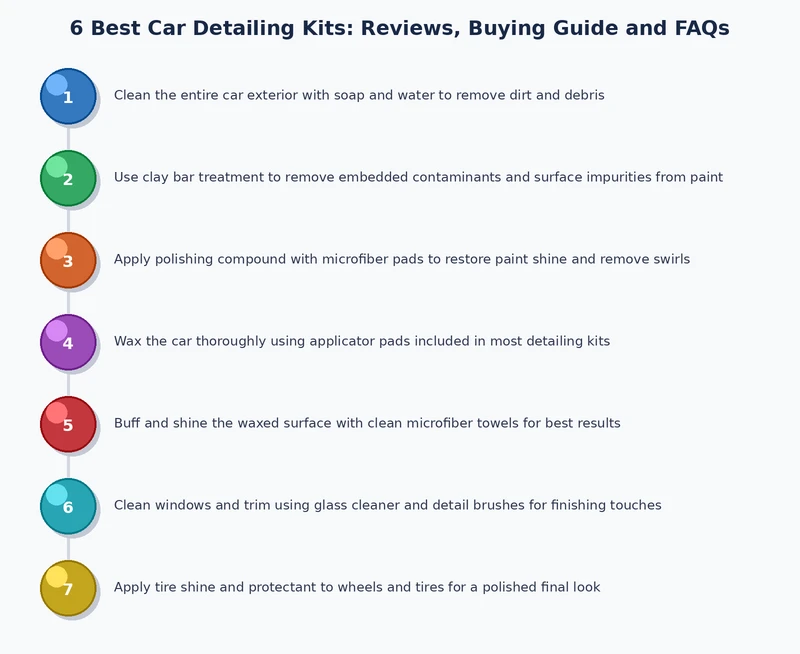
Wash before you do anything else. Applying a clay bar, polish, or wax to a dirty surface creates micro-scratches with every pass. After washing, decontaminate the paint with a clay bar to remove embedded iron particles and industrial fallout that water alone won't lift. Then address swirls and oxidation with a polish if the surface requires correction. Finish with wax or sealant to lock in that work and protect the clear coat. Interior work can happen at any point in the sequence, but handling it after the exterior prevents product transfer back onto freshly cleaned panels.
Detailing chemicals degrade when exposed to temperature extremes. Store your kit in a climate-controlled space away from direct sunlight and freezing temperatures. Most waxes and sealants become unusable after repeated freeze-thaw cycles, and solvent-based products like tire dressings can separate or thicken when stored in a hot garage. Tightly seal every bottle after use to prevent oxidation of active ingredients. Microfiber towels should be washed separately from household laundry using a fragrance-free detergent — fabric softener fills the fibers and permanently destroys their absorbency.
Even with a quality kit in hand, certain habits consistently produce poor outcomes. Identifying them before your first detail session saves you both time and paint correction work down the road.
Applying product in direct sunlight is the single most common mistake among first-time detailers. Heat causes waxes and sealants to cure unevenly, leaving streaks and haze that require complete removal and re-application. Work in the shade or tackle one panel at a time, applying and removing product before moving forward. Using the same towel across multiple product types is equally damaging — a towel carrying wax residue will contaminate your glass cleaner and streak every window it touches.
Overusing product is a financially and qualitatively costly habit. More product does not produce more protection. Thin, even coats of wax cure properly and buff off cleanly. Thick applications remain tacky, attract airborne dust before they cure, and waste significantly more product per session. Apply less than you think you need, buff it off completely, and then evaluate whether a second thin coat is warranted. A quick inspection pass under a work light before you finish will catch any high spots while the product is still pliable — removing them at that stage takes seconds rather than minutes.
How often should you use a car detailing kit? A complete detail — wash, decontaminate, correct, and protect — should happen two to four times per year for most daily drivers. Between full sessions, a spray detailer or quick-detailer maintains the finish and extends wax protection without requiring the full process.
Is a detailing kit worth it compared to a professional detail? Yes, for most owners. A mid-range kit at $70–$90 pays for itself after two or three uses when compared to professional detailing, which typically starts around $150 for a basic exterior service. The trade-off is your time and the learning curve of your first few sessions.
Can you use a car detailing kit on a new car? You can, and you should. New cars leave the factory with paint that has already accumulated rail dust and transport contamination. A first-detail session using a clay bar followed by a quality sealant protects the factory clear coat before degradation begins — not after it's already visible.
Do detailing kits work on matte or satin finishes? Standard gloss waxes and polishes are not appropriate for matte or satin paint. Those surfaces require dedicated matte-safe products. Confirm finish compatibility before applying any product from a standard kit to these surfaces, as gloss products will permanently alter the sheen.
 |
 |
 |
 |

About Diego Ramirez
Diego Ramirez has been wrenching on cars since his teenage years and has built a deep practical knowledge of automotive maintenance and paint protection through years of hands-on work. He specializes in fluid service intervals, preventive care routines, exterior protection products, and the consistent habits that extend a vehicle's lifespan well beyond average. At CarCareTotal, he covers car care guides, cleaning and detailing products, and exterior maintenance and protection reviews.
Get some FREE car parts & gear.. Or check out the latest free automotive manuals and build guides here.
Disable your ad blocker to unlock all the hidden deals. Hit the button below 🚗
| | | |
