Car Care ›
by Diego Ramirez
Nearly 70% of paint swirl marks come from improper washing technique — not road debris. That single fact is why foam washing has become a standard practice among serious car care enthusiasts. When the debate comes up about foam cannon vs foam gun, the answer isn't as simple as "get the more expensive one." Both tools have real strengths, and picking the wrong one wastes money. This guide breaks down exactly how each tool works, where each one shines, and how to build the right setup for a scratch-free wash every time. For a shortlist of top-rated options, check out the best foam cannons reviewed by CarCareTotal.
The core distinction comes down to water pressure. A foam cannon attaches to a pressure washer, while a foam gun connects to a standard garden hose. That difference shapes everything — foam thickness, coverage speed, and overall cleaning power. Understanding both tools means fewer compromises and better results every wash.
Contents
Both tools mix soap, water, and air using a venturi tube to create foam. The mechanical process is nearly identical. What differs is the pressure source — and that gap changes performance dramatically.
A foam cannon threads onto a pressure washer's quick-connect fitting. High-pressure water — typically 1,000–3,000 PSI — passes through a small venturi tube inside the cannon, drawing soap from the reservoir and mixing it with air. The result is thick, snow-like foam that coats vertical panels and stays put for two to five minutes. That dwell time is where the cleaning happens. Surfactants encapsulate dirt and lift it away before a wash mitt ever touches the surface.
Pressure washers do double duty. After the foam dwell, the same machine rinses the car with enough force to blast away loosened grime. That reduces contact time with paint during the mitt stage — which is the whole point of foam pre-washing.
A foam gun uses the same venturi principle, but the pressure source is a standard garden hose running at 40–80 PSI. That's roughly 15–20 times less pressure than a typical pressure washer. Foam guns still produce foam — it's just thinner and less clingy. The foam tends to run off vertical surfaces faster, cutting effective dwell time significantly.
Foam guns work best as a pre-rinse lubricant rather than a deep-cleaning foam application. They're a legitimate tool with a real place in the wash process. Just know their limitations going in.
Here's a direct side-by-side breakdown across the metrics that matter most for real-world car washing.
| Feature | Foam Cannon | Foam Gun |
|---|---|---|
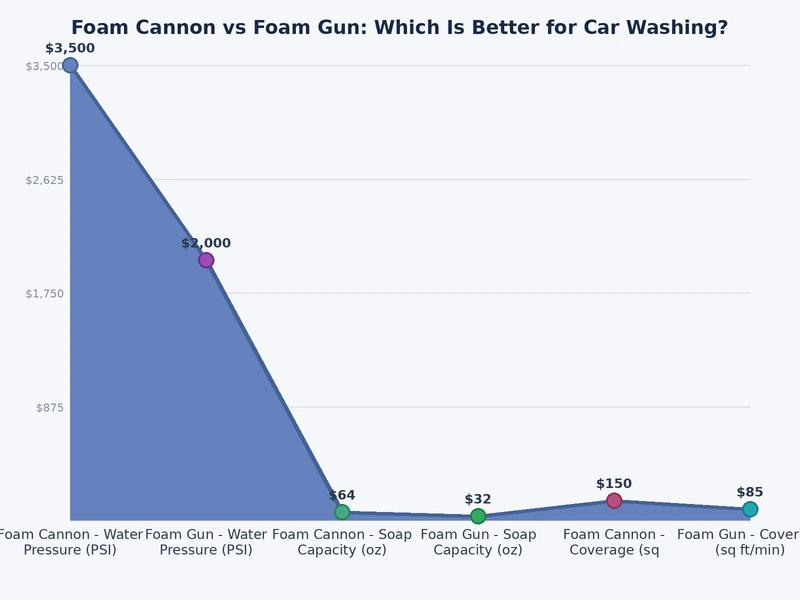
| Pressure required | 1,000–3,000 PSI pressure washer | Standard garden hose (40–80 PSI) |
| Foam thickness | Thick, clingy, snow-like | Thin, watery, runs off quickly |
| Effective dwell time | 2–5 minutes | 30–90 seconds |
| Upfront cost | $30–$80 (cannon) + $150–$400 (pressure washer) | $15–$40 (gun only) |
| Setup time | 3–5 minutes | Under 1 minute |
| Paint safety | Very high — thick foam creates maximum lubrication | Good — still reduces contact friction |
| Best use case | Weekly washes, coated cars, enthusiast detailing | Quick rinse, apartments, budget-conscious beginners |
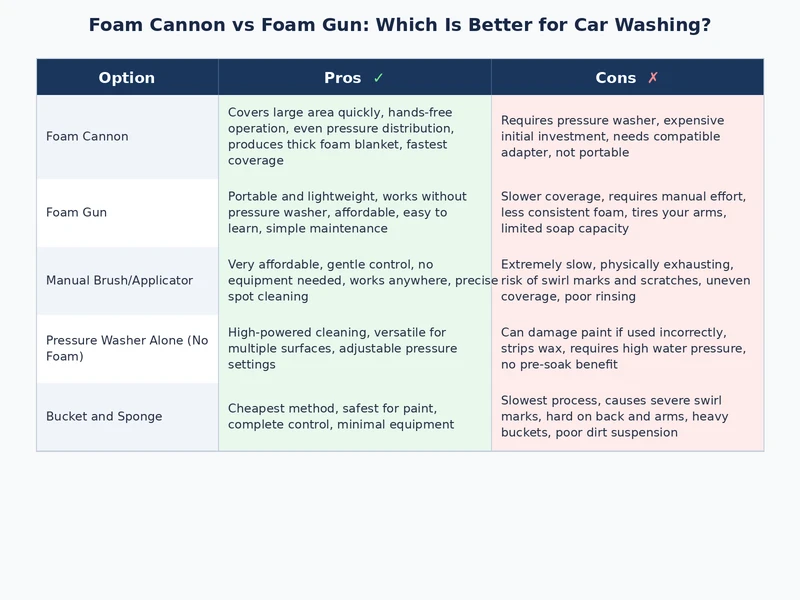
Advantages:
Drawbacks:
Advantages:
Drawbacks:
Pro Tip: Vehicles protected with ceramic or graphene coatings benefit most from foam cannon washing — thick foam reduces mitt friction, which is critical for preserving coating longevity and hydrophobic performance.
Understanding the tools is one thing. Using them correctly is what separates a clean, swirl-free car from a scratched one. Technique matters as much as equipment.
Getting thick, even foam coverage is more about technique and soap selection than equipment alone. A few consistent habits make a significant difference regardless of which tool is in use.
Foam cannons work best with higher-concentrate soap. A ratio of 1–3 oz of soap per 32 oz of water is the standard starting point. Too little soap produces thin, ineffective foam. Too much strips wax, sealants, or coatings from the paint. For foam guns, use closer to 2–3 oz because lower pressure produces less aggressive foam generation. Always use pH-neutral car wash soap. Dish soap and household cleaners strip protective coatings and accelerate paint oxidation over time.
According to Wikipedia's overview of car washing methods, touchless and low-contact techniques have grown significantly as awareness of paint damage from traditional washing has increased — foam pre-washing is central to that shift.
Dwell time is where foam does its actual work. Surfactants need time to encapsulate dirt particles and lift them away from the surface. Cutting dwell short forces the mitt to do more mechanical lifting — which increases micro-scratch risk. Key rules:
The foam cannon vs foam gun debate often comes down to living situation, budget, and how frequently a car gets washed. Neither tool is universally better — the right answer depends on context.
Homeowners with driveway access and an existing pressure washer get the most out of a foam cannon. Weekly washing keeps paint cleaner between professional details, and thick foam significantly cuts down contact washing time. For vehicles with paint protection film or vinyl wraps, low-contact foam cannon washing is one of the safest regular maintenance habits available — it minimizes abrasive contact while still achieving a thorough clean.
For apartment dwellers or renters without outdoor hose access, a foam gun is a practical alternative. It doesn't match a foam cannon's performance, but it provides meaningful paint lubrication during the wash — which is what matters most for preventing swirl marks over the long run.
Serious detailers use foam cannons as a baseline standard. The extra foam thickness reduces the chance of introducing new paint defects during the wash stage — the single most common source of surface damage over a car's life. Anyone who has invested in proper wheel care (see best wheel cleaners for pairing options) or a quality coating understands why eliminating friction matters at every stage of the process. The foam cannon is the tool that makes that goal achievable on a regular wash schedule.
Warning: Never direct a pressure washer above 2,000 PSI at paint from less than 12 inches away — this can lift clear coat edges, damage decals, and force water past door seals and window moldings.
Both foam cannons and foam guns require basic maintenance to perform consistently. Neglect causes clogged nozzles, stuck adjustment knobs, and degraded O-rings — all problems that are easy to avoid with a five-minute post-wash routine.
Running clean water through the tool after every wash is non-negotiable. For foam cannons:
For foam guns, flush clean water through the bottle and gun body for 30 seconds. Soap residue left inside the venturi tube hardens over time and causes inconsistent foam output — often mistaken for a failing tool when a simple flush would have prevented it entirely.
A well-maintained foam cannon lasts five or more years. A neglected one fails within two. The maintenance investment is five minutes per wash session — a worthwhile trade-off by any measure.
The foam cannon vs foam gun question is one piece of a larger car care system. Getting the full setup right pays compounding dividends in paint condition over time — fewer scratches mean less need for correction polish and expensive paint work.
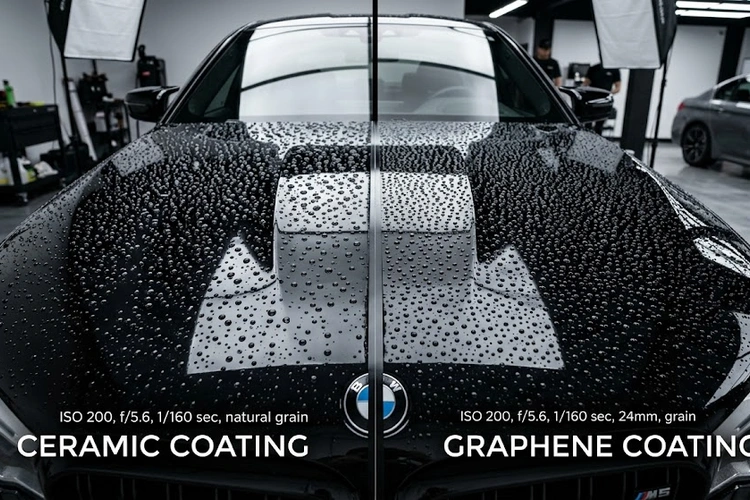
Foam washing delivers its greatest benefit on cars with an active protective coating. Ceramic and graphene coatings create hydrophobic surfaces where water and foam sheet off faster, and dirt has less adhesion to begin with. That means foam dwell is more efficient, contact wash time is shorter, and the risk of introducing scratches drops considerably. For anyone thinking long-term about paint preservation, pairing a foam cannon with a quality coating is the highest-impact combination available. Using a quality car cover during storage rounds out a complete protection strategy.
A complete low-contact wash setup built around foam washing includes:
This kit handles the full wash process from pre-soak to dry with minimal paint contact — which is the entire point of building a foam-based wash routine in the first place.
A foam gun is a functional alternative when a pressure washer isn't available, but it doesn't fully replace a foam cannon. Foam guns produce thinner, less clingy foam with shorter dwell times, which means less dirt is lifted before contact washing begins. For light maintenance washes and quick pre-rinse lubrication, a foam gun works well. For deep cleaning or maintaining coated paint, a foam cannon is the better tool.
High-foam, pH-neutral car wash soaps specifically formulated for foam cannons or snow foam use produce the best results. These products have higher surfactant concentrations designed to generate dense foam under pressure. Dish soap and household cleaners strip wax, sealants, and ceramic coatings — they should never be used in a foam cannon or foam gun.
Most foam cannons perform well between 1,000 and 2,000 PSI. Entry-level electric pressure washers in the 1,600–1,800 PSI range produce excellent foam output for car washing without excessive risk to paint. Gas-powered washers above 3,000 PSI work but require careful distance control — getting too close to paint with that level of pressure can lift clear coat edges and damage trim.
 |
 |
 |
 |

About Diego Ramirez
Diego Ramirez has been wrenching on cars since his teenage years and has built a deep practical knowledge of automotive maintenance and paint protection through years of hands-on work. He specializes in fluid service intervals, preventive care routines, exterior protection products, and the consistent habits that extend a vehicle's lifespan well beyond average. At CarCareTotal, he covers car care guides, cleaning and detailing products, and exterior maintenance and protection reviews.
Get some FREE car parts & gear.. Or check out the latest free automotive manuals and build guides here.
Disable your ad blocker to unlock all the hidden deals. Hit the button below 🚗
| | | |
