by Joshua Thomas
The best generators for RV use combine quiet operation, clean inverter power, and enough wattage to run a rooftop air conditioner and essential appliances simultaneously. Whether you prefer a gas-powered inverter generator or a lightweight battery-free design, the right choice depends on how often you camp, what appliances you need to run, and the noise rules at your campground.
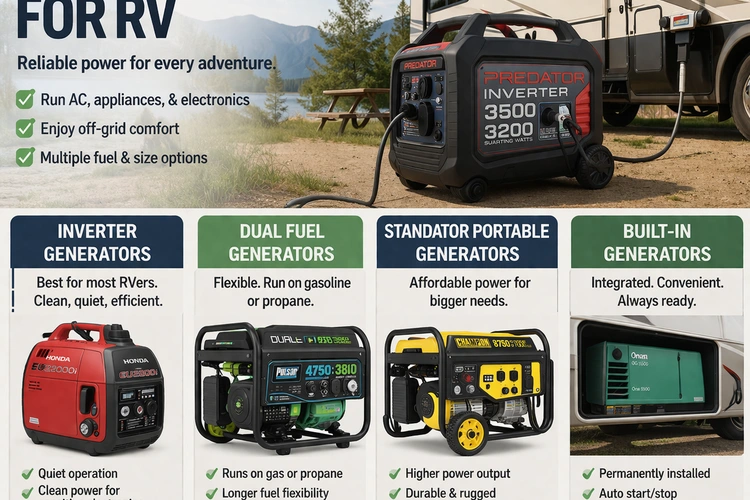
We researched and evaluated the top RV generators available in 2026 — from the ultra-quiet Honda EU2200i and the high-runtime Westinghouse iGen5000 to the lightweight A-iPower SUA4300i. Each product was evaluated on wattage, noise level, fuel efficiency, portability, and real-world user feedback.
Without further ado, here are the best generators for RV camping in 2026.







Contents

The Honda EU2200i is the gold standard for RV inverter generators, combining ultra-quiet operation with the legendary reliability of a Honda commercial-grade engine. Its 2200 watts of clean inverter power runs a rooftop air conditioner, microwave, CPAP machine, or sensitive electronics without damaging them, and the GXR120 engine is built for decades of trouble-free service.
At just 48–57 dB depending on load, the EU2200i is one of the quietest gas generators in its class. Most campgrounds enforce a 60 dB noise limit, and the EU2200i meets it comfortably even at higher outputs. The Eco-Throttle system automatically adjusts engine speed to match demand, extending a full tank to up to 8.1 hours at 25% load.
The CO-Minder carbon monoxide detection system monitors CO levels around the generator and automatically shuts it down before concentrations become dangerous — an essential safety feature when camping in an enclosed or semi-enclosed site. Parallel capability lets you link two EU2200i units to produce up to 4400 watts when larger loads demand it.
The biggest drawback is the premium price — the Honda EU2200i costs significantly more than comparable inverter generators. That said, the strong resale value and rock-solid reputation make it a smart long-term investment for frequent RV travelers. Honda backs it with a 3-year residential warranty.
Pros
Cons
The Westinghouse iGen5000 delivers an impressive combination of high wattage and low noise — producing 3900 running watts at only 52 dB, making it quiet enough for campgrounds while packing enough power to handle a full RV electrical load. For RV owners who need to run a 13,500 or 15,000 BTU rooftop air conditioner plus other appliances simultaneously, this is a top-tier choice.
The standout feature is an extraordinary 18-hour runtime at 25% load on a single 3.4-gallon tank — the longest in this comparison. The ECO Mode automatically reduces engine speed when demand is low, stretching that runtime even further on lighter loads. The remote key fob lets you start or stop the generator from up to 109 feet away.
The LED data center provides real-time readouts of remaining runtime, output voltage, and wattage load — eliminating guesswork while managing your RV power. The RV-ready TT-30R 30-amp outlet means no adapter is needed for standard RV hookups. Clean inverter power keeps THD below 3%, protecting laptops, TVs, and other sensitive devices.
At 104.7 lbs, this is not a one-person carry. The integrated wheel kit and folding handle make it manageable on flat surfaces, but a handcart is recommended for uneven terrain. Westinghouse backs the iGen5000 with a 3-year limited warranty and provides free lifetime technical support.
Pros
Cons
The WEN 56477i is the best mid-range budget pick for RVers who need 4000+ running watts without paying premium inverter generator prices. With 4000 running watts and 4800 peak watts, it can start and sustain a 15,000 BTU rooftop air conditioner, a microwave, and several other appliances at the same time — ideal for a large RV or fifth wheel.
Clean inverter power with less than 3% THD keeps sensitive electronics safe, while the CARB-compliant engine meets California emissions standards and is legal to use in all 50 states. The four 120V NEMA 5-20R receptacles plus one TT-30R RV-ready outlet provide plenty of output flexibility for a full RV setup.
The fuel shut-off valve is a useful feature for long-term storage: running the carburetor dry before putting the generator away prevents varnish buildup — a common cause of failure in generators that lack this feature. The built-in LED control panel light also improves usability during evening or early-morning starts at camp.
At 62 dB, the WEN 56477i is louder than the Honda EU2200i and Westinghouse iGen5000, which may be a consideration at noise-sensitive campgrounds. The 7-hour runtime at 50% load is respectable but shorter than the Westinghouse. WEN backs this unit with a 2-year warranty and US-based customer support.
Pros
Cons
The Champion 100263 is the most versatile generator in this lineup thanks to its dual-fuel capability — it runs on either gasoline or liquid propane. RVers who travel to areas where propane is readily available at RV parks gain significant flexibility, and propane burns cleaner with a longer shelf life than gasoline.
With 3100 watts of running power on gas, the Champion 100263 can reliably start and run a 13,500 BTU rooftop RV air conditioner (which typically needs 2800–3200 watts to start). Champion's Clean Power technology keeps total harmonic distortion below 3%, making this safe for laptops, TVs, and other electronics.
The electric start with the included battery makes cold-morning starts effortless. Champion's Quiet Technology holds noise to just 59 dB — a solid result for a 3400-watt generator. The RV-ready 30-amp TT-30R outlet means no adapter is required for standard RV connections.
The trade-off is size and weight. At 95.9 lbs, this is not a single-person carry and requires two people or a handcart to move on rough terrain. Champion backs it with a 3-year limited warranty and provides free lifetime technical support.
Pros
Cons
The A-iPower SUA4300i earns its spot in this list with an impressive combination of power and portability — delivering 3450 running watts and 4300 peak watts in a package that weighs just 52.9 lbs. That is remarkably light for a generator of this output class, making it one of the most practical options for RVers who move camps frequently.
The CARB-compliant engine meets California emissions standards and can be used across all 50 states. Clean inverter output with less than 3% THD protects laptops, televisions, and other sensitive electronics. The RV-ready outlet and multiple AC receptacles give you flexible connections for a full RV electrical setup.
The built-in CO sensor with automatic shutdown is a critical safety feature: if carbon monoxide builds up near the generator (such as in a poorly ventilated campsite), the unit shuts down automatically before concentrations reach dangerous levels. The factory-installed telescopic handle and wheels require no assembly and make the generator easy to roll in and out of storage.
The 62 dB noise level is louder than premium inverter generators, which could be a consideration at strict campgrounds. A-iPower backs the SUA4300i with a 3-year warranty, which is among the best coverage in this segment.
Pros
Cons
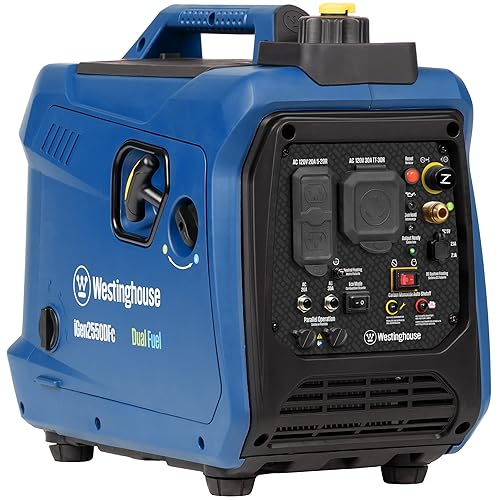
The Westinghouse iGen2550c is the lightest and most compact generator in this lineup, targeting RVers who prioritize portability and quiet operation for tent-trailer camping, small travel trailers with no air conditioning, or use as a supplement to solar panels. At just 43 lbs, one person can carry it in and out of storage with ease.
With 1900 running watts and 2550 peak watts, this generator is best suited for RVs with a 13,500 BTU air conditioner using a soft-starter device (which reduces the startup surge), or for powering essentials like a fan, phone chargers, LED lights, a small refrigerator, and a CPAP machine without air conditioning.
At as low as 52 dB in Eco Mode, the iGen2550c is among the quietest generators you will find at this wattage — comparable to the Honda EU2200i but at a significantly lower price point. The LED data center displays remaining runtime and output voltage at a glance, and the unit includes a TT-30R RV outlet for direct hookup.
The limitation is raw wattage: at 1900 running watts, the iGen2550c cannot start a standard 13,500 BTU RV air conditioner without a soft starter, and is underpowered for heavy-duty RV electrical loads. Westinghouse backs this unit with a 3-year limited warranty.
Pros
Cons
Choosing the right generator for your RV comes down to matching your power needs with the generator's output, then balancing factors like noise, fuel type, weight, and budget. Here is what to evaluate before you buy.
The most important spec is running wattage — the continuous power the generator delivers. Add up the wattage of every appliance you plan to run simultaneously: a 13,500 BTU RV air conditioner draws about 1500W running but needs 2800–3500W at startup; a microwave uses 1000–1500W; a refrigerator runs at 100–150W. Add 20% headroom for safety and you have your minimum running wattage target.
Starting wattage (also called peak or surge wattage) is the short burst of extra power the generator provides to start electric motors. Make sure the generator's starting wattage exceeds the combined surge requirement of the largest motors you plan to start — typically the air conditioner compressor.
Inverter generators produce clean sine wave power with less than 3% total harmonic distortion (THD), which is safe for sensitive electronics like laptops, TVs, and CPAP machines. Conventional generators produce rougher power that can damage or shorten the life of electronics. For RV use, an inverter generator is almost always the better choice.
Inverter generators also run at variable speeds — slowing down when demand is low — which makes them significantly quieter and more fuel-efficient than conventional generators running at a fixed 3600 RPM. The trade-off is cost: inverter generators typically cost more per watt than conventional open-frame generators.
Most campgrounds and RV parks enforce noise limits between 60 and 65 dB during quiet hours. At 30 feet, a 52 dB generator is barely perceptible while a 65 dB model is clearly audible. Always check the campground's noise policy before assuming any generator is acceptable.
Inverter generators range from about 48 dB (Honda EU2200i at light load) to 62–65 dB (larger 4000W+ models). For campgrounds with strict 60 dB limits, the Honda EU2200i, Westinghouse iGen5000, and Westinghouse iGen2550c are the safest choices in this list.
Most portable generators run on regular unleaded gasoline. Dual-fuel models (like the Champion 100263) also accept liquid propane — a useful option at RV parks that offer propane fill stations, since propane has an indefinite shelf life and burns cleaner than gasoline.
Runtime is measured at a fraction of full load — typically 25% or 50%. A generator rated for 18 hours at 25% load may only run 7–9 hours when you're actually running an air conditioner at 60–70% of capacity. Factor in your actual typical load when comparing runtimes across models.
Small travel trailers with limited storage often dictate the maximum generator size. Lightweight models under 50 lbs (like the A-iPower SUA4300i at 52.9 lbs or the Westinghouse iGen2550c at 43 lbs) are easy for one person to load and unload. Larger high-wattage generators (90–105 lbs) need two people or a handcart.
Consider where you will store the generator: inside an RV storage bay, in a truck bed, or in a tow vehicle. Measure the storage space before buying to ensure the generator's dimensions fit with the handle folded.
Parallel capability lets you connect two identical generators together to double their output — two Honda EU2200i units produce 4400W combined. This is useful when you need more power than one generator provides but want to keep each unit lightweight and portable for solo camp setup.
Not all generators support parallel operation natively — some require a separate parallel kit. Check whether the generators you are comparing offer genuine parallel output, not just daisy-chaining power strips.
For official vehicle safety references that can affect equipment planning, review the NHTSA glazing guidance.
Honda EU2200i Portable Inverter Generator - Walmart Link
Westinghouse iGen5000 Inverter Generator - Walmart Link
WEN 56477i 4800W Inverter Generator - Walmart Link
Champion 100263 3400W Dual Fuel Inverter Generator - Walmart Link
A-iPower SUA4300i Inverter Generator - Walmart Link
Westinghouse 2550 Peak Watt Inverter Generator - Walmart Link
Honda EU2200i Portable Inverter Generator - eBay Link
Westinghouse iGen5000 Inverter Generator - eBay Link
WEN 56477i 4800W Inverter Generator - eBay Link
Champion 100263 3400W Dual Fuel Inverter Generator - eBay Link
A-iPower SUA4300i Inverter Generator - eBay Link
Westinghouse 2550 Peak Watt Inverter Generator - eBay Link
For most RVers who need quiet, reliable generator power at a campground, the Honda EU2200i remains the benchmark — it is the quietest, most reliable gas inverter generator at its wattage, and the CO-Minder safety system adds genuine peace of mind for camping use.
If you need more power to reliably run a 15,000 BTU air conditioner, the Westinghouse iGen5000 delivers 3900 running watts at a surprisingly quiet 52 dB with an 18-hour runtime per tank — making it the best high-output choice in this list. The Champion 100263 is the top dual-fuel pick for travelers who want propane flexibility without sacrificing inverter power quality.
Budget-conscious buyers get strong value from the WEN 56477i (4000W running) and the A-iPower SUA4300i (3450W running, just 52.9 lbs) — both offer clean inverter power at a fraction of the Honda price. For smaller rigs or as a supplement to solar, the ultralight Westinghouse iGen2550c at 43 lbs and 52 dB is a hard-to-beat combination of portability and quiet operation.
Match your generator to your actual wattage needs, check your campground's noise policy, and factor in portability for your storage setup — and you will be powering your RV adventures without compromise in 2026.

For a typical RV with a 13,500 BTU air conditioner, you need at least 3000–3500 watts of running power to handle the AC plus other appliances. A 2000W inverter generator works for RVs with no air conditioning or with a smaller 13,500 BTU AC unit paired with a soft starter. Always add up your appliance wattage and add 20% headroom for surge loads.
Yes. Inverter generators produce clean sine wave power that is safe for sensitive electronics, run significantly quieter than conventional generators, and use less fuel through auto-throttle technology. For RV camping — especially at campgrounds with noise limits — the quieter operation of an inverter generator is often a requirement, not a luxury.
A standard 13,500 BTU RV air conditioner requires 2800–3500 watts to start (surge) and 1500–2000 watts to run continuously. A 2000W generator cannot start a standard 13,500 BTU AC unit on its own. However, pairing a 2000W generator with a SoftStartRV device can reduce the startup surge enough that the AC will start on 2000W. Without a soft starter, you need at least a 3000W generator.
Most campgrounds and RV parks set quiet hours between 10 PM and 7 AM, during which generators must not exceed 60–65 dB at 50 feet. In practice, generators at or below 57–60 dB are broadly campground-acceptable. Generators above 65 dB are generally too loud for standard campground use and should be reserved for off-grid camping or work sites.
A dual-fuel generator runs on both gasoline and liquid propane, giving you flexibility to use whichever fuel is available at your destination. Propane burns cleaner, stores indefinitely without degrading, and is available at many RV parks. Gasoline provides slightly more running power than propane in the same engine and is available everywhere. Single-fuel generators are lighter and less expensive, but you are limited to one fuel source.
 |
 |
 |
 |

About Joshua Thomas
Joshua Thomas just simply loves cars and willing to work on them whenever there's chance... sometimes for free.
He started CarCareTotal back in 2017 from the advices of total strangers who witnessed his amazing skills in car repairs here and there.
His goal with this creation is to help car owners better learn how to maintain and repair their cars; as such, the site would cover alot of areas: troubleshooting, product recommendations, tips & tricks.
Joshua received Bachelor of Science in Mechanical Engineering at San Diego State University.


Get some FREE car parts & gear.. Or check out the latest free automotive manuals and build guides here.
Disable your ad blocker to unlock all the hidden deals. Hit the button below 🚗
| | | |
