by Sarah Whitfield
According to the National Highway Traffic Safety Administration, steering and suspension defects account for tens of thousands of vehicle safety complaints filed every year — so when you are trying to understand why does my steering wheel shake causes solutions are closer than you think, and they start with reading the pattern correctly. That persistent vibration transmitting through your hands is not random noise; it is your car signaling a specific system failure, and the speed, conditions, and character of the shake tell you almost exactly where to look. Work through this guide section by section and you will have a confident answer before spending a dollar on parts.

Steering wheel shake maps cleanly onto four core systems: tires and wheels, brakes, steering components, and suspension geometry, and each system produces a signature vibration profile that differs in speed, feel, and braking correlation. Some causes cost twenty dollars and an afternoon to fix; others require professional equipment and a meaningful labor bill. The single most expensive mistake you can make is skipping the diagnostic step and replacing parts based on a hunch, because that approach rarely lands on the right component the first time. This guide covers every major cause across the speed spectrum, walks you through a methodical inspection sequence, and draws a hard line between what you can fix yourself and what requires a shop.
If your vehicle also shakes during cold starts or at idle when it has not yet warmed up, that symptom may trace to an entirely separate issue — the car shakes when cold guide covers that overlap in detail so you can separate the two cleanly. For everything related to steering shake that appears at operating temperature, you are in the right place. Browse the full range of car troubleshooting guides if you are dealing with multiple symptoms at once.
Contents
The speed at which vibration begins is the single most valuable diagnostic clue available to you, and experienced technicians use it to narrow the field before they ever put a car on a lift. Low-speed shake appearing below 45 mph almost always points to a tire or wheel problem — flat spots from extended parking, severe tread cupping from worn shock absorbers, or a bent rim that creates a repeating wobble with every rotation. High-speed shake beginning between 55 and 75 mph is the classic signature of wheel imbalance, which is the most statistically common cause of steering vibration by a significant margin. Brake-related shake is its own category entirely: it appears specifically when you apply the pedal at speed and traces directly to warped rotors or uneven pad material deposited on the rotor face.
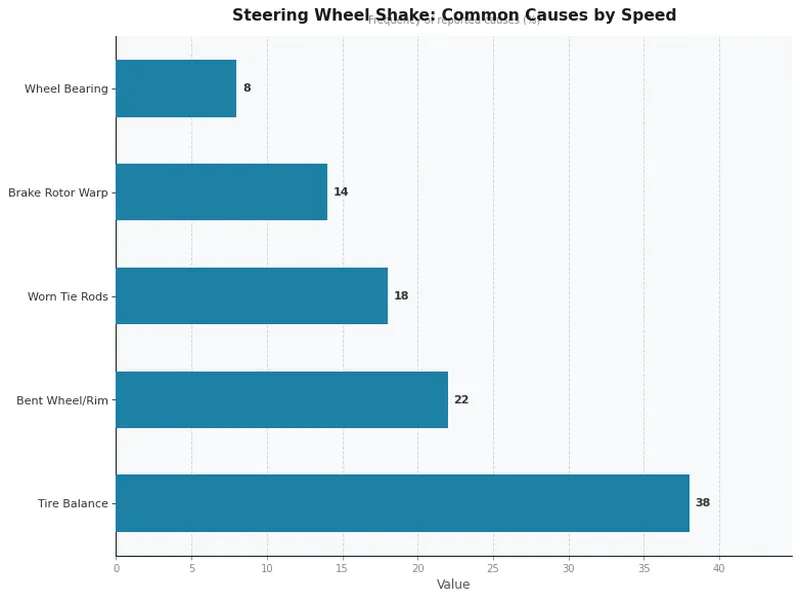
| Speed Range | Primary Cause | Secondary Cause | Braking Correlation |
|---|---|---|---|
| Under 45 mph | Tire flat spot / cupping | Bent wheel rim | No |
| 45–55 mph | Wheel imbalance (early onset) | Worn CV axle | Sometimes |
| 55–75 mph | Wheel imbalance (classic) | Tire belt separation | No |
| Any speed, braking only | Warped brake rotors | Uneven pad deposits | Yes — always |
| Any speed, constant | Worn wheel bearing | Loose suspension joint | No |
| Turning only | Worn CV joint | Loose tie rod end | No |
The most expensive myth in steering repair is that wheel balancing fixes everything. Balancing addresses weight distribution on the wheel-tire assembly and it resolves high-speed shimmy caused by imbalance — but it does absolutely nothing for a worn tie rod, a failing wheel bearing, or a brake rotor with measurable runout. Shops that balance wheels before diagnosing the underlying geometry problem pocket the balance fee and send you home with the same vibration you brought in, and that is not an accident.
The second myth is that all steering shake is equally urgent. A slight high-speed shimmy from minor imbalance is annoying but safe to drive on briefly while you schedule an appointment. A wheel bearing emitting a growl alongside constant vibration is a genuine safety emergency that can result in wheel separation at highway speed — those two situations require completely different response times. The third myth worth dismissing: new tires automatically eliminate shake. New tires mounted with improper runout, reused corroded weights, or internal belt defects can introduce vibration that did not exist before the install, which catches most drivers completely off guard.
The most reliable approach to understanding why does my steering wheel shake causes solutions begin with data you collect while driving — not with a parts list. Note precisely when the shake occurs: the speed at which it begins, whether it worsens or plateaus as speed increases, and whether applying the brakes either intensifies or eliminates it. Those three data points place you in one of three categories before you have touched a single component, and each category has its own repair path.
Start with a visual tire inspection: look for tread cupping along the inner or outer edge, sidewall bulges that suggest internal belt failure, and cracked rubber that signals age-related stiffening. Move to the wheels themselves and look for visible bends at the lip or obvious impact damage. Then check for missing wheel weights — a single missing weight on a front wheel causes textbook highway shimmy and costs nothing to correct at a tire shop. If your steering rack shows signs of wear or leaking fluid, review the specific indicators covered in the steering rack leak symptoms guide, because steering rack wear produces a feel distinct from wheel imbalance and requires a different repair entirely.
Classic high-speed shimmy from wheel imbalance — appearing consistently at 65 mph, not correlated with braking, not worsening over days — is safe to schedule rather than emergency-repair. You can drive it for a reasonable period without meaningful safety risk, provided the vibration stays predictable and does not intensify. That is the one scenario where waiting is acceptable.
Everything else on this list deserves prompt attention. A wheel bearing that combines a low-frequency growl with steering vibration is progressing toward failure, and complete bearing collapse at highway speed removes your ability to steer — that is a same-week repair, not a next-month repair. Brake pedal pulsation combined with pulling during stops indicates rotor runout or a sticking caliper, and both conditions degrade your stopping distance in ways that matter in an emergency braking event. If steering shake appears suddenly at low speed, the wheel pulls sharply to one side, or a grinding noise accompanies the vibration, drive slowly and directly to a shop rather than adding highway miles to the situation.
Start with tire pressure before spending anything. Under-inflated tires develop uneven contact patches that produce low-speed wobble mimicking more serious suspension wear, and correcting pressure to the vehicle manufacturer's specification — not the maximum number molded into the tire sidewall — resolves this immediately. Retest before assuming the problem lies deeper.
A standard four-wheel balance costs between twenty and fifty dollars and resolves the majority of highway-speed shimmy cases outright. If shake appeared immediately after a recent tire rotation, request a road-force balance specifically, which applies simulated load to detect internal belt separation that standard spin balancing misses entirely. Finally, check lug nut torque — loose or unevenly torqued lug nuts create low-speed vibration and wheel wobble that feels alarming but costs nothing to correct with a torque wrench and five minutes of work.
The division between home repairs and shop repairs follows two axes cleanly: the tools required and the safety consequences of doing the job incorrectly. Wheel balancing requires a dedicated machine — not a DIY task. Wheel alignment requires a computerized rack with laser sensors — also not adjustable by hand regardless of what any YouTube shortcut suggests. These are not tasks to improvise, and attempting them without proper equipment produces alignment specs that accelerate tire wear and compromise handling.
Replacing a tie rod end requires a tie rod separator, a tie rod end wrench, and a quality torque wrench — plan a post-job alignment because any tie rod work changes front-end geometry. Replacing a brake rotor needs basic sockets, a caliper wind-back tool if rear pistons are screw-in type, and C-clamps. Wheel bearing replacement varies significantly: pressed-in bearings require a hydraulic press or dedicated press kit, but modern bolt-in hub assemblies eliminate that requirement entirely and drop the skill threshold to intermediate DIY territory. Know which type your vehicle uses before deciding whether to rent a press or order the assembly.
A complete front-end inspection takes under thirty minutes and gives you everything needed to either fix the problem yourself or walk into a shop with a specific part name rather than vague symptoms. Raise the front of the vehicle on jack stands — never rely on a floor jack as your only support — and begin at each wheel. Spin the front wheels by hand and feel for roughness, grinding, or resistance in the bearing. Grab the tire at 3 and 9 o'clock and push and pull laterally; any perceptible play indicates a worn tie rod end or loose wheel bearing. Grab at 12 and 6 o'clock and rock vertically, because play in this plane points to a ball joint rather than the tie rod.
With the wheel removed, examine the rotor face directly. Grooves deeper than 0.030 inches, visible heat cracks radiating outward from the center hat, or a pronounced lip at the outer rotor edge all indicate a rotor that needs replacement rather than resurfacing on a lathe. Thickness variation — where the rotor is measurably thicker in some areas than others due to uneven wear — is what causes the pedal pulsation and steering vibration during braking, and a dial indicator measuring runout above 0.002 inches confirms the diagnosis without ambiguity.
You now have a complete framework for diagnosing and resolving steering wheel shake — from a two-dollar tire inflation check to a wheel bearing replacement that may require a press. Start with the quick wins, confirm your diagnosis with the physical inspection sequence, and make the call on DIY versus professional service based on the tools the job actually requires. Book that wheel balance or suspension inspection this week rather than adapting to the vibration, because the problems behind steering shake only get more expensive the longer they run.
 |
 |
 |
 |

About Sarah Whitfield
Sarah Whitfield spent ten years as an ASE-certified automotive technician before transitioning to full-time automotive writing, giving her a diagnostic skillset that goes well beyond what most reviewers bring to the subject. She specializes in OBD-II code analysis, electrical system troubleshooting, and the intermittent failure modes that frustrate owners and confound general mechanics. At CarCareTotal, she covers car troubleshooting guides, diagnostic tools, and repair resources for drivers dealing with warning lights, strange symptoms, and hard-to-diagnose problems.
Get some FREE car parts & gear.. Or check out the latest free automotive manuals and build guides here.
Disable your ad blocker to unlock all the hidden deals. Hit the button below 🚗
| | | |
