by Liam O'Brien
You're standing in the shop, staring at a seized ball joint fitting that hasn't seen grease in three years, and you realize your old pump-action gun just isn't going to cut it anymore. Maybe you're a weekend mechanic who tackles suspension work on the driveway, or a fleet technician greasing dozens of fittings every shift — either way, the right grease gun makes the difference between a five-minute lubrication job and a frustrating half-hour battle. The market in 2026 offers everything from old-school lever-action workhorses to high-pressure cordless units that would have seemed like overkill a decade ago, and sorting through the options takes more than a quick glance at the spec sheet.
A grease gun is one of those tools that earns its keep quietly, protecting your vehicle's joints, bearings, and fittings from the kind of wear that leads to expensive repairs down the road. According to Wikipedia's overview of grease gun mechanics, the fundamental pumping principle hasn't changed much over decades — but materials, pressure ratings, and power sources have advanced considerably. If you're also shopping for other essential automotive tools to round out your garage setup, this guide will slot right in alongside your existing toolkit. We've tested and researched the top options across pneumatic, cordless, and manual categories so you can make a confident purchase today.
We evaluated pressure output, build quality, loading flexibility, hose length, and real-world usability to arrive at these six standout picks. Whether you need something that runs on shop air, a 20V battery, or nothing more than your own grip strength, there's a grease gun on this list built for your situation. Read on for the full breakdowns, a practical buying guide, and answers to the questions we hear most often.







If your shop runs on compressed air and you're dealing with a constant rotation of vehicles that need greasing, the Lincoln 1162 is the pneumatic grease gun you've been looking for. It delivers up to 6,000 PSI, which is more than adequate for stubborn CV joints, loaded ball joint fittings, and agricultural equipment that hasn't been serviced in a season. The variable speed trigger gives you genuine precision control — you're not just blasting grease and hoping for the best, you're metering the flow deliberately into each fitting until you see the grease purge at the seal.
The 30-inch high-pressure hose and included coupler are a practical upgrade over shorter-hose competitors, letting you reach rear suspension fittings and drivetrain components without contorting yourself around the vehicle. Lincoln's build quality on this unit is professional grade — the cast construction feels dense and well-balanced, and the combination filler coupler with air bleeder valve makes loading from bulk containers fast and mess-free. The fully automatic, continuous operation mode means you hold the trigger and the gun keeps pumping without requiring repetitive lever strokes, which is a significant advantage when you're greasing a fleet of trucks or farm equipment where fatigue becomes a real factor.
This is not a gun you buy for occasional home use — it's priced and built for professional environments where reliability across thousands of shots matters more than initial cost. You'll need a compressor capable of supplying adequate CFM at the correct pressure, so pair it accordingly. For shops that already run pneumatic tools throughout the bay, the Lincoln 1162 integrates seamlessly into that ecosystem and delivers consistent output every time.
Pros:
Cons:
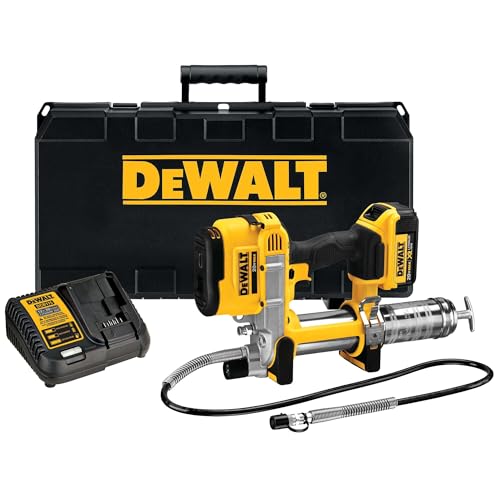
The DEWALT DCGG571M1 is the grease gun you reach for when you want cordless freedom without any compromises on performance. It runs on DEWALT's proven 20V MAX platform and ships as a complete kit with a 4.0Ah battery and charger, so you're ready to work from the moment the box opens. The motor delivers up to 10,000 PSI, which puts it in the same pressure range as the best lever-action guns on the market while eliminating the hand fatigue that comes with manual pumping. If you've ever wrestled with a clogged fitting on a front axle U-joint using a manual gun, you'll immediately appreciate what 10,000 PSI of motorized pressure does to that problem — it clears it in seconds.
The high-volume pump pushes up to 5.0 oz per minute, making it genuinely fast for high-flow applications like agricultural equipment or heavy machinery with multiple fittings per service point. The 42-inch hose is one of the longest in the cordless category, giving you excellent reach under vehicles and into equipment bays without repositioning the gun. DEWALT's variable speed trigger system here is not a gimmick — at low trigger pressure you get slow, controlled grease delivery for small fittings, and at full trigger you get maximum flow for large bearings and high-volume applications. The LED light is a small but genuinely useful addition when you're hunting for fittings in dark wheel wells or undercarriage areas.
The 4.0Ah battery gives you enough runtime to service an entire vehicle's lubrication points multiple times on a single charge, and if you're already invested in DEWALT's 20V ecosystem, the battery integrates with your drills, impacts, and other tools. This is the complete package for the serious DIYer or mobile technician who needs professional cordless performance without hunting for a separate battery. It's worth comparing this alongside the best cordless impact wrenches of 2026 if you're building out a cordless tool collection for automotive work.
Pros:
Cons:
There's a reason the Lincoln 1142 has remained a go-to manual grease gun for professional mechanics for years — it's built like it expects to be used hard and put away dirty. The cast iron pump head is the standout feature here, delivering a level of durability that plastic-head competitors simply cannot match in demanding shop environments. With a maximum pressure output of 10,000 PSI and typical working pressure in the 6,000 to 7,000 PSI range, it generates enough force to clear hardened grease channels and push into fittings that would defeat lesser manual guns without breaking a sweat.
The three-way loading system is genuinely versatile — you can load it with a standard 14.5 oz cartridge, fill it by suction from a bulk container, or use a filler pump for fast bulk loading. The flip-over follower maintains a strong seal during operation regardless of which loading method you choose, so you don't lose prime between shots. Lincoln includes a 6-inch extension and hydraulic coupler with the gun, which handles the most common reach scenarios right out of the box. The 16 oz bulk capacity means fewer refills during extended service sessions, and the overall balance of the gun in hand is well-suited to the lever-pumping motion that manual operation requires.
If you're the type of mechanic who prefers simple, proven tools with no batteries to charge and no air lines to connect, the Lincoln 1142 delivers professional-grade pressure from a completely self-contained package. It demands more physical effort than cordless or pneumatic alternatives, but it also demands nothing else from you in return — no power source, no consumables beyond grease, and no electronics to fail at an inconvenient moment. Just pair it with quality spark plugs and proper grease for a thorough vehicle maintenance session that covers all the fundamentals.
Pros:
Cons:

Alemite is a name that professional lubrication technicians recognize immediately, and the 500-E earns that reputation with a well-engineered lever-action design that balances performance with portability. The die-cast aluminum head is the key differentiator from cast iron competitors — it gives you the structural integrity needed for sustained 10,000 PSI operation while keeping the overall weight of the tool more manageable for technicians who carry their equipment from vehicle to vehicle all day. The vinyl grip adds comfort to the ergonomics equation, reducing hand fatigue during extended lever-pumping sessions that manual operation inevitably demands.
The 18-inch flexible hose hits a practical sweet spot — long enough to reach most fittings without awkward contortion but short enough that the gun doesn't feel unwieldy in tight quarters. The integrated bleeder valve is a genuinely useful feature that many competing guns in this price range omit; it lets you purge air from the barrel after loading so you get consistent grease delivery from the first pump stroke rather than wasting several strokes pushing air through the system. Alemite's three-way loading system accommodates 14-ounce cartridges, suction loading from bulk containers, or fast refill via the Alemite Loader Pump, giving you flexibility across different workflow scenarios.
The 500-E works with both 16 oz and 24 oz capacity configurations depending on how you load it, which extends service intervals in high-volume environments. If you're managing a fleet of vehicles and need a manual gun that's lighter than cast iron alternatives but equally capable at pressure, the Alemite 500-E is the professional tool that answers both requirements simultaneously. It's a thoughtful design that shows Alemite's deep understanding of how lubrication technicians actually use these tools in the field rather than in a catalog photo.
Pros:
Cons:
The Flexzilla Pistol Grip Grease Gun approaches the ergonomics problem from a completely different angle than traditional lever-action designs, and the result is a gun that feels dramatically more natural in hand, particularly when you're working in confined wheel wells or tight undercarriage spaces. The pistol grip configuration lets you operate the gun single-handed, which frees your other hand to hold a light, position the coupler on a hard-to-see fitting, or brace yourself against the vehicle. That one-handed capability is not a marketing claim — it's a genuine operational advantage that you'll notice immediately on the first job.
The soft barrel grip conforms to your hand during extended sessions, which matters more than it might seem during a thorough vehicle greasing job that might involve a dozen or more fittings. Legacy Manufacturing's heavy-duty die-cast head construction ensures the Flexzilla can handle the tough environments and rough handling that shop tools inevitably encounter without the head cracking or the pump mechanism binding up over time. The trigger-actuated pumping mechanism translates your grip strength efficiently into grease pressure, and the overall balance of the pistol configuration puts the weight low and centered rather than out in front of your hand the way lever guns tend to feel.
This is the grease gun you choose if you're doing the work yourself rather than managing a shop of technicians, and if the physical comfort of your tools matters to you during extended sessions. It sits at a lower price point than the powered options while offering a meaningfully better ergonomic experience than conventional lever-action alternatives. For the DIY mechanic who does their own suspension work alongside tasks like checking portable air compressors and other maintenance tools, the Flexzilla offers a refreshingly user-friendly approach to a traditionally uncomfortable task.
Pros:
Cons:

The DEWALT DCGG571B is mechanically identical to the kit version reviewed above, delivering the same 10,000 PSI maximum pressure, the same 5.0 oz per minute high-flow pump output, and the same 42-inch hose — at a significantly lower price because it ships without the battery and charger. If you already own DEWALT 20V MAX batteries from a drill, impact driver, circular saw, or any other tool in that extensive ecosystem, this tool-only version is the smarter purchase for your situation. You're not paying for hardware you already have sitting on the charger, and the DCGG571B performs identically to its kit counterpart once you snap your existing battery into place.
The variable speed trigger on this cordless unit is responsive and intuitive — light trigger pressure for delicate fittings, full trigger for high-volume applications, and everything in between based on your feel for what the fitting needs. DEWALT's 20V platform batteries range from compact 1.5Ah packs to extended-runtime 5.0Ah and 6.0Ah options, so you can match the battery you already own to the runtime your greasing jobs demand. A compact 2.0Ah battery keeps the gun light and maneuverable for quick under-vehicle sessions, while a larger 4.0Ah or 5.0Ah battery extends runtime for fleet servicing without interruption.
The 42-inch hose is long enough to reach from a comfortable standing or kneeling position to fittings on the opposite side of the vehicle's undercarriage, which reduces the number of times you need to reposition yourself during a full lubrication service. At the price of the tool-only version, this is one of the best value propositions in the cordless grease gun category for 2026, particularly for anyone already committed to the DEWALT 20V ecosystem. It's a straightforward, no-compromise choice that delivers professional capability without professional complexity.
Pros:
Cons:
Milwaukee's M12 Cordless Grease Gun earns its place in this roundup by solving a problem the larger 20V guns cannot: getting into genuinely tight spaces where a full-size cordless gun simply doesn't fit. The M12 platform runs on Milwaukee's compact 12V battery system, which produces a noticeably smaller and lighter tool body than 20V alternatives. When you're working on compact cars, tight engine bays, or equipment with restricted access panels, that reduced footprint is worth more than the incremental pressure advantage of a larger gun. Mechanics who regularly work in confined spaces will recognize the M12's dimensional advantage immediately.
The gun runs reliably on the M12 battery platform, and if you already use Milwaukee M12 tools in your workflow — compact drills, ratchets, or inspection cameras — your existing batteries drop straight in. The tool includes a battery and charger in the 2446-21XC configuration, so it arrives as a complete package ready for immediate use. The straightforward design means there's minimal complexity to deal with: charge the battery, load a cartridge, and start greasing. Milwaukee's reliability reputation on the M12 platform is well-established, and that consistency carries through to this gun's performance in regular service use.
This is the cordless grease gun you choose when portability and compact form factor matter more than absolute maximum pressure, and when you're already working within the M12 ecosystem rather than starting fresh. For technicians who prioritize maneuverability and light tool weight over maximum power output, the Milwaukee 2446-21XC delivers a practical cordless greasing solution in the smallest viable package available in 2026.
Pros:
Cons:
Walking into the grease gun category without a framework for evaluation means you'll end up either overspending on capabilities you'll never use or underbuying and fighting your tool every time you use it. These are the criteria that separate the right gun from the wrong one for your specific situation in 2026.
Your power source decision shapes everything else about how you use a grease gun. Manual lever-action and pistol-grip guns require no battery or air supply — they go anywhere, work in any conditions, and never run out of power in the middle of a job. The trade-off is physical effort, which compounds during extended sessions or when fighting stubborn, clogged fittings. Cordless guns running on 12V or 20V batteries eliminate the effort entirely and deliver consistent pressure regardless of how many fittings you've already done, making them the right choice for fleet maintenance or serious DIY work. Pneumatic guns like the Lincoln 1162 are the most powerful option for shop environments that already run compressed air, delivering sustained high-volume output that no battery gun can match for all-day professional use. If you're also evaluating other shop equipment, our coverage of the best portable air compressors of 2026 will help you assess whether your compressor setup can support pneumatic tool additions.
The PSI rating on a grease gun tells you the maximum pressure the pump can generate, and this number matters most when you're dealing with difficult fittings. A standard zerk fitting in good condition requires relatively modest pressure to accept grease, but a fitting that's been dry for years, one that's clogged with hardened grease, or a high-resistance application like a loaded ball joint under vehicle weight can require 5,000 PSI or more to force grease through. Guns rated at 10,000 PSI give you a significant safety margin for these scenarios — you're not running the pump at its limit every time you hit a difficult fitting. Guns rated at 6,000 PSI handle the vast majority of automotive and light industrial applications without issue. Only in heavy agricultural or industrial equipment with genuinely extreme lubrication requirements does the upper end of the pressure range become regularly relevant.
Hose length determines how conveniently you can reach fittings without moving the gun body repeatedly. A 6-inch extension handles most accessible fittings, while an 18-inch flexible hose covers the majority of automotive applications comfortably. For undercarriage work on trucks or large equipment, a 30-inch or 42-inch hose changes the experience dramatically — you position the gun once and reach multiple fittings from that position rather than crawling and repositioning repeatedly. The loading system flexibility is equally important for workflow efficiency: three-way loading (cartridge, suction, and filler pump) gives you options for how and where you refill, while cartridge-only guns lock you into 14 oz cartridges as your only resupply method. High-volume users benefit meaningfully from bulk loading capability.
The pump head material is your primary durability indicator. Cast iron heads like the Lincoln 1142's are essentially indestructible under normal shop conditions — you can drop them, abuse them, and store them carelessly for years without causing functional damage. Die-cast aluminum heads, as found on the Alemite 500-E, offer an excellent balance of strength and weight savings that works well for most professional environments. Plastic-head budget guns are serviceable for infrequent light use but should not be your choice if the gun will see regular professional service. The seals, follower, and bleeder valve quality matter for consistent priming and minimal air-in-barrel issues. Buy from established brands with documented professional track records — Lincoln, Alemite, DEWALT, Milwaukee, and Flexzilla all carry reputations earned over extended periods of professional use rather than marketing claims alone.
For most automotive applications, a cordless grease gun running on a 20V battery platform delivers the best combination of convenience and performance. Models like the DEWALT DCGG571M1 or DCGG571B provide 10,000 PSI of pressure — more than enough for any automotive fitting — while eliminating the physical effort of manual lever operation and the air supply requirement of pneumatic guns. If you already own a manual gun and your greasing needs are modest, a quality lever-action gun like the Lincoln 1142 remains a completely viable choice for occasional use.
Most passenger vehicles with greaseable fittings benefit from lubrication every oil change interval, which typically means every 5,000 to 7,500 miles depending on your service schedule. Trucks, SUVs with heavy-duty suspension components, and vehicles used for towing or off-road driving should be greased more frequently — every 3,000 to 5,000 miles in demanding conditions. Always consult your vehicle's owner's manual for manufacturer-specific recommendations, as some modern vehicles use sealed, lifetime-lubricated joints that cannot and should not be greased.
Most automotive grease guns work best with NLGI Grade 2 multipurpose lithium-based grease for general chassis lubrication, ball joints, and wheel bearings. Some specialized applications require different formulations — high-temperature applications near brake components benefit from synthetic or moly-based greases, while certain manufacturer-specified components require proprietary grease types. Never mix different grease types in the same fitting without thoroughly cleaning it first, as incompatible grease chemistries can degrade and cause lubrication failure rather than protecting the component.
Cordless grease guns function in cold weather, but cold temperatures affect both battery performance and grease consistency simultaneously. Lithium-ion batteries lose capacity below 40°F, which reduces runtime and sometimes reduces the available pressure output. More significantly, grease thickens in cold conditions, requiring higher pump pressure to push through fittings and hoses. When working in cold weather, warm your grease cartridge slightly before use and expect shorter battery runtime. Pneumatic guns are often preferred in cold shop environments because they don't rely on battery chemistry, though grease consistency remains a factor regardless of power source.
PSI refers to pounds per square inch of pressure the pump can generate at maximum effort. For standard passenger vehicle maintenance — greasing ball joints, tie rod ends, U-joints, and driveline components — 6,000 to 7,000 PSI handles virtually all normal situations including moderately clogged fittings. A 10,000 PSI rating gives you headroom for genuinely seized fittings, high-load applications, and agricultural or heavy equipment with tighter lubrication channels. More PSI is always better as a capability ceiling, but the difference between a 6,000 PSI and 10,000 PSI gun becomes relevant primarily when you encounter problem fittings rather than during routine maintenance.
Pistol grip grease guns offer superior ergonomics and one-handed operation, making them distinctly better for working in confined spaces and for extended sessions where hand fatigue becomes a factor. Lever-action guns typically provide higher pump pressure per stroke and are more familiar to mechanics who learned on traditional designs, but they require two hands for most effective operation and cause more wrist strain during heavy use. Neither design is universally better — your choice should be based on where you're using the gun, how often, and which grip style feels more natural and sustainable for your specific workflow.
The right grease gun is the one that removes every excuse not to service your fittings on schedule — because a tool that fits your workflow gets used, and a tool that gets used keeps your vehicle's joints alive for another hundred thousand miles.
 |
 |
 |
 |

About Liam O'Brien
Liam O'Brien has spent over a decade buying, field-testing, and evaluating automotive tools with a focus on what actually performs in a real DIY garage rather than what markets well on a spec sheet. His hands-on experience spans hand tools, diagnostic equipment, floor jacks, socket sets, and specialty automotive gear across a wide range of brands and price points. At CarCareTotal, he covers automotive tool and equipment reviews, garage setup guides, and buying advice for home mechanics.
Get some FREE car parts & gear.. Or check out the latest free automotive manuals and build guides here.
Disable your ad blocker to unlock all the hidden deals. Hit the button below 🚗
| | | |
