by Joshua Thomas
Ever walked out to a dead battery with no jumper cables in sight and no one nearby to help? Most drivers have. The best portable jump starters eliminate that problem — no second car needed, no waiting, no roadside call. A quality unit fits in the glove box and cranks an engine back to life in under a minute.
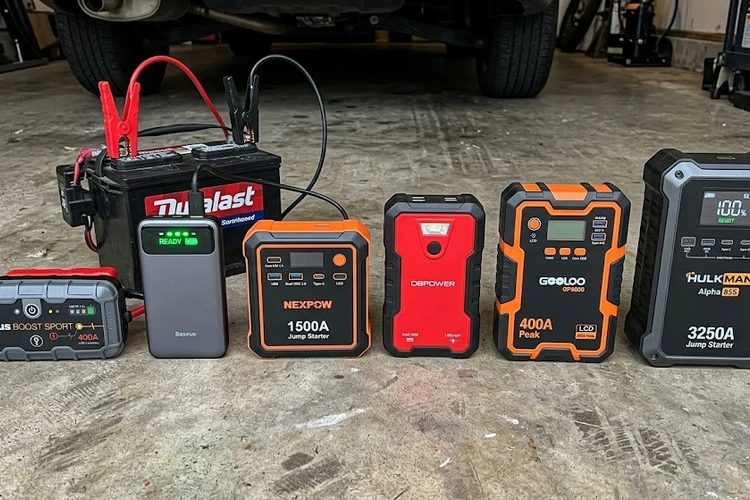
This guide reviews six top-rated models, breaks down what specs actually matter, and helps buyers pick the right unit for their vehicle. Whether someone drives a compact sedan or a diesel pickup, there's a jump starter built for the job. Also see the best car battery chargers for anyone who needs an overnight conditioning option alongside a jump starter.
Contents
These picks span a range of engine sizes, price points, and use cases. Each one was selected based on peak amp output, build quality, safety protections, and consistent real-world performance reports. There's no filler here — every pick earns its spot.
The NOCO GB40 is the most popular portable jump starter on the market, and the reason is straightforward: it does everything right at a fair price. It delivers 1,000 peak amps — enough for gas engines up to 6L — while weighing just 2.4 lbs. The spark-proof clamps and reverse polarity protection make it nearly foolproof for first-time users.
Best for: Everyday drivers with standard passenger vehicles who want a reliable, compact unit.
The GB70 scales up the GB40 formula for larger engines without abandoning portability. At 2,000 peak amps it handles gas engines up to 8L and diesel up to 6L. It still fits in a center console. The same spark-proof and reverse-polarity safety system carries over from the smaller model.
Best for: Truck and SUV owners who need serious cranking power in a lithium package.
The JNC660 uses a traditional lead-acid battery rather than lithium. That means more weight (18 lbs) but also more consistent performance in extreme cold. It delivers 1,700 peak amps and has been a professional shop staple for years. Cold-climate drivers should take note — lithium packs lose significant output below freezing, while lead-acid does not.
Best for: Cold climates and frequent garage or shop use where portability matters less than raw performance.
The Schumacher DSR115 is a lithium jump starter that handles engines up to 10L. At 4,400 peak amps it's overkill for passenger vehicles — but it's the right choice for diesel trucks, RVs, and commercial vehicles. The built-in air compressor adds genuine roadside utility beyond just starting engines.
Best for: RV owners, diesel truck drivers, and fleet operators who need maximum output.
The DEWALT DXAEJ14 combines a 1,400 peak amp jump starter with a built-in air compressor and USB charging hub. One device covers multiple roadside situations. Build quality is solid — DEWALT doesn't put its name on cheap products. It's heavier than a basic lithium pack but that's the price of versatility.
Best for: Drivers who want one versatile kit that handles starting, tire inflation, and device charging.
For under $60, the Tacklife T8 Pro delivers 800 peak amps and charges most smartphones twice over. It won't handle large trucks, but it covers compact and mid-size cars reliably. The LED flashlight and basic safety features are included. At this price, it's the smart choice for a second car or a gift for a new driver.
Best for: Budget buyers with compact or mid-size vehicles who want basic, reliable coverage.
Marketing copy focuses on peak amps. Smart buyers look deeper. These are the specs and features that determine whether a unit actually performs when it counts.
Peak amps measure the maximum burst a unit can deliver. Cranking amps (CA) measure sustained output — what actually turns the engine over. A unit rated at 1,000 peak amps with only 200 cranking amps underperforms a 600-peak unit with 400 cranking amps. Look for cranking amps in the spec sheet, not just the headline number.
Understanding the amps in a standard car battery helps set realistic expectations for what a jump starter needs to match.
For most drivers, lithium wins on convenience. For professional shops in cold climates, lead-acid still earns its place on the shelf.
Never buy a jump starter without reverse polarity protection. Connecting clamps backwards on a modern vehicle can destroy the ECU — a repair that costs hundreds more than the jump starter itself.
The right unit for a city commuter is not the right unit for a ranch truck or a diesel RV. Match the jump starter to the actual vehicle and conditions.
Cold weather changes everything. Battery efficiency drops sharply below freezing, and a borderline battery that works fine in summer can fail completely in January. The guide to maintaining a car through winter covers battery checks alongside every other seasonal prep step.
Price tiers are fairly consistent across brands. Here's what buyers get at each level and whether the upgrade is worth it.
| Price Range | Output | Key Features | Best Pick |
|---|---|---|---|
| Under $60 | 800–1,000A peak | Basic safety features, compact lithium, USB charging | Tacklife T8 Pro |
| $60–$120 | 1,000–1,400A peak | Spark-proof clamps, solid brand warranty, power bank | NOCO GB40 |
| $120–$200 | 1,400–2,000A peak | Handles trucks and SUVs, often includes air compressor | NOCO GB70, DEWALT DXAEJ14 |
| $200–$350 | 2,000–4,400A peak | Heavy-duty diesel and commercial use, multi-function | Schumacher DSR115 |
| $100–$180 (lead-acid) | 1,700A+ peak | Best cold-weather performance, heavier, shop-grade | Clore JNC660 |
The $60–$120 tier covers the needs of most personal vehicle owners. Spending more makes sense only for larger engines, extreme conditions, or professional use. Going under $40 introduces real quality concerns — safety features are often missing at the very bottom of the market.
A jump starter sitting dead in the glove box is useless. Most failures come from preventable storage and usage errors.
Lithium-ion batteries degrade rapidly when stored below 20% charge. A unit left drained for months may not recover full capacity. Recharge every 3–6 months during normal storage. Lead-acid units need recharging more frequently — monthly in warm climates, every 2–3 weeks in winter.
Connecting an 800-amp unit to a 5.7L V8 simply won't work. It won't damage the jump starter, but it won't start the vehicle either. Always confirm peak amp requirements against the engine's displacement before purchasing. When in doubt, size up.
Sustained heat above 140°F destroys lithium battery capacity permanently. A jump starter stored in a car parked in direct summer sun can degrade significantly within a season. Store units indoors or in the shaded rear of a vehicle.
A swollen or cracked battery should never be jump-started — replace it immediately. No amount of cranking amps compensates for a battery that has physically failed.
A jump starter is a bridge, not a fix. Knowing the difference saves time and prevents bigger problems down the road.
If a vehicle needs repeated jump starts within the same week, the battery needs replacement — not another jump. Drivers in that situation should consider a full vehicle check to rule out deeper electrical issues before the problem compounds.
Most gas engines up to 4L need 400–600 cranking amps to start reliably. Engines up to 6L need 600–1,000. Diesel engines and large V8 trucks typically require 1,500–2,000 or more. Always match the jump starter's cranking amp rating — not just peak amps — to the vehicle's CCA requirement listed in the owner's manual.
Lithium-ion models hold their charge for 6–12 months under normal storage conditions. Lead-acid models need topping off every 1–3 months. Before any long road trip or at the start of winter, check the charge level and top off if needed — dead units are useless in an emergency.
No. A jump starter delivers a short burst of power to start the engine — it does not recharge a depleted battery. Once the engine is running, the alternator handles recharging during driving. If a battery is too discharged to hold a charge at all, it needs to be replaced, not just jumped.
 |
 |
 |
 |

About Joshua Thomas
Joshua Thomas just simply loves cars and willing to work on them whenever there's chance... sometimes for free.
He started CarCareTotal back in 2017 from the advices of total strangers who witnessed his amazing skills in car repairs here and there.
His goal with this creation is to help car owners better learn how to maintain and repair their cars; as such, the site would cover alot of areas: troubleshooting, product recommendations, tips & tricks.
Joshua received Bachelor of Science in Mechanical Engineering at San Diego State University.
Get some FREE car parts & gear.. Or check out the latest free automotive manuals and build guides here.
Disable your ad blocker to unlock all the hidden deals. Hit the button below 🚗
| | | |
