7 Best Pressure Washers for Cars of 2026: Reviews, Buying Guide and FAQs
by Diego Ramirez
Over 60% of swirl marks and clear coat failures traced by professional detailers originate from improper washing technique — and a pressure washer used wrong is the fastest way to destroy a paint job. Choosing the best pressure washer for car washing means matching PSI output, GPM flow rate, nozzle angle, and standoff distance to paint-safe thresholds. The most powerful unit on the shelf is rarely the right one for bodywork.
This guide covers seven top-rated pressure washers evaluated on real vehicles, including a full spec comparison, buying criteria, myth-busting section, and maintenance checklist. Before pairing any unit with a foam cannon for a contact-free pre-wash, the machine itself needs to be dialed in. Start here.
Figure 1 — A paint-safe electric pressure washer in use on a vehicle door panel at correct standoff distance
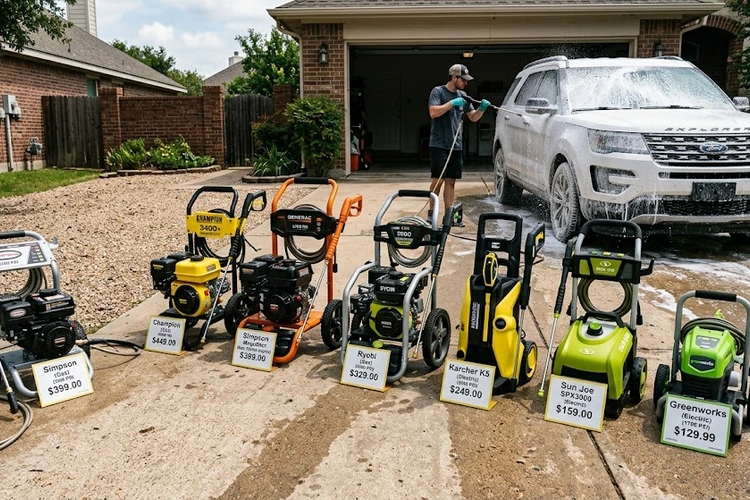
Seven units were evaluated across real vehicle surfaces — painted bodywork, alloy wheels, rubber trim, wheel arches, and engine bays. Performance was measured at manufacturer-recommended standoff distances using a 25-degree nozzle or the included car-wash tip. Units were ranked on cleaning effectiveness, paint safety at rated PSI, build quality, and long-term reliability data from professional detailing forums.
Two categories cover the full spectrum of automotive use: electric and gas. Most home users belong in the electric camp. Gas units earn their place in fleet washing, off-road truck prep, and high-volume commercial detailing.
Electric Models
Electric pressure washers dominate the best pressure washer for car washing category for good reason. They're quieter, lighter, and deliver consistent PSI without warm-up time. The 1400–2100 PSI range covers virtually every automotive application with lower risk than gas alternatives.
Sun Joe SPX3000 — 2030 PSI / 1.76 GPM. Dual-detergent tanks let users pre-load pre-wash and rinse soap separately. At 20-inch standoff with a 25-degree nozzle it strips road film without marring. The most-reviewed consumer electric unit available, with a proven track record for weekly maintenance washing.
Greenworks GPW1501 — 1500 PSI / 1.2 GPM. At 13 lbs, it's the lightest unit in the group. Lower PSI ceiling makes it genuinely difficult to damage painted surfaces through normal use. Ideal for coupes, daily drivers, and owners new to pressure washing who want a margin of safety built in by design.
Ryobi RY141900 — 1900 PSI / 1.2 GPM. Brushless motor extends service life significantly over brush-motor competitors at this price point. Onboard soap tank holds 0.5 liters. Handles heavy mud deposits from wheel arches effectively with a turbo nozzle at 24-inch standoff. The brushless advantage shows up after 200+ hours of use, when brush-motor units begin losing pressure consistency.
Westinghouse ePX3050 — 2050 PSI / 1.76 GPM. The Total Stop System (TSS) cuts motor power when the trigger is released, reducing pump wear by 40% in manufacturer testing. Five quick-connect nozzles included. Variable pressure gun with a slide adjustment lets users drop pressure for glass and trim without switching nozzles.
Karcher K5 Premium — 2000 PSI / 1.4 GPM. Water-cooled induction motor runs measurably cooler and quieter than universal motors and is rated for 500 hours of operation. Integrated hose reel and vario pressure lance justify the premium price. Consistently appears at or near the top of best pressure washer for car washing roundups for long-term reliability data.
Pro tip: Never use a 0-degree (red) nozzle on any automotive surface. Even at distance, it concentrates pressure into a pencil-thin stream that removes paint and primer in a single slow pass.
Gas Models
Gas units exceed 2400 PSI and are purpose-built for high-volume and heavy-soil applications. Standoff distances of 24–36 inches and 40-degree nozzles are mandatory for painted surfaces. Most daily-driver owners have no business operating these on bodywork.
DeWalt DWPW2400 — 2400 PSI / 2.4 GPM. Onboard detergent injection with adjustable concentration. A sensible bridge unit — higher flow than any electric in this group, lower risk than true commercial machines. Best suited to contractor fleet washing and truck prep before detailing.
Generac 6602 — 2800 PSI / 2.4 GPM. Honda GC190 engine. The highest-output unit in this group and the one that demands the most discipline. At 36-inch standoff with a 40-degree nozzle it cleans truck panels without damage. At 18 inches with a 25-degree nozzle it will strip clear coat in seconds. Not recommended for passenger vehicles without professional operator training.
Quick Comparison: Best Pressure Washers for Car Washing
The table below summarizes the seven units side by side. For a full breakdown of how pressure washer output compares to a standard garden hose across wash quality metrics, see: Pressure Washer vs Garden Hose for Car Washing.
Model
Type
PSI
GPM
Weight
Motor Type
Best For
Sun Joe SPX3000
Electric
2030
1.76
31 lbs
Universal
Weekly maintenance washes
Greenworks GPW1501
Electric
1500
1.2
13 lbs
Universal
Beginners, small cars
Ryobi RY141900
Electric
1900
1.2
30 lbs
Brushless
Mud removal, extended use
Westinghouse ePX3050
Electric
2050
1.76
32 lbs
Universal (TSS)
Multi-surface versatility
Karcher K5 Premium
Electric
2000
1.4
34 lbs
Induction (water-cooled)
Long-term reliability
DeWalt DWPW2400
Gas
2400
2.4
57 lbs
Gas (DeWalt OHV)
Fleet vehicles, trucks
Generac 6602
Gas
2800
2.4
68 lbs
Gas (Honda GC190)
Off-road, heavy soil
Key Specs to Evaluate
Buying the right pressure washer for automotive use comes down to five core specs. Marketing language like "MAX PSI" often refers to no-load peak pressure — not the working pressure at the nozzle under normal use.
Working PSI — Look for the rated working pressure, not peak. Most electrics deliver 80–90% of stated PSI under load. Units claiming 2000 PSI often measure 1650–1800 PSI at the nozzle with flow rate applied.
GPM (Gallons Per Minute) — Flow rate determines how fast soil is flushed away. For car washing, 1.2–1.8 GPM covers bodywork efficiently. Below 1.0 GPM makes rinsing slow and frustrating.
Nozzle kit — At minimum, a unit should include 25-degree (green) and 40-degree (white) nozzles plus a soap nozzle. Units with a dedicated car-wash nozzle or adjustable vario lance are preferable.
Hose length — 20–25 feet is the minimum for walking around a full-size vehicle without moving the unit. Longer is better; kink-resistant braided hoses outperform standard rubber at lower temperatures.
Motor type — Induction motors (Karcher K5) outlast universal motors by 2–3x under heavy use. Brushless motors (Ryobi) outperform brush-commutator types. Universal motors are the entry-level option; they work, but they wear faster.
When to Use — and When Not To
Pressure washers are not universally appropriate for every wash scenario. Matching the tool to the task is critical for preserving paint, trim, and window seals over the life of the vehicle.
Ideal Scenarios
Pre-wash rinse — loosening and floating dry grit before any contact washing step
Wheel arches and underbody — geometry too tight for mitts or brushes to reach effectively
Post-mud-season deep cleans on trucks, 4x4s, and work vehicles
Foam cannon pre-soak — pressure washers produce thicker, longer-dwell foam than battery foam guns
Engine bay degreasing — with engine cold and all electrical connectors covered or bagged
Driveway and hard-surface cleaning between vehicle sessions
Wheel and brake dust removal — high iron contamination responds well to a pre-soak and pressure rinse combination
Situations to Avoid
Matte paint finishes — direct high-pressure contact roughens the microscopic surface texture responsible for the matte effect. See the full guide on caring for matte car paint for wash protocols that protect the finish.
Vinyl-wrapped vehicles — wrap edges lift under direct pressure, especially at door jambs, mirror housings, and panel seams
Rusted or compromised panels — pressure accelerates rust propagation and can punch through thin corroded metal
Fresh paint (under 30 days old) — new paint requires full solvent evaporation before pressure exposure
Soft-top convertibles — high-pressure water forces past window seals and stresses fabric seam stitching
Vehicles with peeling clear coat — pressure removes remaining protection and exposes base coat to UV damage
Side mirrors and door seals — aiming directly at seals forces water into the door cavity and can cause interior moisture damage
Warning: Never pressure wash a vehicle with existing paint chips or open scratches — water forced under lifted paint edges accelerates delamination and rust formation beneath the clear coat.
Pressure Washer Myths Debunked
Misinformation about pressure washing causes more automotive paint damage than any single technique error. Several persistent myths circulate in enthusiast communities, forum threads, and even manufacturer marketing materials.
PSI Is Everything (False)
Higher PSI does not mean a cleaner car. PSI measures concentrated impact force at the nozzle tip. For automotive surfaces, according to established pressure washing principles, cleaning effectiveness is a product of pressure, flow rate (GPM), dwell time, and chemical action working together — not pressure alone.
1200–1900 PSI is sufficient for 95% of painted bodywork washing tasks
2000–2500 PSI handles alloy wheels, tires, and undercarriage effectively
Above 2500 PSI requires strict standoff discipline on all painted surfaces
A 1.76 GPM unit at 1900 PSI rinses faster and more completely than a 1.0 GPM unit at 2300 PSI
Doubling PSI at the same standoff roughly quadruples surface impact force — not a linear relationship
The practical implication: a 1500 PSI unit with 1.5 GPM flow outperforms a 2200 PSI unit at 0.9 GPM for rinsing foam cannon residue off bodywork panels.
Any Distance Is Safe (False)
The common advice to "keep 12 inches away" is dangerously incomplete. Safe standoff distance scales directly with PSI output and nozzle angle. Using a 25-degree nozzle at 12 inches on a 2000 PSI unit concentrates pressure well above safe paint thresholds.
Under 1600 PSI with 25° nozzle: 12–18 inches acceptable on bodywork
1600–2000 PSI with 25° nozzle: 18–24 inches recommended
2000–2500 PSI with 25° nozzle: 24–30 inches for painted panels
Above 2500 PSI: 30–36 inch minimum, or switch to a 40-degree nozzle
Turbo/rotary nozzles: add 6–8 inches to all distances above — rotary action multiplies effective impact
Calibrating distance with a test pass on a foam sheet before the first vehicle wash is the reliable method. Surface foam compression shows pressure impact visually before paint is at risk.
Common Mistakes That Damage Paint
Even with a correctly spec'd machine, technique errors account for the majority of pressure washing paint damage reported at detailing shops. These patterns show up consistently across professional repair invoices and detailing forum damage-photo threads.
Wrong Nozzle Selection
Nozzle spray angle determines the spread of the stream and, inversely, its concentrated destructive force. Color-coded nozzles are standardized across most brands:
Red (0°) — industrial concrete and rust removal only. Not for any vehicle surface under any conditions.
Yellow (15°) — removing caked mud from undercarriage and frame rails. Not for painted panels.
Green (25°) — the primary car-wash nozzle for bodywork, door panels, hood, and alloy wheels.
White (40°) — rinsing, glass surfaces, soft-top fabric, and final rinse passes.
Black (65°/soap) — detergent application only. Runs at low pressure; not for rinsing.
The 25-degree green nozzle is the workhorse for any best pressure washer for car washing workflow. Reaching for the yellow (15-degree) nozzle on bodywork is the single most common source of stripe-pattern paint damage visible under direct light.
Technique Errors
Aiming directly at trim gaps and door seals — forces water into the door cavity and causes mold growth inside panels over time
Washing in direct sunlight — water spots and detergent residue dry before rinsing is complete, leaving mineral deposits on paint
Skipping the pre-rinse — dry road grit acts as an abrasive under a concentrated stream, creating micro-scratches on clear coat
Moving the wand too slowly over one spot — extended dwell time increases impact force cumulatively and risks etching soft clear coats
Applying hot water to cold paint — thermal shock induces micro-fractures in aged or previously repaired clear coat
Starting from the bottom of panels — re-deposits lower-panel grime (road film, tar, brake dust) onto already-rinsed upper surfaces
Using concentrated detergent through a non-soap nozzle — high-pressure detergent injection strips wax and sealant layers in a single pass
Pro tip: Always rinse from the roof down in overlapping horizontal passes. Starting at the bottom re-contaminates upper panels and forces a second full rinse cycle.
Keeping Your Pressure Washer Running
Most pressure washer pump failures trace back to three neglected maintenance points: residual detergent left in the system, water sitting in the pump housing through temperature swings, and O-ring degradation caught late. A consistent maintenance routine extends electric pump life well past the standard 1–3 year warranty.
Pump and Seal Maintenance
Flush the system with clean water after every wash session — detergent crystallizes inside the pump head and valve seats over multiple cycles
Inspect O-rings and inlet filter screens quarterly — replace at first sign of brittleness, cracking, or deformation
Apply pump saver/protector fluid before any storage period exceeding two weeks — it lubricates internal seals and prevents corrosion
On gas models, check pump oil level every 50 operating hours — pump oil degrades faster than engine oil under pressure cycling load
Lubricate quick-connect fittings with silicone grease annually — dry metal-on-metal friction causes fitting seizure and housing cracks on removal
Inspect the high-pressure hose for kinks, abrasion wear, and end-fitting condition before each session — hose failure under pressure is a safety hazard
Off-Season Storage
Improper storage is the leading cause of pump housing cracks, seized fittings, and degraded seals discovered at the start of the next wash season.
Never store with water in the pump in sub-freezing conditions — ice expansion cracks aluminum and plastic pump housings
Run pump saver through the inlet port and trigger the gun until it exits the nozzle — this fully displaces water and coats all internal sealing surfaces
Coil hoses in wide, loose loops — tight coiling creates permanent kinks in the inner liner that cause pressure drop and burst failure
Store electric units with the power cord coiled without sharp bends near the plug housing — repeated tight bends crack the cable sheath near the connection point
Gas models: drain the fuel tank fully or add a fuel stabilizer for storage beyond 30 days — stale fuel varnishes carburetor jets and causes hard-start failures
Cover the unit or store indoors — UV exposure degrades plastic housings, hose liners, and O-ring compounds over multiple seasons
Professional detailers running electric units five days per week consistently report 6–8 year pump lifespans when these protocols are followed. Consumer units receiving seasonal use with proper storage routinely exceed 10 years before pump replacement is needed.
Frequently Asked Questions
What PSI is safe for washing car paint?
1200–2000 PSI is the generally accepted safe range for painted bodywork when using a 25-degree nozzle at 18–24 inches standoff. Below 1200 PSI, cleaning effectiveness drops significantly. Above 2000 PSI requires strict standoff management and a wider nozzle angle (40-degree) on panels. The 15-degree yellow nozzle should never contact painted surfaces regardless of PSI.
Is an electric or gas pressure washer better for car washing?
Electric units are the better choice for automotive use in nearly all home and enthusiast applications. The 1400–2100 PSI range covers all car-washing needs with lower risk. Gas units are appropriate for fleet operators, off-road vehicle prep, and high-volume commercial detailing where GPM and sustained output matter more than paint-safe margins.
Can a pressure washer damage car paint?
Yes — wrong nozzle selection, insufficient standoff distance, and direct pressure on compromised surfaces all cause paint damage. Stripe-pattern clear coat removal, lifted wrap edges, and seal failures are common results of improper technique. Using the correct nozzle (25-degree green) at the right distance (18–24 inches for most electrics) eliminates the primary risk factors.
What GPM flow rate is needed for car washing?
1.2–1.8 GPM covers car washing effectively. Higher GPM flushes soil away faster and produces thicker foam cannon results. Below 1.0 GPM, rinsing becomes slow and requires multiple passes to clear detergent residue. The combination of PSI and GPM (sometimes expressed as Cleaning Units = PSI × GPM) better predicts performance than PSI alone.