Car Care ›
by Diego Ramirez
The MTM Hydro PF22.2 Foam Cannon Kit is our top pick for 2026 because it delivers commercial-grade foam performance with a complete, ready-to-use kit that handles everything from daily drivers to trucks and RVs. Whether you're new to foam washing or you've been detailing vehicles for years, choosing the right foam cannon can mean the difference between a showroom finish and swirl-mark frustration. The market in 2026 offers more options than ever, from budget-friendly garden hose attachments to pro-grade pressure washer cannons built for heavy-duty detailing sessions.
Foam cannons work by mixing soap concentrate with water and air to generate thick, clingy suds that cling to your vehicle's surface, dwell on contamination, and lift grime away before you ever touch the paint with a wash mitt. This car care technique — often called a two-bucket or touchless pre-wash — dramatically reduces the risk of inflicting fine scratches and swirl marks during washing. If you're also investing in protecting that freshly washed paint, our guide to the best automotive clear coats of 2026 is well worth reading alongside this one.
We evaluated seven foam cannons across key criteria: foam density, ease of attachment, adjustability, build quality, and compatibility with both standard garden hoses and pressure washers. Pricing ranges from under $30 for entry-level options to over $80 for professional kits, and the right choice depends heavily on what equipment you already own. Below you'll find honest, detailed reviews of each model, a practical buying guide, and answers to the questions we hear most often about foam cannons.






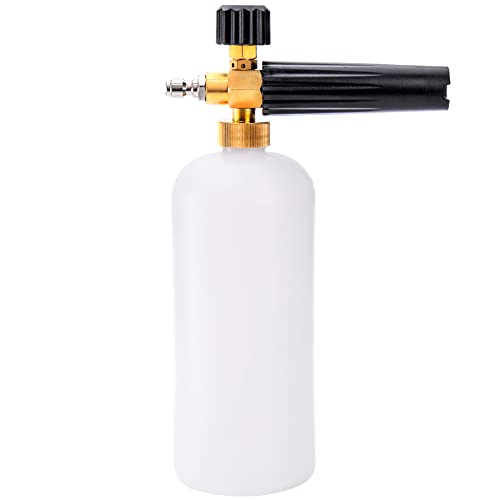




The Chemical Guys TORQ Foam Blaster 6 earns its place as the go-to foam cannon for anyone who doesn't own a pressure washer, and it delivers a genuinely impressive amount of thick suds from nothing more than a standard garden hose. The foam ratio dial gives you precise control over sud density — turn it toward thick for a heavy pre-soak on a mud-caked truck, or dial it back for a lighter rinse on a lightly dusty sedan. Chemical Guys designed this to be the entry point into foam washing, and it succeeds on that front with an intuitive connection process that takes about thirty seconds to get running.
What separates this from cheap foam guns is the quality of foam it actually produces. The thick suds do a credible job of encapsulating and suspending surface contamination, which reduces the friction between your wash mitt and the paint. You won't get the dense, shaving-cream-thick foam that a high-pressure pressure washer cannon delivers, but for a garden hose attachment, the performance is genuinely effective. The build quality is solid plastic, not premium, but it holds up well to regular washing sessions throughout a season. If you're dealing with rust stains on your vehicle before washing, pair this with our recommendations in the best rust removers of 2026 guide for the most complete pre-treatment workflow.
For households without a pressure washer, this is the most practical and cost-effective path into foam washing in 2026. It works with virtually every standard garden hose on the market, requires no adapters, and the soap reservoir holds enough concentrate for a full vehicle wash without constant refilling. The adjustable nozzle also gives you some control over spray pattern, which is useful for getting into wheel wells and around mirrors.
Pros:
Cons:
The MTM Hydro PF22.2 is the foam cannon you choose when you want professional detailer results at home, built in Italy to standards that would be at home in a commercial wash bay. The complete kit includes the SG28 spray gun with a 360-degree hose swivel, multiple plug adapters, and fittings that cover nearly every pressure washer connection type on the market, so compatibility is rarely an issue. This system handles a PSI range of 1,100 to 5,000 and a maximum flow rate of 5.3 GPM, which means it works equally well with a lightweight electric pressure washer or a powerful gas-powered unit.
The foam this cannon produces is genuinely remarkable — dense, creamy, and clingy in a way that entry-level cannons cannot replicate. You can see it dwell on vertical surfaces like door panels and quarter panels for a full minute or more, which gives the soap chemistry time to break down road film, brake dust, and other bonded contamination before you introduce any physical contact with the surface. The SG28 spray gun's ergonomics are excellent, with a comfortable grip and the 360-degree swivel preventing hose torque that typically makes continuous washing fatiguing. This cannon also handles temperatures up to 140°F, which opens the door to hot water washing for superior degreasing on heavily soiled vehicles.
At its price point, the MTM Hydro PF22.2 is genuinely difficult to beat for anyone who already owns a capable pressure washer. Professional detailers consistently recommend this setup because it delivers repeatable, high-quality results across a wide variety of vehicles and surface types, from motorcycles to boats to RVs. The made-in-Italy construction is evident in the tight tolerances, smooth adjustments, and resistance to thread wear that cheaper cannons develop after a few dozen uses.
Pros:
Cons:
The Fasmov Snow Foam Lance punches well above its price bracket with a brass foam core construction that sets it apart from fully plastic alternatives at the same entry-level price point. That brass core isn't just a marketing claim — it directly affects foam quality by creating more consistent air-to-soap mixing under pressure, resulting in noticeably denser suds than comparable plastic-core competitors. The 1/4-inch quick-disconnect fitting snaps directly into any compatible pressure washer lance or trigger gun without tools, and the foam adjustment knob on top gives you easy control over the soap-to-water ratio for different washing scenarios.
To use this correctly, your pressure washer needs to deliver at least 1,000 PSI and 2.0 GPM minimum — below that threshold, foam production drops off significantly. When those requirements are met, the Fasmov produces a respectable snow foam blanket that clings well to horizontal and vertical surfaces. The one-liter bottle is adequate for most passenger cars, though owners of SUVs, trucks, or larger vehicles may find themselves refilling mid-wash. The maximum pressure rating of 160 bar (approximately 2,320 PSI) and 60-degree maximum temperature are worth noting if you plan to use hot water washing.
For anyone shopping for their first pressure washer foam cannon without wanting to spend significant money upfront, this is the most sensible starting point in 2026. It delivers genuine foam washing results, not a watery spray pretending to be foam, and the brass core gives it better longevity than the cheapest plastic options available. If the foam cannon gets you hooked on foam washing and you eventually want to step up, the MTM Hydro reviewed above is the natural upgrade path.
Pros:
Cons:
The iK Foam Pro 12 from Goizper Group occupies a unique category among foam applicators — it requires neither a pressure washer nor a garden hose connection, operating entirely on hand-pumped compressed pressure within its six-liter chamber. This makes it genuinely portable and usable anywhere, from a detailing bay to a parking lot to a boat dock, without any infrastructure requirements beyond a water source to initially fill it. Professional detailers use the iK Foam Pro 12 specifically for interior detailing, fabric seats, carpets, and other surfaces where a high-pressure foam blast would cause damage or excessive saturation.
The foam quality from this pump sprayer is legitimately impressive for a pressurized sprayer in its class — it produces both dry foam (for interior surfaces and upholstery) and wet foam (for exterior washing), which is a versatile capability no pressure washer cannon can claim. The Schrader valve allows you to top up pressure with a standard bike pump or compressed air source, which extends your spraying time significantly between manual pumping sessions. The stable base with foot support prevents tipping on flat surfaces, and the lance parking clip keeps the spray wand secured when you need both hands free for prep work.
The six-liter capacity is generous enough for full exterior pre-soaks on passenger vehicles, and the professional-grade PVC hoses resist kinking and chemical degradation from concentrated detailing products. If you're running a mobile detailing operation or need a foam applicator that works on interior surfaces as well as exterior, the iK Foam Pro 12 is the most versatile tool in this roundup. The pressure release safety valve is a thoughtful addition that prevents over-pressurization and adds a layer of user safety when working with concentrated chemistry.
Pros:
Cons:
The Ontel Carwash Cannon is designed for people who want foam washing results without the learning curve, and it delivers on that promise by stripping the process down to its essential steps: attach to garden hose, add soap, spray, rinse. The five spray settings built into the dial give you meaningful versatility — from a focused stream for wheel wells and door jambs to a broad fan for panel coverage — without the need to swap nozzle tips or make pressure adjustments. This is the foam cannon that someone who washes their car once a month, not a dedicated detailer, will enjoy using regularly.
Performance is consistent with what you'd expect from a garden hose-fed system — the foam is noticeably lighter than what a pressure washer cannon generates, but it's more than sufficient for regular maintenance washing on vehicles that aren't heavily contaminated. The spray-and-rinse workflow the Ontel promotes is genuinely effective for light-to-moderate dirt levels, and the no-residue-or-film claim holds up well when you're using a quality car wash soap concentrate. The five-setting dial is robust and clicks clearly into each position, so you're not guessing whether you've actually changed the spray pattern.
Where the Ontel stands out against other garden hose foam guns is in pure ease of use — the connection process is straightforward, the bottle fills without fumbling, and the overall product requires no instruction reading to operate correctly. If you're shopping for a foam cannon as a gift for someone who wants a cleaner car without the complexity of a pressure washer setup, this is the most approachable option in 2026. It won't satisfy a dedicated detailer's standards for foam density, but as a practical tool for regular quick washes, it performs reliably.
Pros:
Cons:
The AstroAI Foam Cannon earns consistent praise for solving one of the most consistently frustrating aspects of using pressure washer foam cannons — filling the bottle without spilling soap all over your driveway and equipment. The extra-wide neck opening is a genuinely practical design decision that makes measuring and pouring concentrate straightforward, especially when you're working with thick, viscous car wash soaps that drip and run at the worst possible moments. Combined with the heavy-duty foam core, this cannon produces dense, thick foam that covers surfaces evenly and clings well during the dwell period.
Compatibility covers the 1,000–3,000 PSI range, which captures the vast majority of consumer and prosumer electric pressure washers available in 2026. The one-liter bottle is standard for this class of cannon, and the foam quality scales well across that PSI range — you get solid foam even at the lower end of the pressure spectrum, which is reassuring if your pressure washer is on the lighter side. The 1/4-inch quick-connect fitting is the universal standard, so connection to your existing pressure washer gun is instant and tool-free. One critical note: this cannon is pressure washer only — it does not work with garden hoses, and the manufacturer is clear about this.
AstroAI also advises avoiding soap concentrates with wax additives, which can clog the foam cartridge over time and degrade performance. This is standard advice for any foam cannon with a precision orifice, but it's worth heeding if you typically reach for all-in-one wash-and-wax products. For anyone running a consistent car care routine that includes regular steam cleaning or deep decontamination washing — our best steam cleaners of 2026 review pairs well with this foam cannon for a complete exterior cleaning system — the AstroAI is an efficient and user-friendly daily driver cannon.
Pros:
Cons:
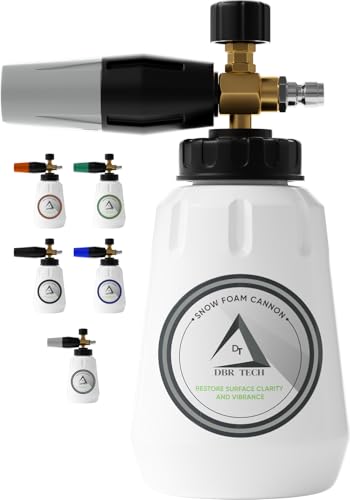
The DBR Tech Pro-Grade Foam Cannon differentiates itself from the field with a 1.1mm orifice — smaller than the 1.25mm standard found on most consumer foam cannons — which creates higher internal pressure and generates noticeably richer, creamier foam with superior surface adhesion. If you've used other foam cannons and found yourself frustrated by foam that runs off vertical panels within seconds, the smaller orifice design directly addresses that problem by producing foam that grips surfaces and stays put for a full dwell period. The 360-degree adjustable spray pattern nozzle lets you rotate between horizontal and vertical spray orientation, which is practically useful when working on flat surfaces like hoods versus vertical door panels.
The operating range of 1,000–4,000 PSI covers a broad spectrum of pressure washers, and the large-mouth soap opening matches the AstroAI's user-friendly filling design without restricting foam output. The grey-colored build has a professional aesthetic and the construction quality feels solid without any of the flex or play in fittings that plague entry-level cannons. This is particularly important for safety and longevity when you're running near the upper end of the PSI range — a slightly loose fitting at 3,500 PSI is a genuine risk, and the DBR Tech's tight tolerances address that concern directly.
According to pressure washing principles, the combination of nozzle orifice size and flow rate determines foam density and coverage quality more than any other single factor — and the DBR Tech's engineering reflects a deliberate approach to optimizing both variables. If you're serious about achieving maximum foam coverage and minimum water consumption per wash, this is the cannon to evaluate first in 2026. The reduced water usage is not just an environmental benefit; it also means less runoff diluting your soap concentration during the wash, which translates to more effective cleaning chemistry at the surface level.
Pros:
Cons:

With seven strong contenders reviewed above, the right foam cannon for your garage depends on factors that go beyond price alone. The decisions below are the ones that actually matter when you're trying to narrow the field and choose confidently.
This is the first and most important question you need to answer before evaluating any foam cannon specs. If you own a pressure washer with at least 1,000 PSI and 1.5 GPM output, you have access to the full range of cannons reviewed here, including the high-performance options that produce genuinely thick, professional-grade foam. If you're working with a garden hose only, your choices are the Chemical Guys TORQ Foam Blaster 6 and the Ontel Carwash Cannon — both produce lighter foam, but they eliminate the barrier to entry entirely and still deliver meaningful washing improvement over a bare wash mitt. The iK Foam Pro 12 is the third path: fully self-contained, requiring neither hose nor pressure washer, ideal for portable use or interior foam applications. Choose based on what you own today, not what you might buy someday.
The foam cannon's orifice is the precision opening through which the soap-water-air mixture passes to form foam, and its size directly controls the foam density you'll achieve. Smaller orifices — like the DBR Tech's 1.1mm — generate higher resistance and create richer, creamier foam that clings to painted surfaces for longer dwell times. Larger orifices produce higher volume foam that covers surfaces faster but tends to run off more quickly. For paint decontamination and pre-wash soaking, maximum foam density and dwell time produce the best results, which favors smaller-orifice cannons. For quick maintenance washes on lightly soiled vehicles, the volume advantage of a larger orifice may matter more than sheer density. Most consumer cannons use a 1.25mm orifice as the standard; 1.1mm represents a meaningful step toward professional foam quality.
Every pressure washer foam cannon specifies a minimum PSI and GPM (gallons per minute) requirement, and operating below those thresholds produces noticeably worse foam. The Fasmov requires a minimum of 1,000 PSI and 2.0 GPM. The MTM Hydro operates across 1,100–5,000 PSI. The AstroAI covers 1,000–3,000 PSI. Before purchasing any pressure washer foam cannon, verify your pressure washer's output specs against the cannon's requirements — most consumer electric pressure washers produce between 1,300 and 2,000 PSI with 1.5 to 2.0 GPM flow rates, which puts them in the compatible range for all the pressure washer cannons reviewed here. Gas-powered pressure washers generally exceed all these requirements with capacity to spare, giving you maximum flexibility in cannon selection.
The internal foam core material is the most meaningful durability indicator in a foam cannon. Brass foam cores — as found in the Fasmov — resist corrosion and maintain consistent performance over many wash cycles, while plastic foam cores can degrade or distort under high-pressure conditions over time. For the external housing, the difference between consumer-grade plastic and professional construction is visible immediately in hand and in the tightness of thread connections. The MTM Hydro PF22.2's Italian manufacturing and the DBR Tech's tight-tolerance fittings both demonstrate what premium construction looks like at opposite ends of the price spectrum. If you're planning to use a foam cannon weekly throughout multiple seasons, the incremental cost of better build quality pays for itself in consistent performance and longevity. You might also appreciate pairing your clean vehicle with well-maintained garage storage — our guide to the best garage floor mats of 2026 covers the often-overlooked part of a tidy garage setup.
No — not all foam cannons require a pressure washer. The Chemical Guys TORQ Foam Blaster 6 and the Ontel Carwash Cannon both connect directly to standard garden hoses and produce adequate foam for regular maintenance washing. The iK Foam Pro 12 is fully self-contained and requires neither a hose connection nor a pressure washer. However, the densest, most professional foam comes from pressure washer cannons operating at 1,000 PSI or above, so if foam quality is your priority, a pressure washer is the better foundation.
You should use a dedicated car wash soap concentrate that specifies foam cannon compatibility on its label. High-foaming pH-neutral shampoos work best, as they're formulated to produce dense suds when aerated through a foam cannon's mixing chamber. Avoid dish soap, as its surfactant chemistry strips protective waxes and sealants from your paint. Also avoid soaps with wax additives when using precision-orifice cannons like the AstroAI or DBR Tech — those wax particles can accumulate in the small orifice over time and restrict foam output. Dilution ratios typically range from 1:10 to 1:20 depending on the soap and how thick you want your foam coverage.
To maximize foam thickness, use a higher-concentration soap ratio, ensure your pressure washer meets the cannon's minimum PSI and GPM requirements, and adjust the cannon's foam ratio dial toward maximum soap output. Cold water produces denser foam than hot water in most foam cannons, so if your pressure washer has a temperature setting, stick to ambient or cold water for foam washing. Switching to a cannon with a smaller orifice — like the DBR Tech's 1.1mm design — produces noticeably richer foam at the same pressure settings. Ensuring the foam cannon's reservoir and orifice are clean and free of soap residue also maintains peak foam output over time.
Yes — foam cannons are excellent tools for washing motorcycles and RVs, though the approach differs slightly by surface type. For motorcycles, the Chemical Guys TORQ Foam Blaster 6 and the iK Foam Pro 12 are ideal because they deliver foam at low pressure that won't force water into sensitive electrical connections or bearings. For RVs and larger vehicles, a pressure washer foam cannon like the MTM Hydro PF22.2 is more practical because it covers large surface areas quickly and generates enough dwell foam to address the road film and oxidation that accumulates on RV siding. Always direct foam away from open vents, intakes, and electrical panels regardless of vehicle type.
You should rinse your foam cannon thoroughly with clean water after every use to prevent soap concentrate from drying inside the orifice and internal passages. A more thorough cleaning — disassembling the cannon and soaking the orifice in warm water or a diluted cleaning solution — is recommended every 10 to 15 uses or whenever you notice a drop in foam quality. For cannons with precision small orifices like the DBR Tech, regular cleaning is especially important because dried soap deposits accumulate faster at the narrower opening. Never use metal tools or sharp objects to clean a foam cannon orifice, as even small scratches change the internal geometry and affect foam output quality permanently.
A foam cannon connects to a pressure washer and uses pressurized water to aerate soap into dense, thick foam that closely resembles shaving cream in consistency. A foam gun attaches to a garden hose and relies on standard water pressure — typically 40 to 80 PSI at the tap — to create a lighter, more diluted foam. The Chemical Guys TORQ Foam Blaster 6 and the Ontel Carwash Cannon are technically foam guns in this distinction, while the MTM Hydro, Fasmov, AstroAI, and DBR Tech are true foam cannons. The practical difference is foam density and dwell time: pressure washer cannons produce foam that stays on your vehicle's surface for 60 seconds or more, while garden hose foam guns produce foam that begins running off within 15 to 30 seconds of application.
 |
 |
 |
 |

About Diego Ramirez
Diego Ramirez has been wrenching on cars since his teenage years and has built a deep practical knowledge of automotive maintenance and paint protection through years of hands-on work. He specializes in fluid service intervals, preventive care routines, exterior protection products, and the consistent habits that extend a vehicle's lifespan well beyond average. At CarCareTotal, he covers car care guides, cleaning and detailing products, and exterior maintenance and protection reviews.
Get some FREE car parts & gear.. Or check out the latest free automotive manuals and build guides here.
Disable your ad blocker to unlock all the hidden deals. Hit the button below 🚗
| | | |
