by Diego Ramirez
Most cars lose measurable paint clarity within 90 days of their last wax — and the main culprit isn't weather, it's between-wash surface contamination. The best quick detailer spray solves exactly that problem. These spray-on formulas lift dust, fingerprints, and light grime while layering on gloss and short-term protection — all in under five minutes. Our team has tested dozens of them across different paint types, coatings, and climates. This guide covers our six favorites, plus everything needed to choose, use, and get the most out of a quick detailer. For anyone building a complete detailing routine, our best car wax reviews pair perfectly with this guide.
Quick detailers aren't just for show cars. Professional detailers use them daily on fleet vehicles, dealership demos, and customer pickups. The chemistry has improved dramatically — modern formulas include synthetic polymers, silica nanoparticles, and even graphene derivatives. The result: products that do real protective work, not just cosmetic touch-ups.
Contents
Quick detailers are water-based spray formulas built on three core components: surfactants, lubricants, and protective polymers. The surfactants loosen and suspend light contamination so it lifts off cleanly. The lubricants allow a microfiber to glide safely across the surface without dragging abrasive particles. The polymers bond lightly to the clear coat and leave behind gloss and a short-term protective barrier.
According to Wikipedia's overview of car washing and detailing, surface lubrication is the critical variable in preventing swirl marks during light cleaning — and that's precisely what a well-formulated quick detailer delivers between full washes.
Our team treats them as a maintenance layer that extends the life of a polish or wax job by weeks. They're not a substitute for polishing compound or wax. They're a force multiplier for whatever protection is already on the paint.
Pro Tip: Always verify pH-neutral labeling before applying any quick detailer to a ceramic-coated car. Acidic or alkaline formulas can strip a coating's hydrophobic layer with just a few uses.
Our team tested each of these products in real-world conditions — not just on a clean show car. We applied them on daily drivers carrying light dust, bird dropping residue, and water spotting. Here's what stood out.
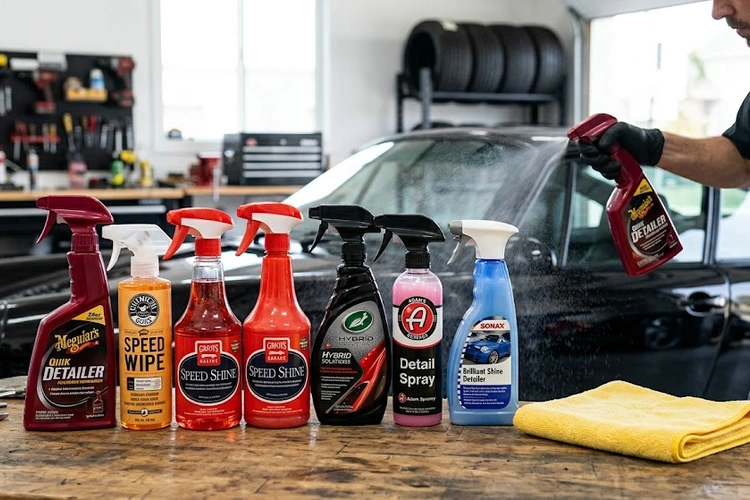
Chemical Guys Speed Wipe earns the top spot for all-around balance. It sprays evenly, buffs out quickly with a microfiber, and leaves a slick, glossy finish with no residue. Our team found it performs well on bare paint, waxed surfaces, and ceramic-coated cars alike. It's also one of the fastest-drying formulas we tested — no re-buffing required.
Meguiar's Ultimate Quick Detailer adds a mirror-like depth to dark-colored paint. The synthetic polymer base bonds quickly and intensifies reflections noticeably. For anyone who prioritizes a showroom appearance between washes, this is the pick. It handles water spots and light smearing especially well.
Adam's Detail Spray is the favorite among enthusiasts who don't cut corners. The formula runs noticeably thicker than most competitors — one spray covers more surface area, which makes the higher price per ounce reasonable. Gloss output is exceptional, and it layers cleanly over ceramic coatings without muting hydrophobic performance.
Griot's Garage Speed Shine is built for people who detail regularly and demand precision. It's streak-free even in warm weather — a common failure point for cheaper sprays. Our team tested it on black metallic and white solid paint with equally clean results. It doubles as a clay bar lubricant, which adds practical versatility.
ONR isn't marketed purely as a quick detailer, but our team has used it in that role for years. Diluted to a 1:64 ratio, it cleans, protects, and polishes in a single wipe. It's especially effective for maintaining paint gloss between washes without juggling multiple products. The gallon concentrate delivers the best cost-per-use value on this entire list.
At its price point, this one genuinely surprises. The ceramic-infused formula delivers water beading that rivals products costing three times as much. It's not as slick as the premium picks on heavier contamination, but for regular maintenance use on a clean surface, the value is hard to argue with.
| Product | Best For | Ceramic Safe | Gloss Rating | Price Range |
|---|---|---|---|---|
| Chemical Guys Speed Wipe | All-around use | Yes | ★★★★☆ | $$ |
| Meguiar's Ultimate Quick Detailer | Gloss depth | Yes | ★★★★★ | $$ |
| Adam's Detail Spray | Premium finish | Yes | ★★★★★ | $$$ |
| Griot's Garage Speed Shine | Enthusiasts | Yes | ★★★★☆ | $$$ |
| Optimum No Rinse (ONR) | Multipurpose | Yes | ★★★★☆ | $$ |
| Turtle Wax Hybrid Solutions Ceramic | Budget use | Yes | ★★★☆☆ | $ |
The method matters as much as the product. Most people underperform their quick detailer by applying too much product and working on a surface that's too dirty. Our team's standard process:
For heavily soiled surfaces, a quick detailer isn't the right starting point. Loose dust should be brushed off first. Significant grime or bonded contamination calls for a rinse or waterless wash before reaching for the detailer. Anyone dealing with stubborn surface contamination should read our breakdown of clay bar vs iron remover — both tools outperform quick detailers for bonded particles.
Quick detailers stack well with other protectants. Applying one after a ceramic coating maintenance wash boosts hydrophobic performance temporarily. Using one after a wax or sealant job adds an extra gloss layer with minimal effort.
Maintenance Tip: Our team applies a quick detailer as the final step after every hand wash — it takes 90 seconds and measurably extends the life of whatever sealant or coating is underneath.
Matte paint owners need a different product entirely. Standard quick detailers add gloss that permanently alters a flat finish. Our complete guide on caring for matte car paint covers which products are actually safe for these surfaces.
Streaks are the most common complaint — and almost always a technique problem, not a product failure. The typical causes:
The fix is almost always less product. Most people use twice what's needed. A light mist per section is enough for a streak-free finish in virtually every condition our team has tested.
With daily use, polymer residue builds up on the surface over time. It shows as a hazy, dull appearance — the opposite of what these products are supposed to deliver. Our team recommends a full wash with a pH-neutral shampoo every 7–10 uses to reset the surface. This prevents buildup and ensures the detailer works on a clean foundation each time.
Warning: Never apply a quick detailer over active bug splatter, bird droppings, or tree sap — the spray's lubricants will smear these contaminants across the paint and accelerate etching into the clear coat.
This is the biggest misconception in consumer car care. Quick detailers remove light surface dust and fingerprints. They don't emulsify road grime, brake dust, or traffic film. Using them as a wash substitute on a dirty car drags abrasive particles across the clear coat — exactly the wrong outcome. Our team treats them strictly as a between-wash maintenance tool, not a replacement for one.
The distinction matters most in high-contamination environments. Anyone parking near construction sites, gravel roads, or heavy traffic needs a proper rinse cycle first. Understanding this boundary is what separates a glossy result from a scratched one.
This myth came from early-generation sprays with problematic pH levels. pH-neutral formulas — which now cover most quality products — are completely safe on ceramic coatings and PPF. Many of them temporarily enhance a coating's hydrophobic performance. The key is confirming pH neutrality before buying. Anything above pH 8 or below pH 6 warrants caution on coated surfaces.
Some people also assume quick detailers are redundant on a ceramic-coated car. Our experience says otherwise. Coatings still collect dust and light grime between washes. A detailer restores surface appearance and adds a thin sacrificial layer that keeps the coating itself cleaner for longer.
Our team recommends using a quick detailer two to three times per week on daily drivers — or any time after parking in a dusty or high-traffic area. Cars that sit outside benefit from more frequent application since airborne contaminants begin bonding to unprotected paint quickly.
Most formulas are safe on glass and exterior trim, but results vary by product. Our team prefers dedicated glass cleaners for windows since detailer residue can leave a slight haze on flat surfaces. For plastic trim, a silicone-free formula is the safer choice — silicone can cause adhesion issues if the trim is ever repainted or wrapped. For a deeper dive into trim maintenance, our guide on cleaning exterior car plastic trim covers the full process.
Quick detailers prioritize cleaning lubrication and immediate gloss enhancement. Spray waxes focus on depositing an actual wax layer for longer-lasting protection. Spray waxes typically protect for weeks longer but require slightly more effort to buff out. Our team uses both in combination — a quick detailer for daily maintenance, a spray wax after every full wash.
 |
 |
 |
 |

About Diego Ramirez
Diego Ramirez is a maintenance and care specialist who has been wrenching on cars since he was sixteen. He focuses on fluid changes, preventive care routines, paint protection, and the small habits that turn a five-year-old car into a fifteen-year-old car.
Get some FREE car parts & gear.. Or check out the latest free automotive manuals and build guides here.
Disable your ad blocker to unlock all the hidden deals. Hit the button below 🚗
| | | |
