Car Care ›
by Diego Ramirez
Meguiar's Ultimate Liquid Wax stands out as the top overall pick for 2026, delivering a glossy finish with strong UV protection in a single easy step. Finding the right car wax can feel overwhelming given the sheer number of options on the market, from traditional carnauba pastes to modern ceramic spray coatings. Each type offers a different balance of shine, durability, and ease of application, and the best choice depends on how much time and effort a detailer wants to invest.

Car wax serves two primary purposes: it creates a protective barrier against UV rays, bird droppings, tree sap, and road contaminants, and it enhances the paint's depth and gloss. A well-waxed vehicle not only looks sharper but also resists the gradual oxidation that leads to faded and chalky paint over time. Whether the goal is weekend show-car prep or basic seasonal protection, the products below cover a wide range of budgets and skill levels. For those also looking to protect a vehicle's exterior from the elements when parked, pairing a quality wax with one of the best car covers of 2026 is a smart combination.
This guide reviews seven of the best car waxes available in 2026, covering liquid waxes, paste waxes, and spray coatings. Each product was evaluated on shine quality, durability, ease of use, and overall value. A detailed buying guide and FAQ section follow the reviews to help buyers make a confident decision based on their specific car care needs.








Meguiar's Ultimate Liquid Wax earns the top spot because it hits the sweet spot between performance and simplicity. The improved 2026 formula uses pure synthetic polymers that bond tightly to clear coat, producing a deep, wet-look gloss that rivals far more expensive sealants. Application is straightforward — spread a thin layer with the included foam applicator pad, let it haze for a minute or two, then buff off with the bundled microfiber towel. Even in direct sunlight, the product goes on smoothly without streaking or leaving white residue on plastic trim.
Durability is where this wax really separates itself from the competition. Most liquid waxes start to lose their water beading after three to four weeks, but Meguiar's Ultimate held strong for roughly six to eight weeks under normal driving conditions. UV protection is built into the formula, which helps prevent oxidation on daily drivers that sit in uncovered parking lots. The 16-ounce bottle provides enough product for roughly six to eight full applications on a midsize sedan, making it a solid value for the price.
One minor drawback is that the liquid formula can be slightly messier to work with than a paste, especially for first-time users who apply too much product at once. Starting with a small amount and working in two-foot square sections eliminates this issue entirely. For buyers who want a single wax that delivers strong shine, reliable protection, and no-fuss application, this Meguiar's formula checks every important box.
Pros:
Cons:
For detailers who prefer the tactile control of a paste over a liquid, Meguiar's Ultimate Paste Wax is the strongest option in 2026. The advanced synthetic formula creates a long-lasting protective barrier that amplifies the clear coat's natural reflectivity, producing a showroom-quality depth that liquid waxes struggle to match. The paste consistency allows for more precise application, making it easier to work around emblems, trim pieces, and body lines without excess product buildup.
Application is remarkably simple for a paste product. The included foam applicator spreads the wax evenly with minimal pressure, and the product removes cleanly with the bundled microfiber cloth. Unlike many paste waxes that require shade and cool panels, Meguiar's formula applies and removes easily even in full, direct sunlight. This flexibility makes it a practical choice for anyone who does not have a shaded garage to work in, which is a common limitation with competing paste waxes.
The 8-ounce container is smaller than the liquid version, which means fewer total applications per purchase. However, paste wax tends to go further per application since users naturally apply thinner, more controlled layers. The finish it produces is noticeably warmer and deeper than the liquid version, particularly on darker paint colors. Buyers who prioritize depth of shine over pure convenience will find this paste wax hard to beat at its price point.
Pros:
Cons:
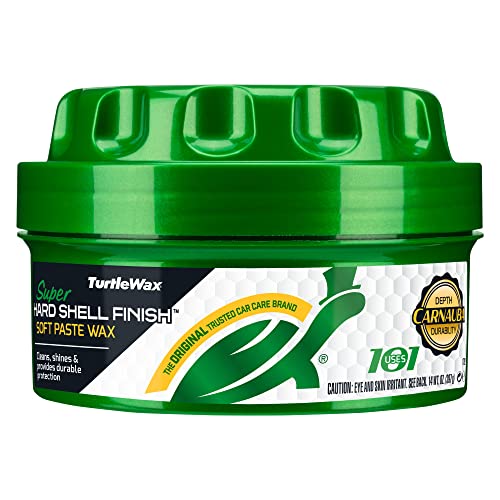
Turtle Wax's Super Hard Shell has been a garage staple for decades, and the 2026 version continues to deliver reliable protection at one of the lowest prices in the category. The "hard shell" name refers to the durable polymer layer the wax leaves behind after curing, which resists wash-off better than many entry-level competitors. For budget-conscious buyers who want honest shine and protection without paying a premium, this paste wax remains a dependable workhorse.
The formula excels at restoring faded finishes, which makes it especially useful for older vehicles that have lost their original luster. A single coat brings back noticeable color depth on oxidized paint, and a second coat adds a respectable level of gloss. The "easy on, easy off" formula lives up to its promise — the wax spreads smoothly, hazes quickly, and buffs away without excessive arm effort. The 9.5-ounce container is generously sized for the price and provides plenty of product for multiple applications throughout the year.
The main trade-off at this price point is durability. The Super Hard Shell's protection tends to break down after roughly three to four weeks of regular driving and washing, which means more frequent reapplication compared to premium options like the Collinite 845 or Meguiar's Ultimate. The shine it produces is also more of a clean, bright finish rather than the deep, wet gloss that enthusiasts chase. For daily drivers and weekend detailers who just want their car to look good without overthinking it, this Turtle Wax paste punches well above its price.
Pros:
Cons:
Collinite 845 has built its reputation over more than 80 years by doing one thing exceptionally well: lasting longer than the competition. This hybrid formula blends heavy-duty polymers with premium grade-one carnauba wax, creating a protective layer that routinely outlasts most consumer waxes by a wide margin. Many users report that water beading remains strong for three to five months after a single application, which is remarkable for a product at this price point. For anyone who wants to wax their vehicle as few times per year as possible, the 845 is the clear choice.
The dual-function nature of this product — part paint sealant (a synthetic polymer coating that bonds chemically to paint), part carnauba wax — delivers both the warm depth of natural wax and the hard durability of synthetic sealants. The result is a high-gloss finish with hydrophobic beading that makes water sheet off the surface rather than pooling. This characteristic is particularly valuable in regions with heavy rainfall, where standing water can leave mineral deposits and water spots on unprotected paint.

The 16-ounce bottle is versatile enough for cars, trucks, boats, RVs, and motorcycles, making it a practical choice for households with multiple vehicles. Application does require a bit more care than some competitors — the product should be applied in thin, even layers and allowed to haze completely before buffing. Applying too thickly can make removal difficult, especially on textured or matte trim. Once the technique is dialed in, though, the Collinite 845 rewards users with some of the longest-lasting protection available outside of professional ceramic coatings.
Pros:
Cons:
Mothers California Gold is the go-to choice for purists who want the warm, rich glow that only genuine Brazilian carnauba wax can produce. Synthetic waxes and ceramic coatings tend to create a sharp, mirror-like reflection, while carnauba delivers a softer, deeper warmth that enhances the natural richness of the paint color. This difference is most noticeable on red, blue, and other richly pigmented finishes where depth of color matters as much as raw gloss. For car show enthusiasts and detailing hobbyists, this natural warmth is often worth the trade-off in durability.
As Step 3 in Mothers' Ultimate Wax System, this paste is designed to lock in the results of prior cleaning and polishing steps. Using it after a clay bar treatment and polish produces the best results, sealing a perfectly smooth surface under a layer of premium carnauba. That said, it performs admirably as a standalone wax on well-maintained paint — buyers do not need to purchase the entire three-step system to get excellent results. The 12-ounce paste container offers a generous supply, and the wax spreads easily with any quality foam applicator.
The primary limitation of pure carnauba wax is its shorter lifespan compared to synthetic alternatives. Most users can expect four to six weeks of solid protection before reapplication is needed, which is roughly half the durability of the Collinite 845 reviewed above. Environmental exposure also affects carnauba more aggressively — frequent rain, extreme heat, and automatic car washes will shorten its effective life. For buyers who enjoy the process of regularly waxing their vehicle and appreciate the unmatched warmth of natural carnauba, the Mothers California Gold remains one of the finest options available in 2026. Those looking to keep their vehicle's entire exterior in top shape may also want to explore the best headlight restoration kits for a complete refresh.
Pros:
Cons:
Turtle Wax's Hybrid Solutions Ceramic Spray Coating bridges the gap between traditional spray waxes and professional-grade ceramic coatings. The ceramic wax polymers in this formula create a harder, more durable shield than standard carnauba or synthetic sprays, offering protection against UV rays, dirt, and road contaminants that keeps the paint cleaner between washes. For buyers who want ceramic-level performance without the intimidating application process of a true ceramic coating, this spray is the easiest entry point available.
The standout feature is its extreme water repellency. After application, water beads tightly and rolls off the surface almost immediately, which reduces drying time and prevents water spots from forming. This hydrophobic performance (the ability of a surface to repel water) is noticeably stronger than traditional spray waxes and holds up through multiple washes. The spray format also makes it incredibly versatile — it is safe for use on paint, glass, wheels, and exterior trim, which means an entire vehicle can be protected with a single product.
Application takes just minutes: mist the product onto a clean, dry panel, spread it with a microfiber towel, then flip the towel and buff to a shine. The entire process for a midsize car takes roughly fifteen to twenty minutes, which is a fraction of the time required for paste or liquid wax. The 16-ounce spray bottle provides enough product for several full applications. The trade-off is that spray waxes generally do not produce the same depth of shine as paste waxes, and the ceramic polymers, while durable for a spray, still do not match the longevity of a properly applied paste product like the Collinite 845. For maintenance waxing between deeper detail sessions, though, this Turtle Wax ceramic spray is outstanding. Keeping the glass equally clean pairs well with one of the best automotive glass cleaners on the market.
Pros:
Cons:
Griot's Garage has long been a favorite among serious detailing enthusiasts, and the Best of Show Spray Wax lives up to that reputation with a premium carnauba-polymer formula that produces a genuinely impressive shine. The name is not an exaggeration — the gloss and color depth this spray creates rivals many paste waxes, which is unusual for the spray wax category. The rich formula delivers what Griot's describes as a "retina-shattering shine," and the results on well-prepped paint genuinely back up that claim.
What sets this spray apart from competitors like the Turtle Wax Ceramic Spray is its durability. Griot's claims two to three times the longevity of other spray waxes, and real-world use supports that estimate. The carnauba and advanced polymer blend creates a protective barrier that holds up through multiple washes and weeks of daily driving. This extended durability makes it a practical choice as a standalone protection product, not just a quick detail spray for car meets and shows. The 22-ounce bottle is larger than most competing sprays, providing extra value per purchase.
Another significant advantage is its compatibility with paint protection films (PPF) and existing ceramic coatings. Many traditional waxes can interfere with or degrade these aftermarket protections, but Griot's formula is specifically designed to work safely on top of them. This makes it an ideal maintenance product for vehicles that already have professional-level paint protection installed. The only real downside is the price — Griot's Garage products carry a premium over mass-market brands. For enthusiasts who treat detailing as a hobby and want the absolute best spray wax available, the extra cost is justified by the superior results.
Pros:
Cons:
The three main formats of car wax each serve different needs and experience levels. Paste wax offers the most control and typically produces the deepest shine, but it takes the most time and effort to apply and remove properly. Liquid wax strikes a balance between ease of use and performance, making it the best starting point for most buyers. Spray wax is the fastest option and works great for maintenance coats between full wax sessions, though it generally does not last as long or produce as deep a finish as paste or liquid alternatives.
How long a wax lasts depends on its formula composition and the conditions it faces. Pure carnauba waxes typically last four to six weeks, synthetic polymer waxes last six to ten weeks, and hybrid or ceramic-infused products can push three to five months between applications. Buyers who park outdoors, live in areas with harsh weather, or prefer to wax as infrequently as possible should prioritize synthetic or hybrid formulas. Those who enjoy regular detailing sessions may prefer the richer look of carnauba, even if it requires more frequent reapplication.
For first-time waxers, application difficulty matters more than most buyers expect. Some paste waxes require careful technique — thin, even layers applied to cool panels in the shade — while modern liquid and spray formulas have been engineered to work in almost any condition, including direct sunlight. Products that include applicator pads and microfiber towels, like both Meguiar's offerings in this guide, reduce the upfront cost of getting started. Spray waxes like the Turtle Wax Ceramic and Griot's Best of Show require virtually no technique at all, making them ideal for beginners or for quick touch-ups.
Paint color plays a subtle but real role in wax selection. Darker paints like black, deep blue, and dark gray benefit most from high-gloss carnauba waxes that enhance depth and richness — the best car waxes for black cars guide covers this topic in detail. Lighter colors like white and silver tend to look equally good with any wax type, since depth perception is less visible on lighter finishes. Metallic and pearl finishes can look stunning under either carnauba or synthetic wax, though carnauba tends to bring out the flake more noticeably. Matte finishes should never be waxed with traditional products — they require specialized matte-specific sealants to avoid adding unwanted gloss.
Reapplication frequency depends on the type of wax and driving conditions. Pure carnauba waxes typically need reapplication every four to six weeks, while synthetic and ceramic-infused waxes can last two to five months. A simple test is to sprinkle water on the surface — if it still beads tightly and rolls off, the wax is still working. Once water starts to sheet flat against the paint instead of beading, it is time for a fresh coat.
Some waxes can be safely layered over ceramic coatings, but not all. Products like Griot's Garage Best of Show Spray Wax are specifically formulated to be compatible with ceramic coatings and paint protection films. Traditional paste waxes, especially those containing abrasives or harsh solvents, can degrade or interfere with the ceramic layer. Always check the product label for ceramic coating compatibility before applying wax over an existing coating.
Neither format is objectively better — they serve different preferences and situations. Paste wax generally provides a slightly deeper, warmer shine and allows for more precise application around tight areas. Liquid wax is faster to apply and remove, making it more practical for regular maintenance. The performance difference between high-quality paste and liquid waxes from the same brand is often minimal, so the choice comes down to personal preference and how much time buyers want to spend on the process.
Car wax provides a thin sacrificial layer that can help prevent very light swirl marks and surface marring from wash mitts and towels, but it does not offer meaningful protection against actual scratches. For scratch resistance, paint protection film (PPF) is the only reliable option. Wax protects primarily against UV damage, oxidation, and chemical contaminants like bird droppings and tree sap, which are far more common sources of paint damage than physical scratching for most daily drivers.
Traditional paste and liquid waxes should always be applied to a clean, dry surface. Moisture trapped under the wax layer can cause streaking, reduced bonding, and uneven coverage. Some spray waxes, however, are designed as "wet application" products that can be sprayed onto a freshly washed vehicle before drying. These quick-detail sprays are formulated differently to work with residual water, but most standard waxes require a fully dry surface for optimal results.
Car polish and car wax serve completely different purposes. Polish is a mild abrasive compound that removes a thin layer of clear coat to eliminate swirl marks, light scratches, and oxidation — it corrects the paint's surface. Wax is a protective coating that sits on top of the paint to shield it from UV rays, contaminants, and environmental damage. For best results, polish should be applied first to prepare the surface, followed by wax to seal and protect the freshly corrected paint. Using wax alone on damaged paint will add shine but will not remove existing imperfections.
 |
 |
 |
 |

About Diego Ramirez
Diego Ramirez has been wrenching on cars since his teenage years and has built a deep practical knowledge of automotive maintenance and paint protection through years of hands-on work. He specializes in fluid service intervals, preventive care routines, exterior protection products, and the consistent habits that extend a vehicle's lifespan well beyond average. At CarCareTotal, he covers car care guides, cleaning and detailing products, and exterior maintenance and protection reviews.
Get some FREE car parts & gear.. Or check out the latest free automotive manuals and build guides here.
Disable your ad blocker to unlock all the hidden deals. Hit the button below 🚗
| | | |
