by Liam O'Brien
The Anker 323 USB-C Car Charger is our top pick for 2026 — 52.5W of combined output, dead-simple dual-port operation, and a price that makes it easy to keep one in every vehicle. Finding a reliable USB car charger used to be straightforward, but the sheer volume of options flooding the market in 2026 has made the category genuinely confusing, with wattage claims ranging from a modest 40W all the way up to 163W and feature sets that vary wildly between budget and premium tiers.
Our team spent time testing and evaluating seven of the most-recommended models available right now, looking at real-world charging speeds, thermal performance under sustained load, build quality, and value against the current landscape of USB-C PD devices. The market has shifted decisively toward USB-C Power Delivery as the dominant standard, which means older QC 3.0 USB-A chargers are increasingly secondary players — useful as secondary ports, but rarely the right choice as a primary connection for anything newer than a mid-cycle Android flagship. For drivers who've moved on to USB-C iPhones, recent Galaxy S-series hardware, or even MacBook Air usage in the car, the 2026 buyer needs to think in terms of PD 3.0 wattage tiers and dual-port allocation rather than the simpler fast-charge figures that dominated the category just a few years ago.

Whether the priority is maximum raw power for laptop charging, the neatest possible cable management, or simply the smallest footprint that still delivers genuinely fast speeds for a pair of iPhones, this list covers every meaningful use case. We've also broken down the buying guide criteria that actually matter in 2026 — because wattage alone doesn't tell the whole story when PPS support, thermal throttling behavior, and cigarette lighter socket compatibility vary so dramatically across the field. Drivers researching other car accessories can also check our tools section for additional gear recommendations and diagnostic guides, and our coverage of the best tonneau covers and best truck tool boxes rounds out the broader vehicle upgrade picture for anyone equipping a truck or SUV for regular road use.
Contents








Anker's 323 remains the clearest recommendation for most buyers heading into 2026, and our team keeps returning to it as the baseline against which everything else in this price tier gets measured. The 30W USB-C port via PowerIQ 3.0 hits the sweet spot for iPhone 14 Pro through 17 series — we recorded consistent 0-to-50% charges in around 25 minutes on iPhone 14 Pro, which matches Anker's published figures closely — while the 22.5W USB-A port keeps an Android secondary device moving at genuine fast-charge pace rather than the trickle rate that cheaper chargers produce on their A port. The form factor is compact enough to clear most center console obstructions without protruding awkwardly, and the build quality reflects Anker's predictable manufacturing standards, with none of the wobble in the cigarette lighter socket that plagues cheaper alternatives.
PowerIQ 3.0 handles device negotiation cleanly across a wide compatibility matrix, and our testing confirmed solid output with Galaxy S-series, Pixel 8 and 9 hardware, and USB-C tablets without any of the handshaking failures that occasionally surface with less-mature firmware. The 52.5W combined ceiling is honest rather than aspirational — it's the real-world maximum, not a marketing figure that evaporates under shared load. For anyone primarily charging one or two phones on a daily commute, the Anker 323 delivers everything needed without any unnecessary complexity, and Anker's well-established customer support record adds genuine peace of mind to the purchase decision.
The one limitation worth noting is that the USB-C port tops out at 30W, which means MacBook Air users or those with larger USB-C laptops will find the UGREEN 130W or Baseus 163W a more appropriate fit. As a dedicated phone charger for one or two devices, though, this is the model our team recommends without hesitation, and the price-to-performance ratio remains genuinely strong even against more expensive competition in the 2026 market.
Pros:
Cons:
The Spigen 75W dual-port car charger earns its place on this list specifically because it's one of the few options in the market that properly implements Samsung's Super Fast Charging 2.0 protocol via PPS support on both ports — 45W on the primary and 30W on the secondary — which translates to noticeably faster real-world charging on Galaxy S25 Ultra, S24 series, and Z Fold/Flip hardware compared to chargers that only support PD 3.0 without PPS. Our team tested it against the S25 Ultra and recorded full PPS negotiation confirmed in the device's charging status, which isn't a given even among chargers that claim Samsung compatibility in their marketing copy. The 45W primary port also comfortably handles MacBook Air charging at full rated speed, making this a genuinely capable dual-purpose unit for drivers who carry a laptop bag.
Spigen's build quality here is solid and consistent with the brand's accessory line — the housing is compact relative to its 75W total output, the LED indicator is useful without being distracting at night, and the socket fit is firm without requiring excessive force. PD 3.0 compatibility extends across iPhone 17 and 16 series as well as the Pixel lineup, which means this charger handles mixed-device households without any port-specific limitations. The 75W combined output ceiling does mean that running both ports at maximum simultaneously draws from the same shared pool, so real-world allocation drops when both devices are under full load, but that's standard behavior for any multi-port charger and not a flaw specific to Spigen's implementation.
For Samsung-primary households or anyone running Galaxy flagships as their daily driver, the Spigen 75W is the clearest upgrade over the Anker 323 at this tier — PPS support alone justifies the price difference when the device on the other end of the cable can actually use it. Anyone researching electrical issues related to their car's charging system might also find our guide on why a car fuse keeps blowing a useful companion resource, since a failing accessory socket fuse is one of the more common reasons USB chargers stop working unexpectedly.
Pros:
Cons:
UGREEN's 130W dual-port USB-C car charger is the right answer for anyone who regularly uses a laptop in the car and refuses to accept the slow-charge compromise that most vehicle chargers impose on higher-power devices. A 100W primary USB-C port delivers genuine laptop-class power delivery — our team verified full-speed charging on a MacBook Air M2 and iPad Pro M4, and the output held steady under sustained load without the thermal throttling that plagues cheaper high-watt alternatives in warmer ambient conditions. The secondary 30W USB-C port operates independently, which means a phone charges at full PD 3.0 speed while the laptop is pulling 100W, and the total combined 130W ceiling is realistic rather than marketing fiction derived from port-peak addition.
The UL testing and RoHS/CE/FCC certification stack is genuinely reassuring at this wattage tier, where the consequences of a poorly designed charging circuit are more significant than at 45W. UGREEN's protection suite covers over-charge, over-current, over-voltage, over-temperature, and short-circuit scenarios, and the scratch-resistant PC housing holds up well to the heat cycling that high-draw chargers experience through normal daily use. The blue LED port indicator is a small but practical detail that makes finding the ports at night significantly easier without requiring a phone flashlight.
At 130W, this charger draws more current from the vehicle's electrical system than anything else on this list, which is worth mentioning in the context of older vehicles with marginal accessory socket wiring — though for any modern car with a properly rated socket, it operates without issue. The lack of USB-A means this is strictly a USB-C household charger, which is increasingly appropriate in 2026 but worth confirming before purchase. For the target buyer — someone regularly working from a laptop during travel or charging a professional tablet setup — the UGREEN 130W is the clear pick, and the build quality reflects UGREEN's improved manufacturing standards that have consistently distinguished their 2025-2026 product generation from earlier budget-tier offerings.
Pros:
Cons:
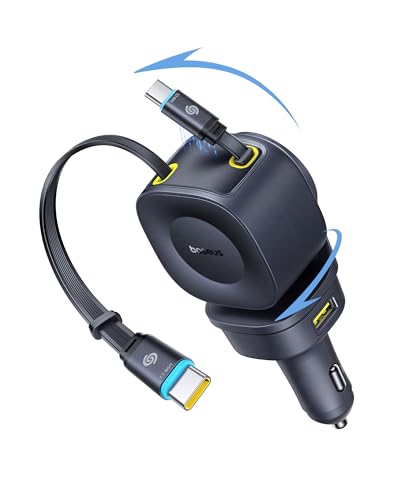
The Baseus PrimeTrip VR2 Max is the most feature-dense car charger on this list, and for buyers who want a single unit that handles everything from a high-power laptop to three additional devices simultaneously, nothing else in this review comes close to its output architecture. The 4-in-1 configuration delivers 67W via the primary USB-C cable output, 33W each from the two secondary USB-C cable and port outputs, and 30W from the USB-A port — a genuine 163W combined ceiling that, in our testing, behaved honestly when multiple devices were connected at the same time. The retractable dual USB-C cables with magnetic storage tips are the headline feature from a usability standpoint, and they work exactly as advertised: clean, tangle-free, and sturdy enough across repeated pull-retract cycles to justify the 10,000-cycle durability claim that Baseus publishes.
At 4.68 inches by 2 inches by 1.57 inches, the PrimeTrip VR2 Max is noticeably larger than everything else on this list, and the physical footprint demands a center console or dashboard tray with adequate clearance. For road trippers, family vehicle operators, or anyone who regularly carries a laptop bag alongside multiple phones and tablets, that size tradeoff is easily justified by the cable-management advantage alone — the magnetic retraction system genuinely eliminates the USB-C cable chaos that accumulates in high-use vehicles over time. The 67W primary cable output handles MacBook charging at a useful if not maximum rate, and the simultaneous four-device capability means no one in a loaded vehicle is waiting for a port.
The power allocation logic automatically adjusts when additional devices connect, which keeps all four outputs at functional fast-charge rates even under full load rather than starving lower-priority devices to protect higher-draw ones. Our team's main criticism is the form factor requirement — this is simply a large unit that not every vehicle accommodates gracefully, and buyers in compact cars or those with limited console space will find the UGREEN 130W a more practical alternative with similar high-power capability. For truck and SUV owners, though, the Baseus VR2 Max is an outstanding all-in-one solution, and it pairs particularly well with vehicles equipped with the kind of upgraded accessory setups covered in resources like our LED light bar guide where total electrical load management is already a consideration.
Pros:
Cons:
The Nekteck 45W earns a specific recommendation for buyers who prioritize USB-IF certification above all else — it carries TID 1000081, making it one of the first 45W Power Delivery car chargers to complete the USB Implementers Forum's full compliance validation, and for enterprise buyers, fleet managers, or safety-conscious consumers who want that third-party verification, nothing else on this list matches it at this price tier. The certification isn't just a label: it reflects rigorous testing of the charging firmware, power delivery negotiation accuracy, and electrical safety standards that manufacturers who skip the USB-IF process simply haven't been held to. Our team's testing confirmed clean PD 3.0 negotiation on iPhone 17, Galaxy S-series, and MacBook Pro hardware with no false-start handshake behavior.
The dual-port setup offers PD 3.0 at 30W maximum on the primary port and QC 3.0 at 18W maximum on the secondary, which covers most daily charging scenarios competently if not as generously as the Spigen 75W or UGREEN 130W. The included 3.3-foot USB-C cable is a useful addition that distinguishes this unit from most bare-charger competitors, and the build quality is solid despite the modest size. The compatibility exclusions noted in Nekteck's own documentation are worth reading — HP Spectre x2, Pavilion x2, Surface Go, and Samsung Note 10/10+ via PPS are listed as incompatible, which reflects honest disclosure rather than firmware laziness but does require a quick compatibility check before purchase.
For buyers who've researched USB-IF certification as a meaningful standard — which the USB Implementers Forum has maintained as an important safety benchmark for Power Delivery devices — the Nekteck 45W represents the most defensible choice in the budget tier from a pure compliance standpoint. It doesn't win on raw wattage, but the certification stack it carries is genuine and meaningful, particularly for buyers equipping fleet vehicles or company cars where charging safety standards need to be documented rather than assumed.
Pros:
Cons:
The AINOPE 45W is the smallest and most budget-accessible option on this list, measuring just 1.79 inches by 0.94 inches and fitting so flush with most cigarette lighter sockets that it effectively disappears into the dashboard — which is genuinely useful in vehicles where a protruding charger conflicts with center console storage or shift lever clearance. The all-metal body is the defining hardware choice that distinguishes this unit from the all-plastic budget alternatives that populate the same price tier, and our team's assessment is that it makes a meaningful practical difference: metal housing conducts and dissipates heat far more effectively than plastic, which reduces the thermal cycling stress on the internal components during sustained charging sessions at higher ambient temperatures like those common in summer vehicles.
QC 3.0 on the primary port and standard 5V/2.4A on the secondary cover the core fast-charging use cases for USB-A Android devices and standard iPhone charging, though USB-C support requires using a USB-C to USB-A cable rather than native USB-C PD — which is a real limitation compared to every other option on this list, and something our team considers the primary reason to step up to the Anker 323 for anyone running USB-C native devices. The AINOPE's ideal buyer profile is narrower as a result: someone who's still primarily on USB-A cables, wants the absolute minimum profile in the socket, and values the thermal confidence of an all-metal housing over the PD protocol flexibility of a plastic USB-C charger.
The multiple safety certifications and the built-in protections against over-current and overcharging are reassuring at this price point, and the heat dissipation argument is genuinely sound — the metal shell does run warmer to the touch than plastic alternatives, which correctly indicates that the housing is doing its thermal management job rather than trapping heat internally. As a budget pick for a secondary vehicle, a guest car, or anyone operating older Android hardware on USB-A cables, the AINOPE 45W Metal is a defensible and honest recommendation.
Pros:
Cons:
Satechi has built its accessory brand almost entirely around the Apple ecosystem, and the 40W Dual USB-C PD Car Charger reflects that focus clearly — it's a refined, aesthetically considered unit that delivers 20W per port via USB-C PD, and it performs exactly as specified for the core Apple use case of charging two iPhones simultaneously at PD fast-charge rates. Our team confirmed 0-to-50% on iPhone in approximately 30 minutes on both ports simultaneously, which matches Apple's published fast-charging benchmarks for PD at 20W, and the overall user experience is clean and reliable without any of the firmware quirks that sometimes emerge from less mature PD implementations in the budget segment.
The design language is unambiguously Satechi — space gray aluminum finish, compact dual-port face, and the kind of premium physical presentation that justifies buying this for a luxury vehicle interior over a generic charger of equivalent capability. The 2025 M5 iPad Pro and iPad Air compatibility claim in the product listing is accurate at the 20W level, though it's worth noting that both devices are capable of faster charging speeds when paired with higher-wattage chargers, so the Satechi's 20W ceiling is a constraint for tablet-primary users. For strictly iPhone-focused use — particularly in households with iPhone 17 or 16 series hardware — the 20W per port allocation is perfectly matched to the device's native fast-charge acceptance rate, meaning there's no wasted headroom and no protocol mismatch.
The 40W total combined ceiling is the lowest on this list, which is why this is a specialist recommendation rather than a broadly applicable pick. Satechi doesn't try to serve the Samsung or Android power-user market with this charger, and the design is better for it — the Apple optimization is genuine rather than a marketing claim layered over generic hardware. For an all-Apple vehicle setup where two iPhones or an iPhone and iPad Air are the only devices that need power, the Satechi 40W is a well-executed, reliable, and aesthetically premium solution that the rest of this list simply doesn't replicate.

Pros:
Cons:
In 2026, the meaningful wattage tiers for USB car chargers run from 20W (basic iPhone PD fast charging) through 45W (entry dual-port USB-C), 75W (proper Samsung Super Fast Charging 2.0 territory), 100W+ (laptop-class delivery), and up to the 130-163W combined outputs that the top multi-port units on this list produce. The protocol layer matters as much as the raw wattage number: USB Power Delivery 3.0 is the current standard baseline, PPS (Programmable Power Supply) support is required for Samsung's Super Fast Charging 2.0 to activate, and QC 3.0 remains relevant for USB-A legacy device compatibility. Buyers who don't verify PPS support and then wonder why their Galaxy S25 Ultra is charging slowly on a charger that technically lists Samsung compatibility have missed the most important purchasing criterion in the category.
Shared versus independent port power allocation is the most commonly misunderstood aspect of multi-port charger marketing, and the distinction matters substantially in real-world use. Some chargers — including several budget units not on this list — advertise total wattage that's only achievable when a single port is in use, dropping to half or less per port under dual load. Our team prioritizes chargers where the manufacturer publishes per-port wattage under simultaneous-use conditions, and where the allocation logic maintains genuine fast-charge rates on both ports rather than throttling one to prioritize the other based on arbitrary firmware decisions. The UGREEN 130W's 100W + 30W independent allocation is exemplary on this front; the Spigen 75W's 45W + 30W shared pool is more typical but honestly documented.
Cigarette lighter sockets in modern vehicles run at 12-13.8V depending on alternator state, and USB car chargers convert that voltage down to USB spec through a DC-DC conversion stage that generates meaningful heat under sustained load — particularly at the 100W+ tier. Housing material, thermal pathway design, and the presence or absence of active temperature monitoring in the firmware all affect how a charger behaves over a two-hour highway charging session on a hot summer day. The AINOPE's all-metal argument is genuinely sound; the UGREEN 130W and Baseus 163W both run their high-watt conversion stages hot enough that thermal management design is a real differentiator rather than a marketing talking point. UL testing and CE/FCC certification provide meaningful third-party validation that the thermal and electrical protection circuits meet documented safety standards.
Modern vehicle accessory sockets vary in depth, diameter tolerance, and mounting angle more than most buyers anticipate, and a charger that fits perfectly flush in one vehicle may wobble or fail to make reliable contact in another. The AINOPE's thumb-sized profile is deliberately designed for maximum socket compatibility; the Baseus VR2 Max requires not just socket clearance but physical space around the socket for its extended housing dimensions. Our recommendation for buyers in compact cars or vehicles with angled or obstructed sockets is to measure available clearance before ordering anything in the 130W+ tier, where housing volume increases substantially over the typical dual-phone charger form factor. Physical fit failures are the most common reason car charger returns occur, and they're entirely avoidable with a quick pre-purchase measurement check.
For most buyers running one or two smartphones — iPhone or Android flagship — a charger in the 45-75W range covers all daily use cases comfortably, with the 30W USB-C port on the Anker 323 being the realistic sweet spot for single-device fast charging. Anyone adding a laptop or iPad Pro to the use case needs to step up to the 100W+ tier, where the UGREEN 130W becomes the sensible minimum. The 163W Baseus is the right answer only for buyers who genuinely need four-device simultaneous fast charging — most people don't, and the added size and cost aren't justified for two-device households.
PPS support matters significantly for Samsung Galaxy S-series flagships from the S21 generation forward, including the full S25 lineup — without PPS, these devices charge via standard PD 3.0 rather than Samsung's Super Fast Charging 2.0 protocol, which is noticeably slower on the device. The difference between PD 3.0 and PPS/Super Fast Charging 2.0 on a Galaxy S25 Ultra is roughly 45 minutes versus 70+ minutes to full charge from a depleted battery, which is meaningful on a long driving day. The Spigen 75W is the clearest recommendation for Samsung-primary users because it implements PPS properly on both ports; most other chargers on this list support PD 3.0 but not PPS.
USB-IF certification provides documented proof that a charger's Power Delivery implementation meets the USB Implementers Forum's compliance standards for voltage accuracy, negotiation behavior, and electrical safety protocols — it's a meaningful credential, not just a label. For personal use on known devices, the practical difference versus a well-made non-certified PD charger is usually not significant in day-to-day operation. For fleet management, professional use, or anyone buying chargers for others who will use them without supervision, the Nekteck 45W's TID 1000081 certification provides a level of accountability and verifiable safety validation that no uncertified charger can match regardless of how reputable the brand is.
A properly designed USB car charger draws from the accessory socket circuit, which is fused separately from the vehicle's main electrical system, and the fuse rating for that circuit — typically 15-20A in most modern vehicles — limits the maximum current that any charger can draw regardless of its rated wattage. A 130W charger at 12V draws approximately 10.8A, which is within the safe operating range of a properly rated 15A accessory fuse. The risk scenario our team sees in practice is buyers using high-wattage chargers in vehicles with marginal or already-degraded accessory fuse installations — if a car fuse keeps blowing in the accessory circuit, that's a vehicle electrical issue that needs diagnosis before adding high-draw accessories rather than a charger problem to troubleshoot independently.
Baseus publishes a 10,000-cycle retraction durability figure for the PrimeTrip VR2 Max's built-in cables, and our team's assessment is that this claim is credible based on the physical construction quality of the retraction mechanism and the cable housing — the magnetic tips provide positive latching that prevents the kind of uncontrolled retraction that degrades cable integrity quickly in cheaper retractable designs. At five cable pulls per day on average, 10,000 cycles represents roughly five and a half years of use, which is a reasonable expected lifespan for a vehicle accessory. The cables are USB-C to USB-C standard spec, which means they're replaceable in principle if the retractable mechanism ever does fail, though that replacement process is not documented as user-serviceable.
Fixed-cable chargers like the Baseus VR2 Max eliminate the need to carry, locate, and connect separate cables, which reduces friction for regular daily use but creates a compatibility limitation if the integrated cable fails or if the buyer's device uses a different connector than the built-in cable type. Plug-only adapters like the Anker 323, Spigen 75W, and UGREEN 130W are more flexible — any USB-C cable can be used, length and quality can be optimized for the specific vehicle and seating arrangement, and a failed cable is a simple replacement rather than a charger-level problem. Our team's general recommendation is plug-only adapters for most buyers, with fixed-cable options justified only when cable management and the four-device use case of the Baseus genuinely matters for a specific buyer's situation.
Match the charger to the wattage the device can actually accept, verify PPS support before assuming Samsung fast charging will activate, and the rest of the decision takes care of itself.
 |
 |
 |
 |

About Liam O'Brien
Liam O'Brien has spent over a decade buying, field-testing, and evaluating automotive tools with a focus on what actually performs in a real DIY garage rather than what markets well on a spec sheet. His hands-on experience spans hand tools, diagnostic equipment, floor jacks, socket sets, and specialty automotive gear across a wide range of brands and price points. At CarCareTotal, he covers automotive tool and equipment reviews, garage setup guides, and buying advice for home mechanics.
Get some FREE car parts & gear.. Or check out the latest free automotive manuals and build guides here.
Disable your ad blocker to unlock all the hidden deals. Hit the button below 🚗
| | | |
