by Sarah Whitfield
Why does a car drift toward one side even when the road is perfectly straight? It's a frustrating experience — and the answer almost always points to one of six fixable problems. The good news is that most causes are easy to diagnose at home before spending a dollar at the shop.
A car that pulls to one side is communicating something specific. The direction of the pull, when it happens, and how strongly it tugs all serve as clues. This guide breaks down each cause and walks through the right repair for each one — from a two-minute tire pressure check to a full suspension overhaul.
Drivers noticing a shaking or vibrating steering wheel alongside the pull should check that resource too. The two problems frequently share the same root cause.
Contents
Not every pull feels identical. Some are slow and subtle — a gentle highway drift. Others are sharp and immediate, especially under braking. Paying attention to when and how strongly the car pulls narrows the diagnosis considerably before any tools come out.
This is always the first thing to check. A tire with low pressure sits slightly shorter than the others. That height difference causes the car to lean and drift toward the underinflated side. Even a difference of five PSI (pounds per square inch) can produce a noticeable pull at highway speeds.
Uneven tire wear tells the same story. A tire worn more on one edge creates an unbalanced contact patch with the road. That imbalance nudges the car off its line. Checking tire pressure takes two minutes and costs nothing — it's the logical first step before anything else.
Wheel alignment refers to the precise angles at which tires contact the road. Hitting a pothole, clipping a curb, or simply accumulating miles can push those angles out of factory spec. When they drift, the car pulls toward the misaligned side.
Alignment problems develop slowly, so many drivers don't notice until the pull becomes obvious or tires start wearing unevenly. The NHTSA tire safety guidelines recommend checking alignment every 10,000–15,000 miles, or immediately after any significant road impact. This is one of the most common causes mechanics encounter.
When brakes apply unequal force across an axle, the car pulls sharply toward the side generating more stopping power. This pull happens under braking specifically — that timing is the key diagnostic clue that separates it from an alignment issue.
A stuck brake caliper (the hydraulic clamp that squeezes the rotor to slow the wheel) is the most frequent culprit. It can drag even when the driver isn't braking, causing a constant pull and a faint burning smell after driving. A collapsed brake hose — which restricts fluid flow to one corner — produces the same effect. Drivers dealing with brake-related pulling often notice noise too; the causes of brake squealing frequently overlap with the conditions that create a pull.
A wheel bearing is the assembly that allows the wheel to spin freely on the axle. When it wears out, it creates drag on one side of the vehicle. That drag pulls the car in the direction of the failing bearing.
The accompanying symptom is a low humming or growling noise that rises in pitch with vehicle speed. The sound may shift slightly when changing lanes because the load transfers between bearings. This is not a problem to ignore — a badly worn bearing can seize without warning while the vehicle is moving.
The suspension system — the network of arms, bushings, and joints connecting the wheels to the chassis — keeps tires planted and steerable. When components like control arm bushings (rubber sleeves that cushion the arm's pivot point) or ball joints (swivel connectors between the arm and the wheel hub) wear out, the wheel's geometry shifts. That shift causes a pull.
Suspension wear is gradual and often sneaks up on drivers. It commonly combines with wandering steering or a clunking sound over rough pavement. Following a solid schedule of routine vehicle maintenance is the most reliable way to catch these parts before they cause bigger problems.
Torque steer is a condition specific to front-wheel-drive (FWD) cars. When the engine delivers power to the front wheels through unequal-length axle shafts, the car can pull during hard acceleration — typically toward the side with the shorter shaft.
Some mild torque steer is a design characteristic of certain FWD vehicles, not a defect. But a sudden worsening of the pull during acceleration points to a worn CV joint (constant velocity joint — the flexible coupling at each end of the drive axle) or a loose motor mount.
A few simple tests can narrow down the cause before a shop visit. Most require no tools at all — just an empty road and a few minutes of focused attention.
Find a flat, empty stretch of road. Drive at a steady 30–40 mph, then briefly release the steering wheel for two to three seconds. Note the direction and strength of the drift. A slow, lazy drift suggests tire or alignment issues. A sharp, aggressive pull points to brakes or a bearing. A pull that only appears during acceleration is a strong indicator of torque steer or a CV joint problem.
Pro tip: Always run this test on a genuinely flat road — most roads are slightly crowned (higher in the center) to drain rain, which makes nearly every car drift right and can easily mask or exaggerate the actual problem.
If tires are suspected, a simple cross-swap confirms or eliminates them as the cause. Move the front-left tire to the front-right position and vice versa. If the pull switches direction after the swap, the tire is the problem. If the pull stays the same, the issue lies elsewhere — in the alignment, brakes, or suspension.
This test costs nothing and takes roughly 30 minutes. It immediately separates a tire-based pull from a chassis-based one, which saves money by avoiding unnecessary alignment services when a tire replacement is actually what's needed.
Start by inflating all four tires to the PSI listed on the sticker inside the driver's door jamb. The number stamped on the tire sidewall is the maximum pressure — not the recommended operating pressure for that vehicle.
If correcting tire pressure doesn't stop the pull, wheel alignment is the next step. A shop technician adjusts three angles — camber (the tilt of the wheel when viewed from the front), caster (the angle of the steering axis), and toe (whether the tires point slightly inward or outward) — back to factory specifications using a dedicated alignment rack.
A stuck caliper cannot be reliably freed and reused — replacement is the only sound fix. If a collapsed brake hose caused the problem, the hose is replaced as a unit. Any time a caliper is replaced, the brake pads on that corner go with it, since uneven wear from the dragging caliper leaves them in poor shape.
Wheel bearing replacement involves pressing the old bearing out of the hub and pressing a new one in. Many modern vehicles use a sealed hub assembly that comes as a complete unit, which simplifies the swap but still requires a hydraulic press — a tool most home mechanics don't have. This job is typically handed off to a shop.
Worn control arm bushings can sometimes be replaced individually, but many shops prefer to swap the entire control arm for long-term reliability. Ball joint replacement involves pressing the old joint out and a new one in. After any suspension work, a wheel alignment is mandatory — the repairs change the geometry, so the car needs to be re-zeroed regardless of how straight it drives afterward.
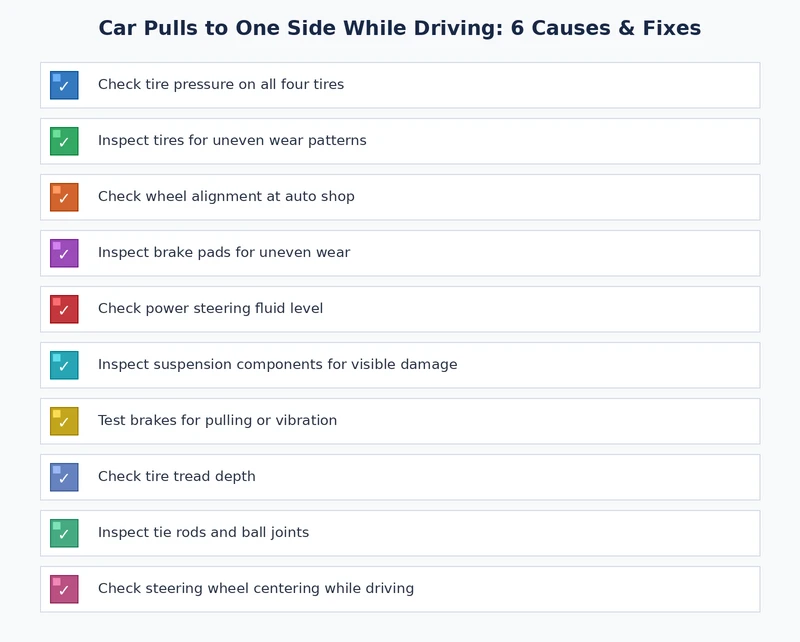
The right repair determines the right toolset. Some fixes need almost nothing. Others require equipment that tips the job toward a professional shop.
For tire pressure and rotation work, the essentials are a reliable tire pressure gauge, a torque wrench to properly tighten lug nuts to spec, and a floor jack with a set of jack stands. For brake repairs, the list expands to include a caliper wind-back tool (used to compress the new caliper piston), a brake bleeder kit, and a standard socket set. Suspension repairs add a ball joint press and control arm bushing driver to the mix.
Wheel alignment is the one job that cannot be replicated at home. It requires a professional alignment rack with sensors mounted to each wheel. Every other repair on this list is within reach for a mechanically inclined driver with the right equipment. Those tackling multiple repairs at once will find that tools like a quality floor jack overlap with many other drivetrain jobs described throughout this site.
Repair costs vary based on the cause, vehicle make, and whether the work is DIY or shop-sourced. Labor is usually the biggest variable — a job that takes a mechanic 45 minutes can take a first-timer half a day. The table below reflects realistic ranges for each repair type.
| Cause | DIY Cost (Parts Only) | Shop Cost (Parts + Labor) | DIY Difficulty |
|---|---|---|---|
| Tire pressure adjustment | Free | Free–$5 | Easy |
| Wheel alignment | Not possible at home | $75–$150 | Shop only |
| Brake caliper replacement | $40–$120 | $200–$450 | Moderate |
| Brake pads (per axle) | $25–$80 | $150–$300 | Easy–Moderate |
| Wheel bearing / hub assembly | $60–$180 | $250–$550 | Hard (press required) |
| Control arm / bushings | $50–$200 | $300–$700 | Hard |
| CV axle shaft | $70–$200 | $300–$600 | Moderate–Hard |
In most cases, tire pressure and alignment together cover the majority of pulling complaints — and they're among the cheapest fixes on the list. Ruling those out first is always the smart move before assuming a more expensive repair is needed.
It depends on the cause. A slight pull from uneven tire pressure is manageable for short trips but should be corrected promptly. A sharp pull under braking, a humming noise, or a sudden worsening of the drift are signs of a safety issue — specifically bad brakes or a failing wheel bearing — that warrant stopping driving and getting the car inspected immediately.
Yes. Uneven tire pressure is one of the most common causes of pulling. A tire with significantly lower PSI than the others sits shorter, causing the car to lean and drift. Uneven tread wear across a tire can produce the same effect. Checking and correcting tire pressure is always the first diagnostic step.
The cost ranges from free (adjusting tire pressure) to $700 or more (control arm replacement with alignment). A wheel alignment — which fixes the most common non-tire cause — runs $75–$150 at most shops. Brake and suspension repairs add labor costs that push totals higher, especially at dealerships.
If misaligned angles are the cause, yes — an alignment will correct the pull. However, alignment won't fix a pull caused by brake, bearing, or suspension issues. Those require their own repairs. Getting an alignment after suspension work is also mandatory, since the repair itself changes wheel geometry.
A pull that occurs specifically under braking — and not during normal driving — almost always points to a brake problem. The most common culprits are a stuck brake caliper, a collapsed brake hose, or severely uneven brake pad wear. The brake system on the pulling side is applying more force than the opposite side, dragging the car in that direction.
Yes. A worn wheel bearing creates drag on the affected wheel, which pulls the vehicle toward that side. The pull from a bad bearing is typically accompanied by a humming or growling noise that increases with vehicle speed. This is a serious safety concern and should be addressed without delay, as a failed bearing can lock the wheel while driving.
Most mechanics recommend checking alignment every 10,000–15,000 miles as part of routine maintenance. It should also be checked immediately after hitting a significant pothole or curb, after any suspension or steering component replacement, and any time the vehicle develops a noticeable pull or the tires begin wearing unevenly.
 |
 |
 |
 |

About Sarah Whitfield
Sarah Whitfield is a diagnostics and troubleshooting specialist who spent ten years as an ASE-certified technician before joining the editorial team. She specializes in OBD-II analysis, electrical gremlins, and the kind of intermittent problems that make most owners give up.
Get some FREE car parts & gear.. Or check out the latest free automotive manuals and build guides here.
Disable your ad blocker to unlock all the hidden deals. Hit the button below 🚗
| | | |
