by Sarah Whitfield
Why does a perfectly capable vehicle develop a disturbing tremor the moment traffic drops below 30 mph — and why does that tremor vanish entirely at highway speed? Car shakes at low speed is one of the most misdiagnosed complaints our team encounters, yet the underlying causes are well understood and largely predictable. Most people assume the worst immediately. In practice, the problem traces back to one of six well-defined mechanical conditions, each with a clear diagnostic path and a definitive fix. Our team has tracked this pattern across hundreds of cases, and the conclusion is consistent: early, systematic diagnosis prevents minor issues from becoming expensive failures.
For a broader overview of related vibration symptoms across all driving conditions, our resource on car shaking while driving covers the full spectrum from idle to highway speeds.
Contents
Understanding why vibration appears specifically at low speed — rather than across all speeds — requires a basic grasp of rotational dynamics. High-speed rotation introduces centrifugal forces and gyroscopic stabilization that mask minor imbalances. At low speeds, those same imbalances produce discrete, low-frequency pulses that the chassis cannot absorb. The result is a shake that is felt most acutely through the steering wheel, seat, and floorpan.
A wheel rotating at 15 mph completes far fewer revolutions per minute than one traveling at 60 mph. The slower rotation means any flat spot, imbalance, or mechanical irregularity produces a vibration whose frequency falls directly within the range that human hands and feet detect most acutely. High-frequency highway vibrations register as a hum or buzz. Low-frequency vibrations feel like a rhythmic lurch or pulse — unmistakable and impossible to ignore.
The National Highway Traffic Safety Administration identifies tire condition as the leading contributor to vehicle handling complaints, and our diagnostic experience confirms that tires account for the majority of low-speed shake cases. However, five other mechanical systems generate identical symptoms, which is precisely why a methodical approach matters more than an instinctive one.
Every vehicle has a natural resonance frequency — a speed range at which vibrations from one component amplify most effectively through the chassis. Many drivers report that their vehicle shakes only within a specific narrow band, such as 5 to 20 mph, then smooths out entirely. This speed-banded behavior is a direct indicator of resonance and immediately narrows the list of probable causes. A vibration that is present at all low speeds points toward a different root cause than one confined to a tight speed window.
Flat-spotting occurs when a tire sits stationary under load for an extended period, deforming the contact patch into a slightly flattened oval. The result is a rhythmic thump that is most pronounced at low speed and diminishes as the tire warms and rounds out — though permanent flat spots from aged rubber never fully recover. Uneven tread wear produces a nearly identical vibration signature, making tires the first item our team inspects without exception.
Tire-related vibration frequently pairs with gradual air pressure loss. Our analysis of why tires slowly lose air explains how a compromised valve stem or bead seal accelerates uneven wear and contributes to low-speed shake. For the full picture of wear patterns and their causes, our guide on unevenly wearing tires details how alignment and suspension conditions drive this type of damage.
Warped rotors produce a vibration that correlates directly with brake application. If the shake intensifies during braking at low speed and disappears during coasting, a distorted rotor surface is the most probable culprit. The technical term is disc thickness variation (DTV) — microscopic differences in rotor thickness that cause the caliper piston to pulse in and out with each revolution, transmitting a rhythmic feedback through the brake pedal and steering wheel.
Rotor warping accelerates when hot rotors are cooled rapidly — a common outcome of aggressive braking followed by immediate parking. Our team recommends a final mile of gentle driving before any sustained stop whenever the brakes have been worked hard, allowing heat to dissipate gradually rather than concentrating at the pad contact zone.
Constant velocity joints allow front axles to transmit power through the full range of suspension travel. A cracked or torn CV boot allows grease to escape and road grit to enter, leading to accelerated wear on the internal bearing surfaces. The resulting vibration at low speed is frequently accompanied by a clicking noise during turns — a combination that is essentially diagnostic on its own.
When a CV joint deteriorates toward failure, it can also generate brake-adjacent sounds that complicate diagnosis. Our post on car makes popping noise when braking provides additional guidance for distinguishing between CV, caliper, and rotor sources when symptoms overlap.
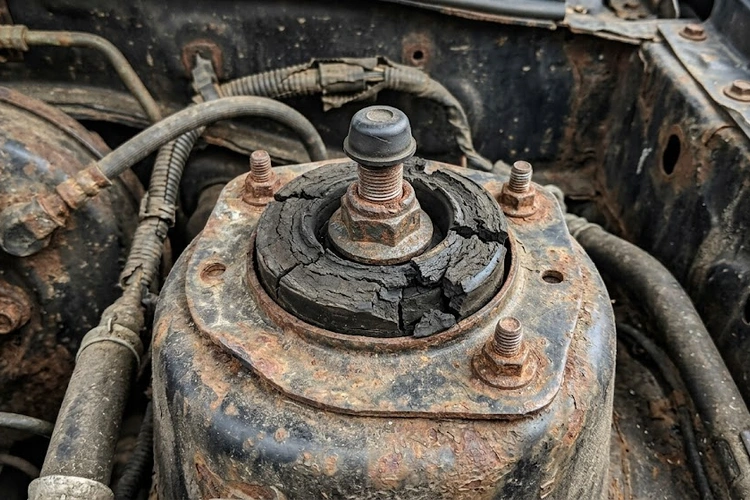
Engine mounts isolate powertrain vibration from the chassis. When a mount deteriorates — whether through rubber degradation, fluid contamination, or structural cracking — the engine's inherent vibration transmits directly into the floorpan and steering column. This type of shake is most severe at idle and during low-speed acceleration, where engine torque loads are highest relative to vehicle speed.
A collapsed mount is identifiable without disassembly. With the vehicle in drive and the foot held firmly on the brake, observe the engine with the hood open. Excessive movement — more than roughly half an inch in any direction — confirms mount failure. Most vehicles have three or four mounts; replacing only the failed unit is acceptable if the remaining mounts test within manufacturer tolerance.
Strut mounts serve as the upper pivot point for front suspension geometry. When the bearing within the mount wears out, the strut cannot rotate smoothly during steering inputs. The resulting friction produces a coarse vibration through the steering wheel at low speeds, particularly during parking maneuvers and slow-speed cornering. Our detailed breakdown of bad strut mount symptoms covers the full range of indicators and typical replacement costs.
Ball joints exhibit a different vibration character — more of a random shimmy than a rhythmic pulse. A worn lower ball joint is a safety-critical failure. It does not tolerate a monitor-and-wait approach.
A loose ball joint can separate without warning at any speed. Our team treats confirmed ball joint wear as a stop-driving condition — not a repair to schedule for next week.
An out-of-balance wheel creates a predictable oscillation that intensifies within a specific speed band. Unlike tire flat spots, imbalance vibration is a smooth wave rather than a rhythmic knock. Static imbalance produces an up-and-down wheel hop; dynamic imbalance produces a side-to-side wobble. Both are correctable with wheel weights at a balancing machine — a process that takes under 30 minutes per wheel and is among the most cost-effective maintenance procedures available.
Alignment drift does not directly cause vibration but creates the uneven tire wear that eventually does. For this reason, wheel balancing and alignment are always addressed together in our diagnostic protocol rather than treated as separate, unrelated services.
The majority of low-speed vibration diagnoses require nothing more sophisticated than basic mechanical tools and systematic observation. Our team's standard toolkit for this class of complaint includes:
An OBD-II scanner is the first tool our team reaches for, not the last. While vibration is generally mechanical rather than electronic, engine misfires, lean fuel conditions, and torque converter shudder all generate vibration symptoms that closely mimic mechanical component failure. Scanning for fault codes before touching any hardware eliminates entire diagnostic branches in under five minutes. A chassis ears electronic stethoscope, though optional, can localize a vibration source to a specific corner of the vehicle with a precision that physical inspection cannot always achieve on its own.
The most powerful diagnostic filter available is the relationship between vibration and specific driving conditions. Our team applies the following matrix before loosening a single fastener:
| Vibration Condition | Most Likely Cause | Secondary Cause |
|---|---|---|
| Only during braking at low speed | Warped brake rotors (DTV) | Loose caliper hardware |
| Constant at low speed, disappears above 30 mph | Tire flat spot or imbalance | Damaged CV joint |
| Worse during slow cornering with an audible click | Worn outer CV joint | Worn wheel bearing |
| At idle and low-speed acceleration only | Failed engine mount | Engine misfire (check codes) |
| Through steering wheel only, not seat or floor | Worn strut mount bearing | Loose tie rod end |
| Whole-body shimmy at very low speed | Worn ball joint | Bent wheel or axle shaft |
Once the condition matrix identifies the most probable cause, our team follows a sequential physical inspection to confirm before ordering parts:
Our experience shows that skipping the lug nut torque check is the most common diagnostic error committed during low-speed vibration investigations — a wheel under-torqued by 40 ft-lb produces a shake that mimics rotor warp closely enough to send most technicians directly to the brake system.
Wheel balancing corrects mass imbalance in the rotating assembly. It does not correct rotor warp, CV joint wear, suspension component play, or engine mount failure. When balancing fails to resolve a low-speed shake — as it frequently does — the correct response is to continue through the diagnostic matrix, not to repeat the balance procedure. Our team considers repeated balancing without resolution a clear signal that the actual cause has not yet been identified. Balancing is one tool among several, not a universal fix.
A flat-spotted tire that shakes for the first few miles before warming and rounding out is not "resolving" — it is returning to a temporarily acceptable state. The flat spot will reform every time the vehicle sits. More critically, drivers who apply this reasoning to ball joint wear or CV joint damage are dismissing a progressive mechanical condition that will not self-correct and will worsen with every mile. Our team treats intermittent vibration with the same urgency as constant vibration, because intermittent means the failure threshold has already been crossed.
Rotor warp and tire flat-spotting affect vehicles of any age and mileage. A two-year-old vehicle left stationary for six weeks will develop tire flat spots. A three-year-old vehicle subjected to repeated aggressive braking will develop disc thickness variation. Mileage is a relevant factor for wear-based failures like CV joints and strut mount bearings, but it is not a prerequisite for any of the six causes documented here. Modern vehicles are not immune.
A consistent presentation: the vehicle shakes noticeably for the first two to four miles of every drive, then the vibration subsides completely until the next cold start. Most people attribute this to a general "warming up" period. The actual mechanism is almost always tire flat-spotting. The contact patch deforms overnight under static load, and the first few miles generate sufficient heat to restore the tire's round profile temporarily. Correct inflation, regular rotation, and tire replacement at appropriate wear intervals are the definitive solutions.
In cold climates, a secondary possibility is ice or compacted snow lodged inside the wheel. The imbalance disappears as the material sheds during driving. Our post on car shakes when put in drive covers cold-start and engagement-phase vibration in additional detail for cases where the shake appears immediately upon selecting drive rather than after a few minutes of movement.
Another common case: a vehicle that shakes specifically during the final 10 to 15 mph of deceleration — coming to rest at a traffic signal, for instance. The steering wheel pulses rhythmically, the brake pedal vibrates underfoot, and the sensation stops the instant the vehicle halts. This is textbook rotor disc thickness variation. The diagnosis takes approximately five minutes with a dial indicator. Resurfacing or replacing the rotors resolves the complaint definitively when DTV is confirmed as the source. No other repair is necessary in the straightforward case.
Several of the six causes documented here are legitimate DIY repairs requiring only basic tools and access to manufacturer torque specifications:
Other repairs in this list require precision measurement equipment, specialty tools, or safety considerations that place them firmly in the professional category:
Our team's standing position: any repair involving the steering system, braking system, or a component whose failure could cause loss of vehicle control warrants professional service unless the home mechanic has directly demonstrated competence with that specific task. The cost of professional labor is always lower than the cost of a collision caused by an incorrect repair.
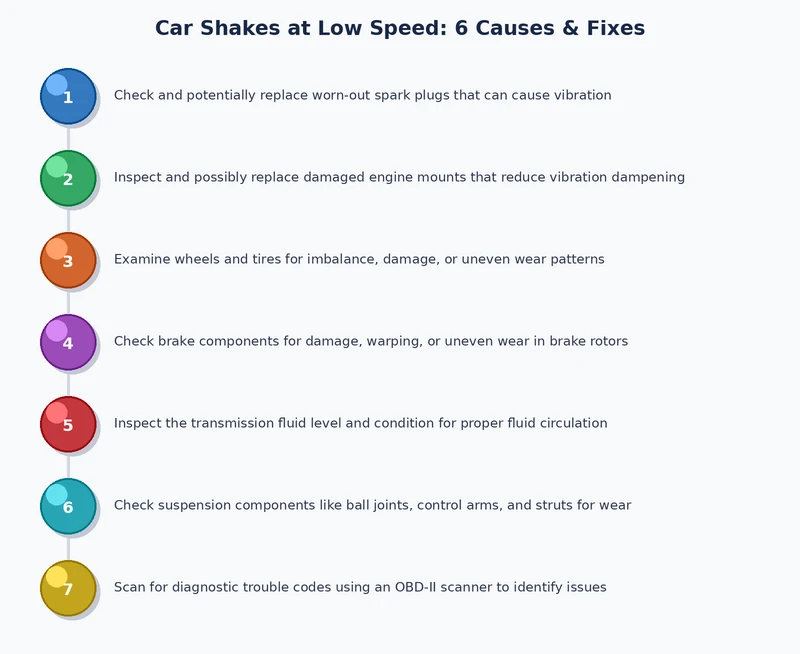
At low speeds, rotational frequency falls within the range that vehicle occupants feel most acutely, and centrifugal stabilization forces are minimal. This allows imbalances from tires, rotors, CV joints, and suspension components to transmit directly through the chassis. At higher speeds, gyroscopic effects and the increased frequency of the vibration shift it out of the perceptible range, which is why the shake often disappears above 30 to 40 mph rather than worsening.
It depends entirely on the cause. A flat-spotted tire or a minor wheel imbalance poses no immediate safety risk, though continued driving will worsen the underlying condition. A worn ball joint, a failing CV joint, or severely warped rotors are a different matter entirely — these represent active safety hazards that our team treats as stop-driving conditions until repaired. Diagnosis before deciding to continue driving is the correct approach.
Tires are the most common single cause of low-speed vibration. Flat spots, cupped tread, uneven wear, and severe imbalance all generate a rhythmic shake that is most pronounced at low speed. A simple inspection — checking tread depth, inflation, and wear pattern across the full tread width — will confirm or rule out tires as the source before any other diagnosis is attempted.
Cost varies widely by cause. Wheel balancing runs $15 to $25 per wheel. A tire rotation and inflation correction may cost nothing beyond shop time. CV axle replacement typically ranges from $200 to $400 per side including labor. Strut mount replacement with bearing averages $150 to $300 per corner. Ball joint replacement ranges from $200 to $500 depending on vehicle design. Engine mount replacement runs $150 to $350 per mount. Rotor replacement with pad service averages $250 to $450 per axle.
Alignment alone will not stop an existing low-speed shake. However, correcting alignment eliminates the uneven tire wear pattern that causes vibration over time, making alignment an essential part of a complete correction rather than a standalone fix. Our team always pairs alignment with wheel balancing and a full tire inspection when addressing vibration complaints.
The most reliable indicator is a clicking or popping sound during slow, full-lock turns in either direction. Vibration caused by a CV joint tends to appear or worsen when the steering wheel is turned near its limits. Visually inspecting the CV boots for tears, cracks, or grease contamination on the inner wheel well provides confirmation. A torn boot does not guarantee joint damage but indicates that contamination has entered the joint and wear is likely underway.
Failed engine mounts produce vibration that is most pronounced at idle and during low-speed acceleration — precisely because engine torque loads are highest relative to vehicle speed in those conditions. At highway speeds, the higher engine RPM shifts the vibration frequency and the symptoms become less perceptible. A quick test is to observe engine movement with the vehicle in drive and the brakes held firmly; excessive powertrain movement under that load is a reliable confirmation of mount failure.
Not always, but it is always a sign that something requires attention. Flat-spotted tires and minor wheel imbalance are straightforward, inexpensive corrections. However, the same symptom can indicate ball joint wear or CV joint failure — conditions that are genuinely serious. The responsible approach is to diagnose the specific cause rather than dismiss the vibration because it does not feel severe. Low-grade, persistent symptoms in vehicles are almost never self-resolving.
A car that shakes at low speed is communicating a mechanical reality — and the vehicle that receives a precise diagnosis and a timely repair is the one that stays reliable, safe, and on the road.
 |
 |
 |
 |

About Sarah Whitfield
Sarah Whitfield is a diagnostics and troubleshooting specialist who spent ten years as an ASE-certified technician before joining the editorial team. She specializes in OBD-II analysis, electrical gremlins, and the kind of intermittent problems that make most owners give up.
Get some FREE car parts & gear.. Or check out the latest free automotive manuals and build guides here.
Disable your ad blocker to unlock all the hidden deals. Hit the button below 🚗
| | | |
