by Sarah Whitfield
Brake-related defects account for roughly 22 percent of all vehicle component failures reported to the National Highway Traffic Safety Administration annually, making the brake system one of the most consequential areas of automotive maintenance a driver encounters. When a car shudders when braking, that pulsating vibration is the brake system communicating a deviation from ideal mechanical operation, and most drivers encounter some form of it during a vehicle's service life. Our team has traced brake shudder to seven distinct root causes, ranging from minor pad deposit buildup to worn suspension components that demand immediate professional intervention.
The vibration manifests as a rhythmic, pulsing sensation transmitted through the steering wheel, the brake pedal, or the entire chassis — and the precise location of that sensation is one of the most reliable diagnostic clues available. Steering wheel shake during braking almost exclusively originates from the front axle, while whole-body shudder without steering wheel movement implicates the rear brake assembly or rear suspension. Our experience confirms that early intervention reduces total repair cost and prevents secondary damage to adjacent components across every case our team has handled.
Contents
Brake shudder is a mechanical feedback loop: as brake pads contact an uneven or thermally distorted rotor surface, the clamping force varies with each rotation, and that variation transmits directly through the suspension and steering column to the driver. The human hand can detect lateral force variations as small as 0.1 pound of side force per revolution, which explains why even minor rotor thickness variation — as little as 0.001 inch — produces a perceptible shudder at highway speeds. Our team consistently finds that drivers describe the sensation as anything from a gentle vibration to a violent wobble, depending entirely on rotor runout severity and vehicle speed at the time of braking.
Two distinct shudder categories appear in diagnostic literature:
Steering wheel vibration during braking almost exclusively originates from the front axle, since the steering column directly connects to the front suspension knuckles and transmits lateral force variation to the driver's hands with minimal attenuation. Seat or floorboard vibration without corresponding steering wheel movement, on the other hand, points toward rear brake assembly issues or rear suspension looseness that only loads under deceleration. Our team uses this front-versus-rear distinction as the mandatory first triage step before any physical inspection, as it immediately narrows the search to one axle and eliminates half of the possible causes from consideration.
Rotor warping — technically called lateral runout or disc thickness variation — is the single most cited cause of brake shudder in independent repair surveys, accounting for an estimated 40 to 50 percent of all shudder complaints seen at general repair shops. Thermal stress from repeated hard braking cycles causes the rotor disc to develop uneven thickness, creating the force variation that transmits as vibration through the suspension. Our measurements on pulled rotors consistently reveal thickness variations exceeding the OEM tolerance of 0.0005 inch on high-mileage vehicles where rotors have never been resurfaced or replaced.
Brake pad material transfer — sometimes called pad glazing — creates irregular deposits of friction compound bonded to the rotor face, producing the same thickness variation effect as geometric warping without any actual rotor deformation. This cause is particularly common after aggressive braking sessions followed by parking with the brakes still hot, which bakes pad compound onto the rotor surface in concentrated patches. Our team's experience is that pad deposit shudder feels nearly identical to rotor warp but responds differently to resurfacing — deposits must be fully removed by machining or the shudder returns within a few hundred miles as the patches rebuild.
Pro Tip: After any high-heat braking event, our team recommends driving at low speed for at least one mile before stopping — this allows rotor temperatures to equalize and prevents concentrated pad material from baking onto the rotor face in permanent patches.
A seized or partially stuck caliper piston applies uneven or continuous clamping force to the rotor, generating both shudder and — critically — asymmetric braking that pulls the vehicle to one side under deceleration. Our detailed breakdown of stuck brake caliper symptoms shows that shudder from this cause typically accompanies a burning smell, abnormal pad wear concentrated on one side of the axle, and directional pull under moderate braking pressure. Caliper seizure is disproportionately common in high-salt climates and in vehicles where brake fluid has absorbed enough moisture to accelerate internal caliper corrosion over multiple seasons.
Worn ball joints, tie rod ends, or control arm bushings allow wheel movement that is not constrained by proper suspension geometry, producing a shudder that manifests during braking as deceleration forces load and expose looseness in the joints. This cause is particularly deceptive because the shudder often disappears entirely at low speeds and only becomes apparent above 50 mph during moderate to hard brake applications, which leads many drivers to assume the brake hardware is at fault. Our team treats every brake shudder complaint with a simultaneous suspension inspection, since replacing rotors without addressing worn bushings or joints produces a recurrence within weeks as the geometry looseness recreates runout at the rotor face.
A worn or pitted wheel bearing introduces lateral play in the hub assembly, which manifests as runout at the rotor face even when the rotor itself is geometrically within specification — effectively mimicking rotor warp in every measurable symptom. The key distinguishing characteristic is that wheel bearing noise, a growling or humming tone that shifts pitch during lane changes, persists outside of braking events where rotor-related shudder is strictly load-dependent and disappears when coasting. Our team treats bearing-induced brake shudder as an urgent safety issue, since a bearing that has progressed far enough to cause measurable hub play is demonstrably close to structural failure with complete wheel separation as the worst-case outcome.
Improperly torqued lug nuts allow the wheel to move microscopically relative to the hub during braking, creating force variations that manifest as a rhythmic shudder often accompanied by a faint clunking sensation at deceleration onset. Our team identifies this as the most easily overlooked cause because it requires no disassembly to diagnose — a torque wrench applied to each lug nut in a star pattern reveals the problem in under five minutes at zero parts cost. OEM torque specifications range from 80 ft-lbs for compact sedans to 140 ft-lbs for full-size trucks, and deviations of even 20 percent from spec are sufficient to produce detectable shudder and dangerous wheel instability.
A faulty ABS wheel speed sensor or a failing ABS control module can trigger spurious ABS activation during normal braking, generating rapid pulsing through the brake pedal that closely resembles mechanical shudder but originates entirely from erroneous electronic intervention rather than any hardware defect. The critical diagnostic differentiator is an illuminated ABS warning light on the instrument cluster — if that warning light accompanies brake shudder, the ABS system deserves investigation before any mechanical components are removed or replaced. Our team consistently finds that drivers conflate normal ABS pulsing on gravel or wet pavement with mechanical shudder, leading to unnecessary rotor and pad replacements that do nothing to address the underlying sensor fault.
The speed range in which shudder manifests carries significant diagnostic weight, and our team uses a structured test sequence to correlate onset speed with probable root cause:
Our team also recommends noting whether the brake pedal pulsates in sync with the shudder — pedal feedback that rhythmically matches the vibration cycle is a near-certain indicator of rotor thickness variation rather than suspension or bearing sources, which tend to produce a more random or directional vibration character.
Physical inspection narrows causation quickly with the following four-step sequence that most people with basic tools can complete in a driveway:
Rotor resurfacing on a brake lathe removes the minimum material necessary to restore a flat, parallel rotor face, and it is economically appropriate when the rotor remains above its minimum thickness specification with sufficient material left for the next pad set's service life. Our team's position is clear: resurfacing suits rotors with minor runout or light deposits, but replacement is the only correct choice when rotors approach minimum thickness, show deep circumferential grooving, or exhibit blue discoloration — none of those conditions improve with machining, and resurfacing them accelerates thermal cracking. Most OEM rotors stamp minimum thickness directly on the rotor hat, ranging from 0.8 to 1.2 mm below new-rotor specification depending on platform.
Proper pad bedding deposits a thin, uniform layer of friction material onto the rotor face, which improves initial bite and prevents the uneven transfer deposits that initiate shudder later in the pad's service life. Our recommended bedding sequence after any pad or rotor replacement:
Warning: Skipping the bedding procedure entirely and making immediate hard stops with new pads is the leading cause of early pad deposit buildup — our team traces a substantial portion of shudder recurrence within the first 5,000 miles directly to this single omission at installation.
The warped rotor diagnosis is so embedded in automotive culture that technicians and owners default to it before ruling out suspension wear, bearing play, or ABS faults — causing expensive rotor replacements that leave the true underlying problem intact. Our team estimates this misdiagnosis rate at 20 to 30 percent in shops that rely on visual inspection and experience rather than a dial indicator measurement of actual rotor runout, which is the only definitive confirmation. Accurate diagnosis requires measuring runout with a dial indicator mounted to the knuckle, and any shop that skips that step is guessing at the most expensive component in the repair chain.
Replacing brake pads on a shuddering vehicle without addressing rotor condition, caliper function, and suspension health is a partial repair that produces a brief symptom-free period before shudder invariably returns — typically within 5,000 to 10,000 miles as the new pads conform to existing rotor defects and recreate the same variation pattern. New pads installed over rotors with runout above spec accelerate wear on the high spots faster than the original pads did, shortening the pad's effective service life and causing the next shudder episode to arrive sooner than expected. Our team's protocol is to inspect and measure all brake and suspension components before authorizing any part replacement.
| Cause | Typical Repair Cost | Safety Severity | DIY Feasible? | Progression Rate |
|---|---|---|---|---|
| Warped Brake Rotors | $150–$400 (replace per axle) | Moderate | Yes — intermediate skill | Gradual over months |
| Uneven Pad Deposits | $80–$250 (resurface + pads) | Low to Moderate | Yes — basic skill | Gradual over weeks |
| Stuck Brake Caliper | $200–$500 per caliper | High | Intermediate | Rapid — days to weeks |
| Worn Suspension Components | $250–$800 (ball joints, bushings) | High | Difficult | Gradual over months |
| Wheel Bearing Failure | $200–$600 per bearing | Very High | Intermediate | Rapid once symptomatic |
| Loose Lug Nuts | $0 (torque wrench only) | Very High | Yes — trivial | Immediate risk |
| ABS System Malfunction | $150–$450 (sensor or module) | Moderate to High | Intermediate | Variable by fault type |
Engine braking — reducing speed through downshifting or applying light, sustained brake pressure rather than a single hard application — distributes thermal load across a longer time window and keeps rotor surface temperatures more uniform, which is the primary mechanism behind rotor distortion prevention. Our team's consistent recommendation is to avoid stopping completely with heavily heated rotors during parking lot arrivals and driveway approaches, as low-speed stops after aggressive braking create the thermal differential that initiates the distortion cycle and promotes the concentrated pad transfer that causes shudder. These two habits alone, practiced consistently, effectively double rotor service intervals compared to drivers who brake aggressively and park immediately after sustained highway deceleration.
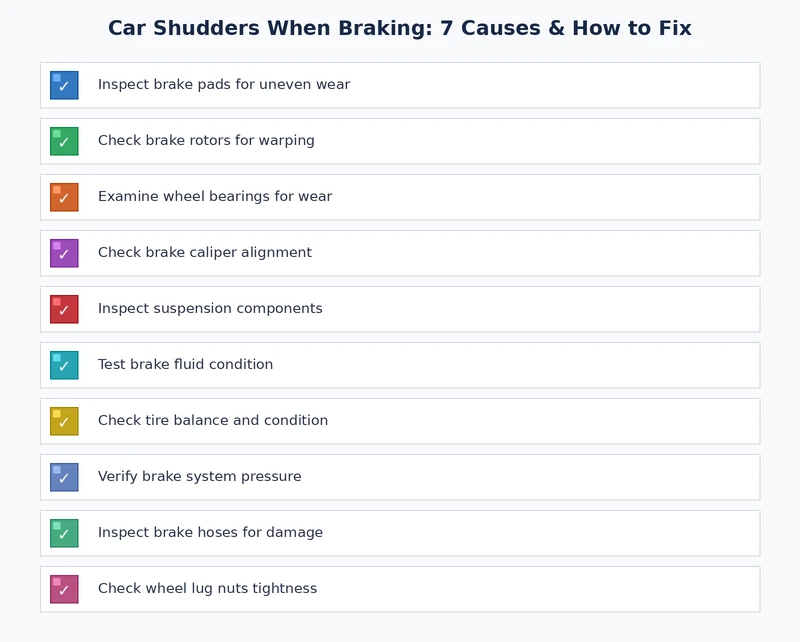
Our team recommends the following interval framework as a minimum standard for catching brake shudder contributors before they produce symptoms that require component replacement:
 |
 |
 |
 |

About Sarah Whitfield
Sarah Whitfield is a diagnostics and troubleshooting specialist who spent ten years as an ASE-certified technician before joining the editorial team. She specializes in OBD-II analysis, electrical gremlins, and the kind of intermittent problems that make most owners give up.
Get some FREE car parts & gear.. Or check out the latest free automotive manuals and build guides here.
Disable your ad blocker to unlock all the hidden deals. Hit the button below 🚗
| | | |
