by Joshua Thomas
You're sitting at a red light, minding your own business, when the engine just dies — no warning, no sputtering, just silence. You restart it, pull into a parking lot, and it dies again the moment you let off the gas. When your car stalls at idle, there's always a specific mechanical reason behind it, and the good news is that it's almost never a mystery if you approach the diagnosis systematically. The seven causes covered in this guide account for the overwhelming majority of idle stalling problems across every make and model, and most of them are absolutely fixable at home. Before diving into each one, it's worth getting familiar with idle air control valve symptoms, since the IAC valve is the single most common culprit behind idle stalling.
Contents
At idle, your engine needs three things working in perfect balance: the right amount of air, a precisely metered fuel charge, and a reliable spark to ignite it every cycle. At highway speeds, the engine pulls enough airflow that small irregularities get masked and the ECU compensates easily. At idle, there's almost no margin for error — even a small disruption to airflow, fuel delivery, or ignition timing causes the RPMs to drop and the engine to quit.
Your ECU relies on a network of sensors to maintain idle stability, constantly adjusting injector pulse width and IAC position to keep the engine running. When one sensor sends bad data, or a valve gets stuck, or a vacuum hose cracks, that balancing act falls apart almost instantly.
Most gasoline engines idle between 600 and 1,000 RPM under normal conditions, according to the U.S. Department of Energy's fuel economy guidance. Cold starts temporarily run higher — sometimes up to 1,500 RPM — before the engine warms up and the idle settles down. If your idle consistently dips below 600 RPM, or if it hunts and surges before dying, you're looking at a problem that needs diagnosis rather than repeated restarts.
Here's every common cause at a glance, along with how hard each fix is and what you'll spend whether you DIY it or go to a shop.
| # | Cause | DIY Difficulty | DIY Cost | Shop Cost | Key Symptom |
|---|---|---|---|---|---|
| 1 | Dirty / Faulty IAC Valve | Easy | $10–$80 | $100–$200 | Stalls in gear, rough low idle |
| 2 | Contaminated MAF Sensor | Easy | $10–$250 | $150–$400 | Stalls on deceleration, poor MPG |
| 3 | Faulty TPS | Moderate | $30–$100 | $150–$300 | Erratic idle, hesitation off throttle |
| 4 | Vacuum Leak | Easy–Moderate | $5–$80 | $100–$400 | High idle, hissing sound |
| 5 | Fuel System Issues | Moderate–Hard | $80–$400 | $200–$700 | Stalls under load, hard hot restart |
| 6 | Bad Ignition Coil / Plugs | Easy–Moderate | $30–$200 | $150–$500 | Misfire codes, rough idle |
| 7 | Stuck EGR Valve | Moderate | $50–$200 | $200–$500 | Rough idle when warm, check engine light |
The IAC valve manages airflow around the throttle plate at idle — when it gets clogged with carbon deposits or fails electrically, your engine simply doesn't get the air it needs to stay running. This is the most common cause of idle stalling on vehicles with over 80,000 miles, and cleaning it costs almost nothing.
Your mass air flow sensor measures incoming air so the ECU can calculate the correct fuel dose — when it's contaminated with oil, dust, or a torn air filter remnant, it sends inaccurate readings and the mixture goes wrong at idle. The fix is almost always a $10 can of MAF cleaner before you even consider replacement.
Our complete guide on mass air flow sensor symptoms covers every warning sign, including how to tell when cleaning won't cut it and replacement is the only path forward.
The TPS tells the ECU exactly where the throttle plate is at every moment — if the signal drops out or reads erratically, the ECU can't calculate correct fuel trim for idle conditions and the engine stalls. You'll usually see a P0121 through P0124 fault code before the stalling becomes consistent.
Read our detailed breakdown of throttle position sensor symptoms to understand how a failing TPS affects drivability in ways that go well beyond idle stalling.
Every rubber hose and plastic fitting in your intake system is a potential failure point — when unmetered air sneaks past the MAF sensor into the engine, the fuel mixture goes lean at idle and the engine can't maintain combustion. Vacuum leaks are sneaky because even a hairline crack causes major idle instability.
A weak fuel pump, clogged injectors, or a failing fuel pressure regulator can all starve the engine at idle — the moment demand drops to minimum, low fuel pressure becomes impossible to compensate for. These problems are usually worse on hot restarts or after sitting in stop-and-go traffic.
Check our guide on fuel pressure regulator failure symptoms to isolate whether the regulator is the culprit before replacing the entire pump assembly on a hunch.
A consistently misfiring cylinder drags down idle RPM in a way the ECU can only partially compensate for — and when idle is already marginal, that single dead cylinder is enough to kill the engine. If you've been driving with a rough idle and ignoring it, start your diagnosis here.
The EGR valve recirculates exhaust gases back into the intake to lower combustion temps and reduce emissions — when it sticks open at idle, it dumps inert exhaust gas into the intake and the engine chokes on it immediately. This is far more common on higher-mileage vehicles where years of exhaust soot have caked the valve pintle solid.
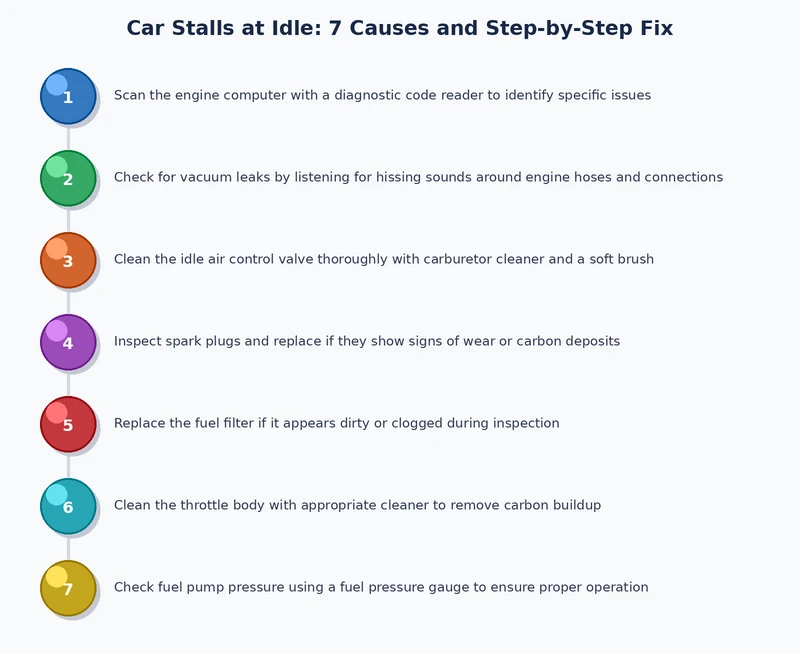
When the obvious causes are ruled out and your car still stalls at idle, move from parts-swapping to data-driven diagnosis — connect an OBD-II scanner that supports live data and watch these specific parameters while the engine idles and then stalls:
If live-data diagnosis comes up clean across all sensors, the stalling cause may be mechanical — low compression from worn rings, a burned valve, or a stretched timing chain can all cause idle instability that no amount of sensor replacement will fix. Run a compression test across all cylinders and verify they're within 10% of each other — a cylinder that reads significantly low points to internal engine wear and a conversation with a professional.
Most idle stalling problems don't appear overnight — they develop slowly as components get dirty or wear out, and consistent maintenance catches them before they strand you. Build these habits into your regular service schedule:
Pro Tip: If your car stalls only when the engine is fully warm but runs fine cold, prioritize the IAC valve and fuel pressure regulator first — both are temperature-sensitive components that fail more predictably under heat than at cold starts.
Labor is almost always the biggest variable in repair cost — what a mechanic does in 20 minutes might take you two hours your first time, but the part cost is identical either way. Here's a realistic breakdown for each of the seven causes:
If you're going to a shop, expect a diagnostic fee of $100–$150 upfront — always ask if it gets credited toward the repair bill, because most reputable shops will apply it.
These fixes are genuinely beginner-friendly — you'll save real money and you won't be risking anything by doing them at home with basic hand tools and a $25 OBD-II scanner:
Some repairs cross into territory where a mistake costs significantly more than the original fix would have — be honest about your skill level and available equipment before starting:
When you brake and decelerate, the engine transitions from throttle input to pure idle — and if the IAC valve is dirty, a vacuum leak is present, or the MAF sensor is sending bad data, the engine can't maintain RPM at that transition point and shuts off. Start by cleaning the IAC valve and throttle body before spending money on sensors, since those two steps fix the majority of stop-related stalling issues.
Yes — a failed O2 sensor sends a flat or incorrect voltage signal to the ECU, which then miscalculates fuel trim and runs the engine too rich or too lean at idle to sustain combustion reliably. If your fuel trims are badly skewed in either direction on live data and your sensors check out, the O2 sensor is a strong suspect worth testing before anything else.
You should get it fixed before relying on the vehicle for regular driving — a car that stalls at idle can die at intersections, in traffic, or during lane changes, creating a real safety hazard for you and everyone around you. Most of the seven causes listed here are inexpensive and straightforward to address, so there's no good reason to put the repair off.
A car that stalls at idle is telling you something specific, and with a methodical approach starting from the IAC valve and working outward through sensors, fuel delivery, and ignition, you'll pinpoint the root cause without blindly swapping parts. Grab a quality OBD-II scanner if you don't already own one, work through the step-by-step diagnosis for each of the seven causes, and check our guides on MAF sensor symptoms and ignition coil failures when you need deeper detail on specific components — most of these repairs are well within reach of any motivated DIYer who's willing to spend an afternoon in the driveway.
 |
 |
 |
 |

About Joshua Thomas
Joshua Thomas just simply loves cars and willing to work on them whenever there's chance... sometimes for free.
He started CarCareTotal back in 2017 from the advices of total strangers who witnessed his amazing skills in car repairs here and there.
His goal with this creation is to help car owners better learn how to maintain and repair their cars; as such, the site would cover alot of areas: troubleshooting, product recommendations, tips & tricks.
Joshua received Bachelor of Science in Mechanical Engineering at San Diego State University.
Get some FREE car parts & gear.. Or check out the latest free automotive manuals and build guides here.
Disable your ad blocker to unlock all the hidden deals. Hit the button below 🚗
| | | |
