by Joshua Thomas
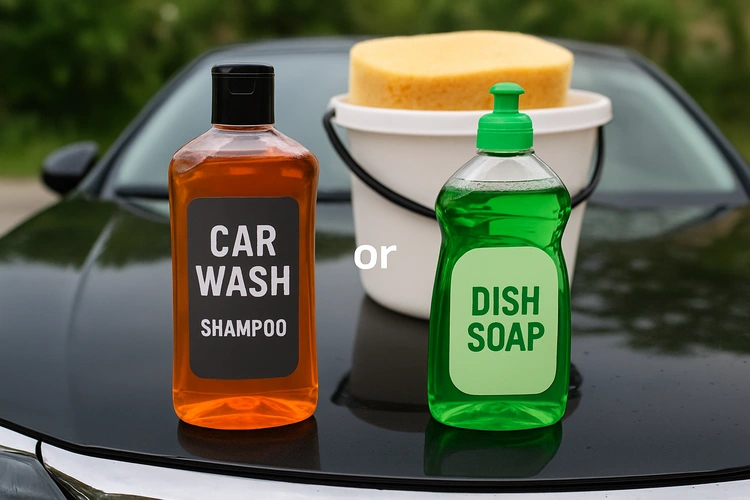
Many drivers have wondered: can you use dish soap to wash a car? It seems like a sensible shortcut — dish soap cuts through grease on plates, so it should handle road grime just as well. The short answer is that dish soap will clean your car, but it will also strip away protective coatings and accelerate paint degradation over time. Before you grab that bottle of Dawn, understand what you're actually putting on your vehicle's finish and why dedicated car wash soaps and shampoos exist in the first place.
Contents
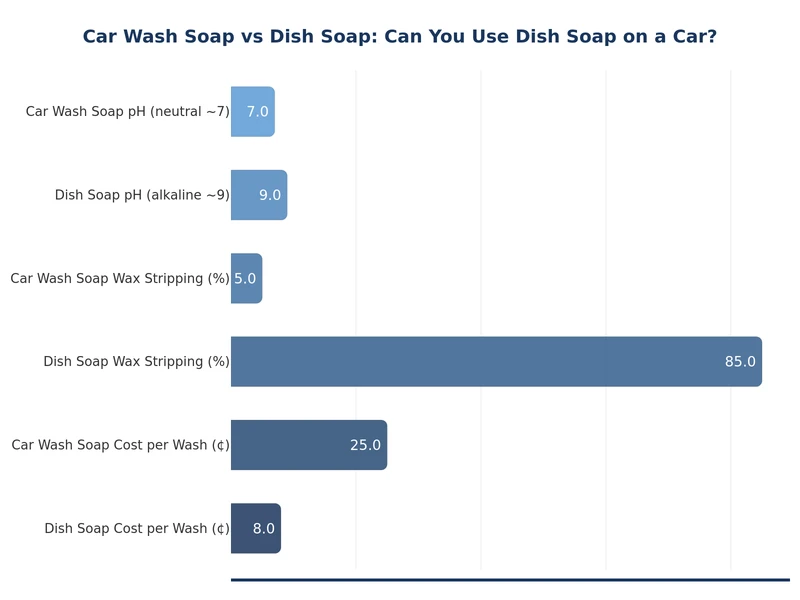
Automotive clear coat is chemically sensitive. Car washing products are engineered to work within a neutral pH range — typically between 6 and 8 — so they lift dirt without attacking the clear coat or underlying paint layers. Dish soaps, on the other hand, are often formulated at a higher pH to aggressively dissolve grease, food residue, and oil. That alkaline chemistry that works brilliantly on pots is the same chemistry that degrades automotive wax, breaks down paint sealants, and — with repeated use — accelerates oxidation of the clear coat itself.
Car wash shampoos contain lubricating surfactants that create a slippery film between your wash mitt and the paint surface. This is critical. A sponge or mitt dragging grit across paint without lubrication is how swirl marks and fine scratches happen. Dish soap formulas prioritize degreasing power and foam, not lubricity. The result is a product that allows more contact friction during washing — a direct contributor to the kind of light scratching that shows up badly on dark vehicles. If you care about keeping your finish scratch-free, check out our guide on how to wash a black car without swirl marks for the full technique breakdown.
Yes, you technically can use dish soap to wash a car — but understanding what happens explains why you shouldn't make it a habit. A single emergency wash with dish soap is unlikely to cause visible damage. The problem is cumulative. Repeated use strips the protective clear coat layer progressively. Once clear coat thins or fails, UV rays reach the base coat directly, causing fading, chalking, and paint oxidation. Repairs at that stage require professional compounding, polishing, or — in severe cases — a repaint. That's an expensive outcome from choosing the wrong cleaner. To understand how UV exposure accelerates this damage, see our guide on how to protect your car paint from sun damage.
Automotive wax and paint sealants are your first line of defense against environmental contaminants, UV rays, and minor abrasions. Dish soap is specifically designed to strip oils and coatings — it does exactly that to your wax layer too. A single wash with dish soap can remove weeks of wax protection. If you've recently applied a ceramic coating or high-quality sealant, dish soap can degrade the bonding layer and drastically shorten its effective life. The economics are simple: a bottle of proper car wash shampoo costs a few dollars and preserves a coating that may have cost hundreds to apply.
| Property | Car Wash Soap | Dish Soap |
|---|---|---|
| pH Range | 6–8 (neutral) | 8–11 (alkaline) |
| Lubricity | High — designed to reduce friction | Low — optimized for degreasing |
| Effect on Wax/Sealant | Preserves protective layer | Strips wax and sealant |
| Effect on Clear Coat | Safe for repeated use | Gradual degradation with repeated use |
| Rinse Residue | Minimal — formulated to rinse clean | Can leave streaks or residue |
| Safe for Rubber & Trim | Yes | Can dry and crack rubber seals |
| Cost per Wash | $0.50–$2.00 depending on product | $0.25–$0.75 |
There is one legitimate use case for dish soap on a car: intentional wax stripping before applying a new coat of wax, paint sealant, or ceramic coating. Detailers sometimes use a diluted dish soap wash as a "prep wash" to ensure the surface is completely free of old wax and oils before bonding a new protective layer. In this context, the stripping action is the point. Outside of this specific scenario, there's no good reason to substitute dish soap for proper car wash shampoo. The marginal cost savings are not worth the cumulative paint and protection damage.
If you're preparing your car for a new wax application and want to know how often that process should happen, our article on how often you should wax your car covers the full schedule and maintenance approach.
The two-bucket method is the standard technique for a scratch-free hand wash. Fill one bucket with clean water and your car wash shampoo at the manufacturer's dilution ratio. Fill a second bucket with plain rinse water. After each pass with your wash mitt, rinse it in the clean water bucket before dipping back into the soap bucket. This prevents transferring grit from the paint surface back onto the mitt — the primary cause of wash-induced swirl marks. Use a grit guard insert in the bottom of each bucket to trap sediment away from your mitt.
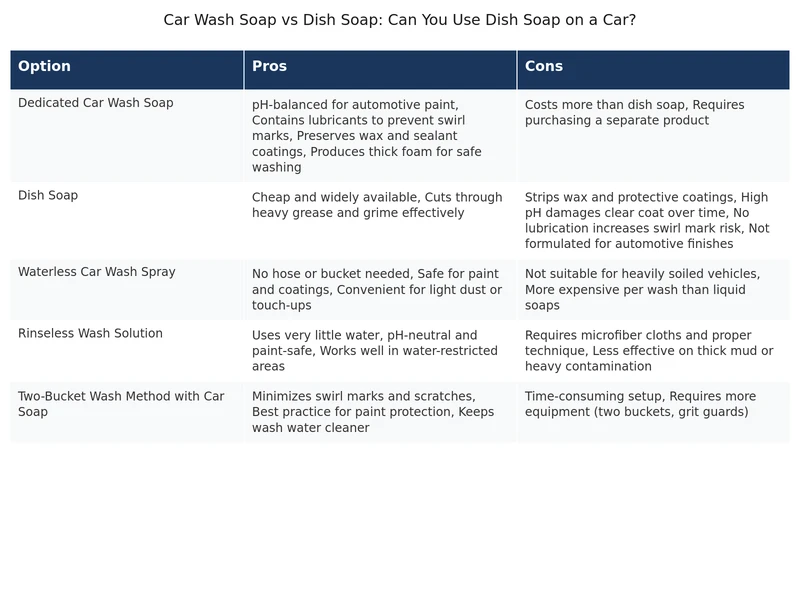
Not all car wash soaps are equal. The main categories are:
Washing with the right product is only one part of paint protection. What you do between washes matters as much. Apply a quality wax or sealant every few months, park in shade or use a car cover when possible, and address contaminants like bird droppings and tree sap promptly — they etch into clear coat chemically and the damage worsens the longer they sit. If minor scratches have already appeared, our guide on how to remove scratches from car paint at home walks through the full correction process by scratch depth. For routine maintenance context, a proper wash fits into the broader car maintenance schedule alongside fluid checks, filter replacements, and tire rotations.
The bottom line on whether you can use dish soap to wash a car: you can, but you shouldn't — at least not regularly. The minor cost savings come at the expense of your paint protection, your wax investment, and ultimately your clear coat. A bottle of dedicated car wash shampoo is cheap insurance. Use the right tool for the job and your paint will stay in better condition for years longer.
A single wash with dish soap is unlikely to cause visible, immediate damage to your paint. However, it will strip your existing wax or sealant protection in that one wash. If you have a ceramic coating, even a single dish soap wash can degrade the bonding layer. It's best to avoid it entirely and keep a bottle of proper car wash shampoo on hand for emergencies.
Dish soap doesn't dissolve paint directly, but its high alkalinity breaks down the clear coat's protective properties over time and strips wax and sealant on contact. Repeated use accelerates clear coat thinning, which allows UV rays and environmental contaminants to reach and damage the base coat underneath.
A pH-neutral car wash shampoo specifically formulated for automotive paint is the safest option. These products are designed to lift dirt without stripping protective coatings, and their lubricating surfactants reduce friction during washing to minimize the risk of swirl marks and fine scratches.
Yes, dish soap is highly effective at stripping car wax — often in a single wash. This is actually the one case where detailers intentionally use diluted dish soap: as a pre-treatment to remove old wax completely before applying a fresh coat or a new paint sealant or ceramic coating.
Dawn, like other dish soaps, has an alkaline pH and strong degreasing surfactants that make it unsuitable for regular car washing. It will strip wax, degrade sealants, and with repeated use contribute to clear coat deterioration. The only appropriate use is intentional wax removal before reapplying a protective coating.
Most vehicles benefit from a wash every two to four weeks under normal driving conditions. Cars exposed to road salt, heavy dust, bird droppings, or tree sap should be washed more frequently, as these contaminants actively damage paint and clear coat the longer they remain on the surface.
 |
 |
 |
 |

About Joshua Thomas
Joshua Thomas just simply loves cars and willing to work on them whenever there's chance... sometimes for free.
He started CarCareTotal back in 2017 from the advices of total strangers who witnessed his amazing skills in car repairs here and there.
His goal with this creation is to help car owners better learn how to maintain and repair their cars; as such, the site would cover alot of areas: troubleshooting, product recommendations, tips & tricks.
Joshua received Bachelor of Science in Mechanical Engineering at San Diego State University.


Get some FREE car parts & gear.. Or check out the latest free automotive manuals and build guides here.
Disable your ad blocker to unlock all the hidden deals. Hit the button below 🚗
| | | |
