by Sarah Whitfield
You turn the key, and the car does absolutely nothing — no click, no crank, just dead silence where a running engine should be. That moment, when your car won't start no click of any kind, leaves most drivers standing in a parking lot with no clear starting point for a diagnosis. The good news is that a completely silent ignition failure almost always traces back to one of six specific electrical components, and most of them are testable with tools you already own.
The absence of a clicking sound is a diagnostic clue in itself. When a starter motor tries to engage, its solenoid produces at least one audible click as it closes the high-current circuit. When that sound never arrives, the electrical signal broke down somewhere before it reached the starter. That insight cuts your diagnostic search considerably, and it separates a no-click condition from a clicking-but-not-cranking condition, which involves a different set of causes entirely.

Contents
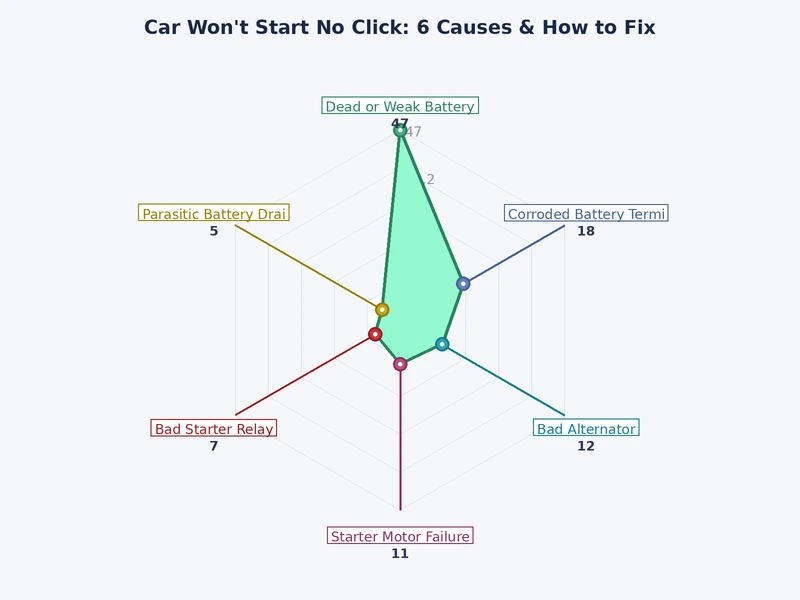
Effective diagnosis starts before you open the hood. Your observations in the first thirty seconds after a failed start will tell you more than a random inspection of individual components. Approaching the problem in a structured sequence also prevents you from replacing parts that are not actually at fault — a costly mistake that is easy to make under pressure.
Before assuming a major failure, run through this checklist in order:
These five steps resolve the diagnosis for a significant portion of no-click complaints. If you observe overlapping electrical symptoms alongside the no-start condition, reviewing common sensor failure patterns can help you rule out secondary electrical problems that sometimes complicate the picture.
Your dashboard and accessories provide valuable diagnostic data during a failed start attempt. A car that goes completely dark — no lights, no radio, no power accessories — points almost exclusively to a dead battery or a catastrophically open connection. A car that powers all accessories normally but still refuses to crank narrows the cause to the starter circuit itself.
Intermittent behavior is also meaningful. A no-click no-start that resolves on its own after a few minutes strongly suggests a failing ignition switch or a loose connection, rather than a fully dead component. Documenting those patterns before ordering parts makes any subsequent diagnosis significantly more accurate.
You do not need a professional shop setup to diagnose most no-click no-start causes, but having the right tools prevents guesswork and avoids the expense of unnecessary part replacements.
The following six causes account for the overwhelming majority of no-click no-start complaints across all vehicle makes and models, according to diagnostic data reported by independent repair facilities. Each cause is listed with a clear explanation of what fails, how to confirm it, and what the repair involves.
A car battery that has discharged below a usable threshold cannot supply the surge of current a starter motor requires. The result is complete silence — no solenoid click, no dashboard response, nothing. This is statistically the most common cause of a no-click no-start condition and deserves to be confirmed before investigating anything else.
To test it, connect a digital multimeter across the battery terminals. A fully charged battery reads 12.6 volts at rest. Anything below 12.0 volts indicates a significant discharge, and a reading below 11.8 volts suggests the battery may no longer accept a full charge at all.
How to fix it: Attempt a jump start first. If the engine cranks and starts normally after a jump, charge the battery fully and then perform a load test. A battery that fails the load test or cannot hold a charge after a full cycle needs replacement. Most automotive batteries show significant performance decline after three years in hot climates and after five years in moderate ones.
Corrosion at the battery terminals creates electrical resistance severe enough to prevent the solenoid from receiving any signal, producing the same dead silence you would get from a completely discharged battery. This cause is particularly common on older vehicles and in humid climates, where the electrochemical reaction between lead clamps and battery acid accelerates considerably.
How to fix it: Disconnect both cables — negative first — and inspect the clamps and battery posts closely. Clean all contact surfaces with a wire brush and a baking soda and water mixture, then rinse, dry, and reconnect. Applying a thin coat of terminal grease after reconnection slows future corrosion and is a step many DIY technicians skip.
Pro tip: Even terminals that look clean externally can have invisible oxidation on their inner contact surfaces — loosen the clamp and rotate it to expose fresh metal before running any electrical test.
The starter motor can fail mechanically or electrically, and when the internal solenoid contacts wear through, the result is no click and no crank even when the battery and connections are in perfect condition. Starters are subject to significant heat cycling over their lifetimes, and the electrical contacts inside the solenoid eventually corrode or erode past the point of reliable operation.
You can find a thorough walkthrough of related symptoms and bypass tests at the guide on how to start a car with a bad starter, which covers direct-trigger methods that isolate the starter from the rest of the circuit.
How to fix it: Use a remote starter switch to apply power directly to the starter solenoid, bypassing the ignition circuit. If the engine still does not crank, confirm that full battery voltage is present at the starter's main terminal. Voltage present but no response confirms starter failure. Rebuilt starters are widely available and typically cost significantly less than new units while performing comparably in most applications.
Most vehicles include a safety switch that prevents the starter from engaging unless the transmission is in Park or Neutral — or, on a manual, unless the clutch is fully pressed. When this switch fails or drifts out of calibration, it sends no signal to the starter circuit, and the car sits in complete silence even when all other components are functioning correctly.
How to fix it: On an automatic, try starting the vehicle in Neutral instead of Park. If it cranks, the switch is misaligned or failing and needs adjustment or replacement. On a manual, fully depress the clutch and rock the pedal slightly while turning the key. Intermittent cranking that responds to pedal movement confirms a failing clutch switch. Replacement switches are generally inexpensive, and the installation is straightforward on most vehicles.
The ignition switch initiates the entire starting sequence by sending voltage through the starter relay. When its internal contacts fail, no signal reaches the solenoid — and the car responds with complete silence on key turn. Ignition switch failure is more common in higher-mileage vehicles and is frequently intermittent during its early stages, which makes it harder to reproduce during a shop visit.
How to fix it: Test for voltage at the starter relay when the key is held in the Start position. If the relay receives no signal, trace the circuit back to the ignition switch and check for output voltage there. Absent output voltage during a start attempt confirms switch failure. Some vehicles require dealer or locksmith programming after replacement due to transponder integration, so confirm your vehicle's requirements before purchasing a part.
A failing ignition switch can also cause intermittent power losses to other systems. These overlapping symptoms occasionally resemble the patterns described in guides covering ignition coil failures, though the root cause and repair path are entirely different.
A fusible link is a short section of wire engineered to fail during a current surge, protecting the rest of the electrical system. When it fails, it cuts power to everything downstream — including the starter circuit. Unlike standard fuses, fusible links are often integrated directly into the wiring harness. They can appear physically intact on the outside while completely open internally, which makes them easy to overlook.
How to fix it: Locate the main fusible links near the battery or along the positive cable in your engine bay. Use a test light or multimeter to check for voltage on both sides of each link. A link that shows voltage on the input side but not the output side has failed and needs replacement. Always match the amperage rating exactly — oversizing a fusible link eliminates its protection function and creates a fire risk. Reviewing guidance on other silent-fail components, such as the symptoms outlined in our fuel pressure regulator failure symptoms article, offers useful context for how electrical interruptions propagate through related systems.
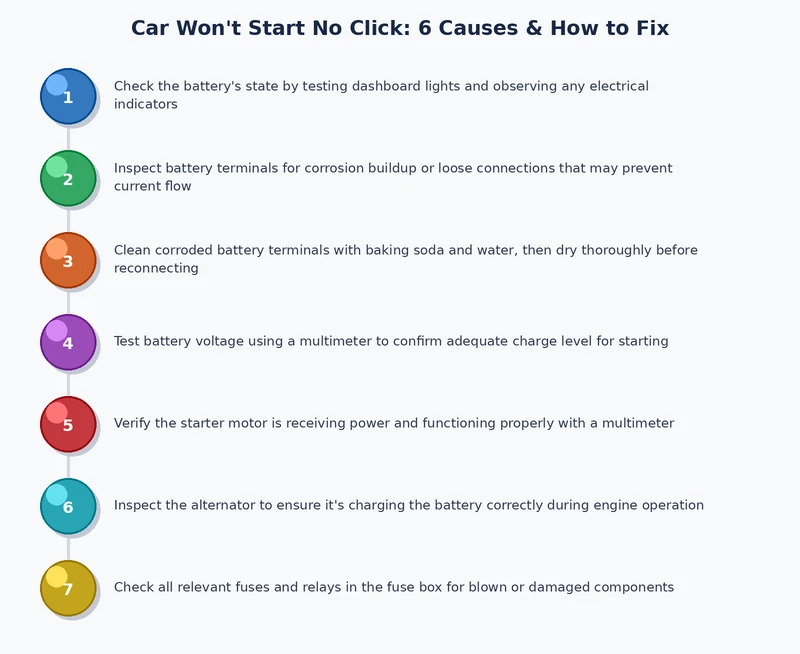
The table below summarizes each cause with its key diagnostic indicator, typical DIY difficulty, average repair cost, and estimated time to complete. Use it to prioritize your diagnostic sequence based on your available tools and experience level.
| Cause | Key Symptom | DIY Difficulty | Avg. Repair Cost | Typical Fix Time |
|---|---|---|---|---|
| Dead / Weak Battery | No lights, no accessories | Easy | $100–$200 (replacement) | 20–45 min |
| Corroded / Loose Terminals | Dim lights, intermittent response | Easy | $5–$30 (cleaning kit) | 15–30 min |
| Faulty Starter Motor | Full power, zero crank response | Moderate | $150–$400 (rebuilt unit) | 1–3 hours |
| Bad Neutral Safety Switch | Starts in Neutral but not Park | Easy–Moderate | $50–$200 | 30–90 min |
| Failed Ignition Switch | Intermittent; no relay click | Moderate | $100–$350 | 1–2 hours |
| Blown Fusible Link | Total electrical loss | Easy–Moderate | $10–$50 | 30–60 min |
Most of the causes behind a no-click no-start are progressive failures — they develop over months or years before they produce a complete stoppage. Building a few inspection habits into your regular maintenance routine can reduce the likelihood of a surprise no-start significantly, particularly as your vehicle passes the five-year mark.
The battery is the most common failure point in the starting circuit and also the easiest to monitor proactively. These habits are worth adding to your regular schedule:
Keeping the battery in good condition connects directly to the health of your broader starting and charging system. The general framework outlined in our vehicle maintenance overview provides useful context for how the battery interacts with other systems over time.
Battery terminals are the most visible connection in the starting circuit, but they are not the only ones that degrade. The main ground strap — the cable from the negative terminal to the chassis or engine block — corrodes internally without showing obvious external symptoms, and it is a frequent source of hard-to-diagnose no-start conditions on older vehicles.
Fusible links and high-amperage fuses deserve a physical inspection every two to three years, particularly after any electrical surge, jump-start incident, or aftermarket accessory installation. Developing the habit of investigating unusual electrical behavior early — rather than waiting for a full failure — pays dividends. For example, the symptoms covered in our idle air control valve guide can sometimes indicate broader wiring or ground faults worth investigating before they cascade into a no-start condition. Similarly, unexplained sensor behavior, like the patterns described in our mass air flow sensor symptoms article, sometimes reflects underlying electrical issues that share a root cause with starting circuit failures.
A no-click no-start condition generates a predictable stream of inaccurate advice in online forums and parking lots alike. Acting on these misconceptions costs time and money, and each one is worth addressing directly before you start replacing parts.
Myth 1: "If the battery was fine yesterday, it can't be the battery." Battery failure can be abrupt, particularly in cold weather or when an internal cell collapses after a period of gradual decline. A battery reading 12.4 volts in the evening can drop below a functional threshold overnight in freezing temperatures, because cold weather increases the current demand of the starter while simultaneously reducing battery output capacity.
Myth 2: "No click means the starter is definitely dead." The starter is only one of six components capable of producing a no-click condition. The battery, terminals, neutral safety switch, ignition switch, and fusible links all generate identical silence when they fail. Testing the starter last — rather than first — saves you the cost of a misdiagnosed replacement.
Myth 3: "Jump-starting always fixes the problem." A jump start provides enough external current to spin the engine, but it does not repair a failed battery or correct a faulty connection. If the underlying cause is not addressed, the no-start condition returns — typically at a less convenient moment. Understanding unrelated symptoms that can appear alongside a starting problem, such as those covered in the exhaust smoke colors guide, helps you separate coincidental issues from your actual diagnosis.
Myth 4: "The key cylinder and the ignition switch are the same part." The mechanical cylinder that accepts your key is a physically separate component from the electrical ignition switch mounted behind it. The cylinder can operate perfectly while the electrical switch fails, and replacing the cylinder in that scenario changes nothing. Diagnosing them as a single unit leads to unnecessary expense and continued confusion when the car still does not start after the work is done.
Complete silence during a start attempt — no click, no crank, no accessory noise — typically means the starting circuit is not receiving power or that the circuit is interrupted before the signal reaches the starter solenoid. The most common causes are a discharged battery, severely corroded terminals, a blown fusible link, or a failed ignition switch. Starting your diagnosis with a battery voltage test and a visual inspection of the terminal connections will resolve the majority of these cases without further disassembly.
Yes — a failed or heavily corroded ground connection is one of the most frequently overlooked causes of a no-click no-start condition. The ground strap connecting the negative battery terminal to the engine block or chassis completes the starter circuit, and when that connection corrodes or breaks internally, the circuit cannot close even when the battery is fully charged. Always inspect and clean the main ground strap as part of any no-start diagnosis, since it can appear visually intact while being open internally.
The quickest field test is to attempt starting the vehicle in Neutral rather than Park on an automatic transmission — or to adjust clutch pedal pressure slightly while turning the key on a manual. If the engine cranks in one position but not another, the switch is either misaligned or failing. A multimeter can confirm the diagnosis by checking whether the switch passes voltage to the starter relay during a start attempt, which removes any remaining uncertainty before you purchase a replacement.
An intermittent no-click no-start warrants diagnosis and repair before you rely on the vehicle for daily use, even if it started eventually on its own. Intermittent conditions typically signal a component in the early stages of failure — most commonly a neutral safety switch, an ignition switch, or a loose electrical connection — and those failures become more frequent and eventually permanent without intervention. Continuing to drive without addressing the cause creates a real risk of being stranded in an unsafe or inconvenient location.
A car that won't start no click is almost always an electrical problem with a clear diagnostic path — start with the battery and terminals, work through the neutral safety switch and ignition switch, and finish with the fusible links, following the sequence in order of likelihood rather than guessing. If your testing confirms a failed starter motor, the guide on how to start a car with a bad starter provides detailed next steps for that specific repair, and if any part of the process exceeds your available tools or comfort level, booking a diagnostic appointment sooner rather than later will save you from a more expensive roadside recovery situation down the line.
 |
 |
 |
 |

About Sarah Whitfield
Sarah Whitfield is a diagnostics and troubleshooting specialist who spent ten years as an ASE-certified technician before joining the editorial team. She specializes in OBD-II analysis, electrical gremlins, and the kind of intermittent problems that make most owners give up.
Get some FREE car parts & gear.. Or check out the latest free automotive manuals and build guides here.
Disable your ad blocker to unlock all the hidden deals. Hit the button below 🚗
| | | |
