by Diego Ramirez
Carnauba wax gives you warmer, deeper gloss that no polymer has fully replicated. Synthetic wax outlasts it by months and resists UV, acid rain, and road fallout without constant touch-ups. When you break down carnauba wax vs synthetic wax honestly, neither wins outright — the right choice depends on what you're protecting, where you park, and how often you want to be back on the driveway with a foam pad.
Both product types have earned a permanent place in serious detailing kits. Browse any of the top picks in our best car wax reviews and you'll see the market split almost evenly between natural carnauba formulas and synthetic polymer or SiO2-based sealants. Understanding what each chemistry actually does to your clear coat is the first step toward spending your money on the right product.
Contents
Carnauba wax is harvested from the leaves of the Copernicia prunifera palm native to northeastern Brazil. Raw carnauba is brittle and nearly unworkable — manufacturers cut it with solvents, beeswax, or other waxes to produce a spreadable paste or liquid. The optical magic comes from carnauba's fatty acid esters, which refract light in a way that reads as liquid depth on curved body panels. That warm, three-dimensional glow is not a marketing fiction. It's a measurable optical property of the natural wax chemistry.
Synthetic wax is built around polysiloxane (silicone) polymers, acrylic resins, or — in current-generation products — silicon dioxide (SiO2) nano-particles suspended in a carrier solution. These polymer chains bond to the clear coat at a molecular level rather than simply sitting on top of it. That bonding difference is the entire reason synthetics outlast carnaubas by a factor of four to eight.
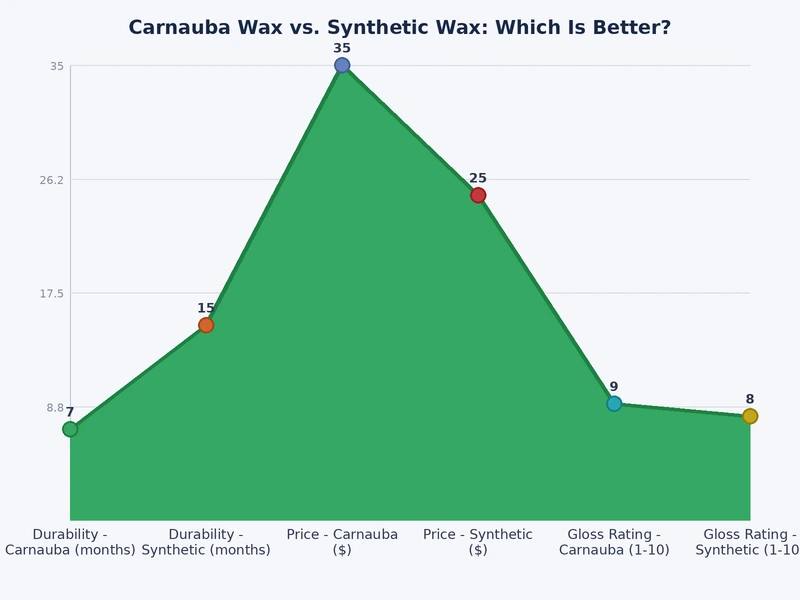
On paper, synthetic wax wins the durability argument without contest: 3–12 months versus 2–8 weeks for most carnauba formulas. In practice, that gap shifts based on how frequently you wash, whether you're parking under trees, and what your climate does. High UV environments are particularly brutal — if you're in a hot region, the strategies in our guide on how to maintain your car in hot weather apply directly to wax longevity as well.
Heat is carnauba's specific vulnerability. The wax begins to soften above roughly 82°C (180°F), which is achievable on a dark hood sitting in direct summer sun for hours. Synthetic polymers don't share that thermal threshold. And if your cooling system is running hot and that heat conducts through the hood, even the best carnauba coat deteriorates faster than expected — a problem worth cross-referencing with engine health before assuming your wax is at fault. High-grade T1 or T2 Brazilian carnauba does form a notably hard sacrificial layer between washes, but it is still no match for a properly applied sealant in sustained outdoor conditions.
Most wax failures trace back to prep, not product quality. Both chemistries require a clean, contaminant-free surface, but synthetic sealants — especially SiO2-based products — are considerably more sensitive to surface oils, silicone residue from previous wax layers, and industrial fallout. If you're switching from a carnauba product to a synthetic for the first time, a full panel wipe with 15–20% isopropyl alcohol solution is mandatory. Skip this and the sealant bonds inconsistently, leaving you with uneven protection and patchy gloss.
Clay bar treatment should precede either product if the paint has any surface contamination. Drag your fingertip in a plastic bag across a freshly washed panel — any roughness or grit means you clay first. Getting the sequence right is part of a broader detailing discipline covered in our guide on how to detail your car's exterior like a pro. Skipping clay and waxing over embedded iron particles causes micro-etching that compounds over time regardless of wax quality.
Never apply wax to a warm hood — let painted surfaces cool to ambient temperature first, or uneven curing will leave streaky residue that requires a complete rework to fix.
Carnauba paste rewards thin application above everything else. Load your foam applicator lightly, work in straight overlapping passes on sections no larger than roughly 2 square feet, and wait for a proper haze before buffing — usually 5 to 15 minutes under normal conditions. Thick application doesn't add protection; it just makes removal harder and wastes a product that isn't cheap. Two thin coats, applied 24 hours apart, outperform a single heavy layer every time.
Liquid synthetics are more forgiving on panel section size but equally sensitive to even distribution. Many SiO2 spray sealants can be applied to a lightly damp panel — check your specific product's directions — making them practical for maintenance applications after a wash. Machine polisher application with a foam finishing pad gives more uniform results on larger vehicles, but hand application is completely viable on compact cars with moderate panel contours.
| Category | Carnauba Wax | Synthetic Wax |
|---|---|---|
| Visual gloss / depth | Warm, organic — best on dark colors | High gloss, cooler tone, strong on light metallics |
| Durability | 2–8 weeks typical | 3–12 months typical |
| UV protection | Moderate | Strong (especially SiO2 formulas) |
| Ease of application | Technique-sensitive | Forgiving, wide margin for error |
| Chemical resistance | Low to moderate | High |
| Cost over time | Higher due to reapplication frequency | Lower per year of coverage |
| New paint compatibility | Safe after full clear coat cure | Check for silicone-free formulas on fresh paint |
On dark paint — deep black, burgundy, navy, forest green — carnauba's warm optical character is genuinely irreplaceable. No synthetic formula currently replicates the three-dimensional liquid depth that high-grade carnauba produces on those colors. It's the product of choice for show car detailers not because of tradition, but because the results are measurably different under proper lighting. T1-grade Brazilian carnauba pastes are also the safest option on fresh factory paint. If you've recently had bodywork completed or taken delivery of a new vehicle, the guidance in our article on how to care for a freshly painted car is worth reading before applying any wax — high-grade carnaubas are solvent-free and won't stress uncured clear coat the way some sealant carriers can.
Synthetic wax earns its keep on daily drivers, outdoor-parked vehicles, and anyone who can't realistically reapply every six weeks. A quality polymer or SiO2 sealant provides meaningful protection against acid rain etching, bird dropping damage, and tree sap bonds — the three most common sources of clear coat degradation in real-world conditions. On silver, white, and light grey metallic finishes, the cooler high-contrast gloss of a synthetic actually reads better to the eye than carnauba's warmer tone.
Hybrid waxes — carnauba blended with synthetic polymer carriers — occupy a practical middle ground. They sacrifice some durability versus a pure synthetic and some visual depth versus a premium carnauba paste, but for most owners the tradeoff makes sense. You get a workable application experience, decent longevity, and gloss that sits comfortably above average.
Streaking consistently traces to three root causes: applying in direct sunlight, using too much product, or removing before the wax has fully hazed. Carnauba typically hazes within 5 to 15 minutes. Synthetic sealants often need 20 to 30 minutes of dwell time, and removing them early leaves a cloudy, uneven film that requires a full rework. If you've got stubborn haze that won't buff clean, apply a thin layer of fresh product over the affected area, let it dwell briefly, then buff off — the fresh product acts as a mild solvent on the residue underneath. For haze baked in by heat, a diluted IPA wipe-down and fresh application is the cleanest path forward.
If your protection is degrading well inside the manufacturer's claimed window, your car wash soap is the most likely culprit. Dish soap and many consumer-grade car wash products contain surfactants that strip wax with every use. Switching to a pH-neutral automotive shampoo will noticeably extend the life of any product, carnauba or synthetic. Touchless car washes that use high-alkaline chemicals are equally destructive — a full detail cycle can be undone in two automatic washes if you're using the wrong chemicals afterward.
Embedded contamination underneath the wax layer is another silent durability killer. Iron fallout and industrial particles that sit between paint and protective layer cause micro-etching that worsens with each weather cycle. Running an iron fallout remover and clay bar before every full application cycle addresses this. The same logic applies when you're dealing with surface damage on plastic bumpers — contamination under any protective product accelerates degradation faster than the environment above it.
Layering carnauba is effective: two to three coats applied 24 hours apart build a measurably harder sacrificial barrier than a single application. Each layer needs to fully cure before the next goes on. With synthetics, most products reach their performance ceiling from a single well-applied coat — additional layers may not bond to the previous layer in the same way and can introduce inconsistent haze.
A technique common among professional detailers: apply one coat of synthetic sealant as a base layer for its chemical resistance and UV blocking, then top-coat with a high-grade carnauba paste for optical depth. The sealant bonds directly to the clear coat; the carnauba bonds to the sealant. You get the durability profile of a synthetic underneath with the gloss character of carnauba on top. Refresh the carnauba top coat as it wears without disturbing the sealant base, and you extend the protection window significantly.
Daily driver, parked outdoors year-round, driven through winter road salt or summer ozone: go synthetic or hybrid. Prioritize UV inhibitors, chemical resistance, and a documented SiO2 percentage. Show car or weekend driver stored in a garage between events: high-grade T1 Brazilian carnauba paste, applied carefully, produces gloss that polymer formulas still haven't matched. Freshly painted car within the first 90 days: use a silicone-free carnauba or a synthetic formula specifically labeled safe for new paint, and avoid anything with aggressive solvent carriers. For current recommendations across every use case and price point, the best car wax reviews guide covers the options worth considering.
Read product labels critically before purchasing. Carnauba content percentages are frequently misleading — a product marketed as carnauba wax may contain as little as 3 to 5 percent actual carnauba. Formulas with meaningful carnauba content will specify T1 or T2 Brazilian grade and cost noticeably more per tin. With synthetics, look for clearly stated SiO2 percentages and durability claims supported by real-world user testing rather than lab conditions. The difference between a $12 spray sealant and a $45 one is often precisely that documentation.
Most carnauba wax formulas last 2 to 8 weeks depending on wash frequency, climate, and carnauba grade. Quality synthetic waxes and sealants typically last 3 to 12 months under the same conditions. The gap is real, but pH-neutral wash products and reduced automatic car wash use will extend either product significantly.
Yes, and many professional detailers do exactly this. Apply the synthetic sealant first, let it cure fully for 12 to 24 hours, then apply carnauba on top. The sealant provides durability and UV resistance while the carnauba adds optical depth. Refresh the carnauba top coat as it wears without stripping the base layer.
For dark paint — black, deep red, navy, forest green — carnauba's warm, three-dimensional gloss is widely preferred among detailers because it enhances depth in a way synthetic polymers currently don't replicate. On lighter colors like silver or white metallic, the cooler high-contrast finish of a synthetic often looks better to the eye.
No. Quality synthetic waxes and sealants bond to clear coat without degrading it. Some early polymer formulas contained solvents that could stress uncured paint, but modern products are clear coat safe. If you're working on a freshly painted car, look specifically for formulas labeled safe for new paint and avoid anything with aggressive solvent carriers.
With carnauba wax, every 4 to 8 weeks is the practical maintenance schedule for outdoor-parked vehicles. With a quality synthetic sealant, twice a year is typically sufficient in moderate climates, though high-UV or coastal environments may warrant three applications. The bead test is your real indicator: when water stops beading and starts sheeting flat, it's time to reapply.
Synthetic wax is the practical choice for most daily drivers. The extended protection window means fewer applications, and the superior chemical and UV resistance handles real-world conditions more reliably. Carnauba is ideal when visual gloss is the primary priority and you're willing to reapply every few weeks — a trade-off that makes more sense for show cars and weekend vehicles than vehicles in daily use.
The wax you actually use consistently beats the premium product sitting unopened in your garage — match the product to your schedule, not your ambitions.
 |
 |
 |
 |

About Diego Ramirez
Diego Ramirez is a maintenance and care specialist who has been wrenching on cars since he was sixteen. He focuses on fluid changes, preventive care routines, paint protection, and the small habits that turn a five-year-old car into a fifteen-year-old car.
Get some FREE car parts & gear.. Or check out the latest free automotive manuals and build guides here.
Disable your ad blocker to unlock all the hidden deals. Hit the button below 🚗
| | | |
