Audio ›
by Joshua Thomas
Wondering whether the choice between component vs coaxial car speakers actually matters for the average driver? It does — and the difference can range from subtle to genuinely transformative depending on listening habits, budget, and how much effort someone wants to put into the install. Car audio upgrades have become far more accessible in recent years, with quality options at nearly every price point, and the speaker type is usually the single biggest factor shaping the final sound. Before diving into specs and trade-offs, browsing the best car speakers available across both categories helps set realistic expectations. Both designs have earned their place in the market, and understanding where each one excels makes it much easier to choose wisely.

Contents
Most factory-installed car speakers are engineered to balance cost with basic functionality, which means they typically deliver audio that is functional but rarely impressive. The aftermarket has long been organized around two primary categories: coaxial speakers (also called full-range speakers) and component systems. Each category approaches sound reproduction differently, and those differences shape everything from installation time to the final listening experience. According to Wikipedia's overview of loudspeaker technology, speakers convert electrical signals into sound by vibrating a diaphragm — but how each speaker type handles different frequency ranges is where the paths diverge in meaningful ways.
Coaxial speakers pack multiple drivers (the individual speaker elements) into a single unit by mounting a tweeter (high-frequency driver) directly on top of the woofer (low-frequency driver) along a shared axis — hence the name "coaxial." Everything lives in one housing, making installation straightforward and compatible with most factory speaker cutouts. The crossover (a small electronic filter that divides audio into frequency ranges) is built directly into the speaker, keeping the wiring simple and the setup self-contained. For drivers who want a meaningful upgrade over factory audio without rewiring the entire vehicle, coaxials are typically the first and most logical stop.
Component systems take a fundamentally different approach by separating each driver into its own dedicated unit. A standard setup includes a standalone woofer, a separate tweeter, and an external crossover — all connected together but mounted in different locations throughout the vehicle. The tweeter typically installs near the A-pillar (the structural column between the windshield and the front door) while the woofer sits in the door panel, and this physical separation allows each driver to be positioned precisely for the best possible sound. The external crossover provides more refined frequency management than a built-in passive unit can deliver, and the result is generally superior sound staging — that sense of three-dimensional space where instruments and vocals feel placed across a wide, lifelike field rather than emanating from a single point.
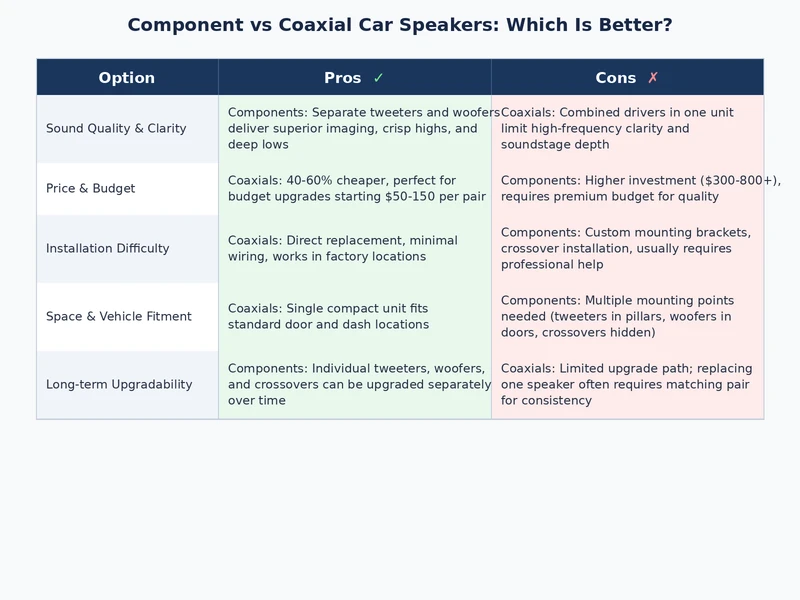
The component vs coaxial car speakers debate consistently comes down to a handful of practical factors: budget, installation effort, and what the listener actually values in their audio experience. Coaxial speakers tend to cost less, install faster, and work reliably with factory head units (the stereo receiver). Component systems command a higher price and require more planning and labor, but they reward that investment with measurably better sound quality in the right setup. The table below captures the core differences clearly.
| Feature | Coaxial Speakers | Component Speakers |
|---|---|---|
| Typical Price Range (pair) | $30–$150 | $100–$500+ |
| Installation Complexity | Low (drop-in replacement) | High (multiple locations) |
| Sound Quality | Good | Excellent |
| Sound Staging | Limited | Superior |
| Crossover Type | Built-in passive | External passive or active |
| Amplifier Needed? | Usually no | Strongly recommended |
| Best For | Budget upgrades, beginners | Audiophiles, custom installs |
Coaxial speakers fit directly into factory speaker openings in most vehicles, so installation typically requires removing a door panel, swapping the speaker into the existing mount, and reconnecting the original wiring harness. The job often takes under two hours per door for a confident DIYer. Component systems, by contrast, require mapping out where each element will live, running additional wiring between the crossover and each driver, and mounting tweeters in positions that may demand custom brackets or panel modifications. Anyone dealing with other vehicle electrical issues simultaneously — such as investigating flickering dashboard lights that can signal unstable voltage — should address those concerns before adding the power draw of a new audio system.
One of the most impactful advantages component systems offer is the ability to place the tweeter at or near ear level, often near the top of the door or the A-pillar. When high frequencies originate from that elevated position, the soundstage expands noticeably — music feels like it projects forward from in front of the listener rather than rising awkwardly from the floor. Coaxial speakers, with both drivers housed in the door panel, tend to produce a lower and less dimensional sound field, which most casual listeners accept without complaint but dedicated music fans find limiting over time. The gap between the two types becomes especially apparent with acoustic music, jazz, or recordings with strong vocal presence.
Pro tip: Always check factory speaker size using a vehicle-specific fitment guide before purchasing — buying speakers that don't match the existing cutout dimensions is a very common and frustrating mistake that costs both time and money.
Every speaker design involves trade-offs, and neither coaxial nor component speakers escape that reality. Knowing where each type genuinely excels — and where it falls short — helps buyers set accurate expectations and avoid disappointment after the purchase.
The most compelling strength of coaxial speakers is convenience paired with reliable performance. Because everything is self-contained within a single housing, the installation is predictable and the internal crossover handles frequency splitting automatically without requiring any additional components or wiring decisions. Heat is a real concern for electronic components in vehicles, and the relative simplicity of coaxial designs makes them somewhat more forgiving in extreme temperature conditions — a meaningful factor for anyone following guidance on how to maintain a car in hot weather, where dashboard and door panel temperatures can climb well past 120°F on sunny days. Budget-conscious buyers will also find that quality coaxial pairs from established brands deliver genuinely satisfying audio at a fraction of what component systems cost.
Component speakers produce noticeably cleaner high-frequency reproduction because the tweeter operates in complete isolation, free from the mechanical vibrations and resonance interference that affect a tweeter mounted directly on top of a woofer cone. The external crossover also allows more precise frequency management, typically with adjustable attenuation (a small dial that controls output level for individual drivers) to fine-tune the balance between highs and lows for a specific vehicle's acoustics. Moisture inside door panels is a legitimate long-term threat to any speaker installation — water intrusion is worth understanding and preventing, as described in this walkthrough of water leaking into the car floor. A consistently damp speaker enclosure can permanently degrade even the most expensive components regardless of brand.
Not every driver needs the same audio setup, and the best choice typically comes down to how invested someone wants to be in the car audio experience. The divide between casual everyday listeners and dedicated audio enthusiasts is real, and it shapes what makes practical sense to buy and install.
Drivers who primarily use their car audio system for background music, podcasts, or hands-free calls during a daily commute will almost certainly find that quality coaxial speakers represent outstanding value. The improvement over factory speakers is substantial and immediately noticeable without requiring professional installation or any additional components. A solid pair of coaxials installed on a weekend afternoon delivers results that satisfy most listeners for years without any follow-up maintenance. It is worth keeping in mind that a healthy vehicle electrical system supports better audio performance — battery terminal corrosion can cause voltage drops that affect how amplifiers and head units perform, so addressing any electrical maintenance needs before an audio upgrade pays dividends.
Warning: Running component speakers off a factory head unit without a dedicated amplifier can produce worse results than coaxials — underpowered tweeters are prone to distortion at higher volumes, which defeats the purpose of the upgrade entirely.
Drivers who genuinely care about audio fidelity — those who notice the difference between a well-mastered album and a heavily compressed stream — will find component speakers deeply rewarding, provided the rest of the audio chain is built to support them. Component systems almost universally benefit from a separate amplifier, and pairing them with an aftermarket head unit that offers more power and equalization options unlocks their full potential. The combined investment in time and money is meaningful, but so is the payoff for listeners who spend significant hours on the road. The component vs coaxial car speakers question comes into its sharpest focus at this enthusiast level, where the engineering differences between the two designs translate directly into audible, measurable results that even non-technical listeners can appreciate immediately.
Regardless of which speaker type drivers ultimately choose, a few practical strategies dramatically improve the outcome of any car audio upgrade and are often overlooked in favor of focusing solely on speaker specs.
Sound deadening material — mass-loaded vinyl or butyl rubber sheets applied to the inside face of door panels — is one of the most underrated upgrades in all of car audio. Bare sheet metal resonates and vibrates at certain frequencies, muddying bass response and creating buzzing sensations that can be distracting and hard to diagnose. This kind of cabin rattle is sometimes initially mistaken for mechanical issues, not unlike trying to distinguish a knocking noise when going over bumps from a creaking suspension — the sounds overlap enough to cause confusion until each source is isolated. Adding even a basic layer of sound deadening transforms the listening experience by giving speakers a more rigid, enclosed mounting surface that reduces unwanted resonance and tightens bass response considerably.
Component speaker installations that require custom tweeter mounting locations, amplifier wiring, or modifications to factory panels often benefit from professional installation — particularly when vehicle warranty concerns are present or when the wiring complexity exceeds what a first-time installer feels comfortable tackling. A skilled installer can also position tweeters with precision, ensuring the soundstage is balanced and centered from the driver's seat rather than skewed to one side. For straightforward coaxial swaps in standard door locations, however, a capable DIYer with basic hand tools and a few hours can typically complete the job cleanly. Plenty of vehicle-specific installation guides and wiring diagrams are freely available, and the component vs coaxial car speakers decision should weigh installation confidence as seriously as budget and sound preferences.
Not always — it depends on the listener's priorities and the supporting equipment. Component speakers deliver superior sound staging and cleaner high-frequency reproduction, but they require more investment in installation and often an external amplifier to perform well. For casual listeners with factory head units and modest budgets, quality coaxial speakers frequently represent a better overall value.
Yes, coaxial speakers can be connected to an external amplifier, and doing so typically improves clarity and dynamics noticeably. Most coaxial speakers have sensitivity and impedance ratings that make them compatible with aftermarket amplifiers. Just make sure the amplifier's power output matches the speaker's RMS (continuous power handling) rating rather than its peak rating to avoid damage.
Professional installation costs vary based on location and the complexity of the specific vehicle, but most shops charge between $100 and $300 for a front component speaker installation when the customer supplies the speakers. Jobs that include amplifier wiring, custom tweeter brackets, or sound deadening can push that figure higher, sometimes significantly depending on vehicle access.
Component speakers do not strictly require a special head unit, but they perform best when paired with a head unit that offers more output power or preamp outputs for connecting an external amplifier. Running components off a low-power factory head unit is possible, but the results will be underwhelming and may produce distortion at moderate to high volumes, which can over time damage the tweeters.
Component speakers can be installed in virtually any vehicle, but the ease of installation varies considerably. Some vehicles have convenient locations near the A-pillar for tweeter mounting while others require more creative solutions. Door panel depth, wire routing options, and existing factory mounting provisions all affect how straightforward the process will be, which is why consulting a vehicle-specific installation guide before purchasing is always worth the time.
The component vs coaxial car speakers decision ultimately comes down to matching the right tool to the right listener — there is no single correct answer, only the answer that fits each driver's budget, vehicle, and expectations. Those ready to explore specific models and compare options should start with the best car speakers guide to find well-reviewed picks across both categories, then make a choice with confidence knowing exactly what trade-offs each path involves.
 |
 |
 |
 |

About Joshua Thomas
Joshua Thomas holds a Bachelor of Science in Mechanical Engineering from San Diego State University and has spent years applying that technical foundation to hands-on automotive work — from routine maintenance to full mechanical repairs. He founded CarCareTotal in 2017 to give car owners the kind of clear, practical guidance that helps them understand what is happening under the hood and make smarter decisions about upkeep and repairs. At CarCareTotal, he oversees editorial direction and covers automotive fundamentals, maintenance guides, and troubleshooting resources for everyday drivers.
Get some FREE car parts & gear.. Or check out the latest free automotive manuals and build guides here.
Disable your ad blocker to unlock all the hidden deals. Hit the button below 🚗
| | | |
