by Joshua Thomas
One of our team members drove a friend's SUV last fall and noticed a sharp clicking sound every time the front wheels turned sharply. It seemed like a minor annoyance. Two weeks later, that same SUV needed a complete CV axle replacement. Catching CV axle noise symptoms early is the difference between a simple boot swap and a full axle job that costs four times as much.
CV axles (constant-velocity axles) are the shafts that transfer power from the transmission to the wheels. They're wrapped in rubber boots packed with grease to keep the joints moving smoothly under load and through tight angles. When those boots crack, grease escapes, dirt gets in, and wear accelerates fast. Our team has diagnosed these issues across dozens of vehicles, and the pattern is always the same — ignore the noise early, pay big later.
If a full replacement ends up being necessary, our guide on CV joint replacement cost covers what most people can expect to pay across different vehicle types and regions.
Contents
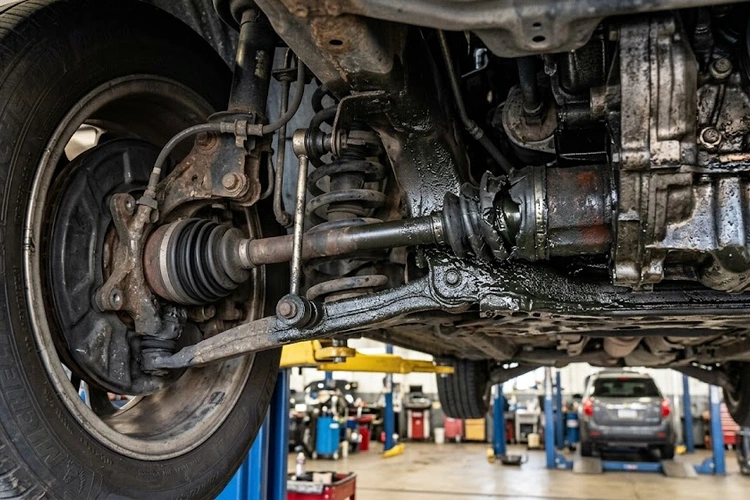
Not all axle noise sounds the same. The type of noise points directly to which part is failing and how advanced the damage is. Our team listens carefully during test drives because the sound itself tells most of the story.
The most recognizable of all CV axle noise symptoms is a sharp, rhythmic clicking during turns. It shows up in the front wheels and gets loudest in tight, slow turns — like pulling into a parking space or navigating a roundabout. The sound comes from a worn outer CV joint struggling to maintain smooth movement through the steering arc.
What makes this noise distinct:
It's tempting to confuse this with loose lug nut symptoms, but lug nut noise tends to be a heavier, irregular knock. The CV click is sharper and strictly tied to turning angle.
A dull clunk when accelerating from a full stop usually points to the inner CV joint. The inner joint absorbs acceleration forces, and when it wears down, power delivery becomes jerky and inconsistent. Some people feel this more than hear it — a shudder through the floorboard or seat when the gas pedal first engages.
Vibration that grows worse at highway speeds is another warning. A bent axle shaft or a severely worn joint creates an imbalance that sends a shimmy through the entire drivetrain. Our team frequently finds this paired with hesitation at highway speeds when drivetrain components are simultaneously under stress.
A low, continuous hum or grinding that changes with wheel speed usually means the joint has run completely dry. This is late-stage damage. Metal grinding against metal generates serious heat and destroys the remaining joint material fast. At this point, a replacement is urgent.
Our team's rule: if grinding has replaced clicking, the window for a cheap repair has already closed. Every mile driven in this condition costs more at the shop.
Understanding the root causes helps most people catch problems before the noise even starts. Our team sees the same failure patterns repeatedly, and they almost always trace back to one of three sources.
The CV boot — that accordion-shaped rubber cover on each joint — keeps grease in and contaminants out. When it cracks or tears, grease flings outward during rotation and debris works its way in. This is far and away the number one cause of CV axle failure.
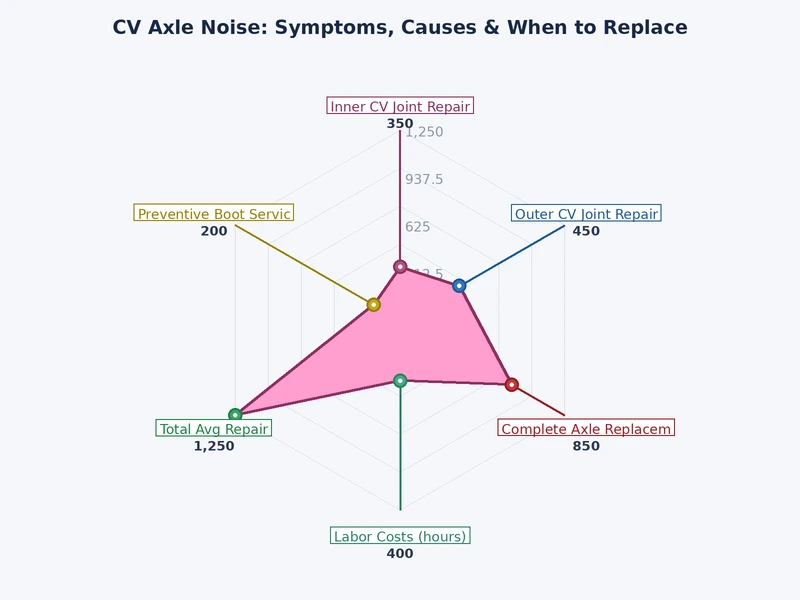
A torn boot caught early costs $30–$80 to replace. Left unchecked, the same joint will need a full axle replacement within months. According to Wikipedia's article on constant-velocity joints, these joints are engineered to handle wide operating angles smoothly — but only when properly lubricated. Without grease, failure is rapid and inevitable.
Most CV axles are built to last 80,000–150,000 miles under normal conditions. Beyond that range, the internal joint surfaces wear thin from years of constant flex and load. Rubber boots also harden and crack from heat cycles alone, independent of mileage.
| Mileage Range | Typical Condition | Recommended Action |
|---|---|---|
| Under 60,000 miles | Joints intact; boots usually healthy | Quick visual check at each oil change |
| 60,000–100,000 miles | Boots may show early hardening or minor cracks | Inspect boots carefully; replace if cracked |
| 100,000–150,000 miles | Joints approaching wear limit; boots at higher risk | Listen for clicking; inspect both boots and joints |
| Over 150,000 miles | High failure risk across all components | Proactive replacement strongly recommended |
Constant off-road driving, potholes, and aggressive cornering accelerate CV wear significantly. Front-wheel-drive vehicles take the hardest hit — the front axles handle both power delivery and steering simultaneously, which stresses outer joints far more than most people realize.
Our team recommends boot inspections every 15,000 miles for anyone who regularly drives on rough roads or unpaved surfaces — not just at standard service intervals.
Our team uses a three-step process to confirm CV axle noise symptoms before recommending any repair. Most of these checks take under 15 minutes and require no tools.
This is the single most reliable field test for outer CV joint failure. Here's how our team runs it:
If clicking appears in one direction only, the outer joint on the side toward the turn is usually failing. If both directions produce noise, both outer joints likely need attention. A clean result in both directions points away from the outer joint — time to check the inner joint instead.
Most people can see the CV boots without lifting the vehicle. On a flat surface, crouch at each front wheel and look toward the axle shaft. What our team looks for:
Grease flung outward during driving coats surrounding metal quickly — this is often visible well before any noise starts. Our team also uses this inspection to catch other nearby wear. Brake rotor surface rust and worn suspension bushings frequently appear on the same high-mileage vehicles where CV boots are degrading.
A shop inspection with a proper lift is necessary when:
In those cases, a visual check from outside the vehicle won't be enough. A mechanic needs to assess the joint under controlled movement to catch the full extent of the damage.
This is the section most drivers skip — and then regret. Our team has watched the full progression from early click to complete axle failure, and it follows the same trajectory every time.
A clicking CV joint doesn't stabilize or heal on its own. The progression is predictable:
Stage 4 is uncommon but not rare. Our team has seen complete axle separations on vehicles whose owners delayed repairs for months. That outcome can also affect connected systems — a bouncing or erratic speedometer occasionally traces back to drivetrain vibration from a failing axle affecting the wheel speed sensor signal.
A CV axle that's clicking today and ignored for two months rarely just gets louder — it gets expensive. Our team has seen $80 boot jobs turn into $400 axle replacements that could have been prevented.
When the joint damage is too advanced for a boot replacement, the full axle shaft comes out. The job involves removing the wheel, disconnecting the hub nut, and pulling the shaft free from the transmission. Remanufactured axles are widely available and perform reliably at a lower cost than OEM parts. Most shops complete one side in 1–2 hours.
For a full pricing breakdown by vehicle type and labor market, our CV joint replacement cost guide gives realistic numbers. If the inner joint is severely worn, it's also worth asking the shop to check for any automatic transmission downshift issues at the same visit — inner joint failure and transmission output wear sometimes occur together on high-mileage vehicles.
Most CV axle failures are preventable. Our team's best guidance comes from tracking what separates axles that fail at 80,000 miles from those that run cleanly past 150,000.
The single most effective thing anyone can do is glance at the boots during every oil change. A cracked boot caught early costs $40–$80. The same joint ignored for six months costs $250–$400. The math is obvious.
Our team's boot inspection checklist:
Most vehicles have four CV joints — two inner and two outer per driven axle. AWD vehicles have up to eight. Each one deserves 30 seconds of attention at every service visit.
Hard cornering at speed, aggressive use over potholes, and wheel spin under load all shorten CV axle life measurably. Here's what our team recommends to extend axle lifespan:
Normal everyday driving doesn't stress CV axles significantly. It's the extreme angles, hard impacts, and prolonged grease starvation that cause failures. Consistent inspections and reasonable driving habits keep most axles running well past their expected service life.
Our team recommends addressing the issue within a few weeks of first noticing clicking. The progression from early noise to joint failure varies by vehicle and driving style, but most ignored CV joints reach severe damage within one to three months of the first symptoms. The sooner the repair, the lower the cost.
It depends on the noise type. The classic clicking sound is loudest at low speeds during tight turns. Humming or vibration from a severely worn axle tends to worsen at highway speeds. Both patterns are warning signs — the difference is the stage of damage.
Yes, and it's common. Worn wheel bearings, loose lug nuts, and worn sway bar links can all mimic CV axle sounds. Our team always starts with the full-lock turning test. If the noise appears during slow tight turns and disappears on straight roads, a CV joint is the primary suspect.
Not always. Our team inspects the opposite side carefully whenever one axle is replaced. If both shafts have comparable mileage and the boots show similar wear, replacing both simultaneously saves a second labor charge later. If the other side looks clean and healthy, replacing just the failed axle is the right call.
A boot replacement is the right repair when the joint itself is still in good condition — no clicking, no wear marks, just a cracked rubber cover. Once noise is present, the joint has already run without grease and wear has occurred. In that case, repairing the boot alone won't stop the problem, and a full axle replacement is the correct fix.
A CV axle asks for almost nothing — just a healthy boot and enough grease — and ignoring that small ask always turns into a big bill at the worst possible time.
 |
 |
 |
 |

About Joshua Thomas
Joshua Thomas just simply loves cars and willing to work on them whenever there's chance... sometimes for free.
He started CarCareTotal back in 2017 from the advices of total strangers who witnessed his amazing skills in car repairs here and there.
His goal with this creation is to help car owners better learn how to maintain and repair their cars; as such, the site would cover alot of areas: troubleshooting, product recommendations, tips & tricks.
Joshua received Bachelor of Science in Mechanical Engineering at San Diego State University.
Get some FREE car parts & gear.. Or check out the latest free automotive manuals and build guides here.
Disable your ad blocker to unlock all the hidden deals. Hit the button below 🚗
| | | |
