by Sarah Whitfield
A differential fluid leak demands attention — ignoring differential fluid leak symptoms long enough leads to metal-on-metal contact inside the axle housing, which ends in a rebuild or full replacement costing well over a thousand dollars. The differential (a gearbox that splits engine power between driven wheels) relies on thick gear oil to keep its ring, pinion, and spider gears lubricated under heavy load, and once that oil level drops, wear accelerates faster than most drivers expect.
Most drivers notice the warning signs only after damage has already started. Spotting the leak early and understanding exactly which symptoms point to a differential problem makes the difference between a $30 seal job and a $1,500 axle overhaul. Drivers already familiar with noise-based warnings can cross-reference this guide with a closer look at rear differential noise symptoms for a complete diagnostic picture.
Contents
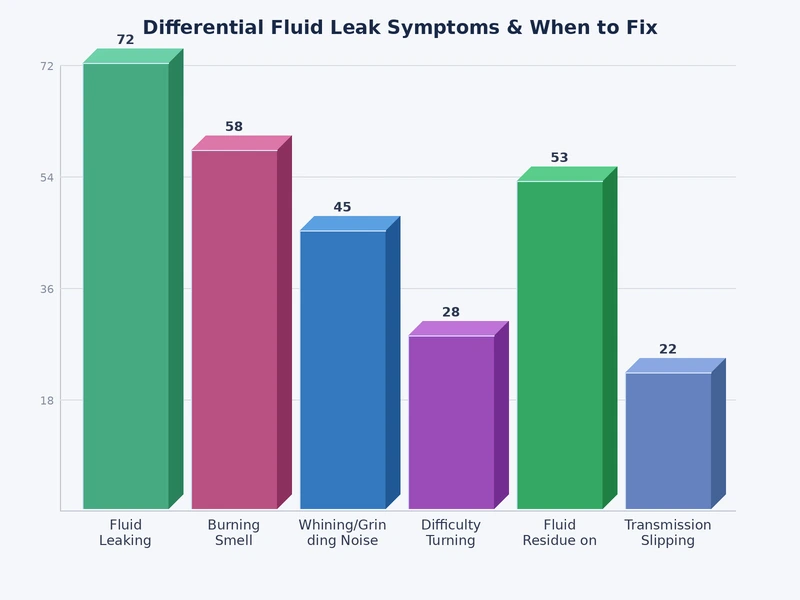
Differential fluid leak symptoms fall into three reliable categories: visual evidence under the vehicle, audible changes while driving, and handling shifts that feel unusual for the road surface. Experienced technicians always check all three before drawing conclusions, because any single clue alone can point toward several different problems.
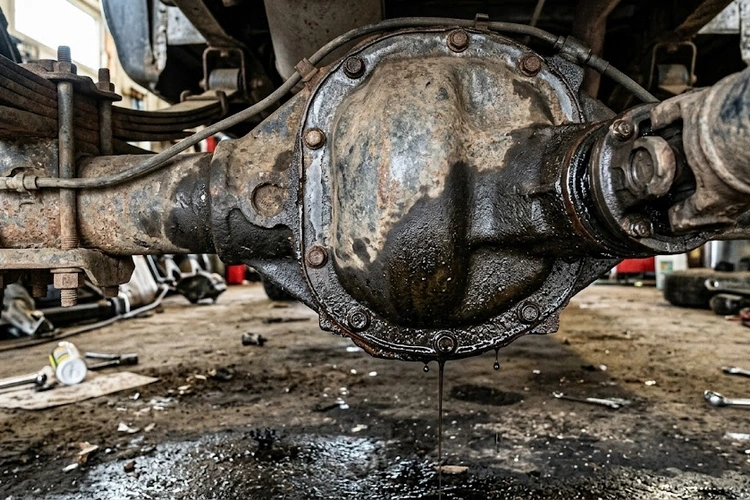
The most obvious sign is a dark, oily patch on the garage floor or driveway, appearing directly beneath the rear axle housing on rear-wheel-drive vehicles, or near the front axle on all-wheel-drive and 4WD models. Differential gear oil is thicker than engine oil and carries a distinctive sulfur-like odor that is hard to mistake once familiar with it. The leak most commonly appears around three specific points: the pinion seal (where the driveshaft enters the differential housing), the axle seals (one on each side where the axles exit), or the differential cover gasket along the back of the housing. Placing clean cardboard under the axle overnight confirms the leak location with minimal guesswork before pulling out any tools.
Unexplained burning or sulfur smells from the undercarriage — especially after highway driving — signal that gear oil is contacting hot metal surfaces nearby. Drivers who detect these odors should also consult a guide on how to diagnose strange car smells to rule out overlapping fluid sources before assuming the differential is the only culprit.
A differential running low on gear oil produces a distinct whining or humming noise that changes pitch with vehicle speed, separating it from tire noise, which tends to remain constant across speeds. A grinding or growling sound that worsens during turns — particularly at low speeds in parking lots — points to worn differential bearings that are starved of lubrication. Drivers also report a clunking sensation during acceleration from a stop as differential internal components develop play from inadequate lubrication. Vehicles with 4WD systems that feel binding or stuck during turns should also be evaluated for drivetrain engagement issues as described in the guide covering a car stuck in 4WD, since a damaged differential can mimic transfer case problems.
Diagnosing a differential fluid leak accurately requires a small set of tools that most home mechanics either already own or can purchase inexpensively at any auto parts store. No specialized equipment is needed for the initial inspection phase.
The undercarriage inspection should always begin with a cold vehicle to avoid burns from hot exhaust components, and to let fresh oil drips settle into a visible pattern. Technicians who plan to check nearby components during the same session — including exhaust mounts and undercarriage brackets — can combine the task with a heat shield rattle check to maximize time under the vehicle.
The differential fill plug sits on the side of the housing, positioned at the level of the correct fluid fill line. With the vehicle on level ground, removing the plug and inserting a clean finger confirms whether fluid sits at the proper height. Fluid that sits more than half an inch below the plug opening indicates a meaningful loss. Most differentials hold between one and two quarts of gear oil, so even a modest leak can drop levels significantly over several weeks of normal driving.
Regular differential fluid service is the single most effective preventive measure against seal degradation and bearing failure. The fluid does not merely lubricate — it also carries heat away from the ring and pinion gears and suspends metallic wear particles, preventing them from recirculating through the bearing surfaces.
| Vehicle Type | Recommended Interval | Key Notes |
|---|---|---|
| Rear-wheel-drive car (open differential) | Every 30,000–50,000 miles | More frequent if vehicle tows a trailer regularly |
| Pickup truck (open differential) | Every 30,000 miles | Inspect immediately after off-road or water crossing use |
| Limited-slip differential (LSD) | Every 15,000–30,000 miles | Requires friction modifier additive; check manufacturer spec |
| Full-time 4WD (front and rear differentials) | Every 25,000–30,000 miles | Two separate differentials require individual service |
| Locking differential | Every 15,000 miles | Inspect for water contamination after off-road exposure |
Using the wrong viscosity or specification of gear oil accelerates seal wear and degrades bearing surfaces faster than low fluid levels alone. Most modern differentials require a specific API GL-4 or GL-5 rated gear oil, and limited-slip differentials need a friction modifier additive mixed into the fluid. Using standard gear oil in a limited-slip unit causes a characteristic chatter during tight turns — a symptom that leads many owners to suspect a leak rather than the wrong lubricant. Drivers performing their own fluid services benefit from reviewing proper flush discipline, similar to the complete-replacement approach described in a guide on how to flush power steering fluid, since partial top-offs without full draining leave degraded fluid in the housing.
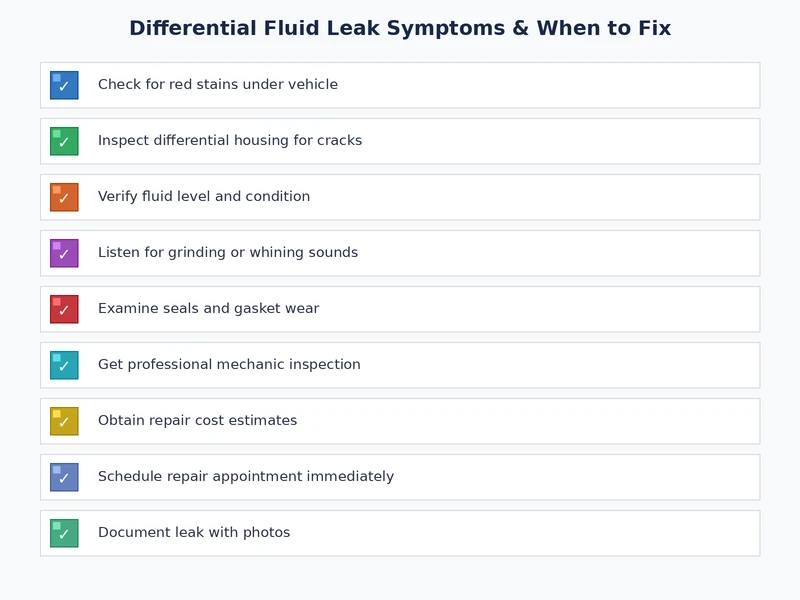
Not every differential leak is an emergency, but none should be ignored indefinitely. The distinction between urgent and non-urgent situations allows drivers to make informed decisions without unnecessary alarm or avoidable delay.
These situations require stopping further driving until a repair is completed. Operating a differential with critically low fluid causes bearing failure within hours of continued highway use, and bearing failure frequently destroys the ring and pinion gears in the same event.
A very slow seep — identified only as slight dampness around the axle seal with no puddle formation on the ground — typically allows the owner to schedule a shop appointment within one to two weeks, provided the fluid level is checked every few days during that period. Long-term vehicle storage introduces a separate risk: seals dry out and shrink when a vehicle sits unused for extended periods, making a post-storage inspection important before returning to regular driving. Drivers bringing a stored vehicle back into service should follow guidance on maintaining a car that sits unused for months to avoid multiple fluid and seal problems appearing simultaneously after the vehicle returns to road use.
Pickup trucks and body-on-frame SUVs with solid rear axles carry the heaviest differential loads and show the highest seal and gasket failure rates after 100,000 miles of service. Vehicles with both front and rear differentials — full-time 4WD systems — double the number of potential leak points that require monitoring. According to NHTSA (National Highway Traffic Safety Administration) consumer complaint data, drivetrain-related fluid leaks represent a consistent reporting category across all major truck platforms, with pinion seals and cover gaskets cited most frequently in owner submissions.
Front-wheel-drive vehicles use a transaxle (a combined transmission and differential unit) rather than a separate differential housing, which means a transaxle leak is sometimes misdiagnosed as a pure transmission issue rather than a differential problem. Rear-wheel-drive passenger cars with solid rear axles develop pinion seal leaks most frequently, as the pinion seal endures the most movement and heat cycling of any seal in the entire differential assembly. Subtle handling changes that accompany gradual fluid loss are often missed without a formal check — a baseline wheel alignment check helps identify uneven wear patterns that develop when differential looseness begins affecting axle geometry.
Replacing a differential cover gasket — the most common leak point on most trucks and SUVs — falls within reach of any home mechanic comfortable with basic hand tools. The process involves draining the old fluid, removing the cover bolts, cleaning both mating surfaces thoroughly, applying a new gasket or RTV sealant (room-temperature-vulcanizing silicone compound), reinstalling the cover to torque spec, and refilling with fresh gear oil of the correct specification. Pinion seal replacement is also DIY-accessible on most vehicles but requires a pinion nut socket and a torque wrench to achieve proper preload on the pinion bearing — skipping the torque step causes premature seal failure that brings the problem back within months.
Axle bearing replacement, ring-and-pinion gear damage, and any internal differential rebuild require specialized equipment — including a bearing press and dial indicator gauges — that most home mechanics do not own. A shop with differential rebuild experience will verify gear backlash (the precise clearance between meshing gear teeth) to manufacturer tolerances, a measurement that determines whether the completed repair runs quietly and lasts years or develops noise and fails prematurely. Any repair involving gear contact pattern adjustment belongs exclusively in a shop environment with proper tooling and reference specifications.
The most expensive misconception in differential maintenance is that a slow leak stays slow indefinitely. Seals that have begun to fail continue deteriorating with each heat cycle — expanding when hot, contracting when cold — and a seep that appears stable for weeks typically accelerates when ambient temperatures change seasonally or when the vehicle takes on a heavy load. The gear oil level drops while the visible puddle remains small, creating false confidence right up until bearing noise begins.
Adding gear oil to a leaking differential buys time for a proper repair — it does not constitute one. The same compromised seal that allows fluid to escape also allows road contamination, moisture, and grit to enter the housing, and gear oil exposed to water or abrasive particles loses its protective film strength rapidly. Drivers who habitually top off rather than repair the seal typically find that the differential requires a complete rebuild at the point they finally address the root cause, at a cost several times higher than the original seal replacement would have been.
Specifications vary significantly across manufacturers and differential designs. Using GL-5 oil in a differential designed for GL-4 can attack yellow metal components such as brass synchronizer rings present in some transaxle designs, while using the wrong friction modifier in a limited-slip unit causes clutch pack wear that mimics a mechanical failure. Drivetrain noise from a differential and noise from a timing chain can overlap in frequency range, causing some drivers to misattribute the source — a thorough comparison of symptoms from a timing chain noise guide helps separate internal drivetrain noise sources accurately before committing to any specific repair path.
Differential gear oil appears as a dark brown or black oily residue, thicker and more viscous than engine oil. It often carries a distinctive sulfur or rotten-egg odor that becomes noticeable near the axle area, particularly after the vehicle has been driven at highway speeds and the differential housing is hot.
The answer depends entirely on the severity of the leak. A very slow seep with fluid still at the correct level may allow one to two weeks of careful driving with daily level checks. An active drip or any audible grinding noise means the vehicle should not be driven until repaired, as bearing failure can occur within hours under those conditions.
The pinion seal, axle seals, and differential cover gasket account for the vast majority of leaks. These components fail due to heat cycling over time, physical damage from road debris, improper installation during a previous service, or the natural hardening and shrinkage of rubber seals in high-mileage vehicles.
A pinion seal or axle seal replacement at a shop typically runs between $150 and $350 per seal, including labor. A cover gasket replacement is usually $100 to $250. Bearing replacement or a full differential rebuild ranges from $400 to $1,500 or more depending on the vehicle and the extent of damage caused by running low on fluid.
Yes. With the vehicle on level ground, removing the differential fill plug — located on the side of the housing — and inserting a clean finger allows a direct check of the fluid level. Fluid should sit at or just below the bottom edge of the fill plug opening. Fluid sitting more than half an inch below that point indicates a meaningful loss that requires attention.
Differential gear oil has a recognizable sulfur-based odor that becomes more pronounced when the fluid contacts hot metal surfaces. Drivers who notice a burning or sulfur smell from the rear of the vehicle after highway driving — without any engine-area source — should inspect the differential housing and axle seals as a priority.
Most open differentials require a fluid change every 30,000 to 50,000 miles under normal driving conditions. Limited-slip differentials need service every 15,000 to 30,000 miles due to the friction modifier breaking down faster. Vehicles used for towing or off-road driving should follow the shorter end of those intervals regardless of visible leaks.
 |
 |
 |
 |

About Sarah Whitfield
Sarah Whitfield is a diagnostics and troubleshooting specialist who spent ten years as an ASE-certified technician before joining the editorial team. She specializes in OBD-II analysis, electrical gremlins, and the kind of intermittent problems that make most owners give up.
Get some FREE car parts & gear.. Or check out the latest free automotive manuals and build guides here.
Disable your ad blocker to unlock all the hidden deals. Hit the button below 🚗
| | | |
