by Sarah Whitfield
A customer brought in a mid-size sedan with a rough idle and a faint exhaust smell bleeding into the cabin. The check engine light had been illuminated for weeks, and fuel economy had dropped noticeably on the highway. After pulling codes and running a smoke test, the diagnosis was immediate: a carbon-fouled EGR valve, stuck in the open position. It is a scenario our team encounters regularly, and one that most drivers dismiss far too long before seeking a repair.
EGR valve symptoms are among the more deceptive warning signs in automotive diagnostics. The exhaust gas recirculation valve is a critical emissions component that also plays a direct role in engine performance. When it fails — whether through carbon buildup, electrical malfunction, or mechanical wear — the engine's air-fuel balance is disrupted in ways that cascade into misfires, knock, and elevated emissions. For context on how these symptoms intersect with ignition problems, our guide on engine misfire symptoms offers a valuable companion read. This article covers the six most common EGR valve symptoms, explains how the system works, and walks through diagnosis, cleaning, and replacement.
Contents
The EGR valve fails in two primary modes: it sticks open or sticks closed. Each produces a distinct cluster of symptoms. Recognizing them early limits downstream damage to components like the catalytic converter and oxygen sensors — repairs that cost considerably more than a valve replacement.
A stuck-open EGR valve floods the intake manifold with exhaust gas at idle — a condition the engine's fuel map is not calibrated to handle. The result is an unstable idle that may dip dangerously low, causing stalling at traffic lights or during slow parking maneuvers. This symptom is one of the most reliable EGR valve symptoms and should prompt immediate inspection rather than continued driving.
A failed EGR valve almost always triggers a check engine light. The most common diagnostic trouble codes are P0400 through P0409, which reference EGR flow malfunctions. P0401 (insufficient EGR flow) and P0402 (excessive EGR flow) appear most frequently in our diagnostic experience. Running an OBD-II scan tool is the fastest way to confirm whether EGR valve symptoms are the source of the warning, rather than assuming a more expensive failure is at fault.
When exhaust gas recirculation is disrupted, combustion efficiency drops. An EGR valve that stays closed deprives the engine of the dilution effect that moderates peak combustion temperatures. The ECM compensates by enriching the fuel mixture, which increases consumption. Most drivers notice a measurable drop in miles per gallon before any other symptoms become obvious — making this an early-warning signal worth tracking.
The EGR system's primary design purpose is to reduce nitrogen oxide (NOx) emissions by lowering combustion temperatures. A malfunctioning valve causes NOx output to spike well above legal thresholds. This is one of the most consequential EGR valve symptoms for drivers in states with mandatory tailpipe testing, as the vehicle will not pass inspection until the fault is corrected and the system is verified under load.
Elevated combustion temperatures — a direct result of a stuck-closed EGR valve — cause the air-fuel mixture to autoignite before the spark plug fires. This produces the characteristic pinging or knocking sound under acceleration or load. Persistent detonation is not a minor nuisance: it causes measurable damage to pistons, cylinder walls, and rod bearings over time. Any knock that coincides with other EGR valve symptoms warrants urgent attention.
A stuck-open EGR valve at highway speeds introduces excessive exhaust gas into the intake charge, disrupting combustion and producing thick, black exhaust smoke. Our guide on exhaust smoke colors covers the complete diagnostic spectrum, but black smoke paired with a rough-running engine is a strong and specific indicator of EGR-related trouble rather than a fueling or injector fault.
Understanding the EGR system's function makes diagnosis more intuitive. The exhaust gas recirculation system routes a metered portion of spent exhaust gas back into the intake manifold. This chemically inert gas displaces a fraction of the incoming air-fuel charge, lowering peak combustion temperatures and suppressing NOx formation. The valve itself controls the volume of recirculated gas based on signals from the engine control module.
Modern vehicles use one of two primary designs. Vacuum-operated EGR valves, common on vehicles produced before the late 1990s, rely on manifold vacuum to open against a spring. Electronic EGR valves, now standard across virtually all modern platforms, are driven by a solenoid or stepper motor controlled directly by the ECM. The failure modes differ accordingly: vacuum valves fail mechanically through diaphragm rupture or pintle seizure, while electronic valves also fail through wiring harness faults, position sensor degradation, and solenoid burnout.
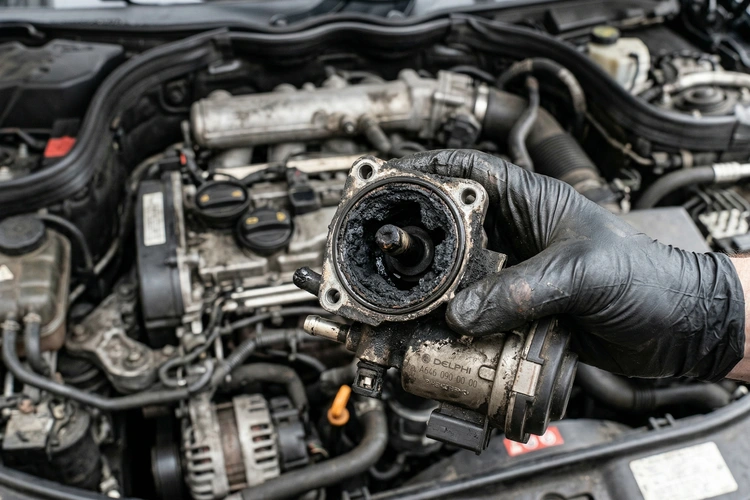
Carbon deposits from recirculated exhaust gases are the leading cause of EGR valve failure across all engine types. Soot accumulates on the valve seat, pintle, and surrounding passages until the valve can no longer open or close fully. High-mileage vehicles operated primarily on short trips are most susceptible: the engine never fully reaches operating temperature, and incomplete combustion accelerates deposit formation. Components that share the same intake environment are equally vulnerable — our analysis of mass air flow sensor symptoms demonstrates how carbon fouling degrades sensor accuracy and produces similar drivability complaints.
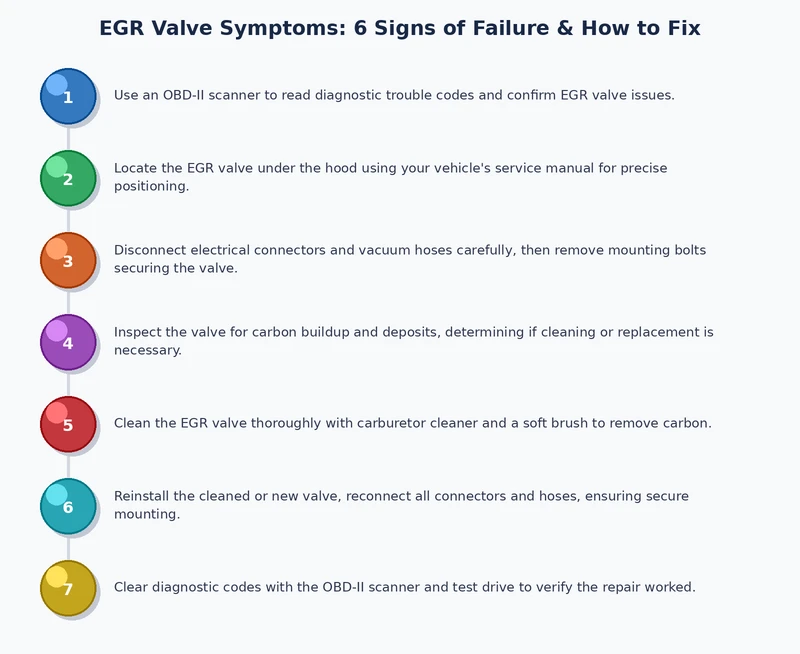
Diagnosing and cleaning an EGR valve does not require specialized shop equipment. A basic OBD-II scanner, a hand-held vacuum pump, and a can of dedicated EGR valve cleaner are sufficient for a thorough evaluation. The process is methodical and takes less than two hours when the valve is accessible.
Connect a scan tool to the OBD-II port and retrieve all stored and pending codes. EGR-specific codes in the P0400–P0409 range confirm that the ECM has flagged an anomaly in the EGR circuit. Record all codes before clearing them, then perform a test drive under load to determine whether the fault is persistent or intermittent — a critical distinction for the repair strategy.
Locate the EGR valve on the intake manifold — it is typically a disc-shaped component connected to a metal tube routed from the exhaust manifold. Inspect the valve body, surrounding passages, and vacuum lines for heavy carbon buildup, cracks, or corrosion. A stuck-open valve often shows a visible carbon ring at the throat of the valve seat. Inspect the wiring harness connector for corrosion or damaged pins on electronic valves.
On vacuum-operated valves, apply 15–20 in-Hg of vacuum to the valve port using a hand pump. A functioning valve will open and cause the idle to roughen or stall momentarily. If the valve holds vacuum but idle quality is unaffected, the EGR passages in the intake manifold are blocked. If the valve does not hold vacuum, the diaphragm is ruptured and the valve requires replacement regardless of its external condition.
If the valve shows no mechanical damage, cleaning is often sufficient to restore full function. Remove the valve, apply EGR cleaner liberally to the pintle and all accessible passages, and use a wire pick or small brush to dislodge carbon deposits. Reinstall with a new gasket, clear all fault codes, and retest under normal operating conditions.
Our team recommends cleaning the EGR cooler and intake manifold passages at the same time — a partially blocked cooler reduces valve effectiveness even after the valve itself is serviced.
Replacement cost varies considerably by vehicle make, engine configuration, and whether the work is performed at a dealership, independent shop, or at home. The table below reflects typical ranges our team has observed across a broad range of domestic and import vehicles.
| Service Type | Parts Cost | Labor Cost | Total Estimate |
|---|---|---|---|
| DIY Cleaning | $8–$15 (cleaner only) | $0 | $8–$15 |
| DIY Replacement (domestic) | $50–$120 | $0 | $50–$120 |
| Shop Replacement (domestic) | $80–$160 | $80–$150 | $160–$310 |
| Shop Replacement (import/luxury) | $180–$380 | $100–$200 | $280–$580 |
| Dealer Replacement | $200–$450 | $150–$300 | $350–$750 |
Most EGR valve replacements take one to two hours of labor. Diesel applications with integrated EGR coolers increase that estimate significantly. The idle air control valve — which works in tandem with the EGR system to stabilize idle quality — often exhibits overlapping symptoms; our article on idle air control valve symptoms helps distinguish between the two. A failing fuel pressure regulator can also produce similar performance degradation; our coverage of fuel pressure regulator failure symptoms outlines the distinguishing characteristics.
Cleaning a removable EGR valve is a realistic weekend task for anyone comfortable working under the hood. On most four-cylinder and V6 engines, the valve is accessible without removing major intake components. The entire process — removal, chemical cleaning, reinstallation with a new gasket, and code clearing — takes roughly 90 minutes. The cost is minimal, and the diagnostic value of inspecting the valve directly is high. Our team considers this one of the most cost-effective maintenance procedures available to home mechanics.
Integrated EGR systems on turbocharged diesel engines route exhaust gas through a cooler mounted deep in the engine bay, often requiring partial disassembly of intake manifolds and charge air piping. The risk of damaging gaskets, seals, or MAP sensors during that work is real and warrants professional handling. Beyond access concerns, if fault codes point to a wiring harness fault or ECM communication error rather than the valve itself, professional diagnosis is the correct path.
A recurring EGR fault on a high-mileage engine also signals the need for broader evaluation. Worn piston rings and degraded valve stem seals allow combustion blowby to accelerate carbon fouling far beyond normal rates. Our post on bad catalytic converter symptoms explains how a compromised exhaust system accelerates EGR deposits downstream, while our guide on bad O2 sensor symptoms covers how oxygen sensor faults generate fault codes that mimic EGR-related diagnostic trouble codes.
The EGR delete concept persists in enthusiast circles and is based on observations of early, poorly calibrated systems. Modern EGR systems are integrated directly into the engine's fuel and ignition maps. Removing the system without a corresponding ECM reflash causes the engine to run lean under partial throttle, increasing knock risk, reducing fuel economy, and degrading throttle response. It also renders the vehicle non-compliant with emissions regulations in all fifty states and most international markets — a legal and financial liability that outweighs any hypothetical gain.
A fault code in the P0400 range indicates an anomaly within the EGR circuit — not necessarily a failed valve. Blocked manifold passages, a failed EGR temperature sensor, a deteriorated vacuum line, or a cracked EGR pipe produce identical codes. Replacing the valve without isolating the root cause results in the same fault returning within weeks. This diagnostic discipline applies equally to other systems: our article on bad ignition coil symptoms illustrates how reading codes without systematic verification leads to unnecessary parts expenditure.
Carbon fouling is indeed more severe in diesel applications due to higher exhaust particulate content, but gasoline-powered engines are equally susceptible to EGR valve failure through electrical faults, actuator sticking, and vacuum line deterioration. Direct-injection gasoline engines — now the dominant configuration on new vehicles — produce significantly more carbon deposits than port-injected designs, making EGR fouling an increasingly common issue on gasoline platforms as those vehicles accumulate mileage. Our team has documented camshaft position sensor faults arising from the same carbon-heavy intake environment; the symptoms overlap considerably, as detailed in our article on camshaft position sensor failure symptoms.
Most EGR valves last between 80,000 and 150,000 miles under normal operating conditions. Vehicles driven primarily on short trips accumulate carbon deposits faster and tend to see failures earlier. Regular fuel system cleaning and the use of quality fuel reduce deposit formation and extend service life considerably.
Short-distance driving is possible but not advisable. A stuck-open EGR valve causes rough idle and stalling, which creates a safety hazard in traffic. A stuck-closed valve accelerates engine knock that causes progressive internal damage. Our team recommends addressing confirmed EGR valve symptoms within one to two weeks of diagnosis to avoid more expensive downstream repairs.
Yes. The EGR system is specifically designed to suppress nitrogen oxide (NOx) emissions. A malfunctioning valve causes NOx output to exceed legal limits and will result in a failed emissions test in all states with mandatory tailpipe inspection programs. The vehicle must pass a retest after the repair is completed and verified.
Carbon deposit accumulation is the most common cause, followed by electrical faults in the valve's position sensor or solenoid. Vacuum line deterioration accounts for many failures in older vehicles. Engines that consume oil — due to worn valve seals or piston rings — accelerate fouling significantly, as oil vapor coats valve components and binds carbon deposits into a harder layer that cleaner alone cannot remove.
On some applications, aerosol EGR cleaner can be sprayed into the valve's intake port with the engine running at a fast idle, which loosens light carbon deposits. This approach works only on mildly fouled valves with accessible ports. Moderate to heavy fouling requires physical removal, direct cleaning of the pintle, and inspection of the valve seat — work that cannot be done in place.
Both conditions produce rough running, poor fuel economy, and check engine lights, making field differentiation difficult without a scan tool. EGR faults generate codes in the P0400–P0409 range and are often accompanied by detonation and elevated NOx. MAF sensor faults produce codes in the P0100–P0104 range and tend to cause hesitation on acceleration rather than at idle. Reading the specific fault codes is the most reliable way to distinguish between the two.
 |
 |
 |
 |

About Sarah Whitfield
Sarah Whitfield is a diagnostics and troubleshooting specialist who spent ten years as an ASE-certified technician before joining the editorial team. She specializes in OBD-II analysis, electrical gremlins, and the kind of intermittent problems that make most owners give up.
Get some FREE car parts & gear.. Or check out the latest free automotive manuals and build guides here.
Disable your ad blocker to unlock all the hidden deals. Hit the button below 🚗
| | | |
