by Joshua Thomas
If your high beams are not working, the most likely cause is a blown fuse or a burned-out bulb — both of which you can check yourself in under 15 minutes. That said, there are seven possible culprits, ranging from simple fixes you can handle at home to electrical faults that need a mechanic's tools.
High beams aren't just a convenience feature. They extend your visible range significantly on dark roads, help you spot animals, and give you more time to react to hazards. Losing them is a real safety concern, not something to put off. Whether one beam is out or both, this guide covers every cause and walks you through how to fix it.
It's also worth knowing that high beam issues often share root causes with other headlight problems. If your headlights have been acting erratically in other ways, our headlights flickering causes guide covers the broader electrical picture.
Contents
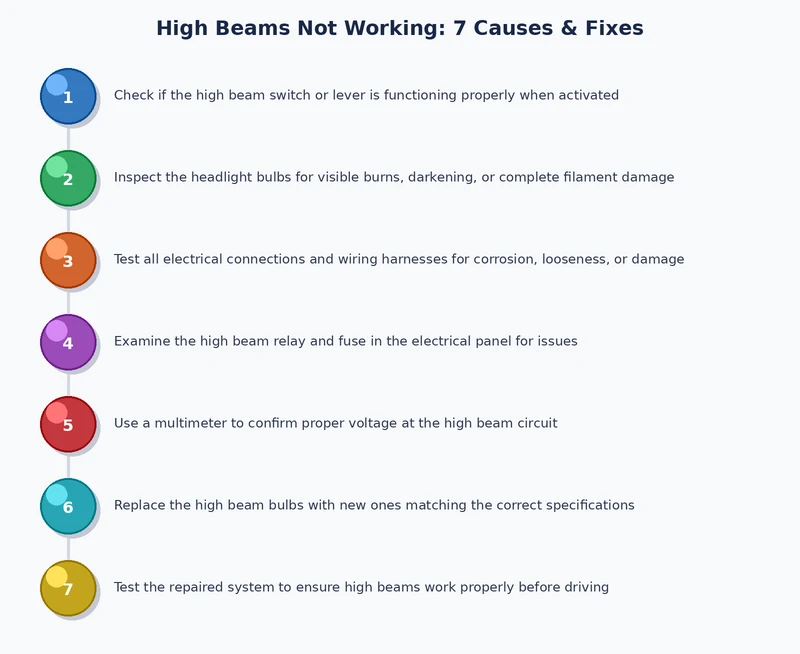
Most cases of high beams not working fall into one of these seven categories. Work through them from the top — the simpler checks first — before moving to the more involved ones. This saves you time and money.
A blown fuse is the first thing to check. Every car has a fuse box — sometimes two, one under the hood and one inside the cabin — that protects electrical circuits from surges. High beams have their own dedicated fuse, and when it blows, the entire circuit cuts out at once.
Open your owner's manual to find the correct fuse location and amperage. Pull the fuse with a fuse puller or needle-nose pliers, then hold it up to a light source. If the thin wire inside is broken or melted, you've found your problem. Replace it with a fuse of exactly the same amperage. Never go higher.
If the fuse checks out, the bulb is next. Halogen bulbs burn out over time, and a single dead bulb is the most common reason one high beam stops working. If both high beams go out at exactly the same time, a bulb is less likely — two bulbs rarely fail simultaneously. That pattern points more toward the fuse or relay.
Bulb replacement is straightforward on many vehicles, but some modern cars require removing the bumper cover or inner fender liner for access. Check your owner's manual or a model-specific forum before you start pulling things apart. A replacement halogen bulb typically costs between $10 and $30 at any auto parts store.
While you're at it, yellowed or hazy headlight lenses reduce your light output even when the bulbs themselves are fine. If the lenses look cloudy, polishing your headlights with toothpaste is a surprisingly effective DIY option that costs almost nothing.
A relay is a small electrical switch that controls high-current circuits. Your high beams have their own relay, usually housed in the under-hood fuse box. When it fails, the circuit never completes — even if the fuse and bulb are both fine. Relays are often interchangeable with other relays in the box, so you can swap one from a lower-priority circuit (like the horn) to test. If the high beams work with the swapped relay, replace it.
The wiring that carries power to your headlights can corrode, fray, or disconnect — particularly on older vehicles or those driven in harsh climates. A corroded or loose connector at the bulb socket can cause one or both high beams to go dark. Start by visually inspecting the wiring harness near each headlight. Look for melted insulation, green corrosion on connector pins, or wires that have rubbed against a sharp edge. A basic multimeter (a tool that measures electrical voltage and continuity) lets you trace the circuit step by step if the visual inspection doesn't reveal anything obvious.
The stalk or switch you pull or push to activate high beams sends an electrical signal through the car's system. If it fails internally, that signal never goes out. A dying switch often causes intermittent problems first — high beams that work one day and not the next. Switch replacement is usually straightforward and requires only basic hand tools, though access varies.
On modern vehicles, the BCM (body control module) is the computer that manages many electrical functions, including headlights. A BCM fault can cause high beams not working even when every individual component — fuse, bulb, relay, switch — tests fine. BCM problems rarely happen in isolation; you'll usually see other electrical gremlins at the same time, like power windows, locks, or interior lights acting strangely. Diagnosing and reprogramming a BCM requires a shop with proper scan tools and software.
Some vehicles — particularly certain GM models and European brands — use a separate DRL (daytime running light) module that manages how the headlights operate across different modes. A failure in this module can kill the high beams specifically while leaving low beams completely untouched. This is one of the less common causes, but if you've ruled everything else out, it's worth investigating. A dealership or brand specialist is usually your best resource here.
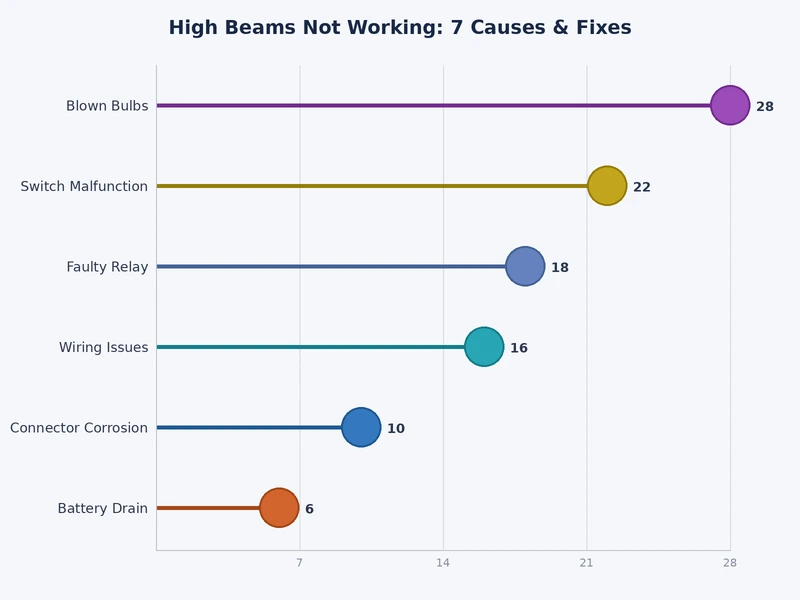
Where you fall on the DIY-vs.-mechanic spectrum depends entirely on which cause you're dealing with. The first three — fuse, bulb, relay — are beginner-friendly. The last four require progressively more skill, tools, and in some cases, specialized software.
If you're comfortable opening the hood and reading a fuse box diagram, you can check the fuse and relay yourself with no special equipment. Bulb replacement is within reach for most people on most vehicles, though some modern designs make it unnecessarily complicated. Budget 20 to 45 minutes depending on your vehicle.
For electrical testing beyond the visual check, a basic multimeter runs about $20 at any hardware store. With it, you can confirm whether voltage is reaching the headlight socket. If voltage is present but the beam doesn't light up, the socket or bulb is the issue. If there's no voltage at the socket, the problem is somewhere upstream — fuse, relay, switch, or wiring.
If you're working through electrical issues and drain the battery in the process, having a reliable charger on hand makes testing much easier. Our roundup of the best car battery chargers can help you find a solid option for the garage.
Once you've confirmed the fuse, bulb, and relay are all fine and the problem persists, it's time to hand it off. Wiring faults require methodically tracing a circuit through a harness — that takes both time and experience. BCM diagnosis requires brand-specific scan tools that most home mechanics don't own. DRL module replacement on some platforms involves significant disassembly.
According to the National Highway Traffic Safety Administration, headlight performance directly affects crash risk on dark roadways. Don't put off a repair because it seems minor — functioning high beams are a legitimate safety feature.
This table summarizes all seven causes with typical symptoms, DIY feasibility, and estimated repair costs. Use it as a quick reference when you're trying to narrow things down.
| Cause | Typical Symptom | DIY Friendly? | Est. Cost |
|---|---|---|---|
| Blown fuse | Both high beams out suddenly | Yes | $1–$5 |
| Burned-out bulb | One high beam out | Usually | $10–$30 |
| Faulty relay | Both out, possibly intermittent | Yes | $5–$20 |
| Wiring / connector | One side, intermittent, or both | Maybe | $50–$200 |
| Bad switch or stalk | Intermittent, both sides | Maybe | $50–$150 |
| BCM fault | Multiple electrical issues together | No | $200–$600+ |
| DRL module failure | High beams only, low beams fine | No | $100–$400 |
Even a simple repair can go sideways when you cut corners or make assumptions. These are the most common errors people make when troubleshooting high beams not working — and how to avoid them.
Replacing a blown fuse with a higher-amperage fuse is never the fix. The fuse blows because something in the circuit is drawing too much current. Putting in a bigger fuse lets that excess current keep flowing, which can melt wiring or start a fire. Always match the amperage rating exactly — it's printed on the fuse and listed in your owner's manual.
The natural oils on your skin create a hot spot on halogen bulb glass when the bulb heats up. This dramatically shortens bulb life and can cause premature failure — sometimes within days. Use nitrile gloves or a clean cloth when handling any halogen replacement. If you accidentally touch the glass, wipe it down with isopropyl alcohol before installing.
If a replacement fuse blows again within minutes or days, something in the circuit is drawing too much current. Replacing it a third time won't solve anything. You need to find the short — a point in the wiring where current is leaking to ground. This is a job for a multimeter and some patience, or a mechanic if you're not comfortable tracing circuits.
One dead high beam almost always is a blown bulb — but not always. A corroded connector on that side creates the exact same symptom. If a new bulb doesn't fix it, pull the connector and inspect the terminals before concluding the job is done. Corrosion is easy to miss and easy to clean with electrical contact cleaner.
When both high beams stop working at the same time but low beams are still fine, the most likely causes are a blown high beam fuse or a failed relay. Both bulbs burning out simultaneously is extremely unlikely. Check the fuse box first — it takes less than five minutes and costs almost nothing to fix if that's the problem.
Yes. A poor or corroded ground connection can prevent enough current from flowing to light the high beam bulbs, even when all other components are fine. Ground connections for headlights are typically bolted to the chassis near the light assembly. Cleaning or re-securing the ground bolt often fixes the problem without replacing any parts.
Intermittent high beams usually point to a failing switch or stalk, a loose connector, or a relay that's starting to fail. Temperature changes can also cause intermittent issues — a component that works when cold but fails when hot (or vice versa) is a common electrical fault pattern. Start by wiggling the wiring near the headlights to see if the beams flicker.
The cost ranges widely depending on the cause. A bulb replacement runs $50 to $100 at a shop (including labor). A relay or fuse is similarly inexpensive. Wiring repairs range from $100 to $250. Switch replacement typically falls in the $100 to $200 range. BCM repairs can cost $300 to $700 or more depending on reprogramming requirements.
You can drive without high beams on well-lit city streets, but it's genuinely unsafe on dark rural roads where visibility drops sharply. High beams extend your sight distance from around 160 feet (with low beams) to 350 feet or more, which matters a lot at highway speeds. Fix the problem before regularly driving in unlit conditions.
For most causes — fuse, bulb, relay, switch — you don't need a dealer at all. An independent mechanic can handle wiring faults just as well. You may want a dealer for BCM reprogramming or DRL module issues on vehicles where those systems are deeply integrated, since proprietary software is sometimes required.
A severely weak battery can cause all kinds of electrical issues, but it's rarely the sole reason high beams stop working. More often, a bad battery causes dim headlights rather than no headlights. If you suspect the battery, check its voltage with a multimeter — a healthy battery reads 12.6 volts or higher with the engine off.
If one high beam still doesn't work after a bulb replacement, the problem is likely a corroded or damaged connector at that socket, a wiring fault on that side, or a bad ground specific to that headlight. Inspect the connector pins for green or white corrosion and clean them with electrical contact cleaner. If the connector looks fine, test for voltage at the socket with a multimeter.
 |
 |
 |
 |

About Joshua Thomas
Joshua Thomas just simply loves cars and willing to work on them whenever there's chance... sometimes for free.
He started CarCareTotal back in 2017 from the advices of total strangers who witnessed his amazing skills in car repairs here and there.
His goal with this creation is to help car owners better learn how to maintain and repair their cars; as such, the site would cover alot of areas: troubleshooting, product recommendations, tips & tricks.
Joshua received Bachelor of Science in Mechanical Engineering at San Diego State University.
Get some FREE car parts & gear.. Or check out the latest free automotive manuals and build guides here.
Disable your ad blocker to unlock all the hidden deals. Hit the button below 🚗
| | | |
