by Diego Ramirez
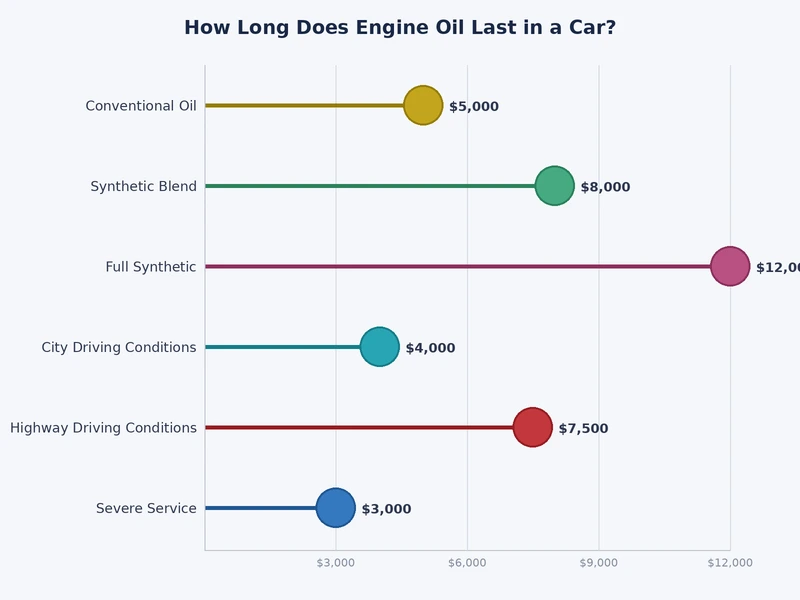
How long does engine oil last in a car? Most people assume a single universal rule governs every vehicle on the road. Our team's answer is more precise: full synthetic oil typically lasts between 7,500 and 15,000 miles under normal conditions, while conventional oil degrades within 3,000 to 5,000 miles. The difference in cost — and in engine protection — is substantial. Understanding the factors that determine oil longevity helps drivers avoid two expensive errors: changing oil too early and changing it far too late. This guide covers the full picture, from manufacturer intervals to real-world driving impact. For a detailed look at oil brand performance, our comparison of Castrol Edge vs Mobil 1 is a strong starting point.
Engine oil does more than reduce friction. It cools internal components, suspends combustion byproducts, and inhibits corrosion on metal surfaces. When it breaks down, none of those functions perform correctly. Our team considers oil maintenance the single most consequential routine task in vehicle ownership — and the most frequently misunderstood.
Contents
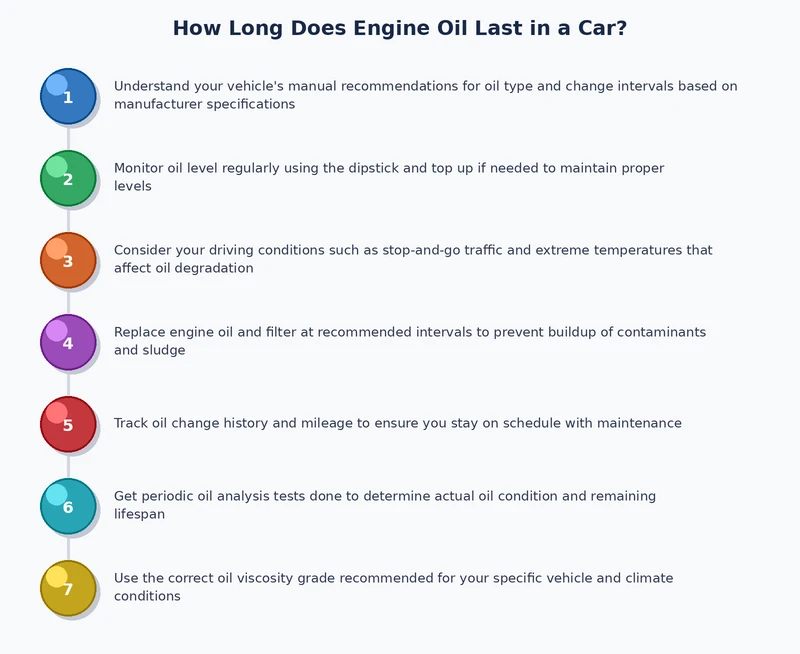
The manufacturer's published interval is the most reliable starting point. Those figures come from actual engine testing — not marketing estimates. Most drivers ignore the owner's manual and rely on quick-lube shop stickers instead. Our team considers that a consistent and preventable mistake.
Modern vehicles fall into clear categories based on oil type and engine design:
Time-based limits matter equally to mileage limits. Engine oil oxidizes (reacts chemically with oxygen) even when the vehicle sits unused in a garage. A car driven only 1,500 miles over eight months still needs fresh oil. According to the Wikipedia overview of motor oil chemistry, base oil oxidation accelerates significantly beyond the oil's rated service life, regardless of how many miles have accumulated.
Our team advises drivers to follow whichever limit — time or mileage — arrives first. Tracking both eliminates the most common reason for overdue changes among low-mileage drivers.
Stretching slightly beyond the standard interval is acceptable under a specific set of conditions:
Extending beyond 15,000 miles is not something our team endorses — even with premium full synthetic products. Sludge accumulation and accelerated bearing wear at the end of a very long interval represent risks that outweigh the marginal cost savings of skipping one oil change.
Our team recommends setting calendar and mileage reminders simultaneously — whichever triggers first initiates the change. This dual-trigger habit eliminates the most common cause of overdue intervals among low-mileage drivers.
Manufacturer intervals are calibrated for "normal" driving. Most real-world driving patterns do not qualify as normal. Our team defines normal as primarily highway operation, moderate ambient temperatures, and minimal idling time. The majority of urban commuters fall into the "severe service" category without realizing it — and they are draining oil life faster than the interval suggests.
City driving degrades oil faster than highway driving for well-documented mechanical reasons:
A city driver accumulating 4,000 miles in stop-and-go conditions subjects the oil to more degradation than a highway driver covering 7,500 miles. Our team's recommendation for predominantly city drivers: reduce the change interval by 20 to 30 percent from the manufacturer's stated figure.
Oil condition is closely tied to overall engine health. Keeping other fluid systems maintained — including transmission fluid — supports the entire drivetrain. Our guide on how often to change transmission fluid covers a parallel maintenance discipline that most drivers neglect for equally long periods.
Several operating environments accelerate oil degradation beyond normal parameters:
Any driver operating regularly under these conditions should treat the vehicle as severe-duty and plan accordingly — shorter intervals, more frequent dipstick checks, and closer attention to oil texture and color between changes.
Our team has reviewed hundreds of engine failure cases over the years. A consistent finding emerges: most failures that appear sudden trace back to oil neglect accumulated across many months or thousands of miles. These are the most damaging and most preventable errors.
Viscosity — the oil's resistance to flow — must match the engine's specification precisely. Using an incorrect grade produces three distinct problems:
The correct viscosity specification is printed in the owner's manual and, on most modern vehicles, also molded directly onto the oil filler cap. Our team recommends consulting both sources before every oil purchase.
Most engines consume a small amount of oil between scheduled changes. This is a normal characteristic — especially in higher-mileage vehicles or engines with minor seal wear. The risk arises when that consumption goes unmonitored.
Checking the oil level once per month — regardless of how many miles have accumulated — is among the highest-impact, lowest-effort habits our team recommends to anyone managing long-term vehicle health.
Tracking oil condition does not require expensive diagnostic tools. The two most reliable monitoring methods are simple, widely available, and take fewer than five minutes each to perform correctly.
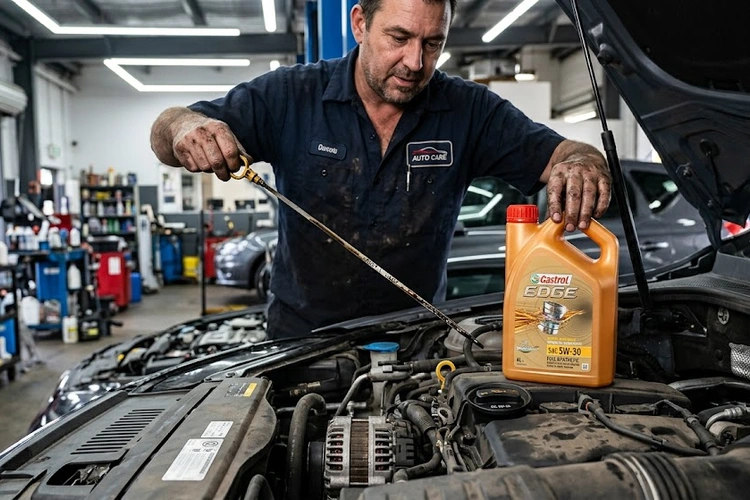
The dipstick remains the most direct and accessible tool for assessing oil condition. Our team follows a consistent four-step process for accurate results:
Two conditions on the dipstick require immediate professional attention rather than a simple change. Oil that carries a strong fuel smell indicates fuel contamination from a rich-running condition. Oil with a milky white or creamy appearance signals coolant intrusion — typically from a failing head gasket. Neither condition is resolved by changing the oil alone.
Most vehicles built after 2010 include an onboard oil life monitoring system (OLMS). These systems use engine management algorithms — not direct oil sensors — to estimate remaining service life based on operating temperature, RPM data, and engine load cycles.
| Oil Type | Typical Mileage Interval | Time-Based Limit | Best Application |
|---|---|---|---|
| Conventional (5W-30) | 3,000–5,000 miles | 3–6 months | Older engines, light-duty use |
| Synthetic Blend | 5,000–7,500 miles | 6 months | Mixed city and highway driving |
| Full Synthetic (5W-40) | 7,500–15,000 miles | 6–12 months | Modern engines, performance applications |
| High-Mileage Synthetic | 5,000–7,500 miles | 6 months | Engines with 75,000+ miles |
| Diesel-Specific (15W-40) | 5,000–7,500 miles | 6 months | Diesel engines, towing applications |
Our team treats any OLMS reading below 20 percent as an immediate action threshold. Waiting for the system to reach zero percent is inadvisable — algorithm accuracy degrades at the low end of its range, and the margin of error widens. The OLMS is a planning tool, not a countdown timer.
Persistent misinformation about engine oil costs drivers money on unnecessary service intervals and damages engines through false reassurance. Our team has examined the most widely repeated myths and assessed each one against current engineering evidence.
The 3,000-mile change interval was sound engineering advice for pre-1990s vehicles using conventional mineral oil in engines with looser manufacturing tolerances. Modern engine metallurgy and modern oil chemistry have made this interval obsolete for the vast majority of vehicles on the road today.
Oil formulation quality matters alongside change frequency. Our article comparing regular vs. premium gasoline examines a parallel debate about input quality — one where the manufacturer specification, not conventional wisdom, provides the correct answer.
Dark or black-colored oil does not automatically indicate a failed or harmful oil condition. Engine oil darkens rapidly because it is performing its designed function: absorbing and suspending combustion soot, carbon particles, and byproducts to keep them from depositing on engine surfaces. This is particularly pronounced in diesel engines and vehicles with active DPF (diesel particulate filter) regeneration cycles.
Oil degradation affects more than the crankcase. Drivers who notice related performance symptoms should review our coverage of signs of a bad catalytic converter, as oil burning often produces downstream exhaust system damage. Engines that develop oil consumption issues also frequently struggle with emissions compliance — a topic covered in our guide on why a car fails an emissions test.
Consistent oil maintenance requires three elements: the correct product, a reliable interval schedule, and accurate record-keeping. Our team has refined a practical framework that applies across vehicle types, mileage ranges, and driving conditions.
The decision between conventional oil, synthetic blend, and full synthetic depends on three primary factors:
Maintaining other vehicle systems alongside oil extends overall drivetrain life significantly. Our articles on extending car battery life and recognizing worn shocks and struts cover two other frequently neglected maintenance areas that interact directly with engine stress levels and overall vehicle reliability.
A simple maintenance log transforms oil changes from guesswork into a diagnostic tool. Our team's recommended record-keeping system takes less than two minutes per entry:
Consistent records reveal developing problems before they escalate. An engine consuming more than one quart per 1,000 miles has a mechanical issue — piston rings, valve seals, or a head gasket — that extended oil changes will not resolve. Our team treats the maintenance log as a diagnostic document, not merely an administrative formality. Patterns visible across six to twelve months of entries frequently predict failures that a single inspection would miss entirely.
Engine oil does not announce its failure — it simply stops protecting, and by then, the damage is already done.
 |
 |
 |
 |

About Diego Ramirez
Diego Ramirez is a maintenance and care specialist who has been wrenching on cars since he was sixteen. He focuses on fluid changes, preventive care routines, paint protection, and the small habits that turn a five-year-old car into a fifteen-year-old car.
Get some FREE car parts & gear.. Or check out the latest free automotive manuals and build guides here.
Disable your ad blocker to unlock all the hidden deals. Hit the button below 🚗
| | | |
