by Diego Ramirez
A failed automatic transmission costs between $1,800 and $3,400 to rebuild — and in roughly 80 percent of premature failures, degraded fluid is the documented root cause. Knowing how often to change transmission fluid is one of the highest-leverage maintenance decisions available. Our team has tracked fluid behavior across dozens of transmission families and vehicle platforms. The answer varies by fluid type, drivetrain architecture, and operating conditions. Most OEM service schedules call for conventional ATF changes between 30,000 and 60,000 miles. Full synthetic ATF intervals typically run 60,000 to 100,000 miles. "Lifetime" fluid designations — stamped on millions of modern transmissions — are widely misunderstood by most drivers.
Transmission fluid performs three critical jobs simultaneously: it lubricates clutch packs and planetary gear sets, cools the transmission case and torque converter, and acts as hydraulic working fluid for solenoids and bands. When it degrades, friction coefficients shift out of spec, operating temperatures spike, and wear accelerates on every moving surface. Most people who push past the service interval end up replacing solenoids or valve bodies before the unit fails outright. Our team treats the ATF change schedule as foundational as routine oil filter service — both protect irreplaceable drivetrain components from cumulative, irreversible wear.
Contents
Most transmission failures are predictable. They follow a pattern: one service interval skipped, then another, fluid turns dark and acidic, solenoid pack starts sticking, and the valve body follows. Our team has traced this sequence across thousands of repair records. A disciplined maintenance schedule breaks the cycle before it compounds. The mileage numbers differ by fluid chemistry and transmission design, but the logic is constant: degrade the fluid and the mechanical wear rate accelerates disproportionately.
Conventional ATF — Dexron VI, Mercon V, Type F — oxidizes faster under thermal stress than full synthetic formulations. Most manufacturers specify replacement every 30,000 to 45,000 miles for conventional fluid under normal driving. Full synthetic ATF resists oxidation and shear breakdown significantly better. Synthetic-spec transmissions — including most ZF 8-speed, Aisin TF-80SC, and GM 10L80 units — carry factory intervals of 60,000 to 100,000 miles when operated within design parameters.
CVT fluid is the most service-sensitive of all transmission fluids. Nissan NS-3, Toyota TC, and Honda HCF-2 degrade faster than planetary ATF because CVT steel push-belts and drive pulleys generate fine metallic particles continuously during normal operation. Our team recommends 30,000-mile intervals for CVT fluid regardless of what the owner's manual states. The "lifetime" designation applied to Nissan Juke and Rogue CVTs has proven catastrophically optimistic — CVT replacements on these platforms routinely trace back to fluid neglect past 60,000 miles.
Pro insight: CVT fluid should never extend past 40,000 miles even on synthetic-rated fluid — metal particle contamination load alone warrants earlier service, independent of oxidation state.
Towing, mountain driving, rideshare operation, and stop-and-go urban cycles all qualify as severe duty under most OEM definitions. Under these conditions, our team cuts every published interval in half. A vehicle towing at maximum rated capacity across 20,000 miles has subjected its ATF to far more thermal cycles than a highway commuter at 60,000 miles on identical fluid. The mileage number is a proxy — thermal history is the real variable.
Mileage is a proxy for thermal stress and time — not a guarantee of fluid condition. Our team evaluates ATF directly at every oil service as a cross-check. A vehicle at 25,000 miles that has towed a boat trailer in summer heat may need fresh ATF more urgently than a highway commuter at 55,000 miles on the same fluid specification. Context determines the actual service need.
Several operating factors push ATF past its service life faster than mileage alone predicts:
Coolant contamination warrants immediate service — no mileage calculation applies. A leaking cooler mixes ethylene glycol with ATF, producing a strawberry-milkshake emulsion that destroys clutch facings within thousands of miles. This visual inspection logic applies across all fluid types. Our team covered the diagnostic value of fluid color in detail in the engine oil color and fluid appearance guide — the same principles apply to ATF condition assessment.
Warning: Never top off degraded ATF with fresh fluid as a substitute for a proper service — diluted, oxidized fluid continues damaging clutch packs and solenoid screens regardless of the fresh fluid volume added.
Not every vehicle warrants early service. A late-model SUV driven exclusively on interstates, never towing, in a mild climate, using factory-fill full synthetic ATF, can reasonably reach the manufacturer's published interval. Our team still recommends a visual fluid inspection at the 50,000-mile mark regardless. The drain plug sample — not the dipstick — tells the real story at that mileage. Dipstick readings show color but not the metallic particle content concentrated at the bottom of the pan.
Vehicles operated under NHTSA maintenance and recall guidance with complete documented service history can justify extended intervals when fluid condition confirms it. The key word is "confirmed" — not assumed from a calendar or odometer reading alone.
Transmission service requires more precision than most routine maintenance tasks. Using the wrong fluid specification — even a nominally close substitute — can trigger shift quality issues, clutch chatter, or solenoid incompatibility within thousands of miles. Our team treats ATF spec matching as non-negotiable. The vehicle identification number traces back to the exact transmission model, and the transmission model determines the exact fluid chemistry required.
OEM-specified fluids are formulated around specific friction modifier packages, viscosity grades, and additive chemistry. GM's Dexron VI is not interchangeable with Ford's Mercon LV despite similar appearance and color. ZF-approved LifeGuard 8 is engineered specifically for 8HP unit clutch pack engagement characteristics. Toyota's World Standard (WS) fluid uses a friction modifier profile incompatible with generic multi-vehicle ATF.
Two primary service methods exist: the pan drop and the machine flush. Each has legitimate applications, and the choice depends on fluid condition at the time of service.
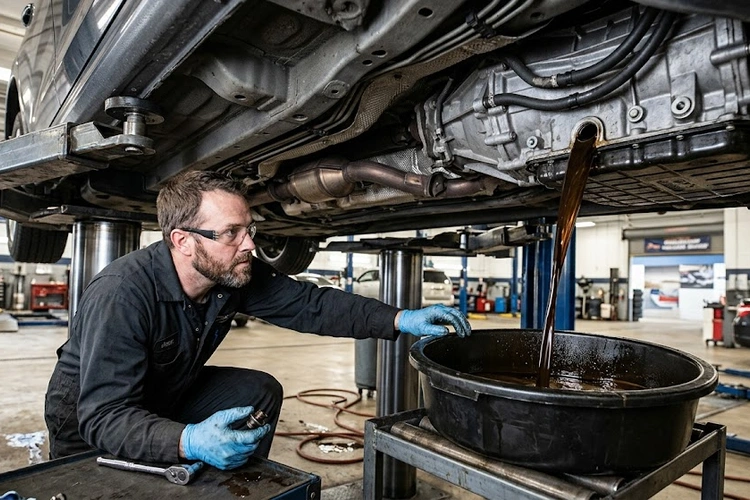
A pan drop removes 40 to 60 percent of total fluid volume, replaces the serviceable filter where applicable, and allows direct inspection of the pan for metallic debris — a critical diagnostic step unavailable with flush-only service. Our team performs pan drops as the baseline for all vehicles with serviceable pans. The flush method uses an exchange machine to push all fluid through the cooler lines, achieving near-complete replacement at 90 to 95 percent. Flush machines work correctly when fluid is not severely degraded. Flushing a transmission with heavy metallic contamination can dislodge debris into valve body passages. Our team reserves flush service for moderately degraded fluid on sealed-pan units where pan inspection is not possible.
Basic pan drop equipment requirements:
Fluid condition is a direct window into transmission health. Our team inspects ATF at every service visit as a low-cost diagnostic step. A single drop on a white shop rag reveals oxidation state, contamination level, and metallic particle load — more diagnostic information than most generic scan tool readouts provide for a healthy-shifting transmission.
New ATF ranges from bright red (Dexron, Mercon) to amber (Toyota WS) to translucent pink (Honda ATF-DW1). Color shift indicates oxidation and heat degradation. Brown fluid with a burnt smell means the fluid has exceeded its thermal threshold — friction modifier depletion is confirmed. Dark brown or black fluid with a metallic shimmer means clutch friction material is in suspension in the sump. At that stage, a pan drop is mandatory before any flush service. Milky or frothy fluid indicates water or coolant contamination and requires immediate attention beyond fluid service alone.
Fluid-related symptoms follow a predictable clinical progression. Torque converter shudder appears first — a light vibration at 40 to 45 mph during light-throttle lockup engagement. This indicates friction modifier depletion, frequently correctable with fresh fluid when caught at this stage. Delayed engagement follows — a pause between selecting Drive and feeling the vehicle begin to move. Hard shifts and clutch slip come next. By the time a vehicle experiences automatic transmission downshift failure, the fluid has typically been degraded for tens of thousands of miles. Catching the problem at the shudder stage is the intervention goal.
Cold-weather engagement delay is a related and commonly misdiagnosed symptom. Degraded ATF loses viscosity retention in low temperatures, causing two- to five-second engagement lag on cold starts. Our team has documented this pattern consistently in high-mileage vehicles with never-changed fluid during winter diagnostics — it also overlaps with conditions described in cold-weather stalling cases where degraded drivetrain fluid viscosity is the underlying cause rather than ignition or fuel system issues.
The following table summarizes our team's compiled data across the most common ATF specifications, service intervals, and primary transmission applications.
| ATF Specification | Type | Normal Interval | Severe-Duty Interval | Primary Applications |
|---|---|---|---|---|
| Dexron VI | Full Synthetic | 45,000 mi | 22,000 mi | GM 6L80, 8L90, 10L80 |
| Mercon LV | Full Synthetic | 60,000 mi | 30,000 mi | Ford 6F35, 6R80, SelectShift |
| Toyota WS | Full Synthetic | 60,000 mi | 30,000 mi | Toyota/Lexus U660E, U760E, A960E |
| ZF LifeGuard 8 | Full Synthetic | 80,000 mi | 40,000 mi | ZF 8HP (BMW, Chrysler, Jaguar) |
| Nissan NS-3 (CVT) | Full Synthetic | 30,000 mi | 15,000 mi | Nissan Juke, Rogue, Sentra CVT |
| Honda ATF-DW1 | Full Synthetic | 30,000 mi | 15,000 mi | Honda/Acura 5-speed automatics |
| Mercon V | Conventional | 30,000 mi | 15,000 mi | Older Ford 4R70W, 5R55S |
Most automatics using full synthetic ATF should be serviced every 60,000 to 100,000 miles under normal driving. Conventional ATF specs require shorter intervals — typically 30,000 to 45,000 miles. Our team recommends confirming fluid condition visually at every oil change rather than relying on mileage alone, since thermal history varies significantly by driving profile.
No. "Lifetime" is a marketing designation, not an engineering specification. Our team's experience shows that factory-fill ATF in high-mileage vehicles consistently shows oxidation, friction modifier depletion, and metallic contamination well before 100,000 miles — particularly in vehicles used for towing, in hot climates, or in stop-and-go driving cycles.
Degraded fluid causes friction coefficient drift in clutch packs, solenoid screen clogging from varnish buildup, and accelerated wear on planetary gear sets and thrust bearings. Most people who never service ATF experience transmission failure between 120,000 and 150,000 miles on vehicles that should reach well past 200,000 miles with proper maintenance.
A flush on a heavily contaminated transmission can dislodge sludge into valve body passages, causing solenoid sticking and erratic shift behavior. Our team reserves machine flush service for moderately degraded fluid. Severely degraded fluid with metallic contamination warrants a pan drop first — inspect the sump, replace the filter, and confirm debris levels before a full fluid exchange.
Transmission fluid service is one of the most skipped and most consequential items on any maintenance checklist. Our team recommends pulling a fluid sample at every oil service, matching ATF specification precisely to the transmission model number, and cutting every published interval in half under any form of severe-duty operation. Anyone managing a high-mileage vehicle should start with a pan drop and filter inspection — the service takes under two hours and costs less than $80 in most cases, compared to the $2,500 average for a transmission rebuild that proper ATF maintenance could have prevented entirely.
 |
 |
 |
 |

About Diego Ramirez
Diego Ramirez is a maintenance and care specialist who has been wrenching on cars since he was sixteen. He focuses on fluid changes, preventive care routines, paint protection, and the small habits that turn a five-year-old car into a fifteen-year-old car.
Get some FREE car parts & gear.. Or check out the latest free automotive manuals and build guides here.
Disable your ad blocker to unlock all the hidden deals. Hit the button below 🚗
| | | |
