by Joshua Thomas
Ever wonder why a freshly washed car ends up covered in dull, chalky circles even after a careful rinse? Those rings and streaks form when minerals dissolved in tap water — calcium and magnesium are the primary culprits — get left behind as the water evaporates off the paint before it gets wiped away. Learning how to dry car without water spots is more straightforward than most people expect, and the results show immediately: a clean, gleaming finish rather than a surface that looks worse than it did before the wash.
A strong foundation at the washing stage makes the drying step far more manageable from the start. Following a structured process like the one outlined in the two-bucket car wash method removes surface contamination thoroughly before it ever gets trapped under a drying towel, setting up the final stage for the best possible outcome.
Contents
The single most impactful adjustment in the effort to dry a car without water spots is simply moving fast after the final rinse. Tap water in most regions contains dissolved minerals, and the moment the water film begins to thin out under warm air or direct sunlight, those minerals concentrate and begin bonding to paint. Getting a quality microfiber towel onto the roof within a minute or two of finishing the rinse makes an enormous difference in the final result.
Working in the shade — with the car at ambient temperature rather than baking from hours parked in the sun — gives more working time before evaporation becomes a problem. A shaded driveway, an open garage, or even a carport creates noticeably better conditions than a sun-drenched concrete pad in the middle of a warm afternoon.
Pro Tip: Washing and drying on a slightly overcast morning, when panel temperatures are lower and sun angle is less direct, produces the cleanest results with the least effort and the narrowest window for spots to form.
A slow, low-pressure final rinse that lets water cascade off the car's surface in a thin film — rather than sitting in individual beads — dramatically reduces how much standing water needs to be towel-dried. This technique, sometimes called a sheeting rinse, involves removing the nozzle tip from the hose entirely and holding the water source close to the panel while moving slowly from top to bottom. Fewer droplets left behind means fewer mineral-rich water pockets to chase.
Starting the sheeting rinse from the roof and working downward mirrors the top-down sequence used during actual drying, so the transition from rinsing to toweling feels natural and continuous rather than a separate operation requiring a mental reset.
The drying tool matters just as much as the technique behind it. A car drying towel made from quality microfiber can hold several times its own weight in water, but only when its tiny fiber loops are clean, open, and free of residue. Washing microfiber towels in a household machine with a gentle, fragrance-free detergent — and absolutely no fabric softener — keeps those loops working as intended. Fabric softener deposits a waxy coating on synthetic fibers that dramatically reduces water-holding capacity, sometimes permanently.
Low-heat dryer settings or air drying protect the fibers from heat damage, and storing clean towels in a sealed container prevents them from picking up garage dust, pet hair, or grit before the next use. A contaminated drying towel dragged across freshly washed paint is one of the more common ways people end up researching how to remove grease from car paint after an otherwise careful detailing session.
Warning: Never add fabric softener when washing microfiber drying towels — it coats the fiber loops with residue that destroys absorbency and turns an expensive towel into a smearing rag that may never fully recover.
Even well-maintained microfiber towels have a finite useful life, and using a degraded one on a freshly washed car is a reliable way to introduce micro-scratches — fine, shallow marks in the clear coat (the transparent protective layer over paint color) — that catch light and dull the finish over time. Several clear signals indicate replacement is overdue:
Replacing drying towels proactively, before visible wear sets in, protects the investment that regular waxing, sealing, and polishing represent over the lifetime of a vehicle.
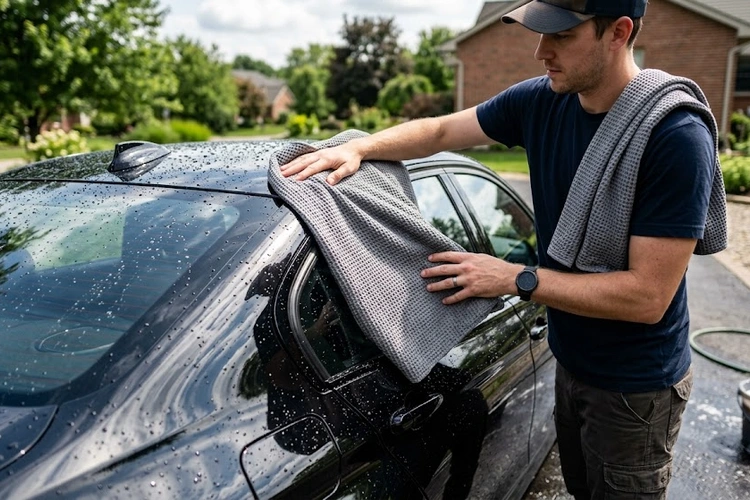
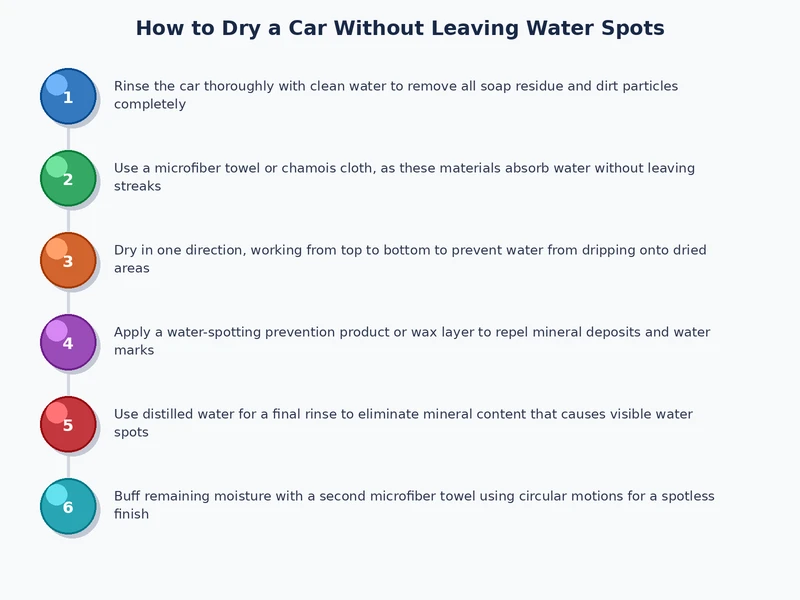
Professional detailers consistently apply a top-down approach, starting from the roof and working toward the rocker panels (the body trim pieces running along the bottom edge of the car, below the door openings). Because water runs downward, drying upper surfaces first prevents drips from landing on sections already cleared of moisture, eliminating the need for backtracking. Each panel gets one overlapping pass with a damp-to-saturated towel — lifting water rather than pushing it around with hard downward pressure.
Door jambs deserve attention early in the sequence. When a door opens mid-dry, water trapped in the recessed jamb area flows outward and can settle on already-dried lower panels, undoing work just completed. Wiping down jambs with a smaller detailing towel before closing each door and moving on keeps the process efficient. For those building a comprehensive maintenance routine, cleaning and conditioning door weatherstripping pairs naturally with this step and helps keep the rubber seals flexible and water-resistant between washes.
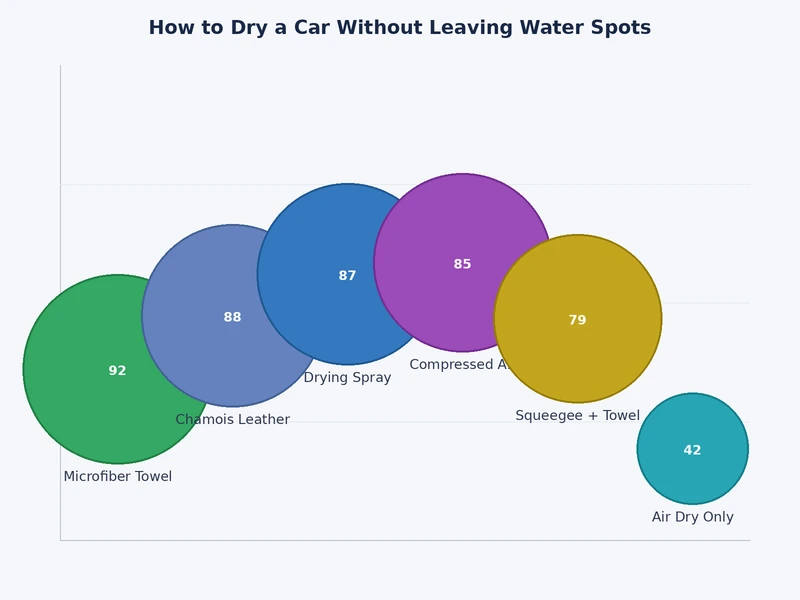
Different situations call for different tools, and understanding the trade-offs between common drying methods helps car owners make better choices rather than defaulting to whatever is nearest at hand.
| Drying Method | Water Spot Risk | Speed | Paint Safety | Best For |
|---|---|---|---|---|
| Microfiber waffle-weave towel | Very Low | Fast | High | Most drying situations |
| Microfiber plush towel | Very Low | Moderate | High | Final wipe on clear coat panels |
| Forced-air car dryer | Extremely Low | Very Fast | Excellent (contactless) | Emblems, grilles, tight gaps |
| Chamois (leather or synthetic) | Low–Moderate | Moderate | Moderate (when clean) | Large, flat body panels only |
| Household leaf blower | Low | Fast | Good (contactless) | Pre-dry before toweling |
| Air drying (no tool) | Very High | Slow | N/A | Only with deionized water |
Adding a quick-detailer spray (a diluted lubricant-and-protectant formula) to each panel immediately before or after toweling helps mineral residue slide off rather than bond to the surface. This step is especially useful in areas where road salt spray and mineral staining are recurring concerns during winter and early spring months.
Working in full sunlight is one of the most reliable ways to produce water spots regardless of technique or towel quality. As noted in the Wikipedia entry on hard water, minerals like calcium and magnesium precipitate (fall out of solution and deposit onto surfaces) significantly faster at elevated temperatures. A dark-colored vehicle parked in summer sun can reach panel surface temperatures well above 120°F, causing even a small droplet of tap water to leave a visible mineral ring within seconds of contact.
Scheduling a wash and dry session for early morning or late afternoon, when panel temperatures are lower and sunlight hits at a less intense angle, produces markedly better results without requiring any change in tools or technique — just a shift in timing.
Some car owners skip dedicated drying tools and reach for whatever is available — bath towels, old cotton rags, or paper towels. Each of these options carries drawbacks that dedicated microfiber avoids entirely.
Warning: Dark-colored vehicles show mineral spot damage far more quickly than lighter ones — a black or navy car dried in afternoon sun with hard tap water can develop permanently etched rings in a single session if the spots are left to bake rather than addressed promptly.
Mineral buildup allowed to accumulate through repeated poor drying sessions also affects how wax bonds to the paint over time, eventually making it necessary to address old wax buildup and paint contamination before any protective product can adhere and perform correctly.
In regions supplied with very soft water (water carrying a low mineral content, typically below 60 mg/L of dissolved calcium carbonate), light air drying after a rinse may leave little to no visible spotting even on unprotected paint surfaces. Vehicles protected by a professionally applied ceramic coating (a hard, semi-permanent layer bonded chemically to the clear coat) or a freshly applied carnauba wax or synthetic paint sealant resist mineral adhesion considerably better than bare paint, making air drying a lower-risk option in those specific cases.
If a vehicle is being washed with purified or deionized water — water that has had its dissolved mineral content removed through filtration or ion exchange — air drying is essentially risk-free because there are no minerals present to leave deposits behind regardless of temperature or sunlight exposure.
Hard tap water, elevated ambient temperatures, direct sunlight, and older or unprotected paint are a combination that makes air drying a near-certain recipe for water spots in any climate. Regions where interior window fogging is a frequent and persistent issue tend to have mineral-rich water supplies, since both problems are associated with high dissolved mineral content and humidity in the surrounding environment. Each round of air drying under these conditions layers another round of mineral deposits onto the paint, creating increasingly stubborn buildup over a season of regular washing.
Vehicles driven regularly on roads treated with salt during winter months face additional compounding risks from chloride-based residue combining with mineral water deposits. Building a broader protection strategy — pairing a disciplined drying technique with measures like underbody rust protection — addresses the full spectrum of water and mineral damage that seasonal driving introduces across the entire vehicle.
Water spots form when mineral-rich tap water — primarily carrying dissolved calcium and magnesium compounds — evaporates off a paint surface before it is wiped away, leaving the dissolved solids behind as a chalky or ring-shaped residue. Harder regional water supplies, warmer temperatures, and direct sunlight all accelerate the evaporation process and increase the severity of spotting on both painted panels and glass.
High-quality microfiber towels, particularly waffle-weave varieties designed for automotive drying, generally outperform traditional chamois cloths because their fine fiber structure lifts and holds water quickly without dragging or smearing. A clean, well-maintained chamois performs adequately on large flat panels, but microfiber delivers more consistent results across tight areas, curves, and varied surface temperatures without requiring the same level of care between uses.
Yes — forced-air tools, whether a household leaf blower or a purpose-built automotive dryer, remove standing water from the surface without any direct contact, eliminating drag marks and dramatically reducing the time minerals have to concentrate and bond to paint. Car dryers are especially effective in tight spaces around emblems, grilles, mirror housings, and panel gaps where towels simply cannot reach without contorting.
Light water spots from a recent wash are typically removable with a quality quick-detailer spray or light paint polish, but mineral deposits allowed to sit through repeated wash cycles — especially on hot panels in direct sun — can etch into the clear coat, creating damage that requires machine polishing or professional paint correction to resolve fully. Acting quickly after each wash is the most reliable way to prevent etching from progressing to that point.
A layer of carnauba wax, synthetic paint sealant, or ceramic coating creates a hydrophobic (water-repelling) surface that causes water to bead up and roll off panels rather than spreading into thin, slow-evaporating films, which reduces the contact time between mineral-rich water and the paint surface and makes any water spots that do form considerably easier to remove before they bond or etch.
Drying a car without leaving water spots comes down to three consistent habits: acting fast after the rinse before evaporation takes over, using a clean and capable car drying towel in a deliberate top-down sequence, and keeping direct sunlight out of the equation whenever possible. Those three adjustments alone resolve the vast majority of spotting problems most car owners encounter. The next wash is a great opportunity to put the sheeting rinse and top-down technique to the test — starting at the roof with a fresh waffle-weave microfiber towel and comparing the results to previous attempts is often all the convincing it takes to make these habits permanent.
 |
 |
 |
 |

About Joshua Thomas
Joshua Thomas just simply loves cars and willing to work on them whenever there's chance... sometimes for free.
He started CarCareTotal back in 2017 from the advices of total strangers who witnessed his amazing skills in car repairs here and there.
His goal with this creation is to help car owners better learn how to maintain and repair their cars; as such, the site would cover alot of areas: troubleshooting, product recommendations, tips & tricks.
Joshua received Bachelor of Science in Mechanical Engineering at San Diego State University.
Get some FREE car parts & gear.. Or check out the latest free automotive manuals and build guides here.
Disable your ad blocker to unlock all the hidden deals. Hit the button below 🚗
| | | |
