by Joshua Thomas
UV rays, heat, and oxidation work silently every day to strip color, dull finish, and crack your clear coat. Knowing how to protect car paint from sun damage is one of the most valuable skills any car owner can develop. Whether you park outdoors daily or just on weekends, sun damage accumulates faster than most people realize. This guide covers every practical layer of protection — from quick habits to long-term coatings — so your paint stays vibrant for years. If you've already noticed fading, check out how to restore faded car paint before applying protection.
Contents
Understanding the mechanism behind paint degradation helps you choose the right defenses. Sun damage is not a single event — it is a gradual chemical breakdown driven by two primary forces.
Ultraviolet radiation penetrates your clear coat and attacks the pigment molecules in the base coat. This process — called oxidation — causes colors to fade, whites to yellow, and reds to turn chalky pink. Dark colors absorb more heat but all colors suffer UV damage equally at the molecular level. Oxidation also makes the surface porous, allowing contaminants like bird droppings and tree sap to bond more aggressively.
Surface temperatures on a dark hood can exceed 80°C (176°F) on a hot day. Repeated thermal expansion and contraction cause micro-cracks in the clear coat. Once the clear coat is compromised, moisture and UV penetrate directly to the base coat, dramatically accelerating fading. If your clear coat is already showing signs of failure, read how to fix peeling clear coat before applying any new protection layer.
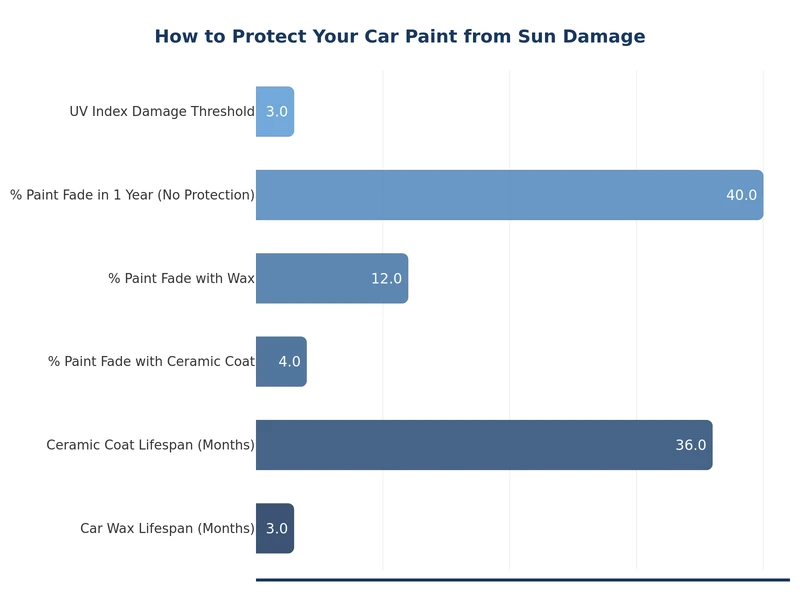
The simplest way to protect car paint from sun damage costs nothing: change where and how you park. Reducing UV exposure time is the foundation everything else builds on.
Parking in a garage is the gold standard. If a garage is unavailable, covered parking structures, carports, and even dense tree canopy reduce direct UV exposure significantly. When parking outdoors, orient the car so the hood — which has the largest flat surface and heats most — faces away from peak sun (generally east-facing in morning, north-facing during midday in the northern hemisphere). Even a 30-minute difference in daily peak-sun exposure adds up to meaningful protection over years.
A quality car cover blocks 95–99% of UV rays and keeps surface temperatures 20–30°C lower than uncovered paint. Choose covers rated with a UV protection factor (UPF) of at least 50. Look for a soft inner lining to avoid micro-scratches when fitting or removing. Avoid cheap polyester covers — they trap moisture against the paint and cause more damage than they prevent. For daily drivers, a half-cover or front-end cover protecting the hood and roof is a practical compromise.
A clean surface holds protective coatings better and gives you visibility into early damage. Dirt, industrial fallout, and UV-degraded wax residue accelerate paint breakdown when baked on by heat.
Wash every one to two weeks if you park outdoors. Use the two-bucket method — one bucket with car-wash soap, one with clean rinse water — to avoid dragging grit across the paint. Use a pH-neutral car shampoo; dish soap strips wax and sealant in a single wash. Dry with a microfiber waffle-weave towel, not a chamois, to prevent fine scratches that scatter light and make fading more visible.
Even visibly clean paint holds embedded contaminants — brake dust, industrial fallout, tree resin — that bond to the clear coat and cause localized oxidation. Clay bar treatment removes these before they cause permanent damage. Decontaminate every six months or before applying any new wax, sealant, or coating. The paint should feel like glass after claying. If you feel fine scratches from contaminants, treat them before they deepen — removing scratches from car paint is much easier at the fine-swirl stage than after they deepen into the base coat.
To effectively protect car paint from sun damage, layered chemical protection is essential. The market offers four main categories, each with different trade-offs in cost, durability, and performance.
Carnauba wax is the classic choice. It provides a warm, deep gloss and a sacrificial barrier against UV and environmental fallout. The downside: durability tops out at two to three months under regular outdoor exposure. Reapplication is simple — apply a thin layer by hand or machine, let it haze, and buff off. Wax works best as a top coat over a longer-lasting base sealant rather than as the sole protectant.
Synthetic paint sealants bond to the clear coat through polymer cross-linking and last four to twelve months depending on the product and conditions. They offer stronger UV resistance than wax and hold up better in high-heat climates. Check out the best paint sealants for tested recommendations. Sealants are the best value option for most daily drivers: better durability than wax at a fraction of the cost of ceramic.
Ceramic coatings chemically bond to the clear coat to form a hard, hydrophobic layer resistant to UV, chemicals, and minor abrasion. Quality DIY ceramics last two to five years; professional-grade coatings can exceed seven years. The trade-off is application difficulty — proper surface prep is critical. Read the full DIY ceramic coating guide before attempting this at home. Ceramic is the best long-term answer for how to protect car paint from sun damage if you're committed to proper prep and application.
Paint protection film (PPF) is a urethane film applied over the paint. It provides the strongest physical protection — stopping rock chips, light scratches, and UV simultaneously. Premium self-healing films absorb minor abrasions and return to a smooth surface with heat. PPF is expensive and requires professional installation for full-vehicle coverage, but partial coverage on the hood, mirrors, and bumper is a cost-effective option for daily drivers on chip-prone roads.
| Method | UV Protection | Durability | DIY Friendly | Avg. Cost |
|---|---|---|---|---|
| Carnauba Wax | Moderate | 1–3 months | Yes | $10–$40 |
| Paint Sealant | Good | 4–12 months | Yes | $20–$60 |
| Ceramic Coating (DIY) | Excellent | 2–5 years | Moderate | $50–$150 |
| Ceramic Coating (Pro) | Excellent | 5–10 years | No | $500–$2,000 |
| Paint Protection Film | Excellent | 5–10 years | Partial | $200–$5,000+ |
| Car Cover (UPF 50+) | Very Good | Until worn | Yes | $30–$200 |
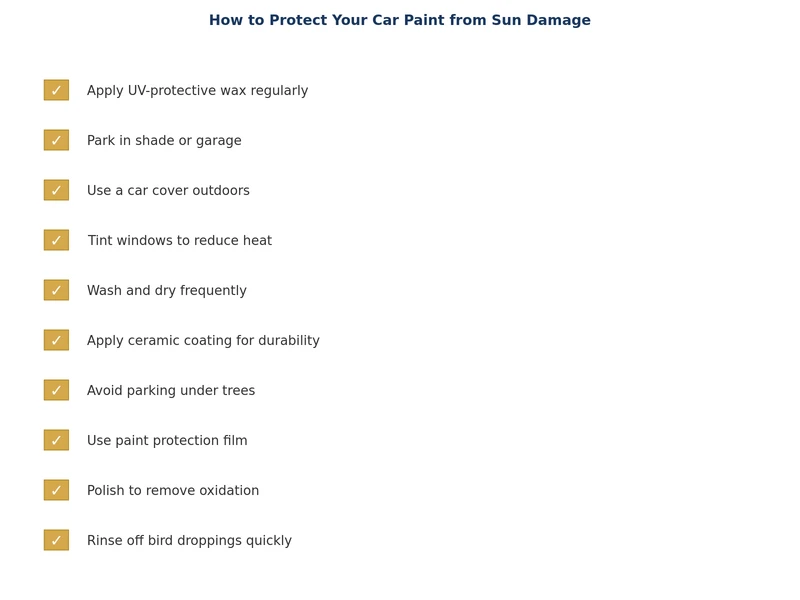
Individual products only work when used consistently. A structured routine closes the gaps between protection layers and catches damage early, before it requires expensive correction.
At the start of each hot season, inspect the paint in direct sunlight at a low angle. Look for dull patches, fine swirl marks, and any areas where water no longer beads. These are signs your protective layer has failed. Decontaminate with a clay bar, correct any visible swirls with a light polish, then reapply sealant or top up your ceramic coating with a spray booster. In summer, rinse the car more frequently — bird droppings and tree sap etch faster in heat and should be removed within 24 hours when possible.
Between full details, keep a spray detailer or ceramic spray booster in the trunk. After washing, a quick spray-and-wipe maintains hydrophobic properties and adds a thin UV-filtering layer at zero extra cost. For minor paint chips that expose bare metal, use a touch-up pen matched to your car's paint code to seal the metal before rust sets in. Address scratches promptly — unprotected scratches expand under heat cycling and UV exposure into much larger repairs.
Protecting car paint from sun damage is not a single product purchase — it is a layered system of parking habits, regular cleaning, chemical protection, and periodic inspection. The investment in time and materials is a fraction of the cost of a professional repaint, which can run $1,000–$5,000 for a single panel. Start with the basics — shade, regular washing, and a quality sealant — and build toward ceramic or PPF protection as your budget and commitment allow.
If using carnauba wax as your primary protection, reapply every two to three months. In hot climates with heavy sun exposure, monthly reapplication gives better continuous UV coverage. Pairing wax over a synthetic sealant base extends effective protection to four to six months between full wax applications.
All colors suffer UV damage at similar rates chemically, but dark colors — especially black and dark blue — absorb more heat, which accelerates clear coat degradation through thermal stress. Light colors show oxidation differently: whites yellow, silvers lose metallic depth. No color is immune; all benefit equally from UV-blocking protection.
For cars parked outdoors daily, ceramic coating offers the best long-term value. A DIY ceramic kit costing $50–$150 lasts two to five years versus sealant at $30–$60 lasting under a year. The upfront cost and prep effort are higher, but the per-year cost is lower and the UV protection is superior.
Partial PPF coverage — hood, mirrors, door edges — is achievable as a DIY project using pre-cut kits for your vehicle model. Full-vehicle or complex panel coverage is very difficult without professional tools and experience. Bubbles, edge lifting, and misalignment are common DIY issues that void warranties on premium films.
Light oxidation responds well to a dual-action polisher with a cutting compound and foam pad. Severe oxidation — chalky, porous, or flaking — may require wet sanding followed by compound and polish. After correcting oxidation, apply a sealant or ceramic coating immediately to prevent rapid re-oxidation of the freshly exposed paint surface.
Trees reduce direct UV exposure, which helps, but they introduce a different risk: tree sap, pollen, and bird droppings that etch paint faster in shaded, humid conditions. If tree parking is your only shade option, wash more frequently and remove organic deposits within 24 hours. A car cover over the paint gives better overall protection than tree shade alone.
 |
 |
 |
 |

About Joshua Thomas
Joshua Thomas just simply loves cars and willing to work on them whenever there's chance... sometimes for free.
He started CarCareTotal back in 2017 from the advices of total strangers who witnessed his amazing skills in car repairs here and there.
His goal with this creation is to help car owners better learn how to maintain and repair their cars; as such, the site would cover alot of areas: troubleshooting, product recommendations, tips & tricks.
Joshua received Bachelor of Science in Mechanical Engineering at San Diego State University.


Get some FREE car parts & gear.. Or check out the latest free automotive manuals and build guides here.
Disable your ad blocker to unlock all the hidden deals. Hit the button below 🚗
| | | |
