by Joshua Thomas
Rust costs vehicle owners in the United States an estimated $23 billion each year, with underbody corrosion responsible for the majority of structural failures in vehicles older than five years on the road. If you drive in regions where winter road salt is common or where humidity remains persistently high, knowing how to protect car underbody from rust is not a minor convenience — it is foundational maintenance that directly affects safety and resale value. The metal beneath your vehicle is exposed to moisture, chemical de-icers, gravel impacts, and temperature extremes every time you drive. Without deliberate intervention, that exposure compounds silently until visible corrosion appears, and by that point, frame rails, suspension mounts, fuel lines, and brake components may already be structurally weakened.
This guide covers the full spectrum of underbody rust prevention: why the underbody corrodes, which treatment methods are most effective, when to apply them, how driving conditions should shape your approach, and the errors that leave vehicles prematurely exposed. For a focused comparison of the sprays and coatings used in this process, the best rust prevention spray for car guide covers top-rated products by category.
Contents
The underside of a vehicle inhabits a fundamentally harsher environment than the painted exterior panels you clean and polish. Factory primer and coating coverage on underbody surfaces is thinner and less uniform — applied primarily to delay cosmetic corrosion rather than to serve as a long-term structural barrier. Road stones chip that coating constantly. Water pools in seams and recesses where body panels meet frame members. Mud packs into cavities and retains moisture for days after a single wet drive. Each of these conditions creates an entry point for oxidation.
Road salt — sodium chloride and calcium chloride applied to roads during winter — is the single most destructive agent in this environment. Salt lowers the freezing point of water, which keeps moisture in a liquid and chemically active state at temperatures where it would otherwise freeze and become inert. In liquid form, salt-laden water accelerates the electrochemical oxidation process that converts iron into iron oxide, commonly known as rust. If you drive on salted roads even a handful of times each winter, the underbody of your vehicle is experiencing accelerated corrosion that compounds year over year without intervention.
Rust does not announce itself with visible damage from the beginning. It starts at the microscopic level in surface scratches, stone chips, and areas where factory coating has thinned or delaminated (separated from the metal beneath it). Surface rust, the first stage, appears as orange or reddish discoloration. At this stage the metal retains most of its structural integrity and treatment remains straightforward and inexpensive.
Scale rust develops next. Here, oxidation has penetrated deeper into the metal, causing it to bubble and flake. Structural integrity in the affected area begins to decline. Penetrating rust is the final and most severe stage — metal develops holes, becomes brittle, and can no longer bear the loads it was designed to carry. Frame rails at this stage cannot be repaired; they require full replacement, a process that frequently costs more than the vehicle's remaining market value. The difference between catching rust at the surface stage and allowing it to reach this final condition is almost entirely a matter of consistent preventive maintenance.
It is worth noting that underbody corrosion extends beyond steel panels. Rubber suspension bushings (the flexible connectors between suspension components) dry out and crack when exposed repeatedly to de-icing chemicals. Aluminum parts develop white powdery oxidation. Thin steel brake lines and fuel lines — running the full length of the underbody — corrode from the outside inward, creating leaks that present direct safety hazards. If you have noticed unusual vibrations or handling changes that you cannot immediately explain, it is worth investigating whether rust-related deterioration in underbody components is contributing, as explored in our guide to driveshaft vibration symptoms and repair costs.
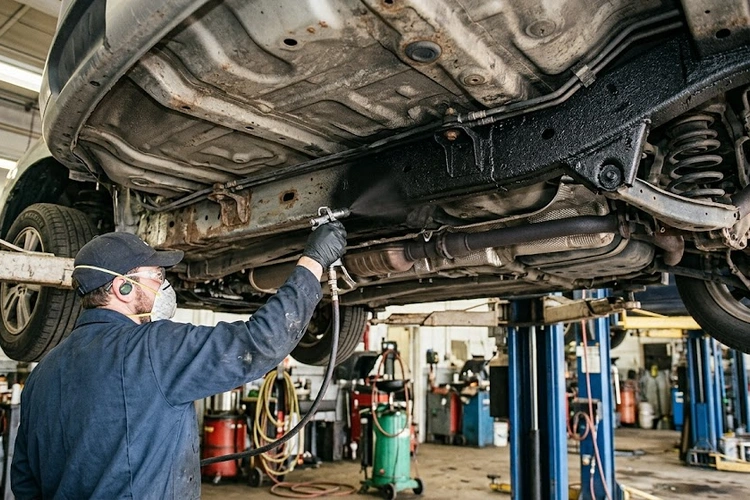
The most durable and widely used approach to protecting the car underbody from rust is the application of an undercoating — a thick, rubberized or asphalt-based compound sprayed directly onto cleaned metal surfaces. Rubberized undercoating creates a flexible membrane that bonds to metal and resists both moisture penetration and stone impact. That flexibility matters: as the vehicle's frame flexes during normal driving, a brittle or rigid coating would crack at flex points and allow moisture to enter directly beneath the protective layer. A rubberized coating moves with the metal and maintains its seal.
Professional application involves lifting the vehicle on a hoist, pressure-washing the underbody thoroughly, allowing it to dry completely, and then applying the coating in multiple overlapping passes with high-volume spray equipment. This process typically costs between $100 and $500 depending on the product used and the thoroughness of the application. Some dealerships offer undercoating at the time of vehicle purchase, though the quality of dealer-applied treatments varies considerably. Do-it-yourself aerosol versions are available at most auto parts retailers and can be effective when applied on a clean, dry surface with sufficient coverage.
Always clean and dry the underbody thoroughly before applying any coating — salt residue or moisture trapped beneath the product will continue corroding the metal from underneath, making the treatment worse than useless.
Rust-inhibiting sprays occupy a different category than undercoating. They do not create a thick physical barrier; instead, they displace moisture from metal surfaces and deposit a thin film that inhibits the electrochemical reaction responsible for rust formation. Products formulated with lanolin (a natural wax derived from sheep's wool), petroleum-based oils, or wax compounds are particularly effective at penetrating crevices and seams that thick undercoatings cannot reliably reach.
These sprays are best applied periodically — typically once or twice per year for vehicles in high-exposure environments — and are most effective as a complement to undercoating rather than a replacement for it. Apply them to exposed bolts, suspension joints, wheel arch edges, and any area where factory coating or undercoating has been compromised. After washing your vehicle at the end of winter, applying a rust-inhibiting spray to the underbody is a low-effort step that extends protection through the warmer months. That post-winter wash also addresses surface-level salt effects on the body panels; our guide on how to remove salt stains from car paint and body covers those procedures in detail.
| Protection Method | Average Cost | Durability | DIY-Friendly | Best Application |
|---|---|---|---|---|
| Rubberized Undercoating | $100–$500 (professional) | 3–5 years | Moderate | New or recently cleaned vehicles |
| Asphalt-Based Undercoating | $80–$300 (professional) | 2–4 years | Moderate | Budget-conscious owners in mild climates |
| Oil/Wax Rust-Inhibiting Spray | $15–$50 (product only) | 6–12 months | Yes | Annual maintenance and crevice protection |
| Epoxy Primer Coating | $300–$700 (professional) | 5–10 years | No | Restoration projects and bare metal surfaces |
| Electronic Rust Inhibitor | $200–$500 (installed) | Life of vehicle | No | New vehicles as supplemental protection |
Surface preparation is the single most important variable in the success of any underbody treatment. Any coating applied over moisture, salt residue, dirt, or existing rust traps those contaminants beneath the protective layer and allows corrosion to continue undetected. The ideal time to apply undercoating or rust-inhibiting spray is after a thorough pressure-wash of the underbody, followed by sufficient drying time — a minimum of 24 hours in a well-ventilated space, and longer in humid or cool conditions where evaporation is slow.
Late spring represents the most favorable seasonal window for full undercoating applications. By that point, winter road salt has been washed away, ambient temperatures are warm enough for coatings to cure properly, and you have the maximum interval before the next salt season begins. For vehicles in regions without harsh winters, timing is less critical, though applying any coating during dry weather and above 50 degrees Fahrenheit consistently produces better adhesion than application in cool or damp conditions.
New vehicles present the most valuable opportunity of all. Applying undercoating at the time of purchase, before factory coating sustains stone chip damage, creates the most complete barrier available. Some automotive professionals consider pre-emptive undercoating on a new vehicle to be the single highest-return rust prevention investment — the metal surface is pristine, coverage is uniform, and the treatment is not competing with existing compromises in the factory finish.
Certain vehicle areas require modified approaches rather than standard undercoating products. Catalytic converters (the emissions control devices mounted along the exhaust pipe beneath the vehicle) generate surface temperatures high enough to ignite standard rubberized coatings. Applying flammable undercoatings near exhaust components is a genuine fire hazard, not a theoretical one. High-temperature coatings designed specifically for exhaust-adjacent zones are available; they should be used exclusively in those areas.
Vehicles with significant existing rust also require a more involved preparation process. Applying a thick coating over active, flaking rust does not arrest the corrosion — it conceals it while that corrosion continues to spread beneath a surface that appears treated and protected. Before applying any protective product to a rusted surface, remove all loose scale with a wire brush or grinder, treat the remaining rust with a chemical rust converter (a product that reacts with iron oxide to create a stable, paintable compound), apply a self-etching or epoxy primer, and then apply the final topcoat. Each of these steps is load-bearing; skipping any one of them produces a coating that looks complete but provides no meaningful resistance to further corrosion.
If your vehicle operates year-round in the American Midwest, the Northeast, Canada, or any region where road de-icing is standard winter practice, a single factory coating is not sufficient over the long term. These vehicles develop measurable frame rust within five to seven years without deliberate intervention. For this driving profile, a professional rubberized undercoating applied every three to four years, combined with annual rust-inhibiting spray treatments in the fall before salt season and in the spring after it ends, forms a reliable and defensible baseline.
Beyond scheduled product applications, frequent underbody washing during and immediately after winter provides a meaningful supplemental benefit. Most commercial car washes offer an undercarriage flush for a small additional fee. Using this option after heavy road salt exposure removes the primary corrosive agent before it has extended contact time with metal surfaces. Even a standard garden hose directed at wheel wells and along frame rails after a salted-road drive eliminates a significant portion of the salt load. It is a minor habit with disproportionate long-term value for vehicles in these environments.
Vehicles with ten or more years of service present a different set of challenges than new ones. At this age, the original factory coating has almost certainly developed multiple compromised areas — thin spots, chips, delaminated sections, and areas of active surface rust. A thorough inspection before any treatment is essential: not just a standing visual check, but a proper examination with the vehicle raised on jack stands or ramps, a bright flashlight, and a probe tool to test for metal softness beneath the surface (a reliable early indicator of penetrating rust).
For restoration projects and older daily drivers with surface rust present, the treatment sequence is more important than any single product choice. Wire brush all loose material, apply rust converter to active rust, follow with an epoxy primer, and then apply the chosen topcoat — rubberized undercoating, chassis paint, or oil-based rustproofing. This sequence takes more time than spraying over an imperfect surface, but it is the only approach that produces results lasting more than one season. Budget-driven shortcuts at this stage create an appearance of protection while rust continues its work beneath.
While evaluating an older vehicle's underbody, it is productive to inspect brake hardware in the same session. Corrosion on brake rotors and caliper brackets can compromise stopping performance well before visible failure occurs. Our guide on warped brake rotor symptoms, causes, and resurfacing options provides a useful reference for what to look for during that inspection.
The most consequential and widespread error vehicle owners make is skipping the post-winter underbody inspection entirely. Winter is the period of maximum rust-inducing exposure for vehicles in salt-belt regions, and the corrosion it initiates continues to develop through spring and summer if it is not identified and addressed. A five-minute visual inspection with the vehicle raised on ramps — examining metal surfaces for new orange discoloration, bubbling coating, flaking material, or areas of wetness when the vehicle has been dry — can catch damage at the surface rust stage when treatment is inexpensive and straightforward.
Many owners rely exclusively on annual shop inspections to identify underbody issues. That approach is reasonable as a baseline, but it means several months may pass between the end of winter and the detection of damage that developed during that winter. Adding a brief self-inspection to your spring maintenance routine closes that gap. You do not need specialized knowledge — you are looking for visible changes relative to the last time you examined the underbody. Any new orange patches, any lifted or bubbling coating, and any soft spots detected with a probe tool warrant prompt professional evaluation.
Not every undercoating product is appropriate for every application area, and conflating them produces outcomes that range from ineffective to hazardous. A common mistake is applying standard rubberized aerosol undercoating to areas near the exhaust system or catalytic converter, where surface temperatures exceed the safe use range of those products. Another frequent error is substituting a sound-deadening undercoating — designed primarily for noise and vibration reduction — for a corrosion-inhibiting product, then expecting equivalent rust protection. These two product categories overlap in some formulations but should not be treated as interchangeable without confirming the manufacturer's corrosion ratings.
Product quality also directly affects the interval between reapplications. Aerosol undercoatings applied at home, while accessible and convenient, typically deliver thinner coverage than professional spray equipment and require more frequent reapplication to maintain protection. If you invest the time in thorough preparation, applying a higher-quality product via professional equipment or a rented spray gun produces results that remain effective significantly longer than aerosol coverage alone.
Finally, applying any protective treatment without fully removing existing salt or contamination is perhaps the most self-defeating error in this process. The coating traps the problem beneath it and delays detection. Wash thoroughly, allow full drying time, inspect carefully, and treat — in that sequence, without shortcuts at any step.
The appropriate interval depends on the method and your driving environment. Professional rubberized undercoating typically remains effective for three to five years and should be reapplied when inspection reveals areas of chipping or delamination. Rust-inhibiting oil or wax sprays are best applied once or twice annually — ideally in the fall before salt season begins and in the spring after it ends. Vehicles operated year-round in salt-heavy climates benefit from the shorter end of these intervals compared to those driven primarily in dry or mild conditions.
Both approaches are viable, and the right choice depends on the condition of the underbody and the quality of result you require. Do-it-yourself aerosol undercoatings perform well on clean, rust-free surfaces and are a practical option for routine annual maintenance applications. Professional application uses high-volume spray equipment that delivers more consistent, thicker coverage — particularly in recessed seams and cavity areas that aerosol cans reach less reliably. For new vehicles or comprehensive treatments intended to last three or more years, professional application generally produces more durable and uniform results than the DIY alternative.
Yes, consistent underbody washing is one of the most straightforward and cost-effective rust prevention habits available to any vehicle owner. Flushing road salt, mud, and corrosive contaminants before they have extended contact time with metal surfaces meaningfully slows the rate of oxidation. Most commercial car washes offer an undercarriage rinse option at minimal additional cost. If you wash your vehicle at home, directing a garden hose at the wheel wells, frame rails, and suspension components — particularly after winter driving or travel on salted roads — removes the primary corrosive agents before they begin their work.
The vehicles that last are not the ones that never encountered rust — they are the ones whose owners never gave rust the time and moisture it needed to take hold.
 |
 |
 |
 |

About Joshua Thomas
Joshua Thomas just simply loves cars and willing to work on them whenever there's chance... sometimes for free.
He started CarCareTotal back in 2017 from the advices of total strangers who witnessed his amazing skills in car repairs here and there.
His goal with this creation is to help car owners better learn how to maintain and repair their cars; as such, the site would cover alot of areas: troubleshooting, product recommendations, tips & tricks.
Joshua received Bachelor of Science in Mechanical Engineering at San Diego State University.
Get some FREE car parts & gear.. Or check out the latest free automotive manuals and build guides here.
Disable your ad blocker to unlock all the hidden deals. Hit the button below 🚗
| | | |
