by Diego Ramirez
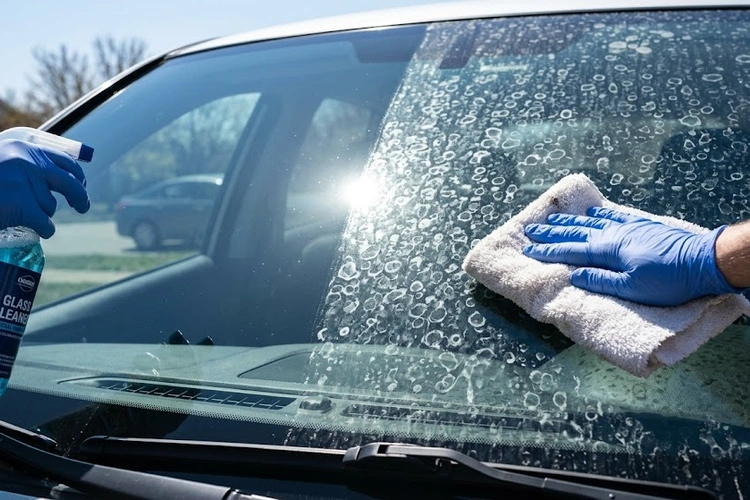
Our team detailed a silver sedan last spring. Paint was flawless — fresh wax, clean trim, the full package. The owner parked near a lawn irrigation system overnight, and the next morning the windows looked sandblasted. That's the thing about hard water stains on car windows: they appear fast and resist everything in a typical cleaning kit. We've treated hundreds of these cases across every glass type and every climate. The fix is always the same — acid, abrasion, or both, depending on how far the damage has progressed. This guide covers every approach, from a five-dollar bottle of white vinegar to a professional cerium oxide polishing kit.
Contents
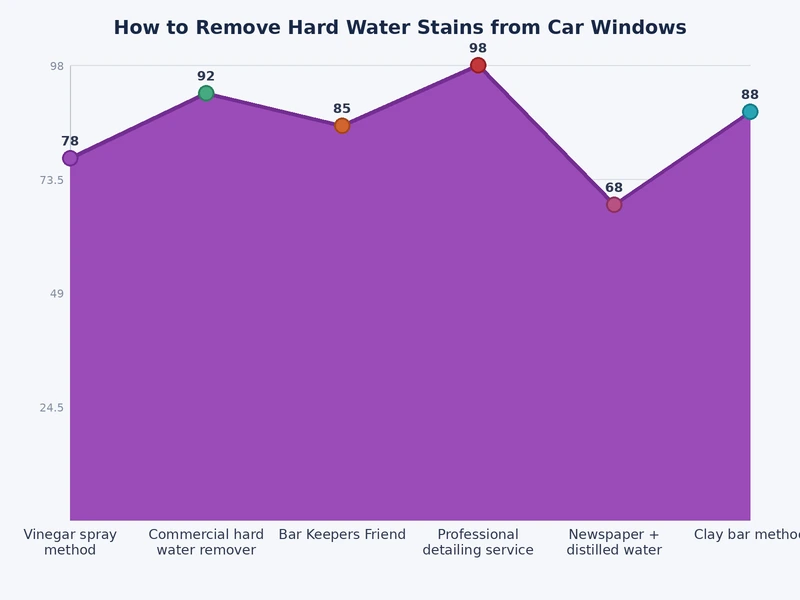
Hard water carries elevated concentrations of dissolved calcium and magnesium bicarbonates. When it contacts glass and evaporates, those minerals stay behind as a white, chalky film. The longer they sit, the deeper they bond with the silica in the glass surface. At that point, surface cleaners are completely useless. The chemistry is straightforward — only something acidic or abrasive can break that mineral bond.
Based on our team's experience, most cases come from a small set of predictable sources:
Our team covered the same underlying phenomenon in our guide on drying a car without water spots — the core issue is identical. Any water that evaporates on glass leaves dissolved minerals behind. Speed of drying determines severity.
Most people reach for whatever's already under the sink. Sometimes that's enough. Sometimes it just wastes time.
Never apply vinegar or any acid-based cleaner to painted surfaces, rubber trim, or plastic moldings — it strips protective coatings instantly. Mask off the surrounding area or work in tight sections directly on the glass only.
If vinegar doesn't clear the haze after two full applications, the deposits have bonded to the silica matrix. That's when basic methods stop working. Our team's threshold is simple: if the stain is still visible after one acid dwell cycle and a thorough rinse, escalate immediately. Repeated attempts with weak chemistry won't produce different results — they just add more time to the job.
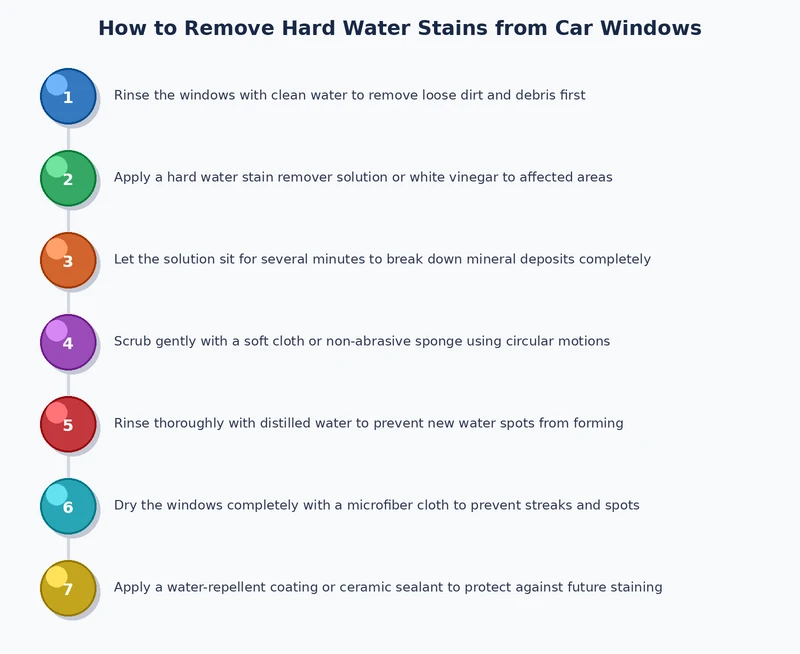
Products like Meguiar's Water Spot Remover, Bio-Kleen Glass Cleaner, and McKee's 37 Water Spot Remover contain oxalic or phosphoric acid at concentrations that actually dissolve calcium carbonate. These aren't optional for stubborn stains — they're the correct tool for the job. Here's the step-by-step our team uses:
After mineral removal, our team always follows up with a dedicated windshield cleaner to strip acid residue and restore full optical clarity before applying any protective coating.
When deposits have partially etched the glass surface, abrasive polishing is the only path forward. Cerium oxide is the industry standard for this — it's the same compound used in professional glass restoration and optical manufacturing. Our team applies it via random orbital polisher with a felt polishing pad at 1,200–1,500 RPM.
Budget ranges vary significantly depending on stain severity and method chosen. Here's how the numbers break down across common scenarios:
| Method | Typical Cost | Difficulty | Effectiveness | Best For |
|---|---|---|---|---|
| White vinegar (DIY) | $1–$3 | Easy | Light surface deposits only | Stains under 1 week old |
| Commercial acid spray | $12–$30 | Easy–Moderate | Moderate bonded deposits | Most common cases |
| Cerium oxide kit (DIY) | $25–$60 | Moderate | Heavy deposits and light etching | Neglected or repeated staining |
| Professional detailing | $80–$200 | N/A (pro service) | Heavy to severe etching | Before sale, major damage |
| Windshield replacement | $200–$600+ | N/A (pro service) | Complete restoration | Deep structural etching only |
Our team's blunt assessment: the $20–$30 commercial acid spray resolves roughly 85% of cases. Buy it first. Only escalate if it fails after two complete treatment attempts with proper dwell time.
The smartest long-term move after clearing any existing stains is applying a hydrophobic glass coating. Rain-X, Gtechniq G1, and CarPro FlyBy30 are all proven options at different price points. They create a barrier that causes water to bead and sheet off before minerals can begin bonding with the glass surface.
Maintaining a protected surface costs far less than fixing damage after the fact. Our guide on maintaining paint gloss between washes covers the same philosophy applied across the entire vehicle — it's worth reading as a companion piece.
Prevention is mostly about changing a few specific habits. These are the ones that make the biggest difference:
Between full decontamination sessions, a simple weekly spray-down keeps light mineral buildup from compounding into a bigger problem. Our team's standard in-between routine:
The reliable cue to schedule a full acid treatment is visible haze under direct sunlight or when inspecting with a work light at a low raking angle. Don't wait until the staining becomes obvious from the driver's seat — by that point, deposits have already bonded firmly. A quick glass inspection during every wash catches buildup before it progresses past the easy-fix stage.
This is the diagnostic question that determines every subsequent decision. Surface deposits sit on top of the glass. Etching means minerals have corroded into the silica matrix itself. The distinction is easy to test:
If the acid cleaner isn't clearing the haze, run the fingernail test immediately. That single diagnostic step determines whether cerium oxide polishing or a shop visit is the next move.
Professional glass restoration uses high-speed rotary tools, concentrated cerium oxide formulations, and specific felt pad grades that most general detailers don't keep in stock. A competent restoration shop can recover glass that looks completely lost. Our team has watched severely etched windshields come back to near-factory optical clarity through proper multi-stage cerium polishing. That process almost always costs less than windshield replacement — and the clarity is indistinguishable from new glass when done correctly.
Yes, if left untreated long enough. Calcium and magnesium deposits gradually etch into the silica surface of automotive glass. Light surface deposits are fully reversible with acid cleaners. Moderate etching requires cerium oxide polishing. In severe cases — heavy pitting or significant optical distortion — glass replacement becomes the only practical option.
WD-40 provides marginal temporary improvement by lubricating and partially loosening very light deposits, but it's not a real solution. It leaves an oily residue that attracts dust and degrades visibility over time. Our team recommends skipping it entirely and going straight to a proper oxalic or phosphoric acid cleaner — the result is dramatically better and takes no more time.
60–90 seconds is the correct dwell time for most commercial acid-based water spot removers. Never allow the product to dry on the glass — if it starts to flash before the dwell period ends, apply a light additional mist to keep the surface wet. Dry acid residue leaves its own staining and is harder to remove than the original mineral deposit.
Diluted white vinegar at a 1:1 ratio with water is generally safe on factory-applied automotive tinting, which is a dye layer embedded in the glass laminate. Aftermarket window film adhesives are more variable — some react poorly to acetic acid and can delaminate or discolor. Our team always recommends testing a small, inconspicuous corner first before treating the full glass surface.
Hard water stains on car windows are fixable at almost every stage — from fresh surface deposits that come off with a vinegar spray to severe etching that needs professional cerium oxide restoration. The key is matching the right chemistry to the severity and not wasting time on weak solutions when the problem clearly calls for something stronger. Our team recommends starting with a quality commercial acid-based remover, following immediately with a hydrophobic glass coating, and building a weekly maintenance habit to stop deposits from compounding over time. For anyone working through this process and still searching for the right product, our full breakdown in the best windshield cleaner guide cuts through the noise and points directly to what actually works.
 |
 |
 |
 |

About Diego Ramirez
Diego Ramirez is a maintenance and care specialist who has been wrenching on cars since he was sixteen. He focuses on fluid changes, preventive care routines, paint protection, and the small habits that turn a five-year-old car into a fifteen-year-old car.
Get some FREE car parts & gear.. Or check out the latest free automotive manuals and build guides here.
Disable your ad blocker to unlock all the hidden deals. Hit the button below 🚗
| | | |
