Car Care ›
by Diego Ramirez
We have all been there: standing in the automotive aisle of a big-box store, staring at a wall of glass cleaner bottles that all promise a streak-free finish. The windshield has that milky haze that makes night driving borderline dangerous, and every product label reads almost identically. Our team spent several weeks testing seven of the most popular automotive glass cleaners on the market in 2026 to cut through the marketing noise and find the formulas that actually deliver on their promises.
A quality automotive glass cleaner does more than remove visible dirt. It must dissolve the invisible film of outgassing residue (the hazy buildup from dashboard plastics baking in the sun), road-spray contaminants, and oily fingerprints without leaving behind streaks, chemical odors, or damage to window tint. The difference between a mediocre glass cleaner and a great one becomes painfully obvious during golden-hour driving, when even the slightest film scatters light across the entire windshield. For anyone who has recently detailed their vehicle with products from our tire shine or plastic restorer guides, a proper glass cleaner is the finishing touch that ties the whole detail together.

After testing each product on interior windshields, exterior glass, side mirrors, and tinted rear windows, we ranked them on streak-free performance, ease of application, drying speed, and value per ounce. Below are the results, along with a detailed buying guide and answers to the questions our readers ask most often.
Contents








Invisible Glass has been a staple in the car care community for years, and the 2026 two-pack offering remains our top overall pick for good reason. This cleaner earned the highest marks in our streak-free testing on both interior and exterior glass surfaces, leaving behind absolutely zero residue even when applied in direct sunlight. The formula is ammonia-free and tint-safe, which means it will not degrade aftermarket window film or cause the purple discoloration that ammonia-based cleaners are known for.
The spray mechanism delivers an even, controlled mist that coats glass surfaces uniformly without excessive dripping or overspray onto surrounding trim. Our team found that a single pass with a quality microfiber towel was sufficient to remove moderate road film, while heavier buildup required just two passes. At 22 fluid ounces per bottle and two bottles per pack, the value proposition is strong for anyone who cleans glass regularly or maintains multiple vehicles.
Where Invisible Glass truly separates itself from the competition is the drying phase. Most cleaners leave behind a faint haze that only becomes visible at certain angles, but this formula dries to a genuinely invisible finish that we could not detect even under harsh cross-lighting conditions. The lack of added fragrances is another plus for anyone sensitive to chemical odors during interior cleaning sessions.
Pros:
Cons:
Rain-X has built its reputation on water-repellent windshield treatments, and the brand's dedicated glass cleaner carries that same aggressive cleaning philosophy. The concentrated formula attacked heavy road grime, tree sap residue, and bug splatter more effectively than any other liquid spray in our testing lineup. On a windshield that had endured a 400-mile highway drive without cleaning, Rain-X dissolved the accumulated film in a single application where most competitors required multiple passes.
The interior performance is equally impressive, particularly when dealing with the stubborn smoke film and protectant overspray that accumulates on the inside of windshields over time. Our team tested it on a vehicle that had been treated with a silicone-based dashboard protectant the week prior, and Rain-X cut through the resulting interior haze without any difficulty. The 23-ounce bottle provides slightly more product than most competitors in the same price bracket, adding a small value advantage.
One thing to note is that Rain-X Glass Cleaner is a standalone cleaning product and does not leave behind the water-beading treatment that the brand's water repellent products provide. Buyers who want the cleaning power plus the hydrophobic coating will need to apply those products separately. The formula does contain a light chemical scent that dissipates within a few minutes of application, which is worth considering for anyone with scent sensitivity.
Pros:
Cons:
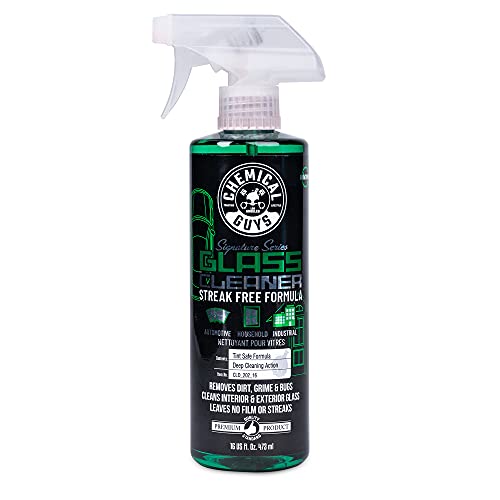
Chemical Guys has positioned its Signature Series glass cleaner as a professional-grade option, and our testing confirms that it delivers a noticeably refined cleaning experience that justifies the slightly higher per-ounce cost. The ammonia-free formula produces an exceptionally clean finish on tinted windows, and our team found zero evidence of film degradation or discoloration after repeated applications on a vehicle with aftermarket ceramic tint. For detailing professionals who work on client vehicles with expensive tint jobs, this level of confidence in product safety is non-negotiable.
The cleaning power sits solidly in the middle of our test group, handling everyday fingerprints, dust, and light road film with ease while requiring a second pass for heavier contamination. Where Chemical Guys really shines is in the optical clarity of the finished surface; our team noticed that windshields cleaned with this product appeared to have slightly better light transmission than those cleaned with most competitors, likely due to the formula's ability to remove microscopic residue that other cleaners leave behind.
The primary drawback is the 16-ounce bottle size, which is 25 to 30 percent smaller than most competitors in the same price range and makes the per-ounce cost significantly higher. Professional detailers will want to purchase the larger gallon refill to bring the cost in line with other options, but casual users buying a single bottle will feel the price premium.
Pros:
Cons:

Sprayway takes a fundamentally different approach to glass cleaning by using a thick aerosol foam rather than a liquid spray, and the results are genuinely impressive on vertical surfaces where liquid cleaners tend to run and drip. The heavy-duty foam clings to side windows and mirrors long enough to dissolve contamination before wiping, which means less product waste and fewer drips onto door panels and trim. The 12-pack format makes this an outstanding value for commercial detailing shops, fleet operators, or anyone maintaining multiple vehicles throughout the year.
The formula uses perfume-grade alcohol as its primary solvent, which provides rapid evaporation and strong cleaning power against greasy films and fingerprints. Our team was particularly impressed by how quickly the foam broke down interior windshield haze; the alcohol-based formula seemed to dissolve the oily outgassing film more aggressively than water-based competitors. The American-made product has a long track record of consistent quality that spans several decades in both automotive and household applications.
The main limitation is the aerosol delivery format itself. The foam is dispensed in a wide cone pattern that makes precision application difficult, and overspray onto dashboard surfaces, headliners, and seat fabric is almost inevitable without careful masking. Buyers who plan to use this product primarily for interior windshield cleaning should keep a towel draped over the dashboard to catch any foam that misses the glass surface.
Pros:
Cons:
Meguiar's Perfect Clarity Glass Cleaner is specifically engineered with an anti-hazing formula that targets the stubborn interior windshield film most generic cleaners merely redistribute. In our testing, this product eliminated the milky interior haze on a three-year-old vehicle's windshield more thoroughly than any other liquid spray, including products that cost twice as much per ounce. The formula spreads thinly across glass with minimal effort and wipes off cleanly without the tacky residue that cheaper cleaners sometimes leave behind.
The 24-ounce bottle sits at the larger end of the standard retail size range, providing solid value alongside the premium cleaning performance. Our team appreciated that the formula is ammonia-free and safe for both factory-tinted and aftermarket-tinted windows, which eliminates the need to stock separate cleaners for different glass types. The product integrates seamlessly into a broader Meguiar's detailing workflow, complementing their compound, polish, and wax products for buyers already invested in the brand ecosystem. Pairing a thorough glass cleaning session with a proper windshield washer fluid top-off ensures maximum visibility in all driving conditions.
The one area where Meguiar's falls slightly behind our top pick is in raw cleaning power against heavy exterior contamination. Bug residue and dried tree sap required pre-soaking or multiple passes, whereas Invisible Glass and Rain-X handled these challenges more decisively on the first application. For buyers whose primary concern is interior haze removal and everyday maintenance cleaning, however, Meguiar's is the stronger choice.
Pros:
Cons:
Griot's Garage positions itself as a premium detailing brand, and its Ultra-Premium Glass Cleaner lives up to that billing with a rich foaming formula that genuinely outperforms most aerosol competitors in our testing. The foam is denser and clings to glass longer than Sprayway's offering, providing more dwell time (the period the cleaning agent sits on the surface dissolving contaminants) for breaking down tough road grime, salt deposits, and smoke film. The result is a cleaner windshield with fewer passes, which translates directly into less time and effort per vehicle.
Being both ammonia-free and dye-free, this cleaner is one of the safest options in our lineup for aftermarket window tint. Detailing professionals who work with high-end tint installations will appreciate the peace of mind that comes with a formula specifically designed to avoid film damage. The product is developed and manufactured in the United States, and Griot's Garage quality control is consistently excellent based on our experience with the brand's broader product catalog.
The price per can is notably higher than Sprayway, which makes it a harder recommendation for budget-conscious buyers or high-volume users who go through several cans per month. The cleaning performance does justify the premium for anyone who values the best possible result on each application, but cost-conscious buyers should note that Sprayway delivers roughly 85 percent of the same performance at roughly half the price per ounce.
Pros:
Cons:
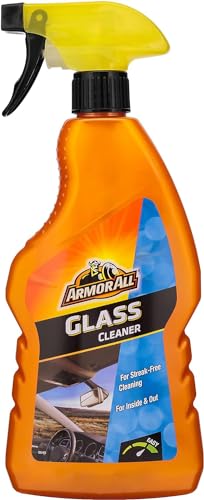
Armor All is one of the most recognizable names in automotive care, and the brand's dedicated glass cleaner offers a no-frills cleaning solution at a price point that undercuts most competitors in our lineup. The 22-ounce liquid spray handles basic cleaning tasks competently, removing everyday dust, fingerprints, and light road film without leaving obvious streaks. For buyers who clean their glass once a week as part of a regular wash routine and never let heavy contamination accumulate, this product gets the job done at the lowest cost.
The formula is manufactured in the United States and applies with a standard trigger sprayer that provides adequate coverage without excessive dripping. Our team found that the cleaning power is sufficient for maintenance-level glass cleaning but noticeably weaker than products like Rain-X and Invisible Glass when confronted with heavy grime, bug residue, or baked-on road film. A second or even third pass was necessary on heavily contaminated surfaces where our top picks needed only one.
Armor All also lacks the explicit ammonia-free and tint-safe certifications that most competitors in this roundup prominently feature. While we did not observe any tint damage during our testing period, buyers with expensive aftermarket window film should consider one of the products in our lineup that specifically guarantees tint compatibility. The product fills its role well as an affordable, widely available glass cleaner for light-duty maintenance on vehicles without window tint.
Pros:
Cons:
The most fundamental decision is choosing between a liquid trigger-spray cleaner and a foaming aerosol. Liquid sprays offer more precise application control and are generally more economical per ounce, making them the better choice for buyers who primarily clean interior glass surfaces where dripping and overspray must be minimized. Foaming aerosols excel on vertical exterior surfaces like side windows and mirrors because the thick foam clings to the glass rather than running down immediately, providing more dwell time for the cleaning agents to break down contamination. Our recommendation is to keep one of each format on hand: a liquid spray for interior work and a foaming aerosol for exterior glass during a full detail session.
Any vehicle with aftermarket window tint, whether it is a basic dyed film or a premium ceramic installation, requires an ammonia-free glass cleaner. Ammonia degrades the adhesive layer and dyes in window film over time, causing bubbling, purple discoloration, and premature peeling that can cost hundreds of dollars to replace. Even vehicles with factory-tinted glass benefit from ammonia-free formulas, as the polyester film layers used in factory tinting can still be affected by repeated ammonia exposure. Five of the seven products in our roundup are explicitly ammonia-free, and we strongly recommend limiting consideration to those options unless the vehicle has no tinting whatsoever.
Not all glass cleaners are formulated for the same level of contamination. Products like Rain-X and Invisible Glass are engineered to tackle heavy-duty exterior grime including bug residue, tree sap, and road tar, while products like Meguiar's Perfect Clarity focus more on eliminating interior haze and outgassing film. Matching the cleaner to the primary use case prevents frustration and wasted product. Buyers who split their cleaning between interior and exterior work may find that two different products, one optimized for each task, deliver better overall results than any single all-purpose formula.
Glass cleaner is a consumable product that most vehicle owners go through regularly, so the per-ounce cost matters more than the sticker price of a single bottle. Multi-packs like the Invisible Glass two-pack and the Sprayway 12-pack dramatically reduce the per-ounce cost and eliminate the inconvenience of frequent repurchasing. Professional detailers and fleet operators should look for gallon-sized refill options from brands like Chemical Guys and Meguiar's to bring the per-ounce cost down to a fraction of retail pricing. For most home users cleaning one or two vehicles, a standard single bottle lasts approximately four to six weeks of weekly glass cleaning.
All seven products in our lineup are safe and effective on household glass, mirrors, and glass tabletops. Automotive glass cleaners are generally formulated to handle tougher contamination than standard household window cleaners, which means they tend to perform better on bathroom mirrors with hairspray buildup and kitchen windows with grease film. There is no risk of damage from using an automotive product on household glass.
Our team recommends cleaning interior glass surfaces every two weeks and exterior glass weekly, though driving conditions significantly affect this schedule. Vehicles parked outdoors in areas with heavy pollen, bird activity, or industrial fallout may require exterior cleaning every few days. Interior windshields develop outgassing haze faster during summer months when dashboard temperatures climb, so increasing interior cleaning frequency during warm weather is advisable.
No. Automotive glass cleaners are formulated for traditional glass and should never be applied to LCD or OLED infotainment screens, digital instrument clusters, or heads-up display surfaces. These screens have anti-reflective and oleophobic coatings that can be stripped or damaged by the solvents in glass cleaner. A dedicated screen cleaner or a lightly dampened microfiber cloth is the only safe option for these surfaces.
A clean, low-pile or waffle-weave microfiber towel is the gold standard for glass cleaning because it absorbs cleaning solution and lifts contamination without shedding lint. Our team uses two towels per surface: one dampened with the cleaning product for the initial wipe and a second dry towel for the final buffing pass. Paper towels and cotton rags should be avoided because they leave behind lint fibers that create streaks, especially on tinted glass surfaces.
Standard glass cleaners are not formulated to remove mineral water spots (etched rings left by hard water or sprinkler overspray). These spots are caused by mineral deposits that bond to the glass surface and require a dedicated water spot remover or a mild acid-based cleaner to dissolve. Attempting to remove water spots with a standard glass cleaner will result in frustration and wasted product, as the spots will remain visible after the cleaner dries. A clay bar treatment, like those covered in our clay bar guide, can also help remove light surface contamination from glass.
Always apply glass cleaner in shade or on glass that is cool to the touch. Direct sunlight and hot glass cause the cleaning solution to evaporate before it can be properly wiped away, leaving behind streaks and residue that are difficult to remove without reapplication. If shade is unavailable, early morning or late evening application provides the best results because the glass surface temperature is lowest during these periods.
The best glass cleaner is the one matched to the task: an ammonia-free liquid spray for interior haze and a foaming aerosol for exterior grime, both applied in the shade with a clean microfiber towel.
 |
 |
 |
 |

About Diego Ramirez
Diego Ramirez has been wrenching on cars since his teenage years and has built a deep practical knowledge of automotive maintenance and paint protection through years of hands-on work. He specializes in fluid service intervals, preventive care routines, exterior protection products, and the consistent habits that extend a vehicle's lifespan well beyond average. At CarCareTotal, he covers car care guides, cleaning and detailing products, and exterior maintenance and protection reviews.
Get some FREE car parts & gear.. Or check out the latest free automotive manuals and build guides here.
Disable your ad blocker to unlock all the hidden deals. Hit the button below 🚗
| | | |
