by Joshua Thomas
If your car's finish looks dull, chalky, or faded, oxidation is likely the culprit. Learning how to remove oxidation from car paint can restore your vehicle's shine and protect the underlying metal. Oxidation occurs when UV rays, moisture, and oxygen break down the clear coat and pigment layer over time. The good news: most oxidation is reversible with the right products and technique. Before you consider an expensive respray, try the methods below. If you've recently dealt with other paint damage, our guide on how to remove bird droppings from car paint covers another common cause of surface deterioration.
Contents
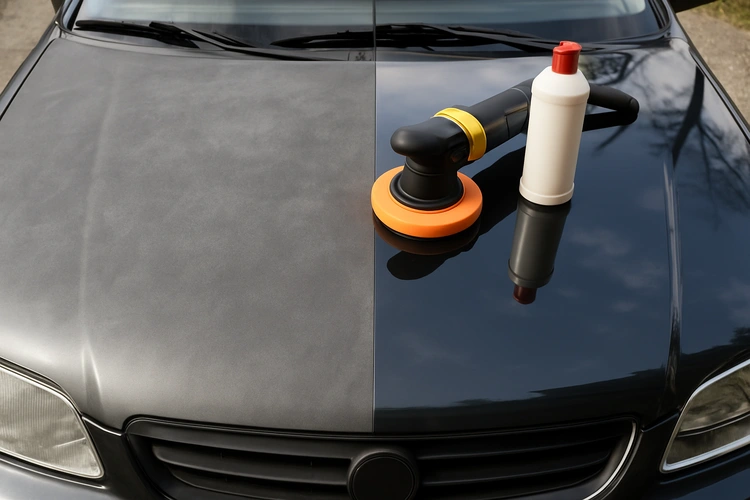
Paint oxidation is a chemical degradation process in which oxygen molecules react with the polymers in automotive paint. The result is a dull, chalky, or faded surface that loses reflectivity and depth. It typically starts in the clear coat and, if left untreated, penetrates into the color layer.
Several environmental factors accelerate oxidation:
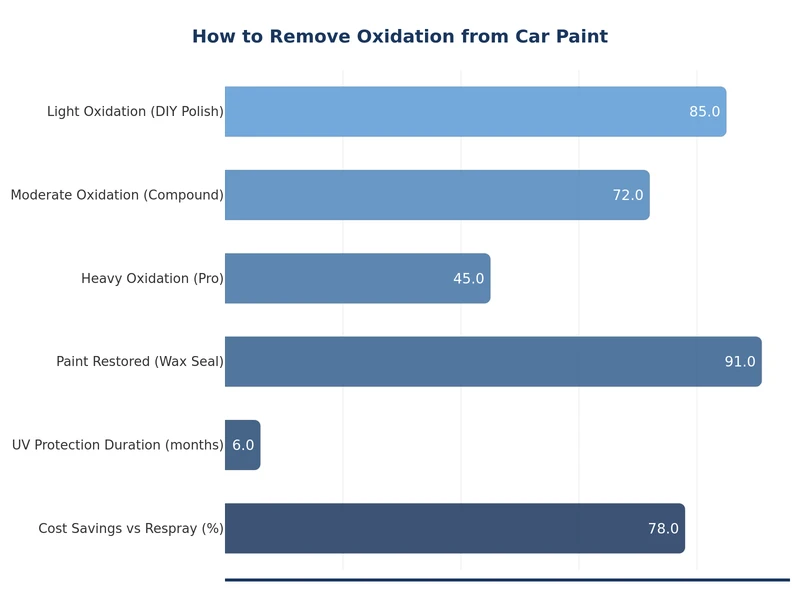
Not all oxidation is the same. Mild oxidation affects only the clear coat and responds well to polishing compounds. Moderate oxidation reaches into the upper color layer but can still be corrected by machine polishing. Severe oxidation penetrates deep into the base coat; at this stage, professional repainting may be the only option. Run your hand across the surface — if it comes away with a white chalky residue, you're dealing with at least moderate oxidation.
| Item | Purpose | Notes |
|---|---|---|
| Car wash soap + microfiber mitt | Pre-clean the surface | Never skip the wash step |
| Clay bar kit | Remove bonded contaminants | Use with clay lubricant spray |
| Rubbing compound | Cut through heavy oxidation | See our best rubbing compound guide for top picks |
| Polish / finishing polish | Remove compound haze, restore gloss | Used after rubbing compound |
| Dual-action (DA) polisher | Faster, safer machine application | Optional but recommended for larger areas |
| Foam applicator pads | Apply compound/polish by hand | Use separate pads for each product |
| Microfiber towels (x4+) | Buff off residue | Use clean, dry towels |
| Car wax or paint sealant | Protect restored paint | Apply immediately after polishing |
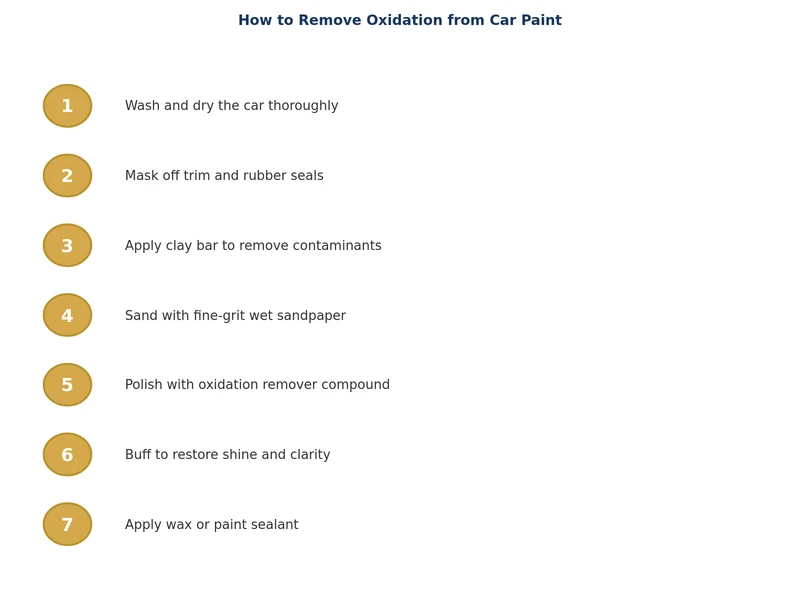
Regardless of which method you choose, the process always starts with a thorough wash. Skipping this step grinds surface dirt into the paint during polishing, causing swirl marks and scratches you didn't have before.
This approach suits small areas, single panels, or mild-to-moderate oxidation:
A dual-action (DA) polisher dramatically reduces effort and produces better results on larger or more oxidized areas. DA polishers are much safer than rotary buffers for beginners because the random orbital motion prevents burning through the clear coat.
Matching the product to the severity level avoids removing more clear coat than necessary. Every polishing session removes a small amount of clear coat — you only have so many passes before the clear coat thins out entirely.
| Oxidation Level | Visual Signs | Recommended Product | Method |
|---|---|---|---|
| Mild | Slight dullness, faint haze | Fine polish or light compound | Hand or DA polisher |
| Moderate | Clear chalk, loss of gloss | Rubbing compound + polish | DA polisher preferred |
| Severe | Deep chalking, paint color faded | Heavy compound, then polish | DA or rotary (experienced users) |
| Beyond repair | Bare metal visible, paint peeling | Professional respray | Body shop required |
Water spots from mineral deposits can mimic mild oxidation. If you're unsure which you're dealing with, read our guide on how to remove water spots from car paint before reaching for a compound.
Removing oxidation exposes fresh, bare clear coat that is now highly vulnerable. Protecting it immediately is not optional — skip this step and oxidation will return within weeks.
A quality carnauba wax provides 2–3 months of UV protection and is the fastest option. Apply in a thin, even coat, allow it to haze, and buff off with a clean microfiber. For best technique, see our detailed walkthrough on how to wax a car by hand.
Synthetic sealants last 6–12 months and bond more durably to the clear coat than carnauba wax. Apply the same way as wax. Good choice if you park outdoors frequently.
A ceramic coating offers 2–5 years of protection and superior hydrophobic properties. It requires the most careful surface prep — any remaining oxidation or polish haze will be locked under the coating. Not ideal as a first DIY step unless you're confident in your prep work.
Once you've restored your paint, keeping oxidation away is far easier than removing it. Follow these habits:
Yes. Mild to moderate oxidation responds well to hand application with a foam applicator pad and a quality rubbing compound. It takes more effort and time than a DA polisher, but the result can be comparable on smaller sections. For severe oxidation covering entire panels, a machine polisher will save significant effort and produce a more even finish.
If the paint is peeling, flaking, or the bare primer or metal is visible, DIY correction won't work. Similarly, if rubbing compound removes the chalky residue but the color underneath is still uniformly faded or blotchy after two passes, the oxidation has penetrated through the clear coat into the base coat. At that point, a professional respray is the only reliable fix.
These household abrasives can temporarily improve minor dullness on a very small area, but they are inconsistent in grit, can leave micro-scratches, and provide no UV protection after treatment. Dedicated automotive rubbing compounds are formulated with controlled abrasive particles and are far safer and more effective. Save the toothpaste for your teeth.
A full correction detail on an average sedan typically takes 4–8 hours depending on oxidation severity, whether you're working by hand or machine, and your experience level. Breaking the job into sections over a weekend is a perfectly valid approach. Work one panel at a time and keep each section out of direct sun.
Any abrasive polishing removes a microscopic layer of clear coat — that's how it works. This is why you should always start with the least aggressive product that gets the job done, and why protection with wax or sealant immediately afterward is essential. A car with a healthy clear coat can typically withstand several correction sessions over its lifetime before the clear coat thins critically.
With no protection, oxidation can return visibly within a few months in hot, sunny climates. With a quality wax applied every 2–3 months or a paint sealant applied every 6–12 months, you can keep your paint looking restored indefinitely. A ceramic coating extends that protection to 2–5 years with minimal maintenance beyond regular washing.
 |
 |
 |
 |

About Joshua Thomas
Joshua Thomas just simply loves cars and willing to work on them whenever there's chance... sometimes for free.
He started CarCareTotal back in 2017 from the advices of total strangers who witnessed his amazing skills in car repairs here and there.
His goal with this creation is to help car owners better learn how to maintain and repair their cars; as such, the site would cover alot of areas: troubleshooting, product recommendations, tips & tricks.
Joshua received Bachelor of Science in Mechanical Engineering at San Diego State University.


Get some FREE car parts & gear.. Or check out the latest free automotive manuals and build guides here.
Disable your ad blocker to unlock all the hidden deals. Hit the button below 🚗
| | | |
