Car Care ›
by Diego Ramirez
Meguiar's Ultimate Compound earns the top spot in our 2026 rubbing compound testing because it removes scratches, swirls, and oxidation on clear coat and single-stage paint without hazing, and it performs reliably whether you apply it by hand or with a dual-action polisher. If your vehicle's finish has been dulled by sun exposure, road contamination, or surface scratches accumulated over several driving seasons, a quality rubbing compound is the most direct and cost-effective path to restoring clarity, without booking expensive body shop time or repainting entire panels.
Rubbing compounds use abrasive particles to level the paint surface by removing a controlled amount of clear coat or single-stage paint, which eliminates defects sitting above that level and restores the underlying gloss. The aggressiveness of the abrasive formula determines how deep a defect the product can correct, and matching that aggressiveness to your specific paint condition, defect severity, and application method is the central skill that separates a professional-quality result from one that leaves haze or swirl marks behind. To round out your detailing arsenal with the right tools and supplies, browse the full selection in our car care section, where you will find companion products for every stage of the paint correction and maintenance process.
In 2026, the rubbing compound market has matured into three distinct tiers: consumer-grade formulas engineered for hand application and mild surface defects, professional-grade cutting compounds that require machine polishers to deliver their full cutting power, and hybrid products with diminishing abrasive technology that bridge both worlds in a single bottle. The seven products evaluated here represent the strongest performers across all three tiers, selected on the basis of cutting efficiency, finish quality, ease of use, and value per ounce. If you are building out a complete detailing setup, our reviews of the best foam cannons and the best shop vacuums for cars cover two tools that work in direct combination with the compounding stage of any detail job.

Contents






Meguiar's Ultimate Compound is the definitive benchmark for consumer-grade paint correction in 2026, delivering professional-caliber scratch and swirl removal in a formula that is safe for all clear coat finishes and glossy single-stage paints. The compound's advanced abrasive technology works in progressive stages — cutting aggressively during the initial passes to remove surface defects, then diminishing as the abrasive particles break down, so the product finishes out to a clean, haze-free surface without requiring a follow-up polish in most cases. At 15.2 ounces, the bottle provides enough product for multiple full correction sessions on a mid-size sedan, which makes its price-per-application ratio one of the best in the consumer segment.
What distinguishes the Ultimate Compound from cheaper alternatives is its ability to restore color and clarity in a single step, removing not only light scratches and swirl marks but also water spots and oxidation that have dulled paint over years of UV exposure. Meguiar's recommends applying it with a foam or microfiber applicator pad by hand for small spot corrections, or with a dual-action random orbital polisher for full-panel correction, and both methods deliver results that are visibly superior to those produced by many competing products at higher price points. The clear coat compatibility is not a marketing qualifier — the formula genuinely does not haze or induce secondary marring on properly maintained modern paint systems.
For the enthusiast who wants one compound to handle the majority of paint correction scenarios without investing in a tiered multi-product system, Meguiar's Ultimate Compound is the clear first purchase in 2026. It is equally at home in the hands of a first-time detailer using a foam pad by hand or an experienced operator running a random orbital at 5,000 RPM, and the results are consistently excellent across both application contexts, which is a rare quality in this product category.
Pros:
Cons:
The 3M Super Duty Rubbing Compound, sold under product code 05954, is the industrial-strength option in this roundup, and it earns its reputation by delivering one of the highest cut rates available in a commercially accessible product, without the premium price tag that typically accompanies professional-only compounds. Packaged in a full quart — 32 fluid ounces — it is engineered for volume work on heavily oxidized automotive and marine paint and gelcoat surfaces, where lesser compounds would require multiple passes and still fall short of full defect removal. The absence of waxes and silicones in the formula is a deliberate choice designed for professional shop environments, where silicone contamination can cause paint fish-eye during any subsequent respray or touch-up work.
3M formulates this compound to cut through P1000 grade and finer scratches on both automotive and marine applications, a specification that covers a wide range of real-world damage scenarios from moderate swirling to the kind of surface degradation you find on a vehicle that has sat unprotected under UV exposure for several seasons. The high cut rate means this product removes material quickly and efficiently, which is its primary advantage for technicians working on panels with severe oxidation, but it also means that application technique matters considerably — using it with too aggressive a pad on a rotary polisher at high speed can generate heat and cut through thin paint, so a methodical approach with proper pad selection is essential for safe, effective use.
For detailers and shop technicians who regularly encounter heavily weathered paint on older vehicles, fleet equipment, or marine vessels, the 3M Super Duty Rubbing Compound offers a compelling combination of cutting power and volume value that makes it a justifiable staple product. The quart size provides enough material for multiple full-vehicle correction passes, and when paired with a quality foam cutting pad and a variable-speed orbital, the results on oxidized surfaces are dramatic and immediate.
Pros:
Cons:
Meguiar's Mirror Glaze M105 Ultra-Cut Compound occupies the upper tier of the professional compounding market, engineered specifically to remove moderate-to-heavy paint defects including scratches, oxidation, swirl marks, acid rain etching, and sanding marks up to 1200 grit — a specification that places it well beyond the capability of consumer-grade products and into the category of compounds that professional detailers deploy for paint correction work on show cars and high-value vehicles. The super micro-abrasive technology that defines the M105 formula is designed to cut with the aggression of a heavy compound while simultaneously minimizing the secondary marring that traditional cutting compounds introduce, which reduces the total number of correction steps required to reach a high-gloss final finish.
The critical distinction between the M105 and the Ultimate Compound lower in Meguiar's lineup is the speed and depth of the cut — M105 is genuinely formulated for machine use, and it performs best when paired with a foam or microfiber cutting pad on a dual-action or rotary polisher, where its ultra-fast cutting rate can be deployed at the right speed and pressure to eliminate deep defects in one or two passes. The 8-ounce size is the standard entry point, and while it appears modest compared to quart-size competitors, the concentration of the formula means that a small amount of product goes a considerable distance on a 6-inch pad, making the apparent cost per ounce less relevant than the cost per panel corrected.
For anyone undertaking serious single-stage or clear-coat paint correction in 2026, the M105 is the compound that professional detailers consistently return to when the defects are too deep for a lighter product and the paint quality demands a finish worthy of a show car. It requires a polisher and proper pad selection to use safely, but in those conditions it produces a level of gloss and clarity that justifies its place at the top of the professional consumer segment.
Pros:
Cons:
Griot's Garage has built a loyal following among enthusiast detailers by engineering products that perform at professional levels while remaining accessible to serious home users, and the Complete Compound exemplifies that philosophy in a 16-ounce bottle that covers all automotive paint finishes with consistent, predictable results. The formula effectively removes scratches, swirl marks, oxidation, and other surface defects while leaving behind a glossy finish that genuinely does not require dust management during the buffing process — a practical advantage that anyone who has worked with older compound formulas in a closed garage will immediately appreciate and value.
One of the standout characteristics of the Griot's Complete Compound is its wipe-off behavior, specifically designed to release from the paint surface effortlessly once the buffing work is complete, without the dried, chalky residue that plagues many competing products and adds unnecessary cleanup time to every correction session. Griot's recommends pairing it with one of their Dual Action Random Orbital polishers and a foam cutting pad for superior defect removal, but the formula also performs effectively as a spot treatment by hand, making it a genuinely flexible tool for both full-panel correction and targeted touch-up work on isolated problem areas.
The Complete Compound's compatibility with all automotive paint finishes — including newer water-based paint systems and ceramic-coated surfaces prior to decontamination — makes it one of the most broadly applicable products in this review, and at 16 ounces it provides enough product for a thorough full-vehicle correction on a standard-size car or truck. Griot's Garage backs its products with strong customer support and a clear product ecosystem, so if you choose to invest in one of their polishers as well, the pairing delivers measurably better results than mixing brands at random.
Pros:
Cons:
The Turtle Wax T-415 Premium Grade Clean Cut Rubbing Compound positions itself as the budget-conscious detailer's gateway to professional-caliber scratch removal, and at 18 fluid ounces per bottle it offers more volume than several of its more expensive competitors while still delivering on the core function of removing 1500-grit sanding scratches, heavy swirl marks, and surface blemishes from automotive paint. The silicone-free formula is explicitly rated for use in professional detail, paint, and body shops — a specification that signals genuine technical quality and not merely a consumer-grade product dressed up with professional-sounding marketing language.
Turtle Wax engineered the T-415 for flexibility across application methods, allowing use by hand for controlled spot corrections or with an orbital or rotary polisher for full-panel efficiency, and that versatility is a meaningful advantage for buyers who do not yet own a dedicated polisher but plan to invest in one as their detailing skills develop. The cut rate, calibrated to address 1500-grit scratches, falls in the moderate range for this product category — more aggressive than light polishes and finishing compounds but less cutting than industrial-strength products like the 3M Super Duty, making it appropriate for vehicles with normal wear-and-tear rather than extreme oxidation or deep gouges.
For the car owner who wants a dependable, shop-approved rubbing compound at an accessible price point, the Turtle Wax T-415 delivers results that exceed its cost category convincingly, and the generous 18-ounce volume means you are not rationing product during application. It does not produce the same final finish gloss as premium diminishing abrasive compounds, and a follow-up polish is recommended for show-quality results, but for restoring a vehicle's appearance to a well-maintained daily-driver standard the T-415 accomplishes the task efficiently and without waste. If you are also evaluating other garage maintenance products, our review of the best epoxy primers may help you plan a more comprehensive paint and surface preparation workflow.
Pros:
Cons:
The menzerna Heavy Cut Compound 400 is the most technically ambitious product in this review, engineered to function simultaneously as a heavy cut compound, a medium cut polish, and a finishing product within a single 16-ounce bottle — a formulation philosophy that eliminates the need to switch between multiple product stages during a correction session and reduces both product cost and working time for detailers who value efficiency above specialization. Menzerna is a German manufacturer with deep roots in the professional and automotive OEM finishing market, and the compound's specification sheet reflects that heritage with silicone-free chemistry and compatibility with both orbital and rotary machine polishers at the professional level.
The compound's all-in-one capability centers on its ability to address hologram effects, uneven paint matting, and light-to-medium-depth scratches that have been set into the paint surface, then transition to a finishing behavior that protects and enhances the underlying color so that the paint appears brighter and more resilient against environmental contaminants including water and road grime. menzerna recommends pairing the compound with their red heavy cut foam pad for machine use to achieve the maximum cutting benefit, but also confirms that hand application with any suitable pad provides additional control for minor spot corrections, which makes the product accessible across skill levels despite its professional-grade origins.
For the detailer who has encountered the frustrating cycle of switching between three separate products in a single correction session — cutting compound, medium polish, and final finish — the menzerna Heavy Cut Compound 400 delivers a credible argument for consolidation, particularly on vehicles with mixed defect severity across different panels where the paint condition varies panel to panel and a single-product workflow saves meaningful time. The silicone-free formula also qualifies it for use before any repainting or protective coating application, giving it additional utility beyond standalone correction work.
Pros:
Cons:
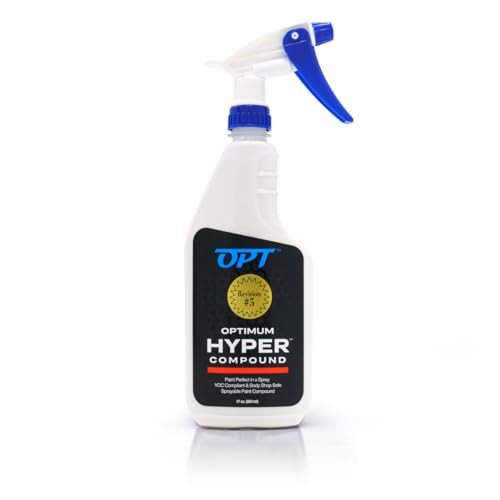
The Optimum Hyper Compound is the only spray-format compound in this review, and it occupies a genuinely unique position in the 2026 market as the only product in its category that can remove 1,000-grit sanding marks and deep scratches in a direct spray-on application, delivering a correction capability that has historically required a traditional paste or liquid compound on a machine polisher. Formulated with a proprietary blend of polymers and abrasives, the spray application method accelerates product distribution across the working surface and eliminates the pad loading issues that slow down paste-format compounds during extended sessions, making it a practical choice for professional detailers who prioritize throughput and working efficiency.
Optimum designed the Hyper Compound explicitly for professional detailers, and the formula reflects that orientation through its extended working time — a property that is critically important in spray compounds, which can dry rapidly in warm or low-humidity environments and lose their cutting effectiveness before the correction work is complete. The long working time allows a technician to apply the product to a full panel and work through it methodically without the pressure of managing a rapidly drying formula, and the no-dusting characteristic keeps the work environment clean and reduces the respray risk that powdery compound residue creates in professional shop contexts.
At 17 ounces in the spray bottle format, the Optimum Hyper Compound represents a meaningful investment compared to entry-level rubbing compounds, but the professional-grade cutting power — removing 1,000-grit marks in one to two passes — and the operational efficiency of the spray application justify the price premium for any detailer who uses it regularly as a business tool or for high-frequency personal correction work. For buyers who appreciate the same level of technical evaluation in their vehicle maintenance products, our review of the best compression testers applies an equally rigorous methodology to engine diagnostic tools.
Pros:
Cons:
The single most important step before purchasing a rubbing compound is an honest assessment of your vehicle's paint condition under proper lighting, ideally bright sunlight or a focused LED inspection lamp that reveals surface defects a fluorescent bulb will miss entirely. Light swirl marks and minor oxidation on a well-maintained vehicle call for a consumer-grade compound with moderate cut rate — products like the Meguiar's Ultimate Compound or Turtle Wax T-415 are calibrated for exactly this scenario and will deliver excellent results without the risk of cutting through thin paint layers. Heavily oxidized paint, deep scratches that catch a fingernail, or 1000-to-1200-grit sanding marks from prior bodywork require a professional-grade product such as the Meguiar's M105, 3M Super Duty, or Optimum Hyper Compound, paired with a machine polisher at appropriate speed and pressure settings for the specific paint thickness and hardness you are working on.
Single-stage paints, found on most vehicles manufactured before the mid-1980s and many commercial vehicles today, are more forgiving of aggressive cutting compounds because the color pigment is distributed throughout the paint layer rather than being protected by a separate clear coat, which means you have more material to work with before reaching a point of no return. Clear coat finishes, which cover the vast majority of passenger vehicles manufactured since 1990, require more careful product selection because the clear coat layer is typically only 50 to 100 microns thick and can be cut through irreversibly if you use an excessively aggressive compound with too firm a pad at too high a machine speed.
The application method you intend to use — hand application, dual-action random orbital polisher, or rotary polisher — should directly inform which compound formula you select, because the same product will behave significantly differently depending on the energy delivered to the paint surface through each application method. Hand application generates relatively low heat and pressure, which means you need a compound that cuts effectively at low working energy — the Meguiar's Ultimate Compound and Turtle Wax T-415 are engineered with this constraint in mind and deliver their rated performance without machine assistance. Dual-action random orbital polishers generate moderate heat and pressure through the random pattern of the pad's orbit, making them the most versatile application platform and the one best suited to professional-grade compounds like the Griot's Garage Complete Compound, menzerna Heavy Cut 400, and M105 when used at appropriate speeds with a quality foam or microfiber cutting pad.
Rotary polishers generate the highest sustained heat and pressure of any application method, which is why they are the tool of choice for removing the deepest defects and the most severe oxidation in the shortest amount of time, but they also carry the highest risk of paint damage when combined with an overly aggressive compound or operated at excessive speeds on thin or soft clear coat finishes. The 3M Super Duty and Meguiar's M105 are both rated for rotary use and perform at their peak with this tool, but the operator must understand the paint system being corrected and monitor surface temperature throughout the session to avoid cutting through the clear coat in concentrated areas.
A rubbing compound is rarely the last product you apply to a vehicle during a proper paint correction session — it is the first step in a sequence that typically moves from cutting compound to finishing polish to protective wax or sealant, and understanding that sequence before you purchase your compound prevents both over-compounding and under-compounding relative to what the rest of your product lineup can achieve. Products with diminishing abrasive technology, like the Meguiar's Ultimate Compound and the menzerna Heavy Cut 400, are designed to transition toward a finish-quality result as the abrasive particles break down during the buffing process, which allows them to function as one-step correction solutions on moderately defective paint without requiring a separate finishing polish afterward.
Aggressive compounds without diminishing abrasive technology, like the 3M Super Duty and the M105 in its full-cut configuration, will leave a compound finish on the paint that is cleaner than the original defected surface but not yet at show-car gloss levels — a finishing polish and a wax or paint sealant are required to bring the surface to its final state of clarity and protection. Planning the full three-step correction sequence and purchasing all required products before you begin the job avoids the frustrating scenario of completing the compounding stage only to discover that your finishing polish is insufficiently capable of removing the compound haze before the final protective coat goes on.
Rubbing compounds are sold in volumes ranging from 8 ounces to 32 ounces or more, and the correct volume for your needs depends on whether you are correcting a single vehicle once per year or running a detailing operation that processes multiple vehicles every week. For a single full-vehicle correction pass with a machine polisher, a standard 16-ounce bottle of most compounds provides sufficient product with some left over for a second session, while an 8-ounce bottle like the Meguiar's M105 is adequate for targeted correction work on specific panels rather than full-vehicle applications. The quart-size 3M Super Duty and the 17-ounce Optimum Hyper Compound offer the best per-ounce economics for high-volume users, and both products store well in sealed containers at room temperature for multiple years without significant degradation of their abrasive performance.
A rubbing compound uses abrasive particles to physically remove a thin layer of paint or clear coat, which eliminates defects like scratches, oxidation, and deep swirl marks by leveling the paint surface around them. A polish uses finer abrasives or chemical agents to refine the surface left behind by compounding, removing the lighter marring that the compound introduces and restoring optical clarity and gloss. For most modern clear coat paint systems, compounding is the corrective step and polishing is the finishing step — both are part of a complete paint correction sequence, and skipping either step produces an inferior result compared to using both in sequence.
You cannot apply a rubbing compound over an intact ceramic coating and expect to correct paint defects beneath the coating, because the compound's abrasives will work on the coating surface itself rather than on the underlying paint. To correct paint defects on a ceramic-coated vehicle, the coating must first be removed by machine polishing with a dedicated coating removal product, then the paint is corrected with the appropriate compound, and finally a new ceramic coating is applied. Using a compound directly on a ceramic coating is not harmful to the paint but will damage the coating's optical properties and reduce its hydrophobic performance, so the coating will need to be restored regardless.
The safe number of compounding sessions for a given panel depends on the original clear coat thickness, the aggressiveness of the compound and pad combination you are using, and the speed and pressure of your machine polisher. Most modern factory clear coats measure between 50 and 150 microns in total thickness, and a single professional compounding session removes approximately 0.5 to 2 microns depending on the cut rate of the product and the duration of the session. As a practical guideline, most vehicles can safely tolerate three to five full compounding sessions over their lifetime before the clear coat becomes dangerously thin, which is why paint depth gauges are a standard tool in professional shops and why paint thickness measurement before any correction work is recommended for high-value vehicles.
You do not need a machine polisher to use a rubbing compound — products specifically formulated for hand use, including the Meguiar's Ultimate Compound and the Turtle Wax T-415, deliver genuine corrective results by hand on light-to-moderate defects when applied with a foam or microfiber applicator pad using firm, overlapping passes. However, a dual-action random orbital polisher dramatically improves both the speed and consistency of correction results, particularly on larger panels and for deeper defects that require multiple passes to fully eliminate. If you own or are willing to purchase a DA polisher, it represents one of the highest-value upgrades available for your paint correction toolkit, and the improvement in results on any compound in this review is immediate and measurable.
Rubbing compound is safe for black paint when used correctly, but black paint requires greater care during the compounding process because swirl marks and fine scratches are dramatically more visible on dark colors than on light colors, making proper technique more critical for an acceptable final result. The key factors for safe use on black paint are selecting a compound with diminishing abrasive technology or a fine-cut formula rather than an aggressive industrial compound, using a foam finishing pad rather than a cutting pad to minimize induced marring, and working at lower polisher speeds with lighter pressure than you would use on a lighter-colored vehicle. After compounding, a finishing polish is mandatory on black paint to remove any residual haze, and a quality wax or paint sealant applied afterward provides ongoing protection and maximizes the depth of gloss that black paint delivers at its best.
Paint oxidation is caused by sustained UV radiation exposure that chemically degrades the clear coat or single-stage paint surface, breaking down the polymer chains in the coating and producing the chalky, dull appearance that is characteristic of severely weathered vehicles and neglected exterior surfaces. A rubbing compound addresses oxidation by removing the degraded surface layer of paint and revealing the undamaged, glossy material beneath it, which effectively reverses the visible symptoms of oxidation when the damage is confined to the outermost layers of the paint system. Severe oxidation that has penetrated through the entire clear coat layer and into the base coat cannot be fully corrected by compounding alone and may require partial or full repainting of the affected panels to restore the original appearance, which underscores the importance of protecting your paint with a quality wax or sealant every six to twelve months to prevent oxidation from reaching that level in the first place.
The right rubbing compound does not just restore your paint — it rewards the detailer who took the time to match the product's cut rate to the defect's depth, and that single decision separates a showroom result from an expensive mistake.
 |
 |
 |
 |

About Diego Ramirez
Diego Ramirez has been wrenching on cars since his teenage years and has built a deep practical knowledge of automotive maintenance and paint protection through years of hands-on work. He specializes in fluid service intervals, preventive care routines, exterior protection products, and the consistent habits that extend a vehicle's lifespan well beyond average. At CarCareTotal, he covers car care guides, cleaning and detailing products, and exterior maintenance and protection reviews.
Get some FREE car parts & gear.. Or check out the latest free automotive manuals and build guides here.
Disable your ad blocker to unlock all the hidden deals. Hit the button below 🚗
| | | |
