by Joshua Thomas
Faded car paint is one of the most frustrating cosmetic problems a vehicle owner faces. UV rays, road grime, and years of neglect slowly break down your clear coat until the surface looks chalky, dull, and worn. The good news: knowing how to restore faded car paint can save you thousands of dollars compared to a full repaint. With the right products, a few hours, and a shaded driveway, you can bring back a deep, glossy finish that looks factory-fresh — no body shop required.
Before grabbing a bottle of compound, it helps to understand what you're working with. Fading is almost always a clear coat issue, not the base color itself. The clear coat is a transparent protective layer that sits on top of your paint — UV radiation and oxidation degrade it over time. If you're also dealing with a chalky white film, that's oxidation, and it calls for a slightly different approach. Our in-depth guide on how to remove oxidation from car paint covers that process in detail.
Contents
The primary cause of faded paint is UV radiation. The sun's ultraviolet rays break down the polymers in your clear coat through a process called photo-oxidation. Over time, the surface loses its ability to reflect light evenly, resulting in a chalky, flat appearance. Heat accelerates this — dark-colored cars in hot climates fade noticeably faster than lighter cars in mild climates.
Other contributing factors include:
Faded paint and failing clear coat look similar but require different fixes. Faded paint has a degraded but still-bonded clear coat — you can cut through it with a compound and restore the gloss. Peeling or flaking clear coat means the bond between layers has failed, and polishing alone won't fix it. If you see lifting edges or bubbling, read our guide on how to fix peeling clear coat before proceeding.
A two-minute inspection before you buy any products tells you exactly how aggressive your approach needs to be — and whether DIY restoration is realistic at all.
Drag your fingernail gently across the dull area. If it leaves a faint line or the surface feels slightly powdery, you're dealing with surface oxidation — easily fixed with a compound and polish. If the area feels rock-hard but looks dead flat, the clear coat may be very thin or heavily degraded.
Pour a small amount of water over the faded section. If the color visually "comes back" when wet — darker and richer — the clear coat is still present and polishing will work. If the surface stays dull and flat even when soaked, the clear coat may be gone in that spot and professional attention is warranted.
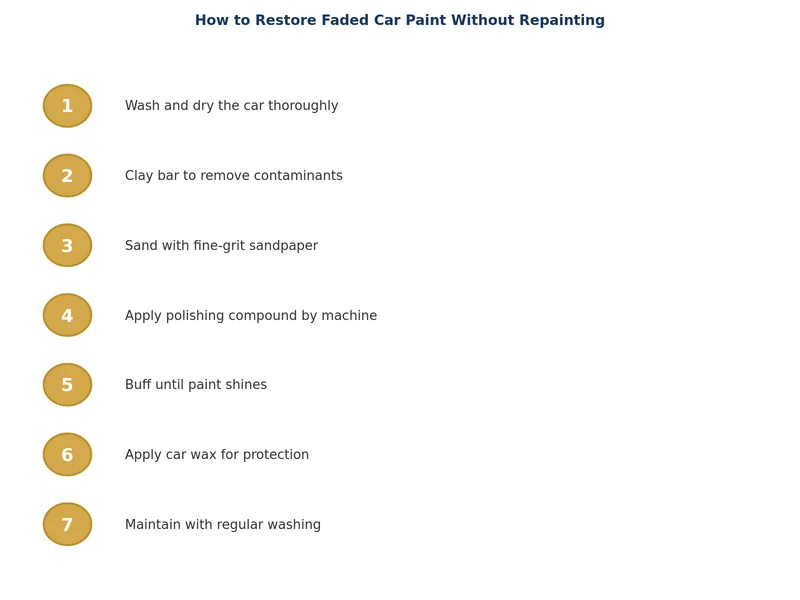
Work in the shade. Direct sunlight heats the panel surface, causing compounds and polishes to dry too fast and leave residue. Aim for a cool, overcast day or work in a garage with good lighting.
Wash the entire car with a pH-neutral shampoo. Then clay bar the panels you plan to restore — clay removes bonded contaminants that would otherwise clog your compound pad and cause scratches. Our clay bar guide walks through the full process. Dry completely with a clean microfiber towel before moving on.
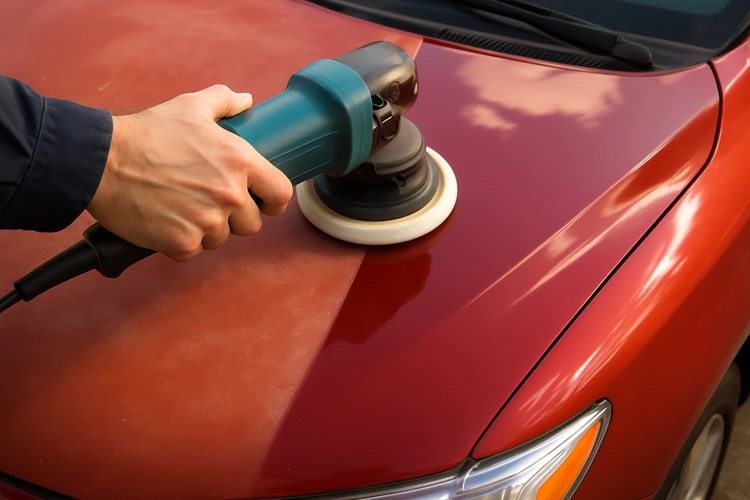
Rubbing compound contains fine abrasives that cut through the degraded outer layer of clear coat to reveal the fresher material below. Apply a dime-sized amount to a foam cutting pad or dual-action polisher pad. Work in overlapping passes across a 2×2-foot section. Keep the pad flat against the surface and use moderate pressure. Wipe residue immediately with a clean microfiber cloth.
Choosing a quality product matters here. See our roundup of the best rubbing compound options to find one matched to your paint type and the severity of your fading.
Compounding removes the degraded clear coat but can leave micro-swirls. A finishing polish — applied with a softer foam pad — removes those swirls and restores maximum gloss and clarity. This step is what separates a good result from a showroom-quality result. Apply, work in sections, and wipe clean.
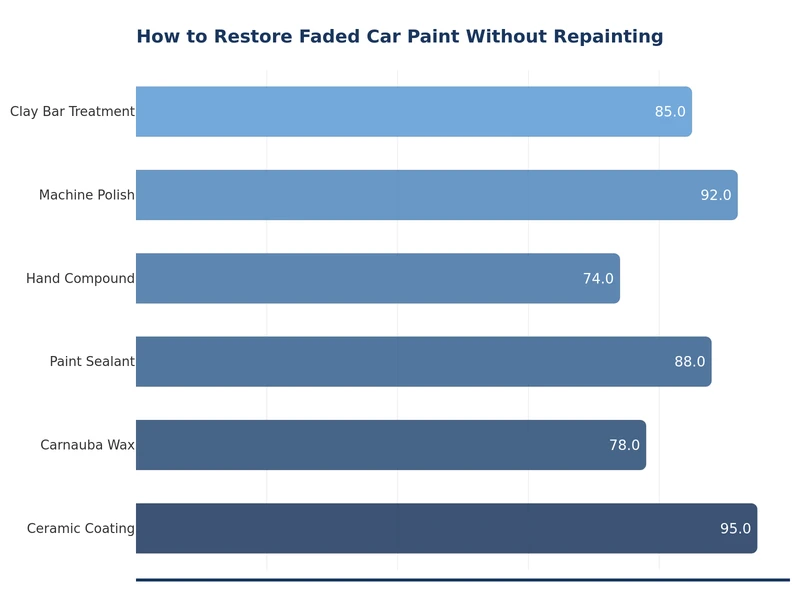
Apply a paint sealant or quality carnauba wax within an hour of polishing. This bonds to the fresh clear coat surface and creates a UV-blocking barrier. Sealants typically last longer (6–12 months), while wax provides a warmer, deeper gloss but needs reapplying every 1–3 months.
| Product Type | Best For | Abrasiveness | Durability |
|---|---|---|---|
| Rubbing Compound | Heavy oxidation, chalky paint | High | Prep step |
| Polishing Compound | Moderate fading, light swirls | Medium | Prep step |
| One-Step Polish/Compound | Light fading, quick refresh | Low–Medium | Short-term |
| Paint Sealant | Post-restoration protection | None | 6–12 months |
| Carnauba Wax | Final gloss and depth | None | 1–3 months |
| Ceramic Coating | Long-term UV protection | None | 2–5 years |
Restoring faded car paint is only half the job. Compounding thins the clear coat slightly, so the restored surface actually needs protection more urgently than before. Without it, the paint will fade again — sometimes within a single season.
UV-blocking sealants and waxes are your primary defense. Reapply every 3–6 months depending on your climate and how much sun exposure the car gets. For longer-lasting coverage, consider a professional-grade ceramic coating — our DIY ceramic coating guide explains the full application process and what to realistically expect from a home install.
Park in a garage, under a carport, or with a car cover whenever possible. Shade alone dramatically reduces UV exposure and surface heat. When washing, use a pH-neutral shampoo and avoid automatic tunnel washes with abrasive brushes. Bird droppings and tree sap should be removed as soon as possible — both are acidic enough to etch clear coat within a few hours on a hot day. A comprehensive approach to how to protect car paint year-round will keep your restoration looking its best for far longer.
DIY polishing works well for most cases of faded or lightly oxidized paint. But there are situations where professional help is the smarter call:
In these cases, compounding will either not help or may make the problem worse by removing the last trace of clear coat. According to Wikipedia's overview of automotive paint, modern factory finishes use a two-stage base coat/clear coat system specifically designed to be maintainable through polishing — but only while the clear coat remains intact. Once it's gone, restoration requires repainting.
For surface-level fading on a car with a solid clear coat, however, a Saturday morning and the right products are all you need. The process is straightforward, the results are dramatic, and the cost is a fraction of any body shop estimate.
Yes — in most cases. If the clear coat is still intact and the fading is surface-level oxidation, a rubbing compound followed by a polish will restore gloss without professional help. The water test is the quickest way to confirm: if the paint looks richer when wet, it can be polished back.
Results typically last 1–3 years depending on how well you protect the paint afterward. Applying a quality sealant or wax immediately after polishing, and reapplying every few months, significantly extends how long the restored finish holds up against UV exposure.
Rubbing compound contains coarser abrasives designed to remove heavily oxidized or degraded clear coat. Polish uses finer abrasives to remove the light swirl marks left by compounding and to maximize gloss and clarity. Most full restorations use compound first, then polish as a finishing step.
When used correctly — on a clean surface, with a clean foam pad, and in overlapping passes — rubbing compound will not cause visible scratches. It does leave micro-marring that a polish removes. The risk increases if you compound dirty paint or use a rotary polisher with heavy pressure on thin clear coat.
Most cars benefit from a light polish once or twice a year. Avoid over-polishing — every pass removes a thin layer of clear coat, and the clear coat is not infinite. Focus polishing sessions on areas that actually need it and always follow up with a protective sealant or wax.
No — not with polishing. If the clear coat is gone, there is nothing left to cut through and reveal. The underlying color coat will be exposed, and the only reliable fix is repainting the affected panels. A body shop can assess the extent of clear coat loss and recommend the most cost-effective repair.
 |
 |
 |
 |

About Joshua Thomas
Joshua Thomas just simply loves cars and willing to work on them whenever there's chance... sometimes for free.
He started CarCareTotal back in 2017 from the advices of total strangers who witnessed his amazing skills in car repairs here and there.
His goal with this creation is to help car owners better learn how to maintain and repair their cars; as such, the site would cover alot of areas: troubleshooting, product recommendations, tips & tricks.
Joshua received Bachelor of Science in Mechanical Engineering at San Diego State University.


Get some FREE car parts & gear.. Or check out the latest free automotive manuals and build guides here.
Disable your ad blocker to unlock all the hidden deals. Hit the button below 🚗
| | | |
