by Joshua Thomas
If you own a classic, a seasonal sports car, or simply a vehicle you won't be driving for months, knowing how to store a car for winter correctly can mean the difference between a spring-ready ride and a costly repair bill. Rust, dead batteries, flat-spotted tires, and degraded fuel are all common problems that develop silently during long storage periods. This complete checklist covers every step — from washing and mechanical prep to fuel treatment and battery care — so your car emerges in top condition. For a broader look at how to clean an engine bay safely before storage, that guide is worth reading first.
Most storage damage is entirely preventable with a few hours of preparation. According to general automotive maintenance principles, consistent care before and after idle periods significantly extends vehicle lifespan. Whether you're stashing a daily driver or a collector car, the steps below apply across the board.
Contents
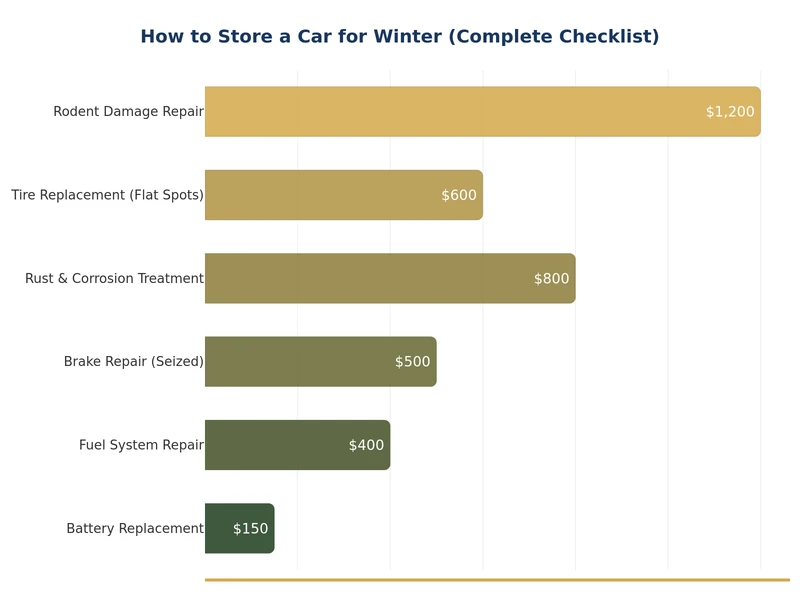
Skipping storage prep leads to problems that compound quietly over weeks. Gasoline degrades in as little as 30 days without a stabilizer, leaving varnish deposits in fuel injectors and carburetors. Brake fluid absorbs moisture and loses effectiveness. Tires sitting under a loaded car develop flat spots that may never fully round out. Rodents nest in engine bays and chew through wiring — a repair that can run into several hundred dollars. Each of these outcomes is avoidable with an afternoon of work before you park the car.
A two-week layup needs little more than a full tank and a charged battery. Anything beyond 30 days warrants the full checklist below. Three months or more — the typical winter storage window — requires every step without exception. The longer the storage, the more important each task becomes.
Start with a thorough exterior wash. Road grime, bird droppings, and tree sap left on paint will etch into the clear coat over months of storage. Pay close attention to wheel wells, rocker panels, and the undercarriage where road salt accumulates. After washing, apply a fresh coat of wax or paint sealant to create a barrier between paint and moisture. For enhanced long-term protection, review our guide on ceramic coating vs paint protection film — both options outperform standard wax for extended storage.
Exposed metal on the undercarriage, around wheel arches, and along body seams is especially vulnerable during storage. Applying a quality rust prevention spray for your car to these areas before storage creates a durable barrier against moisture-induced oxidation. Focus on any spots where paint is thin or chipped.
Change the oil before storage, not after. Used motor oil contains combustion byproducts and acids that will slowly attack engine internals during a long idle period. Top up coolant and verify antifreeze protection is rated for the lowest expected temperature in your storage location. Check brake fluid and power steering fluid levels as well.
Inflate tires to the maximum recommended pressure shown on the sidewall (not the door sticker). This counters the natural air seepage that occurs over weeks and reduces the risk of flat spots forming under the car's weight. For storage beyond three months, consider placing the car on jack stands to remove load from the tires entirely. A tire pressure monitoring system can make ongoing checks easier if you store the car somewhere accessible.
Do not apply the parking brake for long-term storage. Brake pads can bond to rotors during extended contact, particularly in damp conditions. Leave an automatic transmission in Park and a manual in first gear on level ground instead.
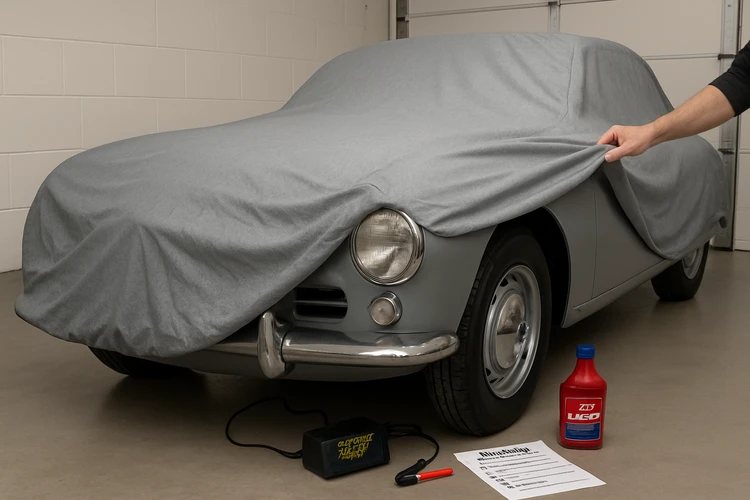
An indoor car cover must be breathable fabric. Never use plastic sheeting — it traps condensation against the paint and actively promotes rust and mold. For outdoor storage, use a cover rated for UV exposure and rain. Ensure the cover fits the car properly; a loose cover that flaps in wind can scratch paint more than no cover at all.
Rodents are a genuine and expensive threat. Before leaving the car, stuff steel wool into the exhaust pipe and air intake (mark these clearly so you remember to remove them before starting). Place rodent repellent pouches inside the cabin and engine bay. Avoid leaving food or organic material anywhere in the vehicle.
Vacuum carpets, wipe all surfaces, and treat leather seats with conditioner. Place silica gel moisture absorbers inside the cabin to prevent mildew buildup. If the storage area has humidity issues, crack windows slightly to allow air circulation — but only if the car is fully covered and in a secure location.
| Task | When to Do It | Storage Duration | Priority |
|---|---|---|---|
| Wash, wax, rust spray | Day of storage | Any | High |
| Oil change | Day of storage | 30+ days | High |
| Fuel stabilizer + full tank | Day of storage | 30+ days | High |
| Battery tender / disconnect | Day of storage | Any | High |
| Inflate tires to max PSI | Day of storage | Any | High |
| Jack stands (remove load) | Day of storage | 3+ months | Medium |
| Pest deterrents | Day of storage | Any | Medium |
| Breathable car cover | Day of storage | Any | Medium |
| Interior cleaning + moisture absorbers | Day of storage | Any | Medium |
| Periodic visual check | Every 2–4 weeks | Any | Medium |
A car battery left connected will slowly self-discharge and may sulfate beyond recovery. Your best option is a battery maintainer (also called a battery tender) — it keeps the battery at full charge without overcharging. Alternatively, disconnect the negative terminal. For very long storage, removing the battery and keeping it indoors in a temperature-controlled space is ideal.
Fill the tank to roughly 90% capacity. A near-full tank limits the air space where condensation forms while leaving room for expansion. Add a fuel stabilizer rated for your expected storage duration and run the engine for 10 minutes afterward so the treated fuel reaches injectors and the entire fuel system. This step is non-negotiable for storage beyond 30 days.
Even in storage, inspect the car every two to four weeks. Look for signs of moisture intrusion on windows, pest activity near the exhaust or air intake, and any visible tire pressure loss. If you notice an unusual smell or any dampness inside the cabin, address it immediately — mold spreads fast in a sealed environment.
Photograph the car's condition — paint, tires, interior — before closing the garage. Note any pre-existing scratches or dings so you have a baseline for spring. Keep your insurance policy active during storage; a parked car can still be damaged by fire, flooding, falling debris, or theft.
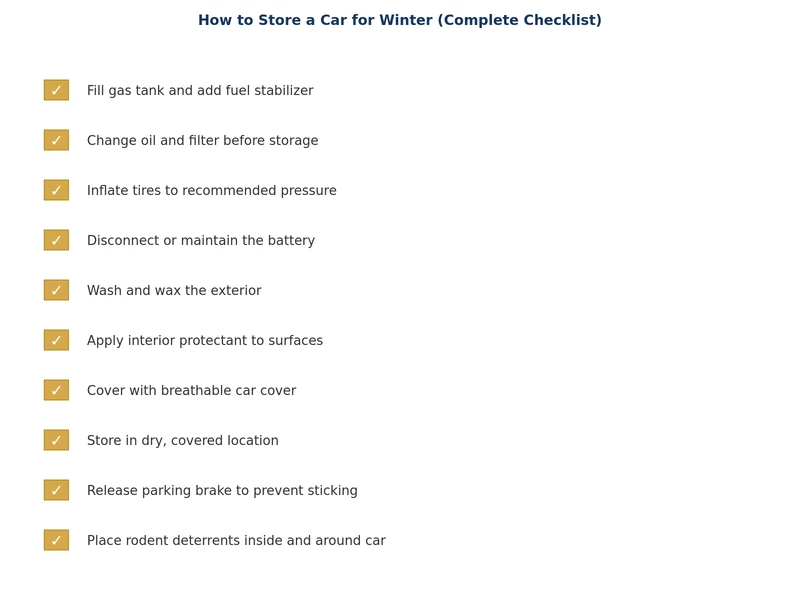
With a fuel stabilizer added and a battery tender connected, most modern cars can sit for three to six months without issue. Without those precautions, fuel begins degrading in about 30 days and the battery may not recover after two to three months of self-discharge.
For storage longer than three months, jack stands are recommended. Removing the weight from the tires eliminates the risk of flat spots developing, which can cause vibration and uneven wear once you return to driving. For shorter storage, simply inflating tires to maximum rated pressure is usually sufficient.
Yes. Used motor oil contains acids and combustion byproducts that corrode engine internals during long idle periods. Changing the oil before storage — not just after — ensures the engine sits in clean, neutral oil for the duration.
Inflate tires to the maximum pressure listed on the sidewall, which is typically higher than the normal operating pressure on the door jamb sticker. This accounts for the natural seepage that occurs over weeks and helps prevent flat spots under the car's weight.
For storage under two weeks, a stabilizer is generally not necessary. Between two and four weeks, it's a low-cost precaution worth taking. For anything beyond 30 days, a fuel stabilizer is essential to prevent varnish deposits from forming in the fuel system.
Outdoor winter storage is possible but significantly less ideal than a garage. If storing outdoors, use a heavy-duty, UV-resistant, waterproof cover that fits snugly. Apply extra rust prevention spray to the undercarriage and check on the car more frequently, as exposure to freeze-thaw cycles and precipitation accelerates deterioration.
 |
 |
 |
 |

About Joshua Thomas
Joshua Thomas just simply loves cars and willing to work on them whenever there's chance... sometimes for free.
He started CarCareTotal back in 2017 from the advices of total strangers who witnessed his amazing skills in car repairs here and there.
His goal with this creation is to help car owners better learn how to maintain and repair their cars; as such, the site would cover alot of areas: troubleshooting, product recommendations, tips & tricks.
Joshua received Bachelor of Science in Mechanical Engineering at San Diego State University.


Get some FREE car parts & gear.. Or check out the latest free automotive manuals and build guides here.
Disable your ad blocker to unlock all the hidden deals. Hit the button below 🚗
| | | |
