by Diego Ramirez
Paste wax delivers superior durability and depth of gloss on properly prepared paint, while liquid wax wins on ease of application and suitability for routine maintenance cycles. The liquid wax vs paste wax car debate ultimately resolves based on paint condition, available time, and the desired protection interval — neither formula is universally superior, and selecting the wrong type for a given situation produces measurably inferior results.
Most enthusiasts reach for liquid wax because it spreads quickly and buffs off with minimal effort. That convenience is genuine, but it carries a cost: liquid formulations contain more solvents and lighter wax concentrations, which translates to shorter protection windows. Paste wax packs a denser wax matrix — often with higher concentrations of carnauba or synthetic polymer solids — that bonds more tenaciously to clear coat and resists UV degradation for considerably longer periods. For owners who detail quarterly or less frequently, paste wax delivers more value per application. For those refreshing gloss between full details, liquid wax fits naturally into a faster maintenance routine, as outlined in the guide on maintaining car paint gloss between washes.
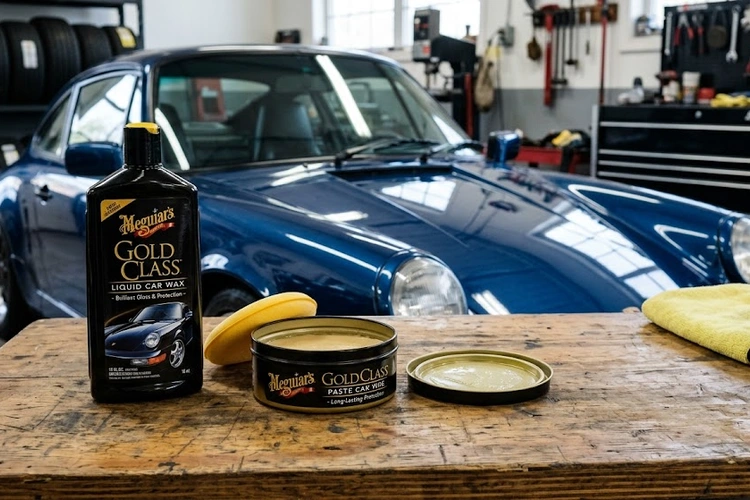
Contents
Car wax is not a single compound but a suspension of wax solids, solvents, emulsifiers, and — in many modern formulas — light abrasives or polymer additives. Carnauba wax, derived from the leaves of the Copernicia prunifera palm, remains the benchmark natural wax solid, prized for its hardness and high melting point of approximately 82–86°C. Synthetic alternatives — polyethylene, silicone polymers, and PTFE-based compounds — are engineered to fill gaps in carnauba's performance profile, particularly in terms of longevity and water-sheeting behavior.
The delivery medium separates liquid from paste. Liquid wax uses a higher solvent-to-solids ratio, suspending the wax matrix in a fluid state that spreads effortlessly but leaves a thinner, more porous cured film. Paste wax contains a denser solid matrix held in a semi-rigid emulsion. Application requires more physical effort, but the resulting film is thicker and more optically uniform when correctly applied. This fundamental chemistry difference explains every downstream performance disparity between the two formats.
Carnauba is classified by grade from T1 to T4, with T1 being the purest and most optically clear. Premium paste waxes frequently use T1-grade carnauba, while entry-level liquid formulations may blend lower-grade material with synthetic fillers to reduce material cost. Grade is rarely disclosed on consumer packaging, making this one of the more opaque quality differentiators in the car care category. Price-per-ounce comparisons between liquid and paste products are therefore unreliable without knowledge of carnauba grade and solids concentration.
| Feature | Liquid Wax | Paste Wax |
|---|---|---|
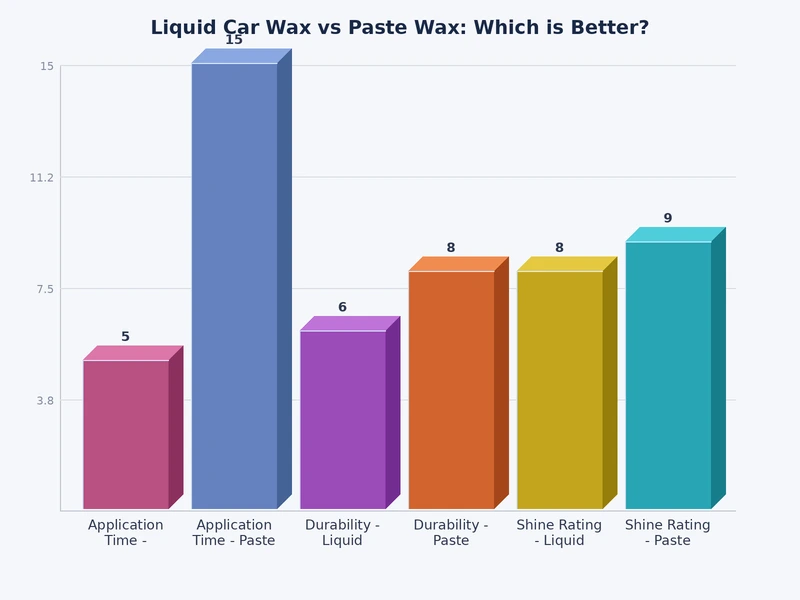
| Application Time | 5–15 minutes | 20–45 minutes |
| Protection Duration | 6–10 weeks | 4–6 months |
| Gloss Depth | Moderate | High |
| Ease of Buffing | Very easy | Moderate effort |
| Contoured Panels | Excellent | Requires masking |
| Best Use Case | Maintenance between full details | Seasonal foundational protection |
| Cost per Application | Lower | Higher |
| Trim Buildup Risk | Low | High |
The table above establishes the key performance gaps clearly. Liquid wax excels on complex body panels and tight trim lines where paste accumulation becomes a cleanup problem. Paste wax outperforms in raw durability — a correctly applied coat of high-grade paste wax protects clear coat for four to six months under normal driving conditions, compared to two to three months for most liquid formulations.
Gloss depth is where paste wax most decisively separates itself. The denser cured film refracts light more uniformly, producing the "wet look" that defines a show-quality finish. On dark colors — black, deep blue, burgundy — this difference is immediately visible to the naked eye. Light colors and metallics show less dramatic variance between the two types, making liquid wax an entirely reasonable choice for daily drivers finished in silver or white.
Water beading — tight, high-contact-angle droplets — is the visual cue most consumers associate with good wax coverage, but it is not the optimal indicator of protection quality. Water sheeting, where water flows off the panel surface in thin, continuous films with minimal bead formation, is the signature of high-quality synthetic polymer coatings. Traditional carnauba-dominant waxes bead aggressively. Synthetic-dominant liquid waxes typically sheet. Both behaviors indicate active hydrophobic protection; the difference is in chemistry, not protection level. Evaluating wax performance by bead behavior alone produces misleading conclusions about product quality.
Liquid wax applies in minutes, removes with minimal buffing pressure, and is available in formulas tailored to specific paint types — including options with light cleansing agents that address minor surface oxidation during application. This makes it the practical choice for high-frequency waxing cycles, for owners who detail their own vehicles in limited time windows, and for application to vehicles with complex contours and deep panel lines. The trade-off is longevity: most liquids demand reapplication every six to ten weeks under regular wash schedules. Gloss depth rarely rivals a quality paste regardless of application care.
Tip: Apply liquid wax with a foam applicator pad rather than a microfiber cloth — foam distributes product more evenly and reduces the risk of thin spots on flat panel sections.
Paste wax produces the deepest, most optically refined gloss of any consumer-grade paint protection product outside of professional ceramic coatings. Applied correctly — in thin, overlapping sections with full cure time before buffing — it bonds tightly to clear coat and resists both UV radiation and chemical fallout with notable effectiveness. The disadvantages are real and non-trivial: application is labor-intensive, paste left too long in direct sun becomes extremely difficult to remove without marring the clear coat, and paste accumulates in trim gaps and panel edges requiring careful masking or cleanup with a dedicated detail brush. For vehicles with delicate or aged paint, the surface preparation disciplines covered in the guide on detailing a classic car without damaging it apply directly to paste wax work and should be reviewed before proceeding.
Warning: Never apply paste wax in direct sunlight or on a panel surface that is warm to the touch — accelerated solvent evaporation causes the product to cure in patches, making it nearly impossible to buff clean without damaging the clear coat.
The single most damaging mistake across both wax types is applying product over contaminated paint. A wax layer over bonded iron fallout, tar deposits, or embedded particulate does not seal the contaminant — it encapsulates it, accelerating the staining or corrosion the wax was meant to prevent. Any wax application must follow a thorough decontamination wash and, ideally, a clay bar pass on paint that has not been waxed recently. Skipping this step is the root cause of the majority of premature wax failures observed in practice.
Excess product is the defining error among first-time paste wax users. A thin, almost translucent layer cures and bonds correctly. A thick, opaque layer cures unevenly, requires excessive buffing force, and frequently leaves swirl marks that require compounding to address. Less product applied more evenly consistently outperforms a heavy application — a principle that runs counter to most users' instincts. With liquid wax, the same principle applies, though the lower solids concentration makes over-application somewhat less catastrophic.
Both liquid and paste wax require adequate cure time before buffing. In direct sunlight or at elevated ambient temperatures, paste wax cures faster and can haze within minutes of application. Buffing too early removes product before solvents have fully evacuated, resulting in uneven gloss. Ideal conditions for paste wax application are overcast skies, ambient temperatures between 60°F and 80°F, and a panel surface that is cool to the touch.
Pro insight: The haze test — a light finger-swipe across the cured panel — remains the most reliable indicator of readiness; the wax should smear cleanly without dragging or streaking before committing to a full buff-out.
When a wax application produces disappointing gloss, uneven coverage, or premature hydrophobic failure, the root cause is almost always in the preparation phase rather than the product itself. Before attributing failure to formula quality, evaluate whether the paint surface was genuinely clean and decontaminated, whether the application method matched the product's requirements, and whether the product was stored and applied at the appropriate temperature. In the overwhelming majority of cases, the wax performed correctly — the preparation did not.
Streaking after buffing typically indicates one of three problems: product applied over a damp surface, insufficient cure time, or a worn applicator redistributing old residue across the panel. On dark colors, hazing is immediately visible under any light source. On light colors, it may only appear under raking or direct sunlight. The correction is to apply a second thin coat correctly and buff with a clean, unused microfiber pad — not to apply more pressure with the original pad, which compounds the problem.
A wax layer that loses water-beading performance within two to three weeks — far short of the product's stated protection window — almost always indicates a contaminated or oxidized paint surface that prevented proper bonding. Before the next application, remove existing buildup thoroughly (the guide on removing old wax buildup from car paint covers the correct multi-step procedure), decontaminate with a clay bar, and apply fresh product to a fully prepared surface. Stacking new wax over compromised old wax never produces a durable result.
The most effective long-term paint care strategy combines both wax types in a complementary rotation. Paste wax serves as the foundational protection layer, applied two to three times per year at seasonal transitions that present the harshest environmental stress — before winter salt exposure and before peak summer UV intensity. Liquid wax layers between paste applications every six to eight weeks refresh hydrophobic performance and add a modest sacrificial layer without disturbing the underlying paste foundation. This hybrid approach captures the durability advantages of paste and the maintenance convenience of liquid within a single cohesive program.
Daily drivers in coastal climates — where salt air, high humidity, and UV intensity accelerate clear coat degradation — require more frequent attention than garage-kept vehicles in moderate inland climates. Vehicles finished in black or deep jewel tones absorb significantly more radiant heat, accelerating oxidation and making consistent wax coverage more critical. Light-colored vehicles in temperate climates can sustain a semi-annual paste wax schedule supplemented with two or three liquid maintenance coats without visible degradation between applications. Climate is a more reliable scheduling variable than calendar date alone.
On paint that measures below 1.5 mil of clear coat thickness on a paint depth gauge, on surfaces with active corrosion or failing paint film, or on vehicles where the owner cannot commit to a minimum quarterly maintenance cycle, a professionally applied spray sealant or ceramic coating represents a more appropriate long-term investment. Wax — regardless of format — is a maintenance product. It preserves good paint. It cannot remediate failing paint, and applying it to degraded surfaces delays necessary corrective action while providing minimal protection. For comprehensive product evaluations across the leading liquid and paste formulations currently on the market, the best car wax reviews resource provides side-by-side testing data to support an informed purchase decision.
Paste wax consistently outlasts liquid wax. A correctly applied coat of high-grade paste wax protects clear coat for four to six months under typical driving conditions, while most liquid formulations require reapplication every six to ten weeks. The higher wax-solids concentration in paste formulas bonds more durably to the paint surface and resists UV degradation more effectively over extended periods.
Yes, and this is the recommended approach in a layered protection program. Liquid wax applied over a fully cured paste wax base adds a sacrificial maintenance layer without compromising the paste foundation beneath. The liquid wax layer is refreshed every six to eight weeks while the paste layer remains intact and continues providing its longer-duration protection.
Paste wax is generally the preferred choice for classic vehicles with original or restored paint, particularly those finished with single-stage lacquer or enamel rather than modern clear coat systems. High-grade carnauba paste provides deep gloss with no abrasive action when correctly applied. However, paint thickness should be measured before any wax work on a classic vehicle, as aged paint with minimal remaining film thickness requires gentler handling across all product types.
The water bead test remains the standard field diagnostic. When water on a freshly washed panel stops forming tight, domed beads and instead spreads into flat sheets or does not sheet cleanly off the panel, the hydrophobic layer has degraded and reapplication is warranted. On dark-colored vehicles, a visual check under raking light for surface dullness is an additional reliable indicator of depleted protection.
Paint color influences which wax type produces the most visually impactful result. On dark colors — black, navy, deep burgundy — the superior gloss depth of high-grade paste wax is clearly perceptible and justifies the added application effort. On light colors and metallics such as silver or white, the gloss differential between liquid and paste is minimal, making the faster liquid application an entirely practical and visually equivalent choice for routine maintenance.
 |
 |
 |
 |

About Diego Ramirez
Diego Ramirez is a maintenance and care specialist who has been wrenching on cars since he was sixteen. He focuses on fluid changes, preventive care routines, paint protection, and the small habits that turn a five-year-old car into a fifteen-year-old car.
Get some FREE car parts & gear.. Or check out the latest free automotive manuals and build guides here.
Disable your ad blocker to unlock all the hidden deals. Hit the button below 🚗
| | | |
