by Sarah Whitfield
Steering system defects rank among the most investigated safety categories at the National Highway Traffic Safety Administration, with steering-related complaints prompting thousands of recall investigations across all vehicle classes annually. A loose steering wheel is one of the clearest warning signs your system is compromised — excess play, on-center vagueness, and a disconnected feel during cornering all point to specific mechanical failures that worsen under continued use. If you're also seeing wheel vibration alongside the looseness, our guide on why your steering wheel shakes covers the overlap in symptoms and causes in detail.
Loose steering stems from multiple failure points — tie rod ends, steering rack internals, ball joints, column bearings, and control arm bushings all produce overlapping symptoms that demand different repairs. Understanding exactly which component has failed changes both your repair strategy and your safety calculus, because some faults allow a cautious drive to the shop while others require you to stop driving immediately.
Contents
Your steering system is a precisely engineered chain, and looseness develops when any link in that chain wears past its tolerance. The most common failure points fall into three categories: front-end linkage wear, rack and gearbox issues, and column-level failures. Identifying which category you're dealing with is the first step toward a targeted, cost-effective repair rather than a costly guessing game at the parts counter.
Tie rod ends are the pivot points that translate rack movement into wheel angle, and they're among the highest-wear items in any steering system. When the ball socket inside a tie rod end wears past spec, you get lateral play that registers as a loose, wandering steering wheel — most pronounced at highway speeds where small deviations amplify quickly. Inner tie rod ends fail more gradually than outer ends, but both demand replacement once looseness is confirmed by a physical check.
On rack-and-pinion systems, internal wear between the rack teeth and pinion gear creates a dead zone at center, making the wheel feel like it's floating rather than connected to the road surface. On recirculating-ball steering gearboxes — standard on trucks and older body-on-frame SUVs — the sector shaft adjustment loosens over time, producing a broader dead zone with several degrees of free rotation before any wheel movement occurs. Both conditions grow more pronounced under load, particularly during lane changes and light-radius turns.
Ball joints connect the steering knuckle to the control arm and are critical to both steering precision and front-end geometry under load. When a ball joint develops play, you'll feel vagueness on turn-in and a tendency for the front end to wander during light braking. Control arm bushings contribute in a similar way — as the rubber degrades and the bushing pivots freely, front-end geometry shifts dynamically under load, producing soft and unpredictable steering response. For related noise that often accompanies these failures at the column level, read our full breakdown on steering column noises and what causes them.
A systematic diagnosis takes under 30 minutes in your driveway and tells you exactly which component needs attention before you spend anything on parts. The two most useful checks are a free-play measurement at the wheel and a hands-on inspection with the front end lifted — together, they isolate the fault to a specific component with high accuracy.
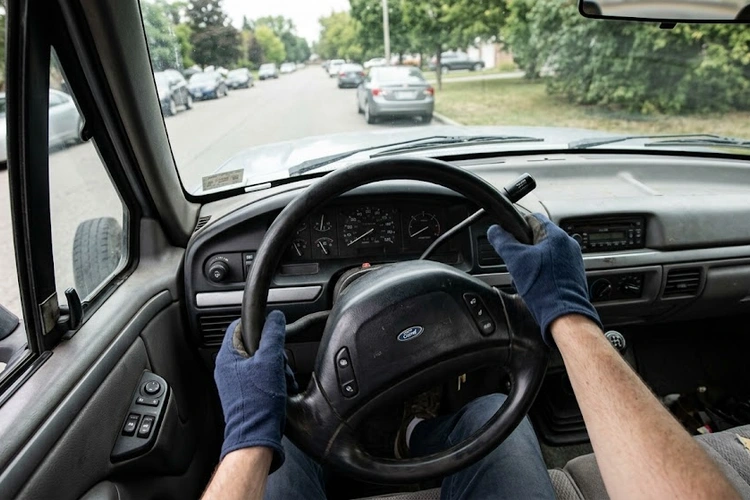
With the vehicle on a flat surface and the engine off, grip the steering wheel at 9 and 3 o'clock and rotate it gently left and right without moving the front tires. The rotational distance before the tires begin responding is your free play measurement at the rim. Most manufacturers specify a maximum of 1.5 to 2.0 inches of free play; anything beyond that indicates a measurable fault in the steering system that requires prompt inspection.
Pro tip: Have an assistant watch the tie rod ends and steering rack mounts from underneath while you work through the free play range — the component with visible movement is your fault point, and you'll find it in under two minutes.
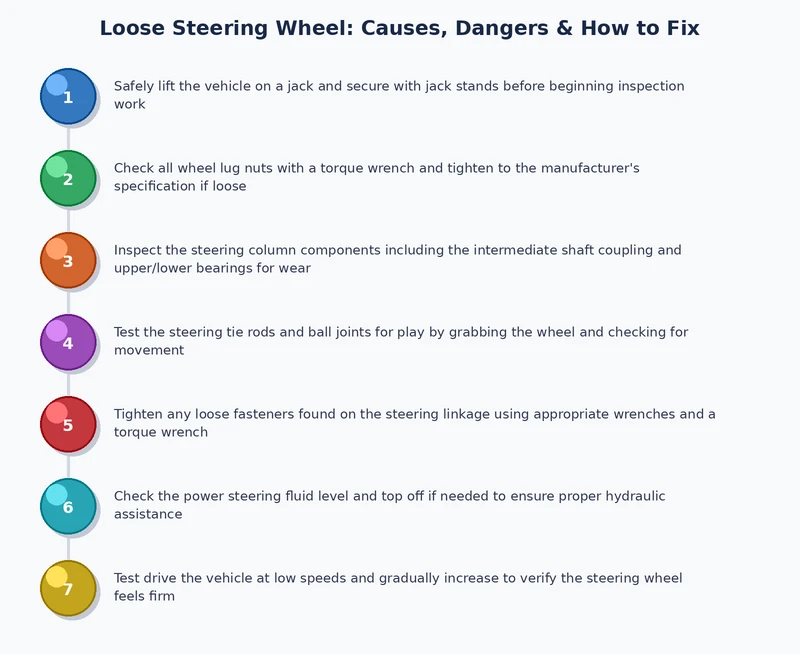
Raise the front end with a floor jack and support it properly on jack stands, then grab each front tire at 9 and 3 and attempt to wiggle it — movement here indicates tie rod play. Shift your grip to 12 and 6 and wiggle again — movement here points to ball joint or wheel bearing looseness instead. Check the steering rack mounting bolts for tightness and look for torn rack boots, which indicate internal wear and potential fluid loss on hydraulic systems. If you're also noticing vibration alongside the looseness, our article on steering wheel vibration and its causes covers the diagnostic overlap in detail.
The right repair strategy depends entirely on what the diagnosis reveals. Minor faults like outer tie rod ends are straightforward DIY repairs for anyone with basic tools and a wheel alignment appointment lined up immediately afterward. Major faults like a worn steering rack or press-fit ball joints require specialized equipment and precise torque specifications that make them professional-only jobs in most cases.
Outer tie rod end replacement is one of the most accessible steering repairs you'll do: loosen the jam nut, count the turns as you unthread the old end, and thread the new end in the same number of turns to approximate the original toe setting. Torque the castellated nut to spec and install a new cotter pin through the castle nut and stud. The turn-counting method only gets you close enough to drive safely to the alignment shop — it's not a substitute for a proper four-wheel alignment afterward.
A complete rack-and-pinion replacement involves disconnecting both tie rods, unbolting the rack from the subframe, and disconnecting the steering shaft coupler at the firewall. On hydraulic systems, capping the power steering lines to prevent fluid loss is essential before the rack comes out. The replacement rack must be centered — with equal rack travel available in each direction — before installation, so that your steering wheel sits centered relative to the full range of rack travel once everything is reconnected and torqued.
Steering repairs span a wide cost range depending on the failed component, your vehicle's make and origin, and local shop labor rates. Use the breakdown below as a baseline for conversations with repair shops — knowing the numbers going in prevents you from accepting inflated quotes without question.
| Component | Parts Cost | Labor | Total Estimate | DIY Friendly? |
|---|---|---|---|---|
| Outer tie rod end (one side) | $20–$80 | 0.5–1 hr | $80–$180 | Yes |
| Inner tie rod end (one side) | $30–$100 | 1–1.5 hr | $120–$250 | With specialty tool |
| Rack-and-pinion replacement | $200–$800 | 2–4 hr | $500–$1,400 | Advanced only |
| Recirculating-ball gearbox | $200–$600 | 2–3 hr | $400–$1,000 | No |
| Ball joint (one side) | $50–$150 | 1–2 hr | $150–$450 | Bolt-in only |
| Control arm bushing (one side) | $30–$120 | 1–2 hr | $130–$380 | No |
| Four-wheel alignment (always needed) | N/A | 1 hr | $80–$150 | No |
Dealerships typically charge 20–40% more per labor hour than independent shops for identical steering repairs, and European or Asian import vehicles carry a parts premium of 30–60% over comparable domestic fitments. If your vehicle has significant mileage, price out both sides of any worn steering component simultaneously — the incremental labor to do the second side while the car is already apart is a fraction of a second visit. Skipping the alignment to save $100 after a steering repair turns a precision fix into a tire-destroying geometry problem within a few thousand miles.
Not all loose steering situations carry equal urgency, and knowing the difference between a cautious-drive-to-the-shop fault and a pull-over-immediately fault is critical for your safety. The key distinction is whether the affected component can still maintain directional control under emergency maneuver loads — because that's the scenario where a marginal part becomes a catastrophic failure.
If your loose steering wheel shows only minor on-center vagueness, free play within 2–3 inches at the rim, and no noise or directional pull, you're most likely dealing with early-stage tie rod wear or a rack adjuster that needs tightening. Drive cautiously, stay off the highway, and get a shop appointment within days — not weeks. What's a $150 outer tie rod end repair today becomes a $1,200 rack replacement if the accelerated wear propagates inward to the rack teeth and inner sockets over the following months.
No — mechanical wear in steering components only progresses once it begins. Free play in tie rod ends, ball joints, or steering rack internals increases with every mile driven, and no amount of use restores worn tolerances. The only fix is replacement of the specific component that has exceeded its wear limit.
It depends on the severity and root cause. Minor vagueness from early-stage tie rod wear allows cautious, low-speed driving to a shop, but significant free play, any directional pulling, or clunking under steering inputs indicates a fault capable of causing sudden loss of steering control — that requires a tow, not a drive.
Outer tie rod end replacement takes one to two hours including the follow-up wheel alignment. A full rack-and-pinion replacement runs three to five hours at a professional shop. Ball joint replacement time varies significantly by design — bolt-in joints take under two hours while press-fit designs on fully assembled knuckles can run three to four hours.
An alignment corrects the geometric relationship between your wheels but does nothing to address mechanical wear or play in the steering components themselves. Replace the worn parts first, then follow with a four-wheel alignment to restore proper toe, caster, and camber — skipping the alignment after steering work leaves your tire wear pattern and handling precision out of manufacturer specification.
 |
 |
 |
 |

About Sarah Whitfield
Sarah Whitfield is a diagnostics and troubleshooting specialist who spent ten years as an ASE-certified technician before joining the editorial team. She specializes in OBD-II analysis, electrical gremlins, and the kind of intermittent problems that make most owners give up.
Get some FREE car parts & gear.. Or check out the latest free automotive manuals and build guides here.
Disable your ad blocker to unlock all the hidden deals. Hit the button below 🚗
| | | |
