Oil Puddle Under Car: What It Means & Where It's Coming From

by Joshua Thomas

A colleague arrived at the shop one morning and mentioned a dark stain on the garage floor — roughly the size of a dinner plate, directly beneath the engine bay. The oil level read fine on the dipstick, but the puddle was undeniable. Discovering an oil puddle under a car is one of the most common maintenance alerts we encounter in everyday vehicle ownership. Acting on it promptly can prevent serious engine damage and avoid far more expensive repairs down the road. When an oil pressure light comes on in combination with visible pooling, the situation becomes urgent — but even a slow drip deserves careful attention.

This guide walks through the causes, diagnostic steps, tools, costs, and repair decisions most people face when dealing with an oil leak. Our team covers everything from the first puddle sighting to understanding what professional repair actually costs.
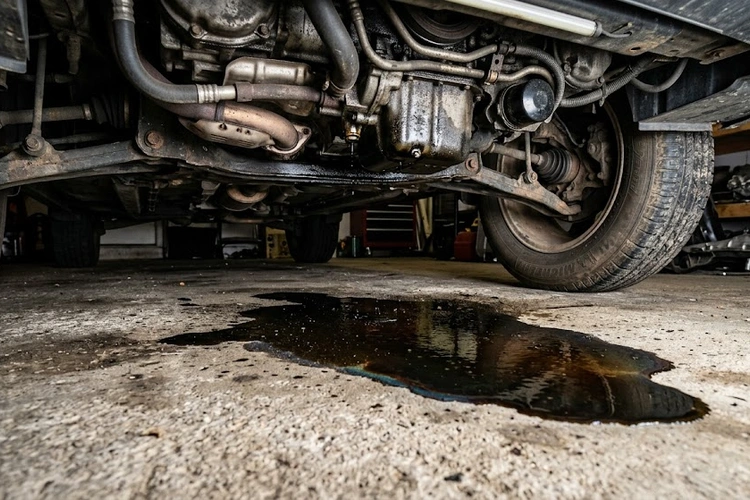
dark oil puddle under car on concrete driveway indicating engine leak
Figure 1 — A dark oil puddle under a car is a warning sign that demands prompt identification and diagnosis.

What Different Oil Puddles Actually Indicate

Not every puddle beneath a vehicle is motor oil. Fluid identification is the critical first step. Our team consistently finds that misidentifying the fluid leads to wasted diagnostic time and unnecessary part replacement.

Identifying Fluid by Color and Location

The color, texture, and location of a puddle provide the most reliable initial clues:

  • Dark brown or black, oily texture: Almost certainly engine oil. Found beneath the engine block, front of the vehicle.
  • Amber or honey-colored: Fresh motor oil or brake fluid. Brake fluid pools near wheels or the firewall.
  • Reddish or pink: Transmission fluid or power steering fluid. Pools toward the center or front of the vehicle. See our guide on transmission leak repair cost for more detail.
  • Clear or light blue: Windshield washer fluid. Generally harmless.
  • Bright green, orange, or pink — sweet smell: Coolant. Requires immediate attention. Related to issues explored in our temperature gauge rising guide.
  • Clear, watery: Condensation from the air conditioning system. Normal in warm weather.

According to the Wikipedia overview of motor oil, conventional and synthetic motor oils share similar viscosity ranges but differ in additive packages — a fact relevant when identifying older versus newer oil leaks by their color degradation over time.

Puddle Size and Frequency

Puddle size matters as much as color. Our team uses these general benchmarks:

  • Spot size (coin to palm): Minor seepage. Monitor for two to three days.
  • Small puddle (palm to hand-span): Active leak. Schedule repair within the week.
  • Large puddle (larger than a sheet of paper): Major leak. Do not drive the vehicle until inspected.
  • Multiple puddles or rapid reappearance: Indicates a pressure-related or multi-point failure.

When Immediate Action Is Required — and When It Is Not

One of the most common questions we receive is whether a given puddle warrants stopping immediately or simply monitoring. The answer depends on several factors working in combination.

Situations That Demand Immediate Attention

Our team recommends stopping the vehicle and calling a professional in the following scenarios:

  • The oil level on the dipstick reads at or below the minimum mark.
  • The oil pressure warning light is illuminated while driving.
  • Smoke is visible from the engine bay — a situation covered in detail in our article on smoke coming from under the hood.
  • The puddle formed overnight after a single parking period.
  • A knocking or ticking noise accompanies the leak.
  • The vehicle was recently serviced and the drain plug or filter may not have been properly seated.

A slow drip may seem minor, but even a half-quart of oil lost per week can lower oil pressure enough to accelerate bearing wear — often without triggering any warning light until significant damage has occurred.

Situations Where Monitoring Is Acceptable

In less urgent cases, most people can safely monitor the situation for a short period:

  • Oil level is at the full mark and has not dropped noticeably in recent weeks.
  • The puddle is very small (spot-sized) and has been consistent for months without worsening.
  • The vehicle is parked on a slope, and the drip is simply trapped oil migrating to a low point.
  • An older gasket is known to seep slightly and has been assessed by a mechanic previously.

Even in these cases, our team recommends checking the oil level every week and scheduling a professional inspection within 30 days.

How to Quickly Pinpoint the Leak Source

Before committing to any repair, pinpointing the exact source saves time and money. Several low-cost methods reliably narrow down the origin of an oil puddle under a car.

The Newspaper Test Method

This technique is simple and requires no tools:

  1. Park the vehicle on a clean, flat surface in the same spot used regularly.
  2. Place a large sheet of newspaper or cardboard underneath the engine bay.
  3. Leave the vehicle running for 10 to 15 minutes, then turn it off.
  4. Allow it to cool for 30 minutes.
  5. Examine the newspaper — the stain location directly corresponds to the leak source above it.
  6. Use a flashlight to trace upward from the stain to the first oily component above.

This method works well for locating leaks on stationary engines. For leaks that only appear while driving, a UV dye test is more appropriate.

Common Leak Points to Inspect First

Based on our team's diagnostic experience, these are the most frequent sources of oil puddles:

  • Oil drain plug: Worn threads or a missing crush washer. Most common after DIY oil changes.
  • Oil filter: Loose, cross-threaded, or old O-ring. Often missed during quick-lube services.
  • Valve cover gasket: Hardens and cracks with age. Oil drips down the side of the engine.
  • Oil pan gasket: Corrodes or warps over time. Creates a steady undercarriage drip.
  • Rear main seal: Located between the engine and transmission. Produces large, consistent puddles near the center of the vehicle.
  • Timing cover seal: Less common but produces significant leaks when it fails.
  • Camshaft seal or crankshaft seal: Typically on higher-mileage vehicles.

Issues related to oil contamination — such as what happens when coolant mixes with engine oil — are examined in our guide on water in engine oil.

Essential Tools for an Oil Leak Inspection

Proper tools make the difference between a confident diagnosis and a frustrating guessing session. Our team recommends assembling the following before starting any inspection.

Basic Inspection Kit

  • Bright LED flashlight or work light: Essential for viewing inside the engine bay.
  • Mechanic's mirror: Allows viewing of hard-to-reach areas behind components.
  • Clean shop rags: For wiping surfaces to identify fresh oil versus old residue.
  • Degreaser spray: Cleaning the engine bay before the test reveals fresh drips more clearly.
  • Cardboard or newspaper: For the ground-level newspaper test described above.
  • Nitrile gloves: Motor oil contains additives that are harmful with prolonged skin contact.

Advanced Diagnostic Tools

For leaks that are difficult to isolate, these additional tools improve accuracy:

  • UV dye kit with blacklight: Inject dye into the oil system, drive normally, then scan with the blacklight. The dye fluoresces at the leak point. Most kits retail for $15 to $40.
  • Smoke machine (leak detector): Injects smoke into the crankcase — visible smoke pinpoints the exit point. Typically a shop-level tool.
  • Borescope or inspection camera: Useful for viewing behind intake manifolds or inside tight spaces.
  • Torque wrench: Needed to re-torque the drain plug or valve cover bolts to specification after any adjustment.

Understanding the Cost of Oil Leak Repairs

Repair costs for an oil puddle under a car vary dramatically based on the leak source, vehicle make, and whether the work is performed at a dealership, independent shop, or at home. Our team has compiled a representative cost range for the most common repairs.

Repair Cost Reference Table

Leak Source DIY Parts Cost Shop Labor (Est.) Total Shop Cost (Est.) Difficulty
Oil drain plug / crush washer $2 – $8 $20 – $50 $25 – $60 Easy
Oil filter replacement $5 – $20 $20 – $50 $30 – $80 Easy
Valve cover gasket $15 – $60 $100 – $300 $120 – $400 Moderate
Oil pan gasket $20 – $80 $200 – $500 $250 – $600 Moderate
Rear main seal $10 – $50 $400 – $1,200 $450 – $1,300 Advanced
Timing cover seal $15 – $60 $300 – $800 $350 – $900 Advanced
Camshaft / crankshaft seal $10 – $40 $200 – $700 $220 – $800 Advanced

Factors That Influence Final Cost

Several variables shift repair costs significantly:
  • Vehicle make and model: European and luxury vehicles carry higher labor rates due to part accessibility and dealer-specific tooling requirements.
  • Engine type: V6 and V8 engines have more complex valve cover arrangements than inline-4 engines, increasing labor time.
  • Geographic location: Shop rates in metropolitan areas typically run 30 to 50 percent higher than rural markets.
  • Combined repairs: If the timing belt or water pump is due for replacement at the same mileage interval, combining the work reduces total labor hours significantly.
  • Sealant versus gasket: Some manufacturers specify RTV sealant instead of a cut gasket. Improper application leads to repeat failures and additional cost.
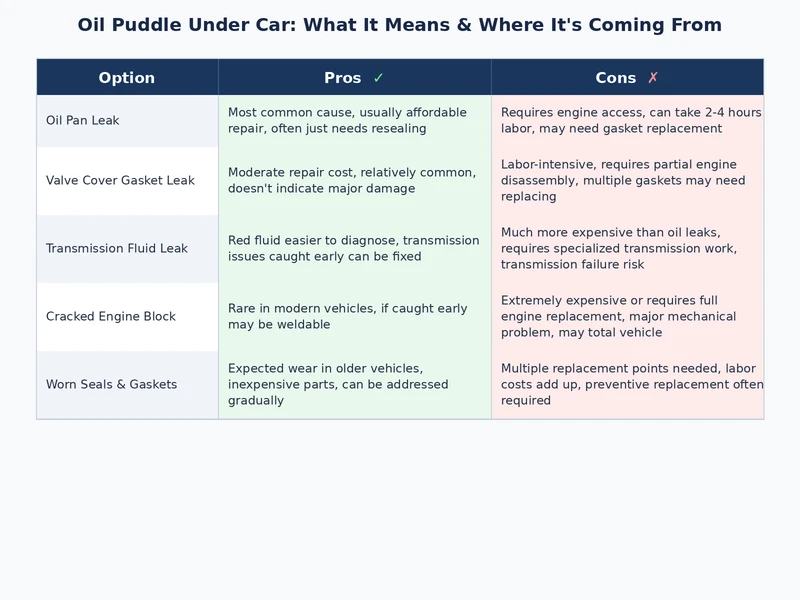
comparison of oil leak sources and repair costs for oil puddle under car diagnosis
Figure 2 — A visual comparison of common oil leak sources, their locations on the engine, and associated repair cost ranges.

DIY Inspection Versus Professional Diagnosis

The decision between a home repair and a professional shop visit depends on the leak's location, required tools, and the individual's mechanical background. Our team presents both perspectives without a strong recommendation either way — the right choice varies by situation.

What Most People Can Handle at Home

Several oil leak repairs are genuinely accessible to home mechanics:

  • Drain plug replacement: Requires only basic hand tools. Most home users can complete this in under 30 minutes with a new crush washer.
  • Oil filter tightening or replacement: A straightforward task requiring an oil filter wrench and a drain pan.
  • Valve cover gasket (inline-4 engines): Accessible on most compact vehicles. A clean work surface, torque wrench, and two to three hours are typically sufficient.
  • UV dye diagnosis: Anyone comfortable adding fluid to the oil fill cap can perform this test independently.

When Professional Help Is the Better Choice

Some repairs exceed the scope of most home garages. Our team recommends professional service for:

  • Rear main seal replacement: Requires transmission or engine removal on most vehicles. Labor-intensive and risk of misalignment is high without proper equipment.
  • Timing cover seal: Accessing this seal typically involves removing the harmonic balancer, timing belt or chain components, and sometimes the front subframe.
  • Leaks from pressurized oil passages: Involve precision torque specifications and sealant cure times that are difficult to manage without shop experience.
  • Unidentified multi-point leaks: A smoke machine or professional UV scan is the most reliable way to identify multiple simultaneous leak sources.
  • High-mileage vehicles with brittle seals: Disturbing adjacent seals during a repair can trigger new leaks if the material is near failure.

Our experience shows that misdiagnosed leaks — where the wrong gasket is replaced — account for a substantial share of repeat workshop visits. A professional diagnosis often pays for itself by avoiding unnecessary part purchases.

The Consequences of Delaying an Oil Leak Fix

Understanding the trade-offs of waiting versus acting helps most people make a more informed decision about urgency.

Short-Term Risks

Advantages of waiting briefly (one to two weeks) for a minor seep:

  • Allows time to gather quotes from multiple shops.
  • Permits scheduling around parts availability.
  • Provides opportunity to verify the leak has not worsened before committing to a repair.

Disadvantages of even short delays:

  • Oil drips on hot exhaust components can create a fire hazard.
  • Oil reaching belts or the clutch disc degrades those components rapidly.
  • Small seeps can expand quickly if temperature cycling causes the gasket to contract further.
  • Environmental contamination — oil drips on public roads and in parking facilities — is a civic and legal concern in many jurisdictions.

Long-Term Engine Damage

Prolonged neglect of an active oil puddle under a car introduces compounding risks:

  • Low oil pressure: As the oil level drops, hydrodynamic lubrication at bearings becomes inadequate. Bearing failure follows rapidly under load.
  • Increased wear on all internal components: Every moving part in the engine depends on an oil film for separation. Reduced volume means thinner films and metal-to-metal contact.
  • Catalytic converter damage: Oil that reaches the exhaust stream fouls the catalytic converter, potentially requiring a $600 to $2,500 replacement.
  • Resale value reduction: A documented history of oil leaks — especially rear main seal failures on high-mileage vehicles — measurably reduces private sale value.
  • Secondary system failures: Oil contamination of the serpentine belt or accessory drive can cause premature belt failure, leading to the symptoms described in our article on serpentine belt symptoms.

Frequently Asked Questions

Is an oil puddle under a car always a serious problem?

Not always — a spot-sized seep from an aging gasket on a high-mileage vehicle may be monitored safely for a short period. However, any puddle large enough to pool on the ground, or any seep accompanied by a drop in oil level, should be diagnosed promptly. Our team treats any active leak as a developing problem rather than an acceptable condition.

How do most people identify whether the puddle is oil or another fluid?

The most reliable field method is color and smell. Dark brown or black fluid with a petroleum odor is almost certainly engine oil. Reddish fluid points toward transmission fluid. Bright green or orange fluid with a sweet smell is coolant. Clear fluid near the front of the vehicle is typically air conditioning condensate, which requires no repair.

Can driving with a small oil leak cause immediate engine damage?

It depends on the leak rate. A very slow seep that does not measurably lower the oil level between changes carries low immediate risk. However, even small leaks can worsen suddenly — especially when the vehicle reaches operating temperature and oil pressure increases. Our team recommends checking the oil level daily whenever an active leak is known to exist.

What is the most common cause of an oil puddle under a car?

In our experience, the oil drain plug and oil filter are the most frequently overlooked sources, particularly after a recent oil change. Valve cover gaskets are the most common age-related failure point. Rear main seal failures produce the largest and most consistent puddles on higher-mileage vehicles.

How much does it typically cost to fix an oil leak?

Costs range from under $30 for a drain plug replacement to over $1,300 for a rear main seal repair on certain vehicles. The repair cost depends primarily on which component is leaking, the vehicle's make and model, and whether the work is performed at a dealership or an independent shop. Our cost table earlier in this article provides a detailed breakdown by leak source.

Does the color of the oil in the puddle indicate how serious the leak is?

Color indicates age rather than severity. Fresh oil is amber or light brown. Oil that has accumulated heat cycles appears dark brown to black. A large puddle of fresh amber oil — for example, after an improper oil change — may represent a more urgent leak than a small patch of older black oil from a slowly seeping gasket.

Is it safe to use oil stop-leak additives as a long-term solution?

Our team views stop-leak additives as a temporary measure suitable for emergencies or low-stakes situations. These products swell or condition seals to reduce seepage but do not repair a mechanically failed gasket or seal. Relying on additives in place of proper repair risks masking a worsening condition and can, in some formulations, affect oil viscosity or harm seals in adjacent systems.

When should most people consider not repairing an oil leak?

On vehicles where the repair cost approaches or exceeds the vehicle's market value, the economic case for repair weakens considerably. Our team recommends obtaining a professional quote and comparing it against the vehicle's current valuation. In some cases — particularly rear main seal failures on high-mileage vehicles — managed monitoring combined with regular top-offs may be the most pragmatic approach while planning for vehicle replacement.

Final Thoughts

An oil puddle under a car is rarely a problem that resolves on its own — and our team consistently finds that early diagnosis prevents the most expensive outcomes. Most people benefit from starting with the newspaper test, checking the oil level, and identifying the fluid type before calling a shop. We recommend scheduling a professional inspection within one week for any active drip, and within 24 hours if the oil level has already dropped or a warning light is present.

About Joshua Thomas

Joshua Thomas just simply loves cars and willing to work on them whenever there's chance... sometimes for free.

He started CarCareTotal back in 2017 from the advices of total strangers who witnessed his amazing skills in car repairs here and there.

His goal with this creation is to help car owners better learn how to maintain and repair their cars; as such, the site would cover alot of areas: troubleshooting, product recommendations, tips & tricks.

Joshua received Bachelor of Science in Mechanical Engineering at San Diego State University.

Get some FREE car parts & gear.. Or check out the latest free automotive manuals and build guides here.

Disable your ad blocker to unlock all the hidden deals. Hit the button below 🚗