by Sarah Whitfield
You park the car on a Friday evening — no warning lights, nothing unusual. Monday morning you turn the key and get nothing. Not even a click. You didn't leave the lights on, and the battery is less than two years old. Welcome to parasitic battery drain, one of the most frustrating electrical faults a car owner can face.
Parasitic battery drain (also called key-off current draw) happens when one or more electrical components keep pulling power from your battery after you shut the car off. A small amount of draw is perfectly normal — your clock, security system, and module memory all need a trickle of power to survive the night. The problem starts when that draw is too large, or when a component refuses to turn off at all. Before you replace anything, check our car battery cost guide — because spending money on a new battery without fixing the drain means you'll be back here in two weeks.
Contents
Not every milliamp of overnight draw is a problem. Your car's electrical system needs a small amount of power at all times, even with the key out. Understanding what's normal — and what isn't — saves you hours chasing ghosts.
Most manufacturers set acceptable key-off current draw (called quiescent draw) at 25–50 milliamps (mA). Some modern vehicles with advanced telematics or factory remote start push that ceiling to 80 mA. Components that are always allowed to draw power include:
Under 50 mA and a healthy battery will survive months in a driveway without a charge. Over 50 mA and you're on borrowed time.
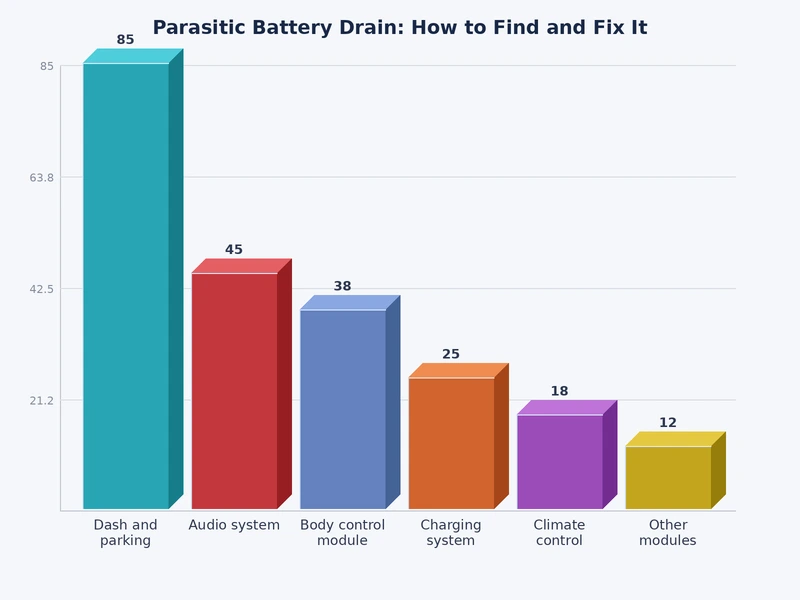
Parasitic drain becomes a real problem when a circuit fails to power down, a relay sticks in the closed (on) position, or a module enters a loop and never goes to sleep. The table below compares typical current draws from common offenders against the normal baseline:
| Component | Normal Key-Off Draw | Faulty / Stuck Draw | Risk Level |
|---|---|---|---|
| ECM / PCM | 5–15 mA | 80–200 mA | High |
| Body Control Module (BCM) | 5–20 mA | 100–400 mA | Very High |
| Aftermarket radio / amplifier | 0 mA (should be off) | 200–1,500 mA | Very High |
| Trunk / dome light stuck on | 0 mA | 300–800 mA | High |
| Stuck fuel pump relay | 0 mA | 500–2,000 mA | Very High |
| Alarm module (fault state) | 10–25 mA | 50–200 mA | Medium |
| OBD-II dongle / GPS tracker | 5–30 mA | 30–500 mA | Medium |
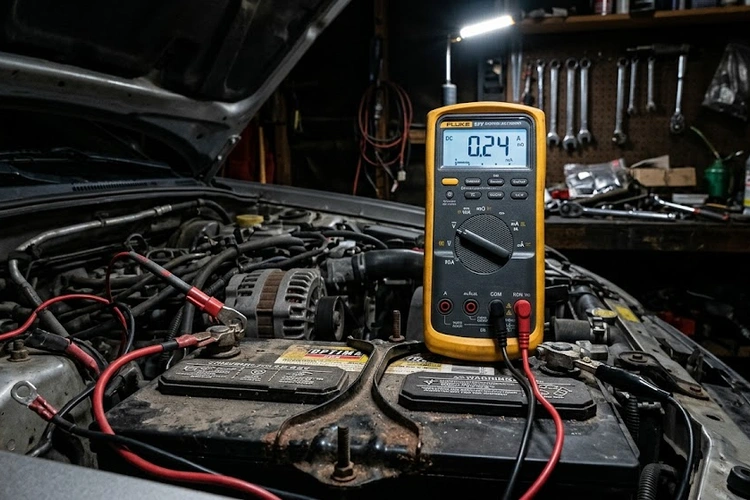
You don't need a shop full of equipment to find a parasitic drain. But cutting corners on tools costs you accuracy — and accuracy is everything with electrical diagnosis.
Pro Tip: Buy a multimeter with a built-in amp clamp if you plan to do this more than once. It eliminates the risk of blowing your meter's internal fuse by accidentally exceeding the amp input range — a mistake every technician makes exactly once.
This is the exact process professional technicians follow. Work through it systematically and you will find the drain.
Warning: Never open a car door during this test — the courtesy lights and modules that wake up will spike your reading and restart your 20-minute wait. Complex vehicles with advanced networks can take up to 45 minutes to fully sleep.
Once you've confirmed excess draw, isolate the guilty circuit:
If your drain is intermittent — the battery dies sometimes but not always — the fault is likely a module that occasionally fails to sleep. This is common in Body Control Modules and requires a scan tool to catch the module awake after a key-off event. If you've already reached the point where the car won't start with no click, the battery is probably too depleted to recover without a full charge first.
Not all circuits are equal when it comes to parasitic drain. These are the repeat offenders that account for the majority of real-world cases.
Keep in mind: a bad alternator that isn't fully charging the battery can look exactly like a parasitic drain problem. If your battery discharges during driving rather than just overnight, read our bad alternator symptoms guide before going further down the drain-testing path.
Parasitic drain diagnosis is genuinely DIY-friendly — up to a point. Knowing where that line is saves you money and prevents you from creating new problems.
If you're comfortable with a multimeter and have a wiring diagram, you can solve 70–80% of parasitic drain cases at home in an afternoon.
A good shop uses a power probe and current clamp connected to a data logger to catch intermittent drains. If they quote a flat-rate diagnosis fee, that's fair — this work is time-intensive even for professionals.
Bad advice about parasitic battery drain is everywhere. Here are the most common misconceptions and the reality behind each one.
A fresh battery will start your car today. It won't fix whatever is draining it. You'll be back to square one within a week or two. Replacing the battery without diagnosing the drain is a short-term patch on a long-term problem — and repeated deep discharges will kill the new battery faster than the old one.
A large-capacity battery can mask a moderate drain for weeks. You don't notice the problem until the battery is weakened enough that normal self-discharge plus the fault push it below the cranking threshold. According to Wikipedia's overview of parasitic drain, the issue is cumulative — it compounds every night the vehicle sits. By the time you notice, you may already have a damaged battery on your hands.
Disconnecting the battery resets nothing relevant to the drain. The fault returns the moment you reconnect. All you've done is clear your radio presets and possibly triggered a throttle-body relearn cycle. Use a memory saver if you need to disconnect during diagnosis so you don't create extra work for yourself.
Insider Note: Drains that come and go with temperature changes are almost always relay failures. Cold weather causes contact surfaces to contract and open intermittently; warm weather causes them to stick closed. If your dead-battery problems track with the seasons, start with the relays.
Modern vehicles have more parasitic drain risk than older ones, not less. More modules, more network complexity, more failure points. The BCM alone manages 60–100 individual functions on a late-model truck. Every function is a potential drain source, and the sleep-wake logic that governs them adds another layer of failure modes that didn't exist on carbureted vehicles.
Before you set up a meter, run through this checklist. These are the five-minute checks that solve roughly 30% of all parasitic drain complaints without any tools at all.
A weak charging system can look exactly like a drain problem because the battery never returns to full charge after each start. If your battery is always running slightly depleted, even a normal 30 mA draw will kill it faster than expected. Have your alternator and charging voltage tested — a healthy system produces 13.8–14.7 volts at idle. Anything below 13.5V at operating temperature needs attention alongside your drain investigation. Electrical issues sometimes cascade; if you're also pulling codes for engine sensors, check for idle air control valve symptoms or other sensor faults that suggest a broader electrical fault rather than a single isolated drain.
If you suspect the issue might be broader — affecting multiple systems rather than one isolated circuit — it's worth checking whether the camshaft position sensor or related engine management sensors are involved, since camshaft position sensor failure symptoms can sometimes accompany module sleep failures in the same electrical network.
Most vehicles draw 25–50 milliamps in key-off mode. Vehicles with factory telematics, remote start, or advanced anti-theft systems may draw up to 80 mA and still be within the manufacturer's spec. Anything consistently above 50 mA on a standard vehicle warrants investigation using the fuse-pull method outlined above.
Yes. Repeatedly draining a lead-acid battery below 50% state of charge causes sulfation — a buildup of lead sulfate crystals on the battery plates that permanently reduces capacity. A battery that has been deep-cycled more than a few times will hold less charge and fail sooner than a healthy unit. Fix the drain before you replace the battery, or the new one will suffer the same fate.
A straightforward drain from a stuck light or a rogue aftermarket accessory takes 30–60 minutes to find and fix. A complex drain from a module sleep failure can take several hours and may require an overnight data-logging session to catch the draw in the act. Most DIYers resolve their drain in a single afternoon once they have a wiring diagram in hand.
It will keep the battery charged, but it will not fix the underlying fault. A trickle charger is a reasonable temporary measure for a stored vehicle, but running a charger indefinitely to offset a faulty circuit wastes electricity and ignores the root cause. Diagnose and fix the drain — the charger is a band-aid, not a repair.
Yes. A corroded or loose chassis ground can cause modules to behave erratically, staying awake when they should sleep or failing to send proper sleep signals across the network. Always inspect the main battery-to-chassis ground strap and the engine block ground strap before assuming the fault is in a module or relay. Clean, tight grounds are the foundation of accurate electrical diagnosis.
Parasitic battery drain is a solvable problem — every single case has a source, and a systematic approach with a multimeter and a fuse puller will find it. Start with the quick five-minute checks, confirm your draw with a meter, then work through the fuse-pull method circuit by circuit. If you don't already own a quality digital multimeter, pick one up and run through this process this weekend — catching a moderate drain early protects a healthy battery from permanent damage and saves you from a frustrating dead-car situation at the worst possible moment.
 |
 |
 |
 |

About Sarah Whitfield
Sarah Whitfield is a diagnostics and troubleshooting specialist who spent ten years as an ASE-certified technician before joining the editorial team. She specializes in OBD-II analysis, electrical gremlins, and the kind of intermittent problems that make most owners give up.
Get some FREE car parts & gear.. Or check out the latest free automotive manuals and build guides here.
Disable your ad blocker to unlock all the hidden deals. Hit the button below 🚗
| | | |
