Popping Noise When Turning: Causes & Solutions

by Joshua Thomas

A worn CV joint affects roughly 1 in 5 vehicles once they surpass 100,000 miles, making a popping noise when turning one of the most frequently reported automotive complaints our team encounters. The sound ranges from a faint click to a sharp crack, and it almost always appears during slow, tight maneuvers — the kind performed in parking lots or driveways. Left unaddressed, the underlying cause typically escalates from a manageable repair into a more expensive failure. For a full breakdown of related expenses, our guide on CV joint replacement cost provides current cost estimates by vehicle type.

Our team has compiled this guide to cover every major cause, a structured inspection method, and clear repair guidance so that most people can walk into a shop — or their own garage — fully informed.
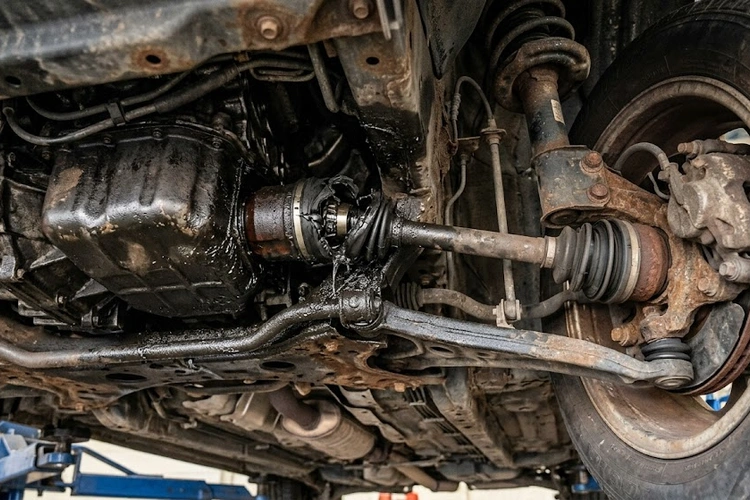
Mechanic inspecting CV joint axle boot for popping noise when turning
Figure 1 — A split or grease-splattered CV boot is the most common visual indicator of the component responsible for a popping noise during turns.

What Causes a Popping Noise When Turning?

The steering and suspension system involves dozens of interconnected components. When any one of them wears, loosens, or loses lubrication, a clicking or popping sound often results during directional changes. Our team consistently identifies four primary culprits across the majority of turning noise diagnoses.

CV Joint Failure

The constant velocity (CV) joint transfers engine power to the drive wheels while accommodating the up-and-down movement of the suspension. Each front wheel has two CV joints: an inner and an outer. The outer CV joint is the most common source of a popping noise when turning at low speeds.

  • The CV joint boots — rubber protective covers — crack over time, allowing grease to escape and dirt and moisture to enter.
  • Without adequate lubrication, the internal ball bearings and cage wear rapidly.
  • The classic symptom: a sharp clicking or popping sound during slow, tight turns, most obvious when navigating parking lots at full steering lock.
  • The noise intensifies as the joint deteriorates and typically disappears when driving in a straight line.

Our team's detailed guide on CV axle noise symptoms covers the full spectrum of failure indicators beyond the turning click — including vibration and grease contamination patterns.

Pro Insight: A CV joint that pops only during full-lock turns in one direction almost always points to an outer joint failure on that side. Symmetric popping during both left and right turns suggests a different component entirely.

Ball Joint Wear

Ball joints are pivot points connecting the wheel hub assembly to the control arms. They absorb road impacts and allow the steering knuckle to pivot during directional changes. Worn ball joints produce a popping or clunking sound that is most prominent during slow turns over uneven pavement.

  • Lower ball joints are load-bearing on most independent suspension vehicles and tend to wear faster than upper joints.
  • Play in a worn ball joint creates the characteristic knock as the joint shifts under lateral load during a turn.
  • Failed ball joints represent a genuine safety risk — a completely failed joint can cause sudden loss of wheel control.

Sway Bar Link Problems

The sway bar (also called an anti-roll bar) connects the left and right suspension arms to reduce body roll in corners. The end links — small rod-like connectors at each end of the bar — are particularly prone to wear. A loose or broken sway bar link produces a popping or rattling noise when turning or traversing bumps.

  • Sway bar link replacement is among the least expensive steering-related repairs: typically $80–$150 per side including labor.
  • The noise from a failed end link is often more pronounced at parking speeds and during low-speed direction changes.
  • A visual inspection from underneath the vehicle frequently reveals a visibly cracked or disconnected link.

Strut Mount Bearing Failure

The strut mount is the bearing plate at the top of the front strut assembly. It allows the entire strut to rotate as the steering wheel turns. A worn strut mount bearing produces a popping or grinding sensation that transmits through the steering column during slow turns.

  • This issue is most common on vehicles with more than 80,000 miles.
  • The noise often worsens in cold weather as bearing grease thickens.
  • Under-torqued wheel fasteners can amplify suspension noise — our guide on loose lug nut symptoms outlines how improperly tightened hardware affects vehicle handling.

Diagnostic Best Practices for Turning Noises

Accurate diagnosis is the most important step in resolving a popping noise when turning. Replacing parts without confirmation is expensive and often fails to address the actual problem. Our team recommends a two-phase diagnostic process: a controlled listening test, followed by a focused visual inspection.

The Controlled Listening Test

Controlled listening narrows the cause to a specific component and location before any tools are needed.

  • Low-speed full-lock turns: Drive slowly and turn the steering wheel to its maximum extent in each direction. A CV joint pop is loudest at full lock. Perform this in an empty parking lot.
  • Stationary steering test: With the transmission in park, slowly rotate the steering wheel lock to lock. Noise that appears only while moving indicates a dynamic load component (CV joint, ball joint). Noise at rest strongly suggests a strut mount bearing.
  • Speed variation test: A noise that changes with vehicle speed but not with steering angle often points to a wheel bearing rather than a CV joint. Our comparison of wheel bearing vs. CV joint noise explains these distinctions in practical terms.
  • Bump sensitivity test: Note whether the noise intensifies specifically over road irregularities. Bump-triggered noise points to strut mounts or sway bar end links.

Warning: A steering wheel that pulls to one side during the popping event is a significant safety indicator — our team's guide on steering wheel pulling when braking explains how to identify related underlying causes.

Initial Visual Inspection

A basic visual check — no tools or lifting required — can confirm or rule out several causes in minutes.

  • Examine CV joint boots visible through the wheel well. Cracked, split, or grease-splattered boots confirm a compromised joint.
  • Check sway bar end links for visible cracks, separation, or disconnection from mounting points.
  • Look for unusual tire wear patterns, which often accompany ball joint or alignment issues.
  • Note any grease marks on the inside of the wheel or suspension components — this confirms a boot failure.

Step-by-Step Physical Inspection Guide

Once the listening test points to a probable cause, our team recommends this structured physical inspection sequence. A floor jack, jack stands, and basic hand tools are sufficient for all steps.
  1. Secure the vehicle. Apply the parking brake, place wheel chocks behind the rear tires, and work only on a flat, stable surface. Safety is non-negotiable before lifting any vehicle.
  2. Raise and support the front end. Lift the vehicle using a floor jack positioned under the manufacturer-specified frame rails — never under suspension components. Place jack stands under the designated support points before beginning any inspection.
  3. Inspect CV joint boots thoroughly. Rotate the axle shaft by hand and examine both inner and outer boots for cracks, tears, or grease contamination. A split boot confirms the CV joint has been exposed to contaminants and requires replacement.
  4. Check for CV joint play. Grip the axle shaft near the outer CV joint and attempt to move it side to side with moderate force. Any perceptible lateral play indicates internal wear requiring replacement.
  5. Test ball joint movement. Grasp the tire at the 12 o'clock and 6 o'clock positions and rock it firmly. Vertical play (top-to-bottom movement) indicates a worn ball joint. Then grasp at the 9 and 3 o'clock positions and rock for horizontal play, which points to a wheel bearing issue.
  6. Inspect sway bar end links. Grasp each link and attempt to move it manually. Loose movement, rattling, or audible clicking under hand pressure confirms wear. Visually confirm the rubber bushings are intact.
  7. Check the strut mount. With an assistant turning the steering wheel slowly, place a hand on the top of the strut tower. A popping or grinding sensation transmitted through the tower confirms an upper strut bearing problem.
  8. Verify lug nut torque. Use a torque wrench to confirm all lug nuts are tightened to the manufacturer's specification. Even slightly under-torqued fasteners produce irregular sounds during cornering under load.
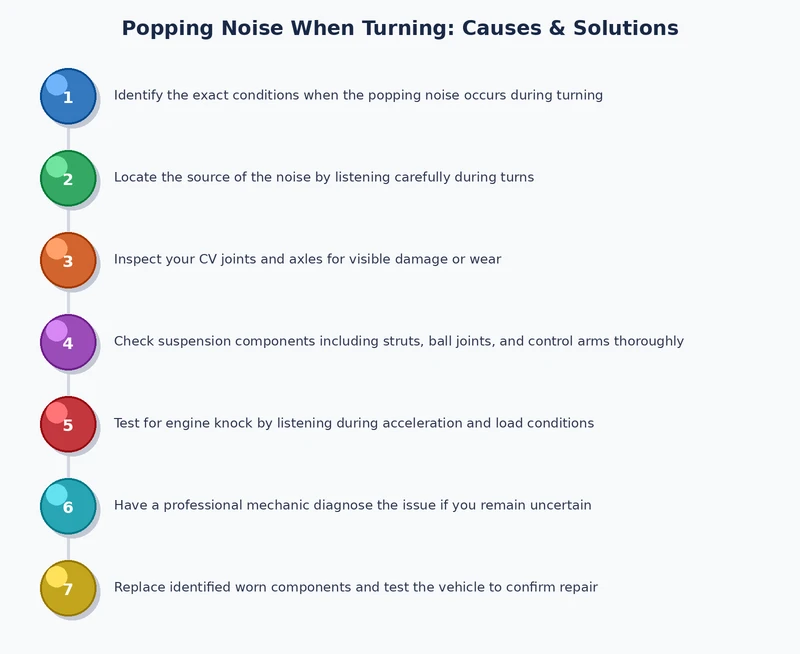
Step-by-step process diagram for diagnosing popping noise when turning a car
Figure 2 — A systematic eight-step inspection sequence eliminates guesswork and reduces unnecessary parts replacement.

DIY vs. Professional Repair: Weighing the Options

The appropriate repair path depends on the specific component involved, the tools available, and the skill level of the person doing the work. Our team presents both sides clearly so most people can make an informed decision.

The Case for DIY

Several components involved in turning noise repairs are accessible to experienced home mechanics.

  • Sway bar end links are the most accessible repair on this list. Most vehicles require only a wrench and socket set, and the job takes under an hour per side.
  • CV axle shaft replacement is manageable for intermediate DIY mechanics. The job requires a torque wrench, ball joint separator, and a breaker bar, plus access to a CV axle replacement for the specific vehicle. Our team estimates a 2–3 hour repair window for most front-wheel-drive vehicles.
  • Completing the repair independently saves $100–$200 in labor costs per component.

The Case for Professional Service

Certain repairs in this category warrant professional attention regardless of DIY capability.

  • Ball joint replacement requires a press tool to remove and install the joint in the control arm on most vehicles. Without this tool, the repair is not feasible at home.
  • Strut replacement requires a spring compressor — a tool that poses a significant injury risk when used without proper training. Our team consistently recommends professional service for any job involving compressed suspension springs.
  • Professional shops carry liability for their work. Any repair performed under a shop warranty provides recourse if the problem recurs.
  • Alignment — frequently required after suspension work — is only available with professional equipment. A misaligned vehicle after a DIY suspension repair creates additional tire wear and handling problems.

Pro Tip: Routine inspection of brake rotors during any suspension job is a sound practice — our team's guide on brake rotor surface rust explains what to look for while the wheel is already removed.

Repair Costs and What to Expect

Repair costs for a popping noise when turning vary significantly by component, vehicle make, and whether the work is performed at a dealership or independent shop. The following table reflects typical ranges for parts and labor combined at an independent repair facility in the United States.

Component Typical Repair Cost (Parts + Labor) DIY Difficulty Urgency
Outer CV axle shaft $200–$400 per side Moderate High — drive carefully until repaired
Inner CV axle shaft $250–$450 per side Moderate–Hard High — affects drivability
Lower ball joint $150–$350 per side Hard (press tool required) Critical — safety risk if failed
Sway bar end link $80–$150 per side Easy Low–Medium
Strut mount bearing $200–$400 per side Moderate (spring compressor required) Medium — worsens over time

Dealership labor rates typically add 30–50% to independent shop estimates. Luxury and European vehicles carry higher parts costs across all categories. Our team recommends obtaining at least two written estimates before authorizing any suspension repair.

  • Ask shops to inspect adjacent components during any suspension job — replacing a CV axle shaft and ignoring a cracked inner boot on the same side leads to a repeat repair within months.
  • OEM (original equipment manufacturer) parts are generally preferred for ball joints and CV axles given the safety implications of these components.
  • Aftermarket parts from reputable brands (Moog, Gates, Dorman) represent a reasonable middle ground for budget-conscious repairs on older vehicles.

Maintenance Habits That Prevent Popping Noises

A large portion of popping noise cases our team encounters are preventable. Consistent, simple maintenance habits extend the life of every suspension component discussed in this guide.

  • Inspect CV joint boots annually. A 30-second visual check during routine oil changes catches cracked boots before grease escapes. Early detection reduces a $300+ axle replacement to a $40–$80 boot kit replacement in most cases.
  • Address potholes carefully. Repeated hard impacts accelerate ball joint wear, compress strut bearings, and stress sway bar links. Slowing before road irregularities reduces impact forces substantially.
  • Keep wheel fasteners properly torqued. Check lug nut torque after tire rotations and any wheel removal. Most passenger vehicles specify 80–100 lb-ft — confirm the vehicle-specific value in the owner's manual.
  • Schedule four-wheel alignments after suspension work. Any component replacement involving steering geometry warrants a fresh alignment to prevent accelerated tire wear and handling issues.
  • Lubricate grease fittings where present. Some ball joints and tie rod ends include grease fittings (zerks). These components benefit from periodic grease injection with a standard grease gun during oil changes.
  • Avoid pressure washing directly at suspension joints. High-pressure water strips grease from exposed joints and accelerates rubber boot degradation, particularly on inner CV joints and ball joints.

Frequently Asked Questions

Is it safe to drive with a popping noise when turning?

It depends on the cause. A failed outer CV joint that pops only during full-lock turns is drivable for a short period with care, but continued driving accelerates the failure. A worn ball joint is considerably more serious — a completely failed ball joint can result in sudden loss of wheel control. Our team recommends prompt diagnosis for any sustained popping noise, and immediate professional inspection when the noise is accompanied by steering pull or vibration.

Why does the popping noise only occur during slow turns, not at highway speeds?

Outer CV joint failures produce noise primarily under full or near-full steering lock, which typically occurs at low speeds. At highway speeds, the steering angle is minimal, so the worn joint operates within a range that does not trigger the noise. This pattern is one of the clearest diagnostic indicators of an outer CV joint problem rather than a wheel bearing or strut issue.

Can a popping noise when turning come from the rear of the vehicle?

Yes. Rear-wheel-drive vehicles and all-wheel-drive vehicles have rear CV joints or universal joints that can produce similar symptoms. Rear sway bar end links and rear strut mounts are also common sources. Rear popping during turns on front-wheel-drive vehicles most often points to rear sway bar links or rear strut mounts rather than drive axle components.

How does cold weather affect a popping noise when turning?

Cold weather thickens grease inside CV joints and strut mount bearings, which often makes existing popping noises louder in the morning. A noise that disappears after the vehicle warms up does not indicate the problem has resolved — it indicates the grease has reached operating temperature. Cold-weather amplification of turning noise is a reliable indicator that a repair is overdue.

What is the difference between a clicking and a popping noise when turning?

In our team's experience, a sharp, rhythmic clicking that increases with vehicle speed and steering angle almost always indicates a worn outer CV joint — this is the textbook CV joint sound. A deeper, less rhythmic pop or clunk, particularly during slow maneuvers over bumps, more commonly points to a ball joint, sway bar end link, or strut mount. The distinction helps narrow the diagnosis before any physical inspection begins.

Key Takeaways

  • A popping noise when turning most commonly originates from a worn outer CV joint, and the classic indicator is a sharp click during slow, full-lock turns that disappears in a straight line.
  • Ball joint failure carries the highest safety risk of all turning noise causes and warrants immediate professional inspection when suspected.
  • Annual visual inspection of CV joint boots catches early failures before grease loss occurs, converting a costly axle replacement into an inexpensive boot repair.
  • A structured diagnostic process — listening tests followed by physical inspection — consistently outperforms guesswork and prevents unnecessary parts expenditure.

About Joshua Thomas

Joshua Thomas just simply loves cars and willing to work on them whenever there's chance... sometimes for free.

He started CarCareTotal back in 2017 from the advices of total strangers who witnessed his amazing skills in car repairs here and there.

His goal with this creation is to help car owners better learn how to maintain and repair their cars; as such, the site would cover alot of areas: troubleshooting, product recommendations, tips & tricks.

Joshua received Bachelor of Science in Mechanical Engineering at San Diego State University.

Get some FREE car parts & gear.. Or check out the latest free automotive manuals and build guides here.

Disable your ad blocker to unlock all the hidden deals. Hit the button below 🚗