by Sarah Whitfield
You pull up to a drive-through, press the window button, and the glass does not move. You hold the switch down harder, check the others — still nothing. A power window not working is one of those small failures that turns into a genuine nuisance the moment you actually need your window open. The good news is that most failures trace back to one of six well-understood causes, and several of them are straightforward enough to fix in your own driveway. If you have already dealt with a car door that will not open from inside or outside, you already know that door-related problems often share the same electrical and mechanical roots — and the same diagnostic logic applies here.
Contents
Every power window system depends on four parts working in sequence: the switch, the motor, the regulator (the scissor-arm or cable mechanism that physically moves the glass), and the wiring that ties them to the fuse box. When you press the switch, it sends a low-voltage signal that energizes the motor, which drives the regulator up or down while the glass rides along in a rubber-lined channel. All four components must be functional and properly connected for the window to respond.
Power window parts live inside the door, where they absorb constant vibration, wide temperature swings, and moisture intrusion over thousands of cycles. Motors wear down their internal brushes gradually, regulators crack or lose their cable tension, and switches collect corrosion on their contact pads. The wiring harness that passes through the rubber door boot — the accordion-shaped conduit between the body and the door — flexes every time the door opens and eventually develops internal wire breaks with no visible damage on the outside. Knowing these failure points lets you target your diagnosis instead of replacing parts blindly.
A blown fuse is the quickest thing to eliminate, because checking it takes under two minutes and costs nothing. Look up the fuse box location in your owner's manual, pull the window fuse, and hold it to a light source — a blown fuse shows a visibly melted wire inside the clear housing. Replace it with a fuse of identical amperage. A fuse that blows again immediately is a warning that a short circuit or a binding motor is drawing excessive current, so do not keep replacing fuses without investigating the root cause. Fuse-related electrical issues often overlap with the kind of slow battery drain covered in detail in our guide on parasitic battery drain.
The window switch — especially the driver's door master panel that controls all four windows — is a high-cycle component that wears out from repeated use and contact oxidation. A quick way to test it is to swap the suspect switch with the matching switch from an unaffected door position; if the previously dead window now moves, the switch was at fault. Replacement switches are typically plug-and-play and require only a trim removal tool and a flat screwdriver to access.
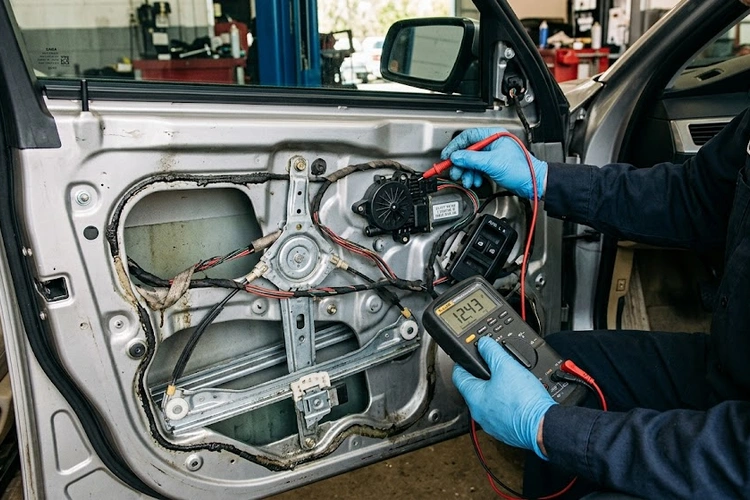
Motor failure usually announces itself gradually — you notice the window slowing down over several weeks before it stops entirely, which is the motor's carbon brushes wearing to nothing. With the door panel removed, you can test the motor directly by applying 12 volts from a jumper wire across its connector; a healthy motor spins freely in both directions, while a dead one stays silent. Replacing a window motor is a moderate-difficulty job that most careful DIYers can handle in about an hour.
The regulator is what translates the motor's rotation into vertical glass movement, and it fails more often than people expect. On scissor-style designs, a pivot arm cracks or a roller pops its track; on cable-driven designs, the cable frays and snaps. The telltale sign is hearing the motor hum normally while the glass refuses to move or drops suddenly into the door cavity. Many suppliers sell the motor and regulator as a combined assembly, which is often the smartest buy if both parts are aging.
Wires that flex through the door boot thousands of times can break internally without any visible cracking on the insulation jacket. Corroded connector pins cause the same intermittent or total loss of function. Wiggle the harness near the door boot while holding the switch down — any momentary glass movement confirms a broken wire at that location. A multimeter is the right tool here; set it to continuity mode and trace each wire until you find the open circuit, then splice in a replacement section.
Before you pull a single door panel, check the master switch panel for a window lock-out button. One accidental press of that button disables all rear window controls from the passenger side, and it gets misdiagnosed as a mechanical failure regularly. Some vehicles extend this function to individual windows or use a dedicated child safety lock that can be tripped without the driver noticing. Check for any illuminated lock icon on the master panel and press it to toggle the feature off.
Pro tip: always test all four windows from the driver's master switch before opening any door panel — a single locked-out switch or a shared fuse can make one failed circuit look like four separate failures.
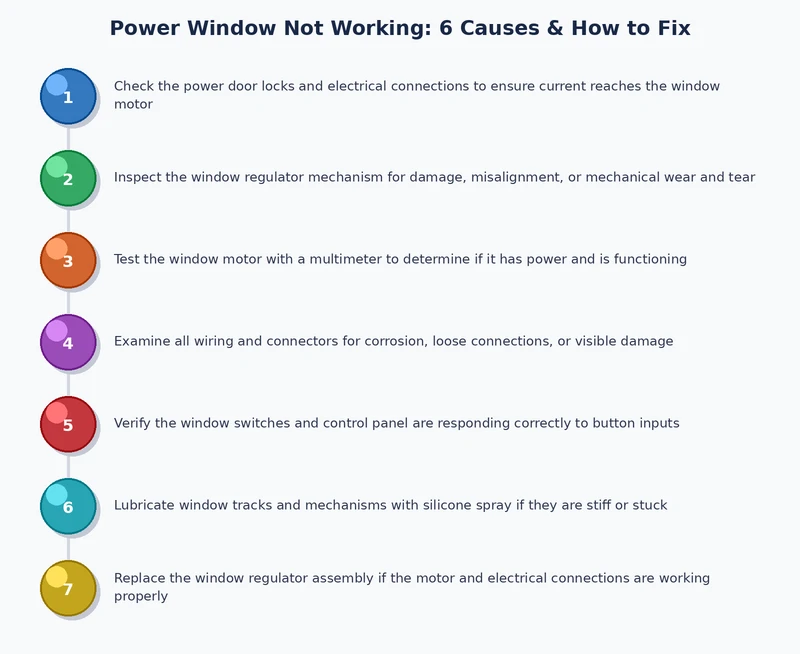
The fastest diagnostic path follows the order of the causes listed above — fuse first, then lock-out, then switch, then motor and regulator, then wiring. This sequence matters because each earlier step takes minutes while the later steps take an hour or more. If all four windows are dead simultaneously, focus on the fuse box and the master switch circuit rather than assuming four motors failed at once. If only one window is out, isolate its individual switch, then test its motor and regulator before chasing wiring.
With the door panel off and the motor's connector unplugged, touch a pair of jumper wires from the battery's positive and negative terminals to the motor's two pins. Reverse the wires to test both directions. A motor that spins freely both ways is good; one that hums without turning has a seized gear set; one with no response at all has failed windings. This direct-power test takes about three minutes and eliminates guesswork before you buy anything.
Fuse replacement, switch swap, and motor-regulator assembly exchange are all realistic DIY repairs for anyone comfortable with basic hand tools. Door panels on most vehicles clip in place and come free after removing two or three screws, and a set of plastic trim tools prevents broken clips. If you enjoy hands-on electrical diagnosis — similar to tracing down a bad alternator — then chasing a broken wire with a multimeter is equally satisfying and saves a significant portion of the shop labor charge.
Bring the car to a shop when the glass itself has come off its track and is leaning at an angle inside the door, when multiple windows failed at the same time and basic fuse checks turned up nothing, or when the repair involves a frameless window design — common on sports cars and some four-door hardtops — where glass alignment is critical and unforgiving of small mistakes. Shops also have dedicated wire-tracing tools that find internal breaks in a wiring harness far faster than a multimeter in a tight door cavity.
Parts prices vary by vehicle make, model year, and whether you choose OEM or aftermarket components. The table below gives realistic cost ranges for the most common repairs:
| Repair Type | DIY Parts Cost | Shop Total (Parts + Labor) | Difficulty |
|---|---|---|---|
| Blown fuse replacement | $1–$3 | $20–$50 (diagnostic fee) | Easy |
| Window switch replacement | $15–$80 | $80–$200 | Easy |
| Window motor replacement | $40–$120 | $150–$350 | Moderate |
| Regulator replacement | $40–$150 | $150–$400 | Moderate |
| Motor + regulator assembly | $60–$200 | $200–$500 | Moderate |
| Wiring repair (broken wire) | $10–$30 | $100–$250 | Moderate–Hard |
Luxury vehicles and trucks tend to sit at the high end of these ranges, while compact cars and older domestic vehicles are generally less expensive to repair. If your car has one-touch or auto-up window memory, confirm that the replacement motor supports those features before ordering.
The rubber-lined channel that guides the glass dries out over time and creates friction that forces the motor to work harder on every cycle, accelerating wear on the brushes and regulator. Apply dry silicone spray — not WD-40 or grease, which attract grit and degrade the rubber — to the felt channel twice a year. Pay particular attention before winter, when cold temperatures stiffen the seals and increase the load on an already-aging motor. A window that moves noticeably slower than it used to is the earliest sign of a problem, just as catching a car AC that stops blowing cold air early prevents a bigger repair down the road.
Holding the window switch fully depressed for several seconds after the glass has already reached the top of its travel forces the motor to stall against its mechanical stop, generating heat and wearing the brushes faster. Pressing the switch while a child lock-out is active causes the motor to strain against a locked circuit repeatedly. Both habits are easy to correct once you understand what they cost the motor over thousands of cycles.
Yes — a battery that is too weak to drive the window motor under load can leave the window completely unresponsive even if it still starts the car. If your window failure coincides with sluggish cranking or other electrical oddities, test your battery and charging system before diagnosing the window components themselves.
Intermittent power window failure almost always points to a switch with oxidized contacts or an internal wire break in the door boot harness, where temperature changes cause a borderline connection to open and close unpredictably. A window that works on warm days but fails when it is cold is a strong indicator of a wiring issue near the door hinge area.
You can drive short distances, but leaving the window open overnight or in rain exposes your interior to water damage and creates a theft vulnerability. As a temporary fix, cut a piece of foam weatherstripping or cardboard to size and wedge it between the glass and the door frame to hold the glass up until you complete the repair.
A power window that stops working is never a mystery — it is a fuse, a switch, a motor, or a wire, and every one of those is fixable once you know where to look.
 |
 |
 |
 |

About Sarah Whitfield
Sarah Whitfield is a diagnostics and troubleshooting specialist who spent ten years as an ASE-certified technician before joining the editorial team. She specializes in OBD-II analysis, electrical gremlins, and the kind of intermittent problems that make most owners give up.
Get some FREE car parts & gear.. Or check out the latest free automotive manuals and build guides here.
Disable your ad blocker to unlock all the hidden deals. Hit the button below 🚗
| | | |
