by Sarah Whitfield
Have you ever walked up to your car, grabbed the door handle, and felt absolutely nothing happen? When a car door won't open from inside or outside, the cause almost always falls into one of a handful of well-understood mechanical failures — and our team has diagnosed enough of them to know that most drivers are far closer to a solution than they realize. In this guide, we walk through the most common causes, the smartest repair decisions, the myths our team keeps hearing from drivers, and the long-term habits that prevent the problem from ever coming back. For anyone starting their search on the troubleshooting side of this issue, this is the complete breakdown.

Contents
The door mechanism is surprisingly complex for something most people use a dozen times a day — a handle connects to a latch through a series of metal rods, plastic clips, and cables, and any single break in that chain stops the entire system. Our team always starts diagnosis by narrowing down whether the failure is on the inside, the outside, or both sides simultaneously, because that distinction immediately points toward different components.
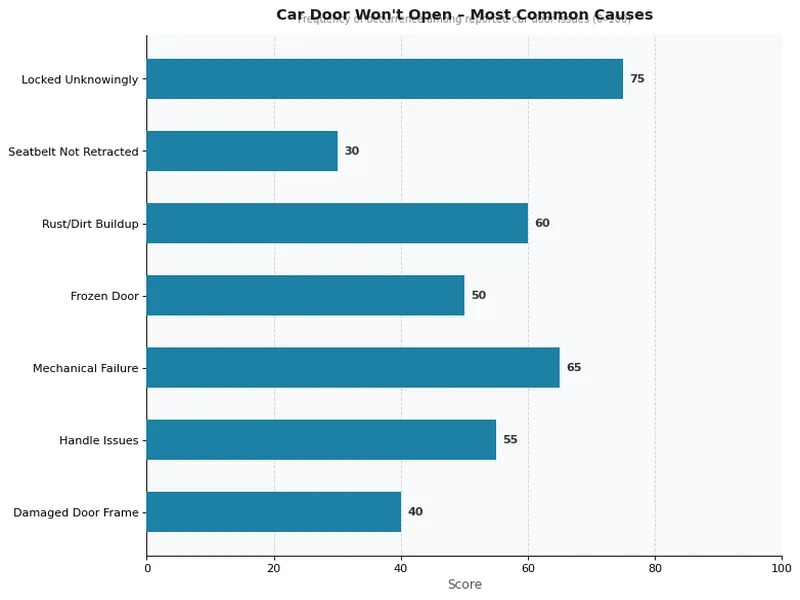
Interior and exterior handles both connect to the latch through rods or cables, and when those connections break, the handle moves freely without actually triggering anything. Our team sees this most often on older vehicles where the plastic clips have become brittle from years of heat cycling (repeated warming and cooling through the seasons). The failure tends to be gradual — the door starts feeling stiff or requiring extra force before it eventually refuses to open at all.
The door latch (the spring-loaded mechanism that grips the striker pin on the door frame) can jam, corrode internally, or break outright — and when it does, pulling the handle accomplishes nothing. Lock actuators (the small electric motors inside power-lock systems) can also fail in a position that physically blocks the latch from releasing. According to Wikipedia's overview of car door mechanics, the latch assembly is the most mechanically intricate part of the door, which explains why it's also the most common failure point on high-mileage vehicles.
Pro Tip: If the door opens from one side but not the other, the latch is almost certainly fine — focus on the handle rod or cable on the non-working side before touching anything else.
This is the most overlooked cause on the entire list, and our team has watched it waste hours of diagnostic time that could have been resolved in thirty seconds. Rear doors have a small switch or slider built into the door edge — visible only when the door is open — that disables the interior handle entirely when activated. Most drivers don't know this switch exists until a mechanic points it out directly. Checking the door edge is always the very first step our team takes when only the inside handle has stopped working on a rear door.
Prevention costs far less than repair when it comes to door hardware, and our team consistently finds that vehicles with the fewest door problems over the years are the ones that received even a small amount of periodic attention. The most common reason door components fail prematurely is not age alone — it is a combination of moisture, accumulated dirt, and a complete absence of lubrication over many years of use.
Our team recommends applying white lithium grease (a thick, paste-like lubricant that resists washing away in rain and resists evaporation) to door hinges, the latch mechanism, and the striker pin at least once per year. This takes about five minutes per door and dramatically extends the working life of every moving component. The key distinction our team always makes is between a cleaner and a lubricant — these are different tools for different jobs.
Warning: Never spray any lubricant directly into a door lock cylinder — it attracts fine dust particles and can gum up the internal tumblers over time, creating an entirely new problem.

Rust is the single biggest long-term enemy of door mechanisms, and our team sees it most aggressively on vehicles driven in climates with heavy road salt, coastal humidity, or extended rainy seasons. The latch and striker pin are especially vulnerable because they sit exposed to the elements with every door opening and closing. Keeping the door's weather stripping (the rubber seal around the door frame) in good condition is one of the most effective defensive measures available — a cracked or compressed seal allows water to pool inside the door cavity, where it accelerates corrosion on rods, clips, and the latch assembly itself.
Several persistent myths circulate among drivers dealing with a car door that won't open from inside or outside, and our team has watched these misconceptions lead people toward expensive repairs they didn't need and solutions that made the underlying problem worse. Getting the diagnosis right from the start is worth far more than any quick fix.
This assumption sends drivers straight toward an expensive lock actuator replacement when the real problem is a disconnected rod, a jammed latch, or a broken handle clip that has nothing to do with the locking system at all. Our team finds that the majority of stuck-door cases involve purely physical mechanical failures rather than any electrical lock component. If the key fob and the manual lock both work normally, the actuator is almost certainly fine — and replacing it would be a complete waste of money. Problems with door electronics also tend to appear alongside other warning indicators, so checking a dashboard warning light that appeared around the same time can help confirm whether electrical systems are actually involved.
WD-40 is a water displacer — that is literally what the "WD" stands for — and while it is genuinely useful for breaking loose a frozen or corroded component in the short term, it evaporates within days and leaves the metal dry and unprotected. Our team sees this pattern over and over: a driver sprays WD-40 on a stiff latch, the door works for a week or two, and then the problem returns worse than before because the evaporating spray has washed away whatever residual grease was already present. White lithium grease or a dedicated door hinge lubricant is the correct long-term solution — not a water displacer.
Team insight: Our team keeps WD-40 and white lithium grease as separate tools for separate jobs — WD-40 for breaking loose corroded bolts, lithium grease for everything that needs to stay lubricated long-term.
Not every door repair sits beyond the reach of a motivated home mechanic, but some jobs cross a clear line where professional help is the more cost-effective choice — and our team thinks being honest about that line is more useful than cheerleading for either side. The table below shows how the most common door repairs compare in terms of difficulty and cost.

| Repair Task | DIY Feasibility | Approx. Cost (DIY) | Approx. Cost (Shop) | Skill Level |
|---|---|---|---|---|
| Disengage child safety lock | Very High | $0 | $0–$50 (diagnostic fee) | Beginner |
| Reconnect door rod or clip | High | $0–$15 | $50–$130 | Beginner |
| Replace interior door handle | High | $15–$45 | $80–$210 | Beginner |
| Replace exterior door handle | Medium | $25–$90 | $100–$320 | Intermediate |
| Replace door latch assembly | Medium | $20–$65 | $150–$360 | Intermediate |
| Replace lock actuator (electric) | Low | $35–$90 | $160–$420 | Advanced |
Reconnecting a disconnected rod, replacing a broken interior handle, disengaging a child safety lock, or lubricating a stiff latch are all tasks that most mechanically inclined people can handle with basic hand tools and a door panel removal guide specific to their vehicle make and model. Our team always recommends consulting a model-specific repair forum before pulling a door panel, since clip locations and panel removal sequences vary widely between manufacturers and pulling in the wrong direction can snap mounting tabs that are expensive to source separately. Door hardware problems sometimes travel alongside other component failures inside the door cavity — a power window that stopped working around the same time as the handle can point to a wiring harness issue affecting multiple systems at once.
Replacing a lock actuator, repairing a door frame bent in a collision, or dealing with a latch that is fully jammed in the closed position with the door shut — these are situations where a professional's tools and experience prevent the job from getting worse. Our team strongly cautions against forcing a jammed door with pry tools, since the door frame and the B-pillar (the structural column between the front and rear doors) can sustain permanent damage from even modest force applied at the wrong angle, turning a mechanical repair into a body shop bill.
Our team's experience across many years and many vehicles consistently shows that the cars with the fewest door failures are the ones that received simple, consistent attention rather than expensive reactive repairs after a complete failure. A solid door maintenance routine takes less than thirty minutes per year across all four doors and costs almost nothing compared to the labor bill for a full handle or latch replacement.
A door that occasionally feels stiff, a handle with any looseness or play developing in it, or a latch that requires an extra-firm slam to fully engage — these are all early signals that a failure is building. Our team recommends addressing these symptoms immediately rather than waiting for a complete failure, because the repair is almost always simpler and cheaper when caught at the warning stage rather than after the mechanism gives out entirely. Catching issues early is the same principle that applies to other car problems our team covers, like a car that won't shift out of park — the underlying system is different, but the logic of early intervention over reactive repair is exactly the same in both cases.
The lock and the latch are separate systems. A door can be fully unlocked but still refuse to open because a handle rod has disconnected, a latch has jammed mechanically, or a broken clip is preventing the handle from transmitting force to the release mechanism. Our team checks the handle and rod connection first before ever suspecting the lock assembly itself.
No — child safety locks only disable the interior handle on rear doors. If the door also refuses to open from the outside, the problem lies with the exterior handle, the connecting rod, or the latch assembly itself rather than the child lock switch.
Our team considers it a safety risk and recommends against driving with a door that is difficult or impossible to open in an emergency. In a collision or other urgent situation, the ability to exit the vehicle quickly matters enormously, so addressing the repair promptly is the responsible approach regardless of how minor the problem seems day to day.
Costs vary widely depending on the root cause. Reconnecting a door rod costs almost nothing in parts and under an hour in labor. Replacing a full latch assembly or lock actuator at a shop typically runs between $150 and $400 depending on the vehicle make and model. Catching the problem early — when only a clip or rod needs attention — keeps costs on the low end of that range.
Our team recommends white lithium grease for hinges, striker pins, and latch mechanisms because it stays in place, resists washing away in rain, and does not evaporate the way spray lubricants do. Silicone spray works well for weather stripping and rubber seals. WD-40 is useful for breaking loose a corroded component but should not be used as a long-term lubricant on any moving door part.
If the door is fully shut and the latch is jammed in the closed position, our team recommends against forcing it with pry tools since that risks bending the door frame. The correct approach is accessing the latch through the door panel from inside the vehicle, which requires removing the panel with the door in the closed position — a job best handled by a mechanic with the right tools and experience with that specific vehicle.
A car door that won't open from inside or outside is one of those problems that feels alarming in the moment but almost always has a straightforward fix once the root cause is identified — and our team hopes this guide gives anyone dealing with it a clear, confident path forward. Start with the simplest possibilities first: check the child safety lock on rear doors, inspect the handle rods for disconnected clips, and try the latch before assuming anything electrical is involved. If the problem is caught early, most repairs are well within DIY reach and cost very little — so our team strongly recommends acting on the warning signs rather than waiting for a complete failure to force the issue.
 |
 |
 |
 |

About Sarah Whitfield
Sarah Whitfield spent ten years as an ASE-certified automotive technician before transitioning to full-time automotive writing, giving her a diagnostic skillset that goes well beyond what most reviewers bring to the subject. She specializes in OBD-II code analysis, electrical system troubleshooting, and the intermittent failure modes that frustrate owners and confound general mechanics. At CarCareTotal, she covers car troubleshooting guides, diagnostic tools, and repair resources for drivers dealing with warning lights, strange symptoms, and hard-to-diagnose problems.
Get some FREE car parts & gear.. Or check out the latest free automotive manuals and build guides here.
Disable your ad blocker to unlock all the hidden deals. Hit the button below 🚗
| | | |
