by Joshua Thomas
Cooling system failures account for roughly 40 percent of all engine-related roadside breakdowns, and a leaking radiator is the single most common cause. Catching radiator leaking symptoms before the coolant level drops far enough to trigger overheating is the difference between a $150 hose repair and a $3,000 engine rebuild. A slow radiator leak rarely announces itself loudly. It bleeds drop by drop until the damage becomes impossible to ignore.
The radiator is the primary heat exchanger in a vehicle's cooling system. Hot coolant — the liquid mixture of water and antifreeze that absorbs engine heat — flows from the engine into the radiator, passes through a network of thin aluminum or plastic tubes, releases heat into the surrounding air, and returns cooled. When the radiator develops a leak through corrosion, impact, or a failed seal, the entire circuit loses both pressure and volume simultaneously. Temperatures climb. Hoses expand. Head gaskets fail.
Drivers who have already noticed an unexplained drop in their coolant tank or experienced coolant reservoir bubbling should treat those signs as early indicators of a radiator leak already in progress. The sections below cover every symptom, cause, tool, and repair method needed to handle this problem correctly.
Contents
Several distinct signs point to a compromised radiator. No single symptom is conclusive on its own, but two or more appearing together is a reliable indicator that the cooling system has been breached. Identifying them correctly — and quickly — prevents the secondary damage that turns a minor repair into a major one.
A puddle of liquid beneath the front of the vehicle after overnight parking is the clearest external signal. Coolant is typically green, orange, pink, or blue depending on the antifreeze formula. It has a slightly oily texture and a distinctly sweet odor. Drivers uncertain whether the puddle is coolant or condensation water can review car leaking clear water underneath: normal or not? for a direct comparison of common fluid types.
The puddle's location also matters. Coolant dripping directly beneath the radiator or the front engine bay points to the radiator as the source. A puddle closer to the firewall (the metal panel separating the engine compartment from the cabin) may indicate a leaking heater core instead — a related but separate failure covered in detail at heater core failure symptoms.
Ethylene glycol (the active ingredient in most antifreeze formulas) produces a distinct sweet smell when it contacts hot engine surfaces and burns off. A persistent maple-syrup or candy-like odor from the engine bay — especially after a drive — is one of the most reliable early radiator leaking symptoms even before a visible puddle appears.
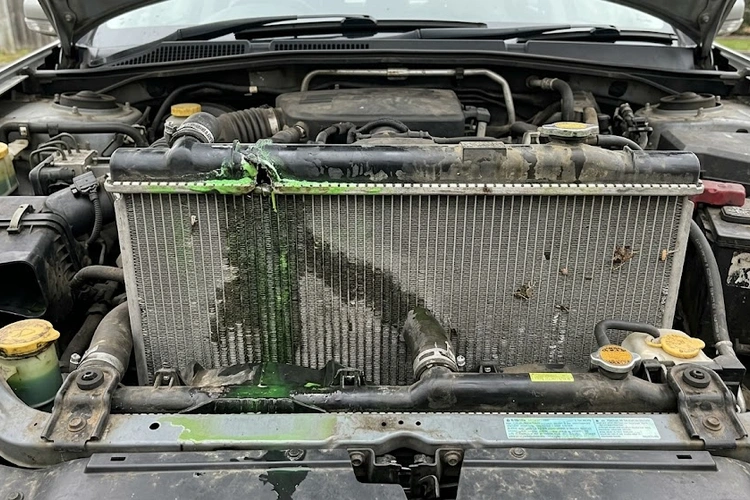
Visual discoloration reinforces the diagnosis. White crusty deposits around radiator seams or hose connections are dried coolant mineral residue. Dark staining on the radiator fins or green streaks running down the housing are physical evidence of past or ongoing seepage.
Warning: Ethylene glycol is toxic to animals. Even a small coolant puddle in a driveway poses a serious hazard to pets, which are drawn by its sweet smell. Clean any spill immediately with absorbent material and water.
A coolant leak reduces system volume, which means less heat is removed from the engine per cycle. The temperature gauge climbs into the upper range during normal driving — often approaching the red zone before the driver notices anything else. Many modern vehicles display a dedicated coolant temperature warning light (a red thermometer symbol) before the gauge reaches maximum.
An engine that consistently runs cold after a thermostat sticks open can complicate diagnosis, because the abnormally low operating temperature masks what the gauge would otherwise reveal. Always inspect both the thermostat and the radiator together when the cooling system behaves unpredictably.
Not all radiator leaks are identical. The source determines the correct repair. The table below maps the five most common leak origins to their typical symptoms, severity, and recommended fix.
| Leak Origin | Typical Symptom | Severity | Recommended Fix |
|---|---|---|---|
| Corroded radiator core | Slow seep, white deposits on fins | Moderate–High | Radiator replacement |
| Cracked plastic end tank | Visible crack, rapid coolant loss | High | Tank repair or full replacement |
| Failed radiator hose | Soft or bulging hose, spray pattern | Moderate | Hose replacement |
| Loose or corroded clamp | Seep at hose connection point | Low–Moderate | Tighten or replace clamp |
| Internal head gasket leak | Bubbling reservoir, white exhaust smoke | Critical | Head gasket replacement |
Most modern radiators use an aluminum core with plastic end tanks joined by rubber gaskets. Over time, coolant becomes acidic as its corrosion inhibitors deplete — a process that accelerates sharply when coolant flushes are skipped. Acidic coolant attacks aluminum fins and internal passages, eventually producing pinhole leaks. According to Wikipedia's overview of engine radiators, electrolytic corrosion from stray electrical currents is an increasing failure mode in aluminum-core radiators, particularly when coolant types are mixed improperly or left unchanged beyond the service interval.
Road debris, low-speed collisions, and insufficient antifreeze concentration in freezing climates all cause physical radiator damage. A standard 50/50 mix of antifreeze and distilled water protects to approximately −34°F (−37°C). Running plain water in cold climates causes coolant to expand as it freezes, splitting internal passages beyond repair. Inspect the radiator face for bent fins and debris after any significant road debris strike.
Radiator hoses deteriorate from the inside out. Electrochemical degradation — caused by voltage differentials in the coolant — weakens the inner lining of rubber hoses even when the outer surface appears intact. Squeezing a cold hose near its clamp connection reveals the true condition: a hose that feels hard and brittle, or conversely soft and spongy, is past its service life. Clamps lose clamping force from thermal cycling or corrode enough to allow seepage at the connection point.
Pro Tip: Replace all radiator hoses and clamps when installing a new radiator. The labor cost is already committed, and a hose failure months later undoes the entire repair.
Locating a radiator leak accurately requires specific instruments. Guessing wastes time and leads to unnecessary part replacements. Two tools handle the vast majority of cooling system leak diagnostics.
A pressure test kit connects to the radiator filler neck and allows the technician to pressurize the cooling system to its normal operating pressure — typically 13 to 16 psi — without running the engine. A sealed system holds pressure steady. A gauge that drops over ten minutes confirms a leak somewhere in the circuit. The kit also tests the radiator cap itself, which is a frequently overlooked leak point when the cap's internal rubber seal fails and allows coolant to escape past it under pressure.
A UV dye kit introduces fluorescent tracer dye into the coolant. After a short drive, a UV (ultraviolet) light is used to scan the entire engine bay. The dye glows bright yellow-green wherever coolant has escaped — pinpointing leaks too small or too hidden for visual inspection. UV dye is particularly effective at locating seeps at the inlet and outlet tank seams of the radiator, where the plastic-to-aluminum joint is under constant thermal stress and is the most common failure point on vehicles over seven years old.
The correct fix depends entirely on the leak's location, size, and root cause. There is no universal solution. The three options below are ranked from least to most invasive, and each applies to a specific set of leak conditions.
Radiator stop-leak additives — the category reviewed in depth at best radiator stop-leak products — are appropriate in exactly two situations: a genuine roadside emergency where no repair facility is reachable, and very minor pinhole seeps in otherwise structurally sound radiators. Stop-leak works by depositing solid particles or polymer compounds at the leak point as coolant flows through it. The repair is temporary by design.
Stop-leak is not appropriate for cracked plastic tanks, failed gaskets, corroded cores, or any leak larger than a slow seep. Overuse deposits residue in the narrow passages of the heater core, causing costly secondary failures.
Two-part epoxy compounds formulated for cooling systems can seal hairline cracks in metal radiator housings when applied correctly to a clean, dry surface. The process requires draining the system completely, degreasing the repair area with solvent, mixing and applying the epoxy per manufacturer instructions, allowing a full cure (typically 24 hours), and pressure-testing before refilling. On a small crack in otherwise sound metal, a proper epoxy repair lasts for years. On a contaminated or structurally weak surface, it fails within weeks.
A corroded core, cracked end tank, or any radiator with significant age-related deterioration warrants full replacement. A new aftermarket or OEM-equivalent radiator restores full cooling capacity, eliminates all current leak points, and typically carries a one- to three-year warranty. During replacement, inspect related components: a failed intake manifold gasket that allowed combustion gases into the coolant will contaminate the new radiator with oil and acidic residue if not addressed at the same time.
The debate over stop-leak products is legitimate. They are neither universally harmful nor universally effective. Understanding both sides prevents misuse.
Benefits:
Drawbacks:
The verdict is clear: use stop-leak once as a bridge to a proper repair. Treating it as a permanent solution guarantees a more expensive failure later.
Several well-intentioned actions routinely convert a manageable radiator leak into a far more expensive repair. Avoiding these errors is as important as executing the correct fix.
Adding coolant to a leaking system without finding and sealing the leak is the most common mistake vehicle owners make. The level will continue to drop, the operating condition will worsen, and the risk of sudden overheating remains constant. Topping off is acceptable for a day or two while a repair appointment is scheduled — it is not a maintenance strategy.
The cooling system operates under 13–16 psi of pressure. Removing the radiator cap while the engine is hot releases that pressure instantly, spraying scalding coolant outward at high velocity. Always allow the engine to cool for at least 30 to 45 minutes before touching the cap. Even then, place a thick cloth over the cap and turn it slowly to bleed residual pressure before removing it fully.
Green (IAT), orange (OAT), and pink or yellow (HOAT) antifreeze formulas use different corrosion inhibitor chemistry. Blending them does not produce enhanced protection — it neutralizes the inhibitors in both, leaving metal components unprotected and accelerating the corrosion that produces leaks. Always use the coolant type specified in the owner's manual. When switching formulas, flush the system completely first.
A radiator leak rarely occurs in isolation. By the time a radiator develops a confirmed leak, the coolant is typically acidic, the hoses are nearing end of life, and the water pump impeller may be corroded. Replacing only the radiator while leaving degraded hoses, a worn thermostat, or a marginal water pump in place invites a repeat failure within months. A complete cooling system service — all components inspected and replaced as warranted — is the correct standard.
Repair costs vary based on leak source, vehicle make and model, and whether the work is performed at a dealership, independent shop, or at home.
The cost gap between a $150 hose replacement and a $2,500 head gasket repair makes early detection of radiator leaking symptoms one of the highest-value maintenance habits a vehicle owner can develop. A $30 pressure test kit, used at the first sign of coolant loss, can prevent thousands of dollars in downstream engine damage. Acting on early warnings is not optional — it is the rational choice.
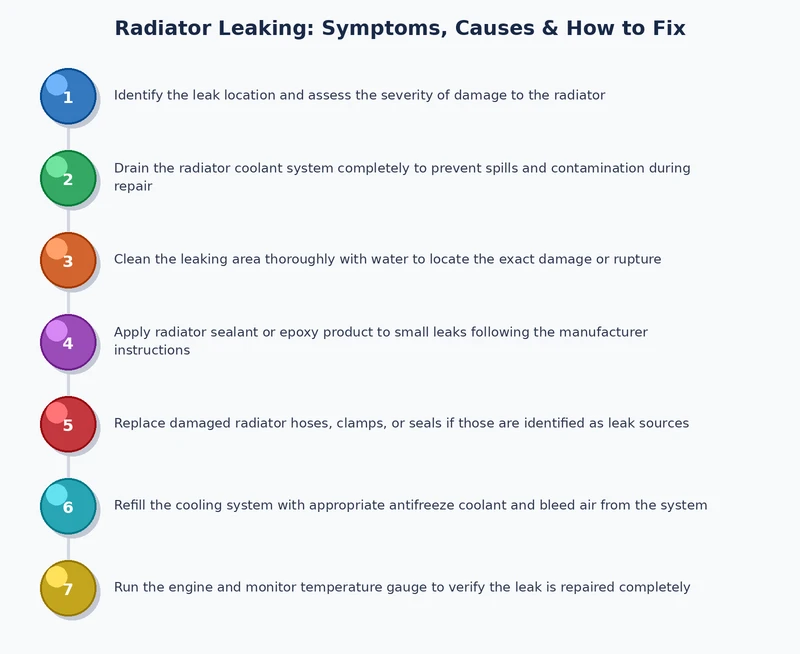
A leaking radiator is a serious mechanical issue that compounds over time. A slow seep can escalate to rapid coolant loss under highway driving conditions, leading to overheating and irreversible engine damage within minutes. Any confirmed radiator leak warrants prompt repair — not deferred maintenance.
Short distances are possible if the coolant level is fresh and the temperature gauge is monitored at all times. Driving any significant distance with a known radiator leak is not recommended. If the temperature gauge approaches the red zone, the vehicle must be stopped immediately to prevent engine damage.
Coolant color depends on the antifreeze formula: green for traditional IAT, orange or red for OAT and DEXCOOL variants, pink or yellow for HOAT global formulas. All types share a slightly sweet odor and a translucent, mildly oily appearance. Fresh coolant is bright and clear; degraded coolant appears rusty, brown, or cloudy.
Stop-leak products work reliably on pinhole leaks and minor seeps in structurally sound radiators. They do not repair cracked tanks, failed gaskets, or corroded cores. Overuse clogs heater core passages and reduces cooling efficiency. Stop-leak is best used once as an emergency measure before a permanent repair is performed.
A properly maintained radiator on a modern vehicle typically lasts eight to fifteen years. Vehicles that receive regular coolant flushes on the manufacturer's recommended schedule consistently reach the upper end of that range. Neglected coolant — left acidic for years — accelerates internal corrosion and shortens service life significantly.
Corrosion from degraded, acidic coolant is the most common cause in vehicles beyond seven to eight years of age. In newer vehicles, failed rubber hoses at connection points and physical damage from road debris are the leading causes. Regular coolant flushes and annual hose inspections are the most effective preventive measures available.
A radiator leak ignored is an engine overhaul earned — identify the symptoms at the first warning, fix the source completely, and the cooling system will outlast every other component in the engine bay.
 |
 |
 |
 |

About Joshua Thomas
Joshua Thomas just simply loves cars and willing to work on them whenever there's chance... sometimes for free.
He started CarCareTotal back in 2017 from the advices of total strangers who witnessed his amazing skills in car repairs here and there.
His goal with this creation is to help car owners better learn how to maintain and repair their cars; as such, the site would cover alot of areas: troubleshooting, product recommendations, tips & tricks.
Joshua received Bachelor of Science in Mechanical Engineering at San Diego State University.
Get some FREE car parts & gear.. Or check out the latest free automotive manuals and build guides here.
Disable your ad blocker to unlock all the hidden deals. Hit the button below 🚗
| | | |
